
The wrong education degree will waste your time, your money, and won’t move your career one inch.
If you’re a clinician or basic scientist in medical education, the real question isn’t “Should I get an MHPE / MEd?” It’s: “What actually changes my job, my credibility, and my pay — and what’s just extra letters on my email signature?”
Let me be blunt:
For most medical educators, you can get very far with no formal education degree. But if you do go back to school, the MHPE usually beats a generic MEd for serious academic medicine careers.
Here’s how to think about MHPE vs MEd vs no degree — in a way that actually matches how departments hire and promote.
The core truth: roles drive degrees, not the other way around
If you’re mainly teaching a few lectures or precepting on the wards, you don’t need a degree. You need:
- Good bedside teaching skills
- A reputation as solid faculty
- Maybe a couple of teaching awards
But if you’re aiming for things like:
- Vice Chair for Education
- Program Director or APD who wants job security and respect
- Director of UME/OME blocks, clerkships, or curriculum
- Simulation center leadership
- Assessment or faculty development lead
- Promotion on an “educator” or “education scholar” track
…then formal training starts to matter. Not always required, but strongly favored.
The basic breakdown:
| Career Goal | MHPE | MEd | No Degree |
|---|---|---|---|
| Occasional teaching | ⚪ | ⚪ | ✅ |
| Clerkship/block director | ✅ | ✅ | ⚪ |
| Program Director/APD | ✅ | ⚪ | ⚪ |
| Vice Chair for Education / DIO | ✅ | ⚪ | ⚪ |
| Education research career | ✅ | ⚪ | ⚪ |
| K-type or education-focused grants | ✅ | ⚪ | ⚪ |
✅ = strong value, ⚪ = optional / modest value
MHPE vs MEd: what they actually do for you
Forget the marketing language. Here’s what these degrees really give you.
MHPE (Master of Health Professions Education)
This is usually the “insider” degree for serious medical educators.
Typical brands you’ll see:
- MHPE, MSHPE, MS-HPEd, MHPEd, MHPE (MedEd)
- Offered by places like University of Illinois Chicago, Maastricht, University of Calgary, Maastricht, Harvard (MMSc-MedEd), etc.
What it actually focuses on:
Health professions context baked in
Curriculum and assignments are explicitly about medical and health professions education — not K–12 or generic adult learning.
Example: Needs assessment for a residency program, OSCE design, EPAs, milestones, entrustment, CBME.Education research and scholarship
You learn to:- Design studies on curricular interventions
- Build surveys and assessment tools
- Do qualitative and mixed-methods work
- Write for journals like Academic Medicine, Medical Education, Teaching and Learning in Medicine
Assessment and program evaluation
This is where MHPEs quietly dominate.- OSCE design and validity evidence
- Workplace-based assessment systems
- Program evaluation models (Kirkpatrick, CIPP, etc.)
- Entrustment decisions and competency frameworks
Credibility in academic medicine
In promotion and leadership searches, an MHPE (or equivalent) is often interpreted as:
“This person is serious about education, can design curriculum, can do scholarship, and can play at the national level.”Capstone or thesis that can become publications
Most MHPE programs require a substantial project. It often turns into:- A peer-reviewed paper
- A national presentation
- A foundation for further grants or education career awards
Translation:
If you want to build a career identity as a medical educator (not just “someone who teaches”), MHPE is usually the more powerful degree.
MEd (Master of Education)
MEd is broader. Sometimes exactly what you need. Sometimes way too generic.
Common flavors:
- MEd in Curriculum and Instruction
- MEd in Higher Education
- MEd in Adult Learning
- MEd in Educational Leadership
What it actually gives you:
Solid theory and pedagogy
You’ll see:- Learning theories (constructivism, behaviorism, etc.)
- Instructional design
- Classroom management (sometimes irrelevant to med ed)
- Assessment principles (but not usually OSCEs, EPA, etc.)
Transferable skills
Good if you:- Might leave medicine and move into broader higher education roles
- Want options in university administration, instructional design, or faculty development outside health sciences
Variable relevance
This is the big catch. An MEd can be highly useful or almost useless, depending on:- Whether you can tailor projects to medical education
- How admin and chairs at your institution value it
- Whether the program understands health professions context at all
Perception in departments
I’ve heard this exact phrase from several PDs and vice chairs:
“An MEd is nice, but an MHPE signals they’re really in medical education.”
That’s not always fair. But it’s reality in a lot of academic centers.
No degree: when that’s absolutely fine
You don’t need a master’s in education to:
- Be a great clinical teacher
- Win local teaching awards
- Be a core faculty member
- Be an APD or even PD at some smaller or community programs
- Contribute to curriculum design with mentorship
Where “no degree” starts to hurt you:
- Applying for education leadership jobs at big academic centers where you’re competing with people who do have MHPE/MEd
- Going up for promotion on a clinician-educator or education scholar track with weak scholarship
- Trying to be taken seriously in national med ed research circles
- Applying for education grants or K-type awards that explicitly like or expect training
So no, you’re not doomed without a degree. But at a certain level, you’ll feel the glass ceiling.
The single most important question: role-based ROI
Ask this first:
“What exact job, title, and responsibilities am I aiming for in the next 5–10 years?”
Then back-calculate whether a degree helps, and if so, which one.
Let’s run through some common scenarios.
Scenario 1: “I’m a clinician who likes teaching but I don’t want my life consumed by it.”
Goal: Strong teacher, maybe local leadership (course director, small program leadership), but no desire to be national med ed scholar.
Best approach:
- No degree needed
- Do a short certificate in medical education or faculty development if offered locally
- Get involved in:
- Clerkship or course committees
- Teaching academies
- A few education projects with existing mentors
Degree ROI:
Low. A degree here is mostly “nice to have” and may not meaningfully change your day-to-day or salary.
Scenario 2: “I want to be Program Director / Clerkship Director and be good at it.”
Goal: Real education leadership at residency or UME level, recognized as “the education person” locally.
Best approach:
- Strongly consider an MHPE or similar health professions program
- Or, a targeted MEd in higher ed/adult learning if you can orient your projects to med ed
Why MHPE is usually better:
- Direct content on:
- Competency-based medical education
- Milestones, EPAs, assessment systems
- Program evaluation
- Signal to your institution that you’re investing in education leadership, not just picking up random letters
Here’s how degrees map to this role:
| Path | Impact on Role |
|---|---|
| No degree | Enough in some places, limited in big academic centers |
| MEd (generic) | Moderate help, depends on how tailored and known |
| MHPE / MHPEd | Strong help, aligns directly with responsibilities |
Scenario 3: “I want to build a research and scholarship career in med ed.”
This is where no degree becomes a real handicap.
If you want to:
- Publish regularly in med ed journals
- Win education research awards
- Compete for grants and K-awards
- Be considered for national med ed leadership roles
Then you want something like:
- MHPE / MMSc-MedEd / MS-HPEd
- Possibly a PhD in Health Professions Education later if you get deep into it
Why MHPE beats a generic MEd here:
- Training in health-professions-specific research methods
- Exposure to real med ed scholars as faculty
- Network of peers publishing in the same spaces you want to publish in
- Capstone that can launch multiple papers
Scenario 4: “I might leave academic medicine or want broader options.”
Here the MEd might actually make more sense.
If you could see yourself:
- Moving into non-medical higher ed roles
- Working in central university teaching & learning centers
- Doing instructional design or faculty development outside medicine
…then a more general MEd in higher ed or adult learning is not a bad play. Marketable outside med schools. Less specialized but more portable.
How these degrees actually change your daily life
Let’s talk practical impact, not theory.
What changes with an MHPE/MEd?
Usually:
You get tapped for more leadership roles.
“We need someone to redesign the clerkship” quietly becomes “Let’s ask her, she has an MHPE.”You become the go-to assessment and curriculum person.
People ask you: “Can you help fix our OSCE?” “Is this assessment valid?” “Can you help with this education project?”You have easier promotion conversations.
Your CV looks more intentional:- Education degree
- Education leadership roles
- Education scholarship
That’s exactly what clinician-educator and educator tracks want to see.
You speak the language of committees and accrediting bodies.
ACGME, LCME, CBME, milestones, entrustment, validity evidence — you’re not just surviving in those meetings; you’re leading them.
What doesn’t magically change?
Salary might not jump right away.
Some institutions give a small stipend bump; others don’t. The bigger money usually comes from new roles, not the degree itself.You don’t instantly become a great teacher.
Degrees make you better at designing systems, assessments, curriculum — but bedside teaching still needs practice and feedback.It won’t fix a toxic department.
If your leadership doesn’t support education, an MHPE just makes you the best-trained frustrated person in the room.
Time, cost, and “is it worth it?” math
You’re a busy clinician. So let’s be realistic.
Typical MHPE (or similar) programs:
- Length: 2–3 years part-time
- Format: Mostly online with occasional in-person sessions, or fully distance
- Cost: Often $20k–60k total, highly variable
- Workload: Manageable but real — think 5–10 hours/week during active terms
Typical MEd programs:
- Similar time and cost range
- Some are cheaper (especially state university or online-only)
- Some are less flexible if not designed for working clinicians
Use simple ROI thinking:
- Will this open doors to roles I actually want?
- Can it accelerate promotion?
- Will it meaningfully improve my skill and confidence?
- Is my institution willing to help pay (CME funds, tuition benefits, departmental support)?
If you can’t answer “yes” to at least two of those, don’t enroll yet.
A quick decision framework
Here’s the no-nonsense decision tree most people should use.

| Step | Description |
|---|---|
| Step 1 | Do you want major education leadership? |
| Step 2 | Skip degree for now |
| Step 3 | Do you want career in med ed research? |
| Step 4 | Choose MHPE or similar med ed degree |
| Step 5 | Do you want options outside health professions? |
| Step 6 | Consider MEd in higher ed or adult learning |
And a rough sense of where people actually end up:
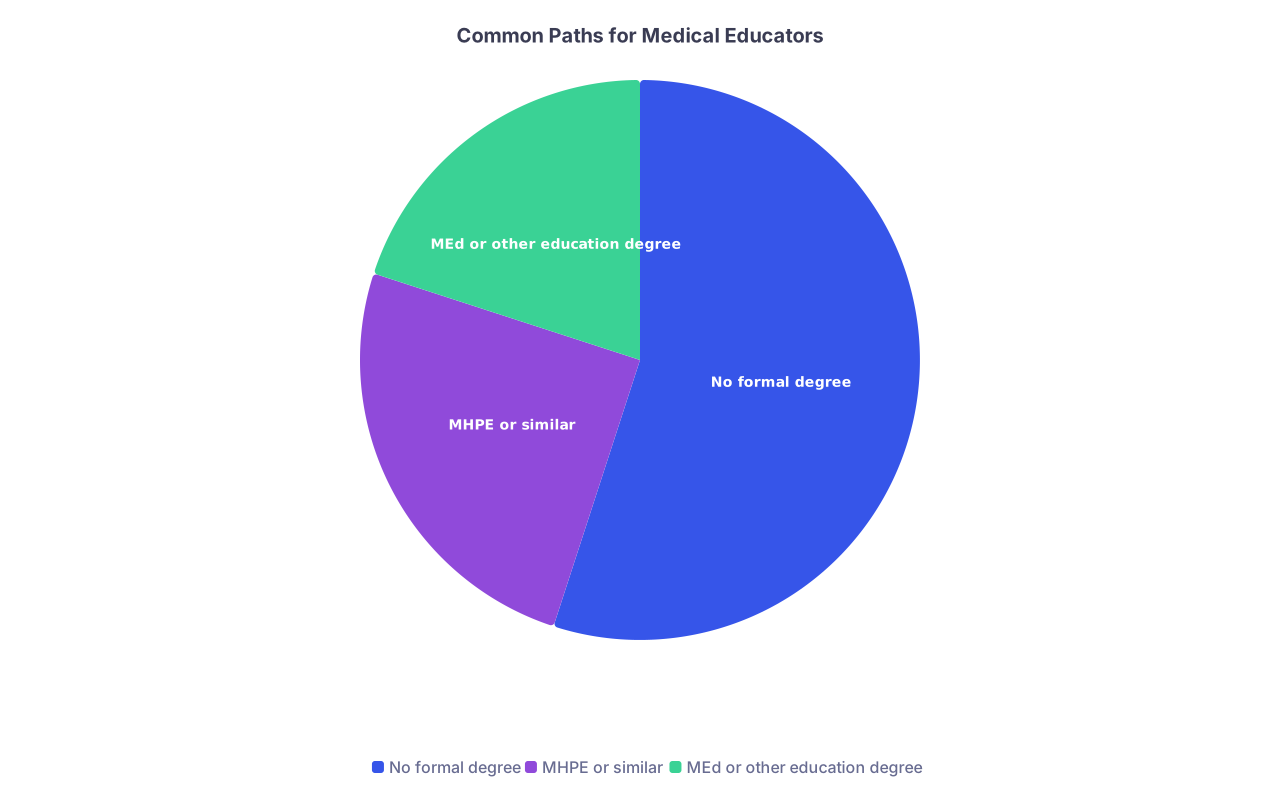
| Category | Value |
|---|---|
| No formal degree | 55 |
| MHPE or similar | 25 |
| MEd or other education degree | 20 |
Not exact numbers, but it’s roughly what you see if you skim the bios of faculty in many academic departments.
Concrete next steps (not theoretical)
If you’re seriously debating this, do three things before you apply anywhere:
Read job descriptions
Look at:- Program Director, Clerkship Director, UGME/DIO roles
- Education research faculty jobs at med schools
See what degrees they actually list or prefer.
Talk to 2–3 people who already have these degrees
Ask:- “What specifically changed after you finished?”
- “If you could do it again, would you pick the same program?”
- “Did your department help with cost or time?”
Map your current CV against where you want to go
If you’re already:- in a major education role
- presenting nationally
- publishing in med ed
…then an MHPE will likely amplify what you’re already doing.
If you’re not there yet, you might need experience first, degree second.

FAQ: MHPE vs MEd vs No Degree (7 questions)
Do I need an MHPE or MEd to be a Program Director?
No, not everywhere. Many PDs have no formal education degree, especially in smaller or community programs. But at large academic centers and for competitive PD roles, having an MHPE (or equivalent) is increasingly common and can be a real advantage — both for getting the job and for actually doing it well.Is an MHPE “better” than an MEd for medical educators?
For most academic medical educator careers, yes. MHPE-type programs are designed around health professions education, use medical examples, and train you for the exact problems you’ll face in residency/UME leadership and med ed research. A good, tailored MEd can work, but a generic one will often feel misaligned.Will a degree in education increase my salary?
Directly? Often no or only a little. Indirectly? Yes, if it helps you move into higher-responsibility roles (PD, vice chair for education, director of curriculum) that carry stipends or protected time. Think “degree → eligibility and credibility for bigger roles,” not “degree → automatic pay raise.”I love teaching but hate research. Is a degree still worth it?
Only if you want formal curriculum/assessment leadership or long-term career security as an educator. MHPE/MEd programs almost always include some scholarship or evaluation work. If you truly want zero research, you might be better off with faculty development programs, local teaching academies, and strong mentorship instead of a full degree.Can I get promoted on an educator track without a degree?
Yes, in many places. You’ll just need a strong portfolio of:- Local or national education leadership
- Peer-reviewed med ed scholarship
- Recognized impact (awards, invited talks, innovations)
A degree helps create structure and credibility for that portfolio, but it’s not mandatory if you have sustained, documented contributions.
What if my department doesn’t value education degrees at all?
Then be very cautious about spending your own money and time. If promotion criteria, leadership searches, and culture all prioritize clinical RVUs or basic science grants only, an MHPE or MEd might not pay off locally. In that case, get experience, publish a bit if you can, and consider a degree later if you move to a more education-friendly institution.How do I choose between different MHPE or med ed master’s programs?
Look at five things:- Faculty (are they publishing in real med ed journals?)
- Flexibility (part-time, online, built for clinicians)
- Cost and institutional support (CME, tuition benefits)
- Capstone expectations (can it realistically become publications?)
- Alumni outcomes (what jobs did grads actually get?).
If a program can’t show you concrete examples of alumni in roles you want, be skeptical.
Key takeaways:
- You don’t need a degree to be a strong teacher, but you usually do for higher-level education leadership and scholarship.
- For serious academic medical educator careers, an MHPE or equivalent health professions degree typically beats a generic MEd.
- Decide based on the specific roles you want, not on fear of being left behind or seduced by extra letters after your name.