What do you do when you’re the only person in your small hospital who actually wants to teach, and there’s zero structure in place for it?
You’re not at a big academic center. No residency office. No GME dean. No weekly grand rounds with glossy slides and a sponsored lunch. Just you, a small community hospital, a couple of rotating students (maybe), and an itch to build something that looks like proper medical education.
Good. You can absolutely build a real teaching role here. But you need to be deliberate, political, and a bit scrappy.
Let’s walk through how to do that, step by step, in the real world—not the “ideal academic medicine” fantasy.
Step 1: Get Clear on What You Actually Want
If you do not define your teaching role, your hospital will define it for you: “Oh great, they like education—let’s dump every student and random project on them.”
You need to decide 3 things first:
- Who you want to teach
- How much time you’re actually willing to commit
- What you want in return
Forget “I just love teaching.” That’s cute but not a plan.
Think in concrete terms:
Who:
- Med students (3rd/4th year)?
- Residents from an external program who rotate through?
- New NPs/PA’s?
- Your own hospitalists/ED docs/nurses?
Time:
- 15 minutes per day on rounds?
- One 45-minute session per week?
- Half-day per month of protected “education time”?
- Or are you building an actual longitudinal curriculum?
Return (this matters):
- A small stipend?
- Protected time in your schedule?
- Formal title (e.g., Site Director, Clerkship Director)?
- Academic appointment with a med school?
- Stronger CV for future academic moves?
Write it down. Literally. One page.
Example:
“I want to build a structured teaching experience for 3rd-year IM clerkship students and rotating IM residents, with:
- Daily 15-min case-based teaching on rounds
- One 45-min weekly session
- A simple evaluation system
In return, I want:- 0.1 FTE protected for education
- A formal role as ‘Site Director for Medical Education’
- Support in pursuing a volunteer faculty appointment at X Medical School.”
If you do not put this on paper, you will drift into “I’m just doing a ton of teaching for free and no one seems to care.”
Step 2: Build a Simple, Defensible Case for Why the Hospital Should Care
Your hospital is not a charity. They care about:
- Recruitment
- Quality metrics / outcomes
- Reputation
- Accreditation and partnerships
Tie your teaching role directly to those.
Here’s the short version of the pitch you’ll eventually use:
“Teaching improves recruitment”
Med students and residents who rotate there are your future hires. If you build a decent micro-educational environment, they remember this place fondly.“Teaching improves care and safety”
Learners who ask questions force attendings to stay current. A structured teaching culture tends to correlate with better documentation, safer ordering, and reduced cowboy behavior.“Teaching improves the hospital’s brand”
Being a clinical rotation site with X or Y school makes the hospital look less sleepy and more legitimate.
Put this into a tight one-page “proposal” document. No fluff, no 10-page GME policy. One page, sections labeled:
- Problem (no structure for learners now)
- Proposed solution (your specific teaching role and basic structure)
- Benefits (recruitment, quality, reputation)
- What you need (protected time, title, minimal support)
You’ll use this later for leadership. For now, just get it written.
Step 3: Start Teaching Quietly Before You Ask for Anything
You need proof of concept. Administrators love “show me it works” more than “fund my idea.”
So you start small. This month. With whatever you have now.
If you have:
A single 3rd-year student:
- Do 10–15 minutes “chalk talk” at a defined time each day: post-rounds, in the workroom, with the computer off.
- Keep topics directly tied to your patients: hyponatremia workup, chest pain risk stratification, DKA management, etc.
Rotating residents from an outside program:
- Do “one case, one pearl” daily.
- Once a week, a slightly more formal 30-minute mini-lecture or case conference.
New hires / APPs / nurses:
- Run short, high-yield “micro-teaching” moments on specific problems—sepsis orders, delirium prevention, anticoagulation reversals.
You are not building the Mayo curriculum. You are building 2–3 reliable, repeatable teaching rituals that people start to expect.
Stick with it 4–8 weeks. Then do this: get feedback.
Very simple: ask learners for a 3-question anonymous survey via Google Form or paper.
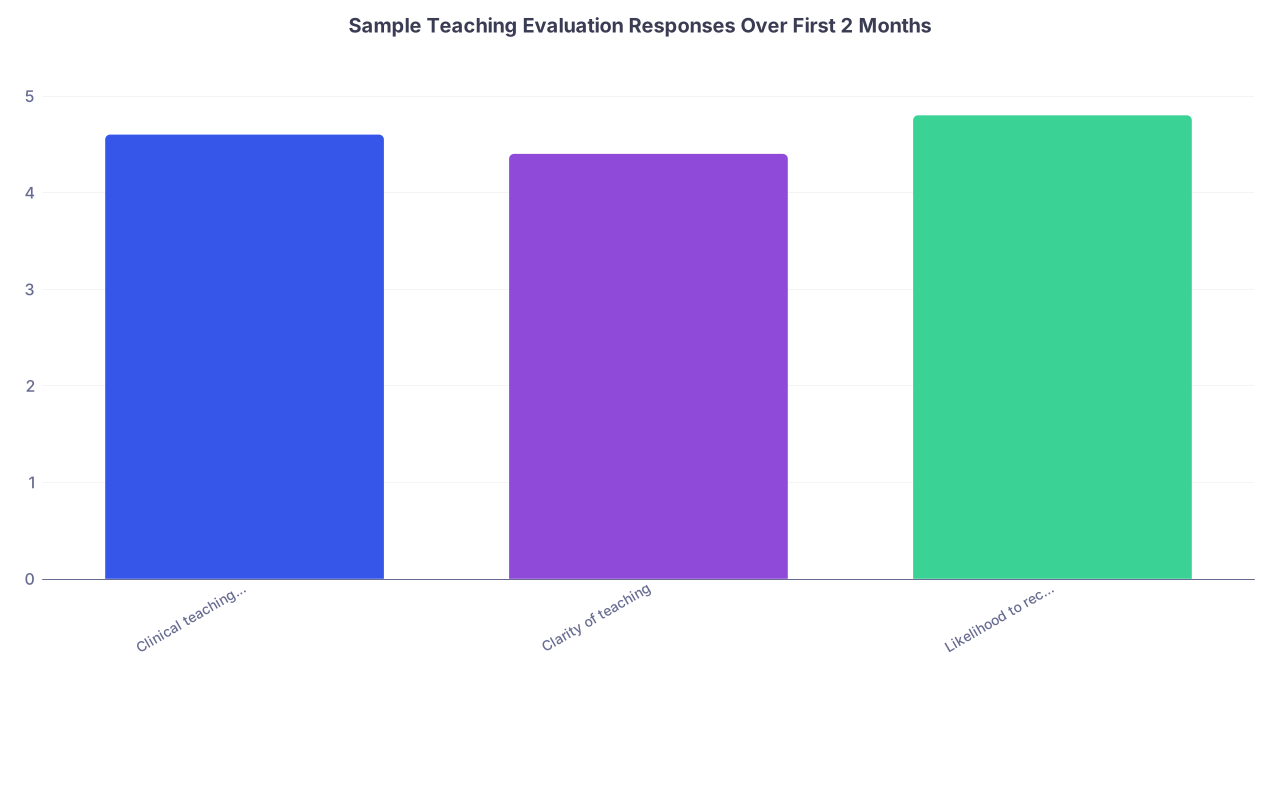
| Category | Value |
|---|---|
| Clinical teaching usefulness | 4.6 |
| Clarity of teaching | 4.4 |
| Likelihood to recommend rotation | 4.8 |
Do not overcomplicate the evaluation. Something like:
- “Rate the usefulness of daily teaching sessions (1–5)”
- “What worked well?”
- “What should be improved?”
Collect 10–20 of these. These are your ammunition when you go upstairs.
Step 4: Design a Minimal, Realistic Teaching Structure
Once you’ve proven you can actually teach and learners like it, you need structure. Not for bureaucracy. For sanity.
Use this mental rule: “If I got hit by a bus, another attending could pick this up.”
Think in three buckets:
- Daily teaching
- Weekly or monthly scheduled sessions
- Longitudinal elements (evaluations, feedback, projects)
Daily Teaching: Keep It Tight
Aim for 10–20 minutes max. You and they are still doing real clinical work.
Common formats that work well in community hospitals:
Case-based “one problem” talks
- “Today: Anemia on admission”
- “Today: Troponin bump in CKD”
You walk through one example from an actual patient and generalize.
“Teach on the move”
Teaching at the workstation or bedside, but organized:- Before seeing a COPD patient: “Alright, someone walk me through GOLD classification.”
- After a new PE diagnosis: “3 minutes on when I do NOT give thrombolytics.”
Mini whiteboard sessions
Use any blank wall and a cheap portable whiteboard. Draw the thing. People remember visuals.
You need a simple topics list so you are not reinventing the wheel each day. Draft 15–20 topics you see all the time:
| Day | Topic |
|---|---|
| 1 | Approach to chest pain |
| 2 | Hyponatremia workup |
| 3 | Inpatient diabetes management |
| 4 | AKI: prerenal vs intrinsic |
| 5 | Antibiotic choices for CAP |
Fill the rest in similarly. Reuse this list each rotation.
Weekly / Monthly: Anchor Sessions
Pick ONE consistent time weekly if possible. Example:
- Wednesdays 12:30–1:00 pm – “Hospital Clinical Teaching Session”
Rotate formats:
- Interesting case conference
- Short guideline update (e.g., new heart failure meds)
- Skills sessions (EKG interpretation, CXR read-outs)
Even if only 2 residents and 1 student show up, keep it on the calendar. Eventually, people start arranging around it.
Longitudinal Pieces
Once you’ve got daily and weekly teaching, add one or two “big kid” elements:
- Individual feedback meetings with each learner at the midpoint and end of rotation (15 minutes)
- A simple one-page goals sheet at the start of rotation
- Optional: A tiny “resident project” – one-page teaching handout or 5-minute lightning talk by the learner
This starts to look like an actual micro-curriculum.
Step 5: Formalize Your Role with Leadership (Without Getting Steamrolled)
At this point, you’ve:
- Been teaching consistently for a couple months
- Gotten solid learner feedback
- Sketched a more formal structure
Now you go to leadership. Not with “I’d like to teach more.” With a pitch.
Who you talk to depends on the place:
- CMO or medical director
- Hospitalist group director
- ED director (if you’re EM)
- Chief of staff
You schedule a short meeting (20–30 minutes). You bring:
- Your one-page proposal
- A short summary of what you’ve already built
- A few anonymized positive quotes from learners
- A concrete ask
Something like:
“I’ve been running daily 15-minute teaching sessions with our rotating students and residents for the last 8 weeks, and the feedback has been strong. They’re rating the teaching 4.5/5 on average, and several have said this is one of the best community rotations they’ve had.
I’d like to formalize this into a small but structured medical education role: a Site Director for Teaching. That would include:
- A defined micro-curriculum (which I’ve drafted)
- A standard onboarding sheet for learners
- Weekly 30-minute case conference
- Standardized evaluations
What I would need is 0.1 FTE protected time (roughly half a day per week) and a formal title. I also think this could position us as a more attractive site for X Medical School or Y Residency Program.”
Here’s the trick: you’re not asking permission to start teaching. You already started. You’re asking them to invest a tiny amount in something that’s already working.
They might say:
- “We can’t give you FTE, but we can give you a title and some admin support.”
- “We can’t commit now, but keep doing it and we’ll revisit in 6 months.”
- Or occasionally: “This is great—yes, we’ll support 0.05–0.1 FTE.”
Even if they say no to money, push for structure: title, recognition, ability to put “Director of Medical Education – [Hospital]” on your CV.
This is not cosmetic. Titles in a small place mean leverage when you negotiate with med schools or residencies.
Step 6: Link Yourself to a Medical School or Residency Program
If your hospital is not yet a teaching site: this is where you change that.
You want an upstream institution that:
- Sends you students or residents
- Gives you a volunteer or part-time faculty appointment
- Provides evaluation forms, expectations, sometimes malpractice coverage for learners
Ways to make that happen:
Use your own networks
- Where did you train? Email your old PD or clerkship director.
- “We’re a small community hospital 45 minutes away, and I’ve built a structured teaching setup. Would you be interested in placing a couple of students or residents per year here?”
Cold outreach (yes, this works more than you think)
- Many med schools or DO schools are hungry for decent community sites.
- Find the “Director of Clinical Education” or “Clerkship Director” on their website. Send a short, specific email:
- Who you are
- What your hospital is like
- What teaching structure you already have
- What you’re offering (number and type of learners)
Partner with an existing residency or school that already uses nearby sites
- If there’s a big program 30–60 minutes away, they may want a community experience block.
When they ask, “Do you have a structured experience?” you say yes, and you show them:
- Your daily/weekly teaching plan
- Sample schedule
- Evaluation tools
- Names of other attendings (if any) willing to teach
This is where that earlier structure pays off.

| Step | Description |
|---|---|
| Step 1 | Start Teaching Informally |
| Step 2 | Collect Learner Feedback |
| Step 3 | Design Simple Curriculum |
| Step 4 | Meet with Hospital Leadership |
| Step 5 | Get Title or Minimal Support |
| Step 6 | Approach Med School or Residency |
| Step 7 | Become Official Teaching Site |
Step 7: Protect Your Clinical Sanity While You Teach
Here’s the failure mode I see all the time: An attending in a small hospital says yes to every student and resident, teaches constantly, still carries a full high-acuity load, and six months in they’re burned out and bitter.
Do not be that person.
You need boundaries.
Practical safeguards:
Cap your learner load
- Example: No more than 2 learners per attending at a time (or whatever is realistic for your service).
- If leadership wants more, they need to add more teaching attendings or lower your census.
Adjust your census
- If you are on a hospitalist service:
- Teaching weeks: slightly lower cap (e.g., 14 instead of 18).
- Non-teaching weeks: normal loads.
- Put this in writing with your group director.
- If you are on a hospitalist service:
Set clear teaching windows
- Tell learners:
- “We do most of our formal teaching between X and Y times.”
- Outside of that, you’ll still explain critical decisions, but you’re not running a constant lecture.
- Tell learners:
Learn to say, “This is an attending-level decision”
Not everything is a Socratic dialogue. Sometimes you say, “Here’s the short reason I’m doing this; full deep-dive tomorrow when it’s controlled.”
You are not a martyr. You are a professional trying to balance education and patient care.

Step 8: Develop Yourself as an Educator (Without Moving to Academia)
You don’t need to move to a university hospital to get better at teaching. You just have to be intentional about it.
Pick 2–3 of these and actually follow through:
Do a focused teaching course
- Many med schools, state medical societies, or specialty societies run short “clinical teaching” or “preceptor” workshops.
- Go, steal their tricks, bring them back.
Read one real book on clinical teaching
Not 20. One. For example:- “Teaching in Your Office” or similar short practical guides.
Your goal is specific: get 3–5 concrete strategies you actually use.
- “Teaching in Your Office” or similar short practical guides.
Watch how your best teachers taught you
- Borrow structure: “one-minute preceptor”, “SNAPPS”, classic bedside questioning patterns.
- Write down specific phrases they used. Reuse them.
Ask for feedback from learners
Every few rotations, explicitly ask:- “What’s one thing that helped you most about my teaching?”
- “What’s one thing I should change?”
Do not argue. Just listen.
You are now, whether you like it or not, the “education person” in your hospital. Act like it. That doesn’t mean perfection. It means continuous small upgrades.
Step 9: Start Building a Local Teaching Culture, Not Just Your Own Brand
If you stop at “I teach a lot,” you will eventually hit a wall. Burnout or resentment or stagnation.
The real move is to pull others in, so teaching is not just “your thing.”
Ways to do that:
Recruit one other interested attending
- Maybe the younger partner who enjoys students.
- Start by having them co-teach a weekly session or run 1–2 mini-talks per rotation.
Give people ready-made materials
- Build 5–10 simple, one-page teaching outlines: chest pain, COPD, sepsis, AFib, etc.
- Share them with other attendings: “If you want to teach but hate prep, here’s a plug-and-play session.”
Create small recognition rituals
- End of each rotation: shout-out email to the team praising a specific good teaching moment another attending did.
- Nominate colleagues for teaching awards at partner med schools (even if the award is small).
Let residents or students teach occasionally
- Give them a 5-minute slot once a week to present a pearl.
- Now the culture is: we all teach.
You’re shifting identity from “small community hospital that sometimes has students” to “small community teaching hospital.” That’s not semantics. That’s how you get institutional support, resources, and eventually more time.

| Category | Value |
|---|---|
| Bedside teaching | 45 |
| Workroom mini-lectures | 25 |
| Formal weekly session | 20 |
| Feedback/evaluations | 10 |
Step 10: Make It Count for Your Career
If you’re going to put this much energy into teaching, it should pay off beyond warm fuzzies.
Turn your informal efforts into:
A real CV section
- List your role (Site Director for Medical Education, Community Preceptor, etc.)
- List specific responsibilities: number of learners/year, types of sessions, curricular elements you built.
-
- Ask med schools or residency leadership you work with for formal letters describing your contribution.
- These matter if you ever apply for academic appointments or leadership roles.
Academic title
- Push gently but persistently for a volunteer or adjunct faculty appointment at the med school you partner with.
- Once you have that, you’re officially “faculty,” even if you’re 45 miles away at a community site.
Promotion opportunities
- As your teaching program matures, you can reasonably ask for:
- Slight FTE adjustment
- A small stipend
- Course or rotation director titles
- As your teaching program matures, you can reasonably ask for:
Do not undersell what you’re doing. Building a teaching role from scratch in a small hospital is harder than inheriting a fancy service in a big-name academic center. Own that.
The Move You Can Make Today
Open a blank document and write a one-page “Micro Teaching Plan for My Hospital.”
Three sections. That’s it:
- “Who I will teach and how often”
- “What my daily and weekly teaching will look like (concrete examples)”
- “What I eventually want in return (time, title, partnership)”
Then pick tomorrow’s patient list and choose ONE teaching topic tied to an actual case. Plan a 10-minute session. Deliver it.
Once you’ve done that for 2 weeks straight, you’re no longer someone who “wants to teach.” You’re already the small community hospital attending who’s quietly building a teaching role from scratch.