
The belief that you can “just squeeze in” teaching on top of crushing RVU targets is fantasy.
If you are a clinician with heavy RVU expectations and you want real, protected time for teaching, you’re in a negotiation. Not a feel-good chat about “our educational mission.” A negotiation. With numbers, trade‑offs, and leverage.
Here’s how to handle it like a grown professional, not a guilty trainee who’s “sorry to bother you.”
1. Get Clear On What You Actually Want (And What It Costs)
You cannot negotiate vague feelings. You can only negotiate specifics.
So before you walk into anyone’s office:
- Decide what kind of protected teaching time you want.
- Decide how much.
- Translate it into RVUs and money.
Common forms of protected time
Most academic clinicians asking for teaching time are really asking for one (or several) of these:
- A half-day per week for small group teaching, simulation, or preclinical lectures.
- Reduced clinic sessions when you’re precepting residents/students.
- Dedicated time to design or run a course, clerkship, or boot camp.
- Time for feedback, evaluations, and remediation (the invisible work).
Be concrete. “I want one half-day (4 hours) per week blocked from clinic from August–May to direct the third-year clerkship.” That’s something a chair can plug into a schedule and a budget.
Convert your ask into RVUs
If your life is dominated by RVU targets, you have to talk in their language.
Take one half‑day per week of clinic. How many RVUs is that?
- Count your typical new and return patients per half‑day.
- Use your billing data: how many RVUs per visit on average?
- Multiply.
If you usually see 8–10 patients per half‑day at ~2.5 RVUs per encounter, that’s 20–25 RVUs per half-day.
Multiply by weeks. That’s what you’re asking to remove from clinical.
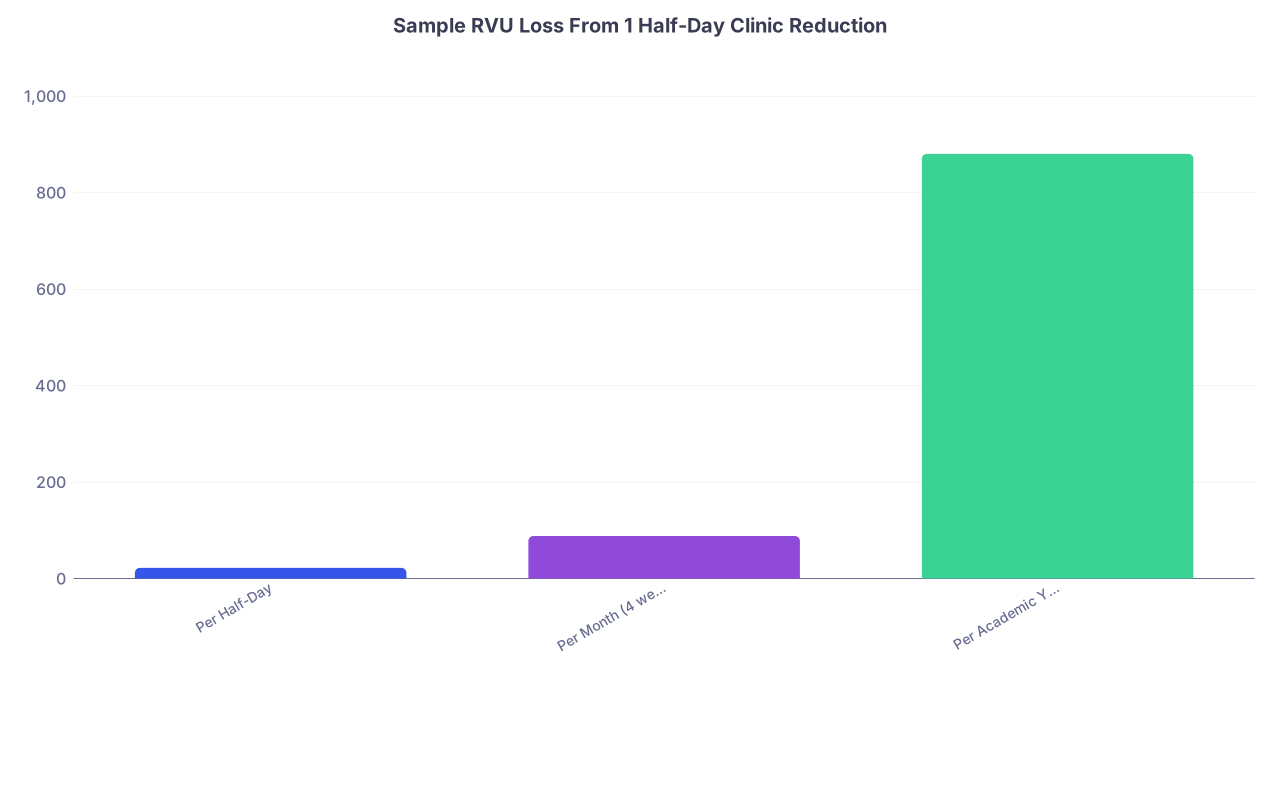
| Category | Value |
|---|---|
| Per Half-Day | 22 |
| Per Month (4 weeks) | 88 |
| Per Academic Year (40 weeks) | 880 |
So your ask becomes:
“I’m requesting protection for one half-day per week for teaching, which corresponds to roughly 880 RVUs per academic year.”
Now you’re speaking their currency. You’re not “less committed.” You’re offering a specific trade: 880 RVUs for defined teaching output.
2. Understand How Your Institution Actually Values Teaching
Do not assume your hospital / school leadership has no way to value teaching. They probably do. It’s just buried in policy documents, someone’s Excel sheet, or an old faculty affairs memo.
You need to find out three things:
- How do they currently assign FTE or effort to teaching?
- Is there an internal RVU-equivalent or “teaching RVU” system?
- What’s the going rate for directors, assistant program directors, course leaders, etc.?
Ask around quietly first. Senior faculty, clerkship directors, and program directors know this because they had to fight for it.
| Teaching Role | Typical Effort/FTE | Notes |
|---|---|---|
| Clerkship Director (core) | 0.1–0.3 FTE | Often 0.2 FTE target |
| Residency Program Director | 0.4–0.7 FTE | Depends on program size |
| Associate/Assistant Program Dir | 0.1–0.3 FTE | Often 0.1–0.2 range |
| Course/Block Director (preclinical) | 0.05–0.2 FTE | Varies widely |
| Regular clinical precepting | 0–0.1 FTE | Often un- or undercompensated |
Even if your place doesn’t use formal “teaching RVUs,” they may have standard:
- Stipends (e.g., $10k/year for clerkship director).
- Effort allocations (e.g., 0.2 FTE reduction in clinical time).
- Explicit guidelines in the GME or UME handbook.
You’re trying to figure out: “If I’m doing X teaching work, what should my effort look like here?”
Why this matters: you can frame your ask as “alignment with existing norms,” not “special treatment for me.”
3. Build a Teaching Portfolio That Looks Like Work, Not Hobby
Leadership responds better when your teaching is packaged as a clear role with deliverables, not a random collection of nice things you do.
You need a one‑page “teaching role proposal” that covers:
- Scope of work
- Time required
- Tangible outputs
- Benefits to the department/program
Scope of work
List actual tasks, not vague labels. For example, for a clerkship teaching role:
- Weekly small-group case-based sessions for 3rd year students (2 hours).
- Preparation and updating of teaching materials (2 hours).
- Mid-rotation feedback meetings with students (1 hour/week).
- End-of-rotation written evaluations (1 hour/week).
- Coordination with site directors and grading committee (1 hour/week).
That’s 6 hours/week of work. Not counting random email fires.
Tangible outputs
You want things they can put in reports, accreditation documents, and marketing slides:
- Number of sessions taught/year.
- Number of learners supervised/year.
- Curricular innovations (new OSCE, new simulation, new QI module).
- Outcome data: exam scores, course evaluations, match outcomes, milestone progress.

| Category | Value |
|---|---|
| Small group sessions | 40 |
| Lectures | 12 |
| Direct supervision | 80 |
| Admin & feedback | 60 |
This isn’t vanity. This is ammunition. Program and clerkship directors have to report this stuff anyway; aligning your work with those metrics makes it easier for leadership to justify your time.
4. Map Out Your Leverage Honestly
You might hate the word, but this is about leverage. Not in a sleazy way. In a reality-based way.
Your leverage can come from:
- Being hard to replace clinically (niche skills, high complexity panel).
- Being critical to an accreditation-required teaching function.
- Being someone trainees consistently request and rate highly.
- Being aligned with big institutional priorities (wellness, diversity, QI, simulation).
If you’re in a low‑margin specialty and your chair is under pressure, pure financial leverage may be limited. But accreditation leverage is real. If the residency or clerkship suffers because key faculty are burnt out or leaving, that’s a real institutional risk.
Ask yourself bluntly:
- What would it cost them to lose me?
- What would it cost them if this teaching function collapsed?
- Who would have to pick up my teaching if I stopped?
You don’t say this out loud as a threat. You use it to calibrate how firm you can be and how big your ask should be.
5. Prepare A Concrete Proposal, Not A Complaint
Do not walk in with, “I’m burned out and want to do more teaching.” That sounds like you want a hobby break from real work.
You walk in with a short written proposal. One or two pages. Structured like this:
- Purpose: what role or time block you’re proposing.
- Rationale: how this supports the department/program/school (not just you).
- Specific ask: FTE or RVU reduction and associated schedule changes.
- Deliverables: what they can expect in return.
- Metrics: how you’ll show it’s working and revisit.
Example language (adapt to your style):
- “I’m proposing a formalized 0.1 FTE protected time allocation (approx. 4 hours/week, ~880 RVUs/year) to support my role as X and expand Y teaching activities.”
- “This would be implemented as protection of Thursday afternoon clinic, allowing me to commit to recurring teaching and curricular development.”

| Step | Description |
|---|---|
| Step 1 | Clarify Teaching Goals |
| Step 2 | Quantify RVU Impact |
| Step 3 | Research Local Norms |
| Step 4 | Draft Proposal |
| Step 5 | Meet With Section Chief |
| Step 6 | Update Schedule and Contract |
| Step 7 | Revise or Escalate |
| Step 8 | Approved? |
You’re not whining. You’re pitching a business case: trade RVUs for educational value, with deliverables and accountability.
6. The Actual Conversation: How To Talk To Your Chair
Let’s get concrete. You’ve got your numbers, you’ve got your proposal. You’re walking into the meeting with your division chief or department chair.
Here’s how this can sound.
Opening
“I wanted to talk about formalizing my teaching role and aligning my clinical effort with that. Right now I’m at X RVU target and teaching Y hours/week on top of that. I think there’s a more sustainable structure that benefits both our RVU needs and our educational programs.”
You’re framing this as alignment and sustainability, not personal preference.
Present your proposal
“I put together a brief outline of what I’m doing and what I’m proposing. Right now, I’m responsible for:
- Weekly inpatient attending with residents and students, including direct observation and feedback.
- Monthly lecture in the residency core curriculum.
- Serving as site lead for the third-year clerkship, which involves student orientation, grading, and remediation.
This averages about 4–6 hours/week of teaching and admin work, on top of full clinical sessions.
I’m requesting 0.1 FTE of protected time—about one half-day per week—to formalize and expand this role. That’s about 880 RVUs/year. In exchange, I’ll be responsible for [list deliverables].”
Then stop talking. Let them react.
Common pushbacks and how to respond
“We don’t have budget for more protected time.”
Response:
“Understood. My concern is that we’re already getting this work for free, and it’s not sustainable. If 0.1 FTE is too much right now, could we start with 0.05 FTE and revisit in 6–12 months based on outcomes like evaluations and recruitment?”“Everyone teaches. Why should you get special protection?”
Response:
“I agree everyone teaches at some level. What I’m proposing is not casual teaching; it’s a defined role: [clerkship lead, core faculty, etc.] that carries administrative and curriculum responsibilities. I’m asking that we treat it as such, with a clear time allocation, so it doesn’t erode clinical performance or burn me out.”“Can you just be more efficient or squeeze this in between patients?”
Response:
“I’ve been doing that for the last X years. It’s led to [late notes, after-hours work, burnout signals]. The quality of feedback and teaching suffers when it’s done in 3‑minute gaps. If we want meaningful workplace-based assessment, remediation, and coaching, it needs devoted time.”
This is where your burnout and retention data can matter. If they’ve lost faculty recently, say it plainly: “I’d like to stay here long term. I can’t sustain this load without some structural change.”
7. Negotiating Alternatives If “Protected Time” Is A Dirty Word
Sometimes leadership panics when they hear “protected time.” They imagine a black hole of non-productivity. Fine. You can be flexible with the packaging.
Here are variants that may be easier to sell:
- A time-limited pilot: “Let’s try this 0.1 FTE for one academic year and reassess with agreed-upon metrics.”
- Redistributed clinical load: “I can take on more inpatient weeks (which are more teaching-heavy) and reduce outpatient half-days, keeping overall RVUs close while formalizing the teaching component.”
- Stipend plus small RVU relief: “If full FTE reduction isn’t possible, could we combine a modest stipend with a 0.05 FTE reduction?”
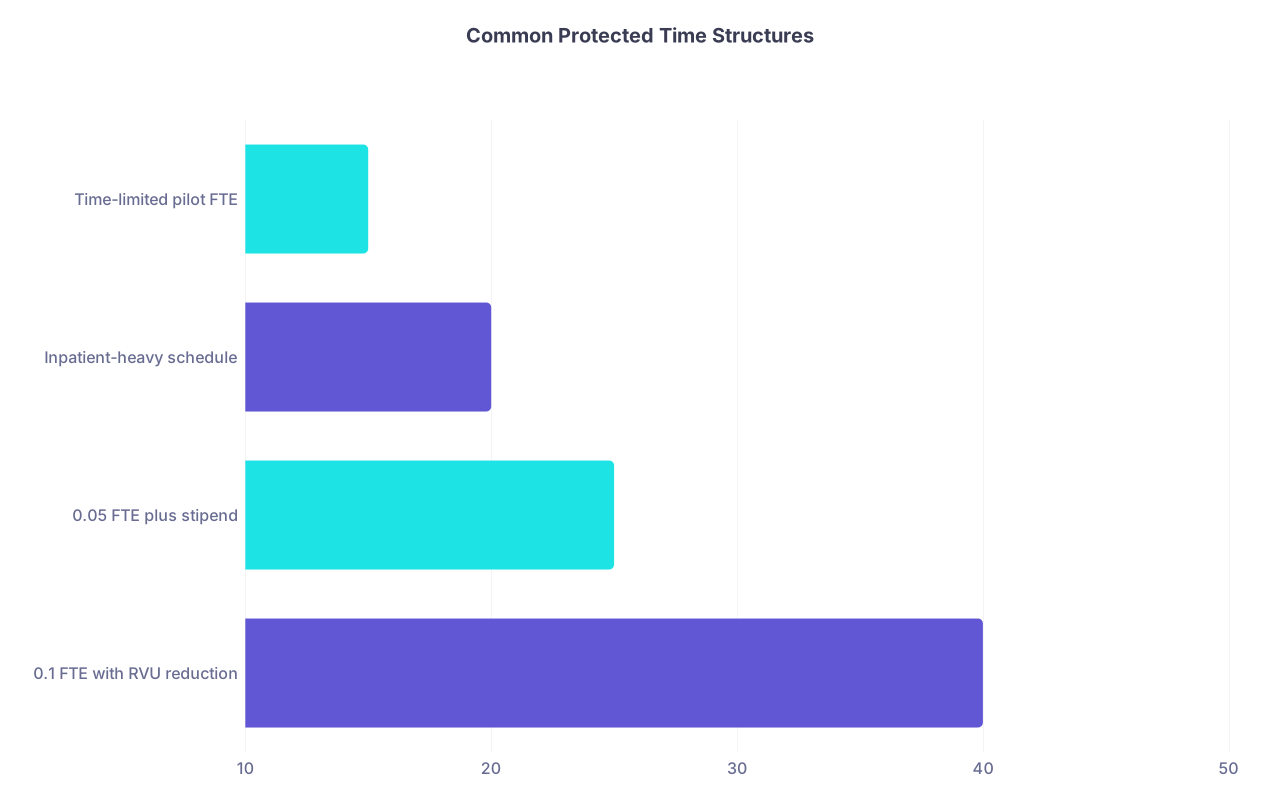
| Category | Value |
|---|---|
| 0.1 FTE with RVU reduction | 40 |
| 0.05 FTE plus stipend | 25 |
| Inpatient-heavy schedule | 20 |
| Time-limited pilot FTE | 15 |
The more options you bring, the easier it is for them to say yes to something.
8. Protecting The Time You “Win” (So It Does Not Get Eaten)
Getting the FTE is half the battle. Keeping it is the other half.
Once you have any protected time:
- Get it in writing. Contract addendum, workload allocation letter, or at least an official email summary from your chair.
- Block it on your schedule. Not “maybe I’ll keep Thursday open.” Hard block. Recurrent. Visible to schedulers.
- Guard it from “just this once” encroachment.
Because what happens in real life?
- A colleague is out, and your “teaching afternoon” turns into a full clinic.
- An admin double books you “because that’s the only time the patient can come.”
- Leadership forgets the agreement after 6 months.
You need a polite but firm script:
“When we set up this 0.1 FTE, we agreed my Thursday PM would be reserved for teaching and clerkship work. If we need to flex occasionally for emergencies, I’m happy to trade with another half-day, but I can’t routinely convert that to clinic without undermining the agreement.”
You will feel annoying saying this. You are not. You’re enforcing what you already negotiated.

And crucially: actually use the time for teaching. Not for catching up on notes. That’s how people decide protected time is “fluffy” and cuttable.
9. If They Say No: Decide Your Line In The Sand
Sometimes leadership genuinely cannot or will not budge. Then you have to decide your boundaries.
Ask direct follow-ups:
- “What would need to change for this to be possible in the future?”
- “Is there any level of teaching role that would come with protected time here? Or is that not how our department operates?”
- “Are there specific metrics or financial thresholds we’d need to hit before we could revisit this?”
If the honest answer is: “Our model does not and will not support real educational FTE,” then you need to decide:
- Are you willing to teach at the current level essentially as volunteer labor?
- Do you scale back your teaching to match your paid time?
- Do you start exploring departments or institutions that take the educational mission more seriously?
People stay “for the residents” all the time and burn out quietly. That’s a noble but unsustainable martyrdom. You are allowed to insist that if they want your teaching, they buy some of your time.

10. Long Game: Position Yourself As Core Educational Faculty
If you want protected time to stick and grow, you should be seen as core to the educational infrastructure, not a random “nice teacher.”
Over 1–3 years:
- Take on roles that are structurally important: evaluation committees, CCC, CCC chair, course or clerkship co-director, simulation director.
- Publish or present something education-related. Even a poster at a local GME day gives you proof that you’re not just chatting with learners; you’re building something.
- Collect feedback and outcomes data on your teaching. Not just “Dr. X is so nice,” but “Observed feedback sessions improve milestone scores in [domain].”
This shifts you from “clinician who likes teaching” to “educator-clinician whose role we’d have to rebuild if they left.” That’s the person who gets their 0.1–0.3 FTE and keeps it.

| Stage | Activity | Score |
|---|---|---|
| Early Years | Volunteer teaching 3 | - |
| Early Years | Informal mentorship 3 | - |
| Middle Years | Small leadership roles 4 | - |
| Middle Years | Course or site director 4 | - |
| Established | Program leadership 5 | - |
| Established | Formal protected time 5 | - |
FAQ (exactly 5 questions)
1. My department literally has no teaching FTE for anyone. Am I wasting my time asking?
Not necessarily, but you need to calibrate expectations. In small hospitals or new programs, the first 0.05–0.1 FTE for education often comes from creative budgeting or shifting clinical duties, not a big formal plan. Start small, frame it as a pilot, and tie it directly to something they care about: accreditation, recruitment, or retention. If after a clear, data‑driven proposal they still say “teaching is just extra,” that’s a red flag about long‑term fit.
2. I’m in a procedure-heavy specialty with huge RVU pressure. Do I have any leverage for teaching time?
Yes, but it’s different. Your leverage is that proceduralists are hard to replace and programs need you to train residents. You’re also generating more revenue per hour, so a 0.05 FTE reduction might be more acceptable than it looks on paper—especially if it improves recruitment or quality metrics. Consider teaching in ways that align with procedural work (sim, skills labs, OR teaching with slightly lighter lists) rather than strictly blocking clinic.
3. Should I threaten to leave if I do not get protected time?
Do not bluff. If you are genuinely at the point where staying without change is unsustainable, you can be honest about that—calmly. “I want to stay here, but this workload is not something I can keep doing long term. I’m looking for a way to make this sustainable.” If you say you’ll leave and then stay under the same conditions, you’ve just told them your boundaries are fake.
4. Can I negotiate protected time as part of my initial job offer rather than later?
That’s actually the best time to do it. New hires underestimate how much leverage they have before signing. When you have your offer letter, respond with: “I’d like to see 0.1 FTE explicitly allocated to teaching and education roles, with X clinic sessions instead of Y.” If they say yes up front, you avoid the whole “but you’ve always done it this way” trap later. Have the specifics (how many clinics, what teaching roles) ready before you counter.
5. What if I got “soft” verbal agreement but no change in my contract or schedule?
Then you do not have protected time. You have goodwill and a vague promise, which will evaporate as soon as the schedule gets tight. Send a polite follow‑up email summarizing: “To recap our conversation, we agreed on [0.1 FTE / Thursday afternoons blocked] for teaching and clerkship work starting [date]. I’ve attached a brief outline of my responsibilities. Please let me know if this matches your understanding.” If they will not put it in writing or allow scheduling changes, assume it is not real and adjust your teaching commitments accordingly.
Bottom line:
Protected teaching time in a high‑RVU environment is not a favor; it’s a trade. Quantify what you’re asking, package your teaching as real work with deliverables, and negotiate like a professional. If your institution wants your teaching, they should buy some of your time.