
What do you do when you’re the “go-to person” for one obscure skill… and you’re tired of it being invisible on your CV?
You’re the only rheumatologist who does ultrasound-guided injections.
The only cardiologist who actually understands a specific device.
The pulmonologist who runs the tricky post-transplant bronchs.
Everyone pages you. Residents seek you out. Nurses say, “If Dr. X is on, we’ll be fine.”
But on paper? You’re just “Associate Professor of Medicine.” Maybe “Core Faculty.” No formal teaching title. No protected time. And every year your chair says, “We value your teaching,” while your clinical RVUs creep higher.
If that’s you, this is about turning that niche skill into a signature teaching role that:
- Is formally recognized
- Comes with defined responsibilities
- Can justify protected time or at least boundary-setting
- Becomes part of your academic identity and promotion file
Let’s walk through how to do it, step by step, in the real world.
Step 1: Define Your Niche Like a Curriculum Director, Not Like a Technician

Right now, your “niche” probably lives in sentence fragments:
- “I’m the one who handles the weird LVAD stuff.”
- “They call me when the endobronchial valves clog.”
- “I’m the only one who can reliably reduce these tricky dislocations.”
That’s not a teaching role. That’s informal service.
You need to convert that into an educational product.
Do this:
Write a one-line title for your niche as if it were a course or program.
Think:
- “Point-of-care ultrasound for rheumatology practice”
- “Advanced device management for heart failure cardiology fellows”
- “Complex airway and bronchoscopy skills for pulmonary fellows”
- “Perioperative management of complex autoimmune patients”
List 3–5 concrete skills you actually teach (or could teach).
Not vague “understand device management.” Think:
- Perform and interpret US-guided knee injections
- Program and troubleshoot brand X LVAD alarms
- Perform bronchoscopic evaluation of anastomotic complications
- Build a safe steroid-taper plan in high-risk surgical patients
Identify your primary audience:
- Residents?
- Fellows (and which year)?
- Advanced practice providers?
- Community physicians (CME)?
You’re moving from “I do this thing” to “I run this teaching program.” Even if that program doesn’t technically exist yet.
Quick reality check: Is your niche actually niche enough?
Sometimes people think their angle is unique when it’s just… common.
You likely have a real niche if:
- Colleagues explicitly defer to you (“Ask Priya, she’s the contrast allergy person”).
- Trainees specifically request to be on your service or clinic.
- Referrals from other divisions land on your schedule for “this exact thing.”
If you’re not sure, pay attention for a week. Track pages/consults related to that skill. If it’s weekly, not yearly, it’s usable.
Step 2: Turn Your Informal Teaching into a Structured Offering
Right now your teaching is probably ad hoc:
- “Can you swing by the procedure room?”
- “Do you have 5 minutes to show me how you do this?”
- “Can I observe your clinic next week?”
That doesn’t translate into titles or protected time. Structured offerings do.
You want at least one thing that looks like this:
- A named workshop
- A recurring teaching block
- A mini-fellowship track
- A simulation or skills lab
- A formalized rotation element

| Step | Description |
|---|---|
| Step 1 | You have a niche skill |
| Step 2 | Define as teachable curriculum |
| Step 3 | Create structured teaching offering |
| Step 4 | Align with program needs |
| Step 5 | Get role formally named |
| Step 6 | Leverage for promotion and protection |
Concrete moves:
Create a 60–90 minute session around your niche
Example: “Introduction to LVAD Alarms for PGY2–3 Residents”Break it into:
- 15–20 min core concepts
- 20–30 min hands-on or case-based practice
- 10–15 min assessment or debrief
Offer it to a specific group with a clear schedule
Not “I’m available.” Instead:
- “I run a quarterly 90-minute LVAD emergency management session for residents on the CCU.”
- “All rheum fellows get three half-days per year of ultrasound skills with me.”
- “PACU APPs do a yearly workshop on high-risk autoimmune patients.”
Build in assessment from day one
You need evidence of impact. That means:
- A brief pre/post test (even 3–5 questions)
- A short confidence rating scale
- A skills checklist (for procedures)
This changes the conversation with leadership from “I help when needed” to “I direct X educational activity that meets program requirements Y and Z.”
Step 3: Align Your Niche with Someone Else’s Pain Point
You get traction when what you offer solves a program director’s or department’s problem.
They don’t care that you like airway toys. They care that:
- Fellows are graduating without specific competencies
- Residents are unsafe or inefficient with a certain task
- Accreditation requires training in X and you’re covering that gap
- Hospital metrics are bad (readmissions, complications, delays) and education can help
, Fellowship directors, Hospital quality leaders, CME/Faculty development office](https://cdn.residencyadvisor.com/images/articles_svg/chart-who-benefits-most-from-your-niche-teaching-2597.svg "Who benefits most from your niche teaching")
| Category | Value |
|---|---|
| [Residency program directors](https://residencyadvisor.com/resources/medical-teaching-careers/from-community-program-pd-to-medical-school-educator-making-the-jump) | 80 |
| Fellowship directors | 70 |
| Hospital quality leaders | 60 |
| CME/Faculty development office | 50 |
Do a quick mapping:
Look at your residency/fellowship milestones or EPAs. Which ones does your skill support?
For pulmonary, for example:
- “Manage mechanically ventilated patients with advanced modes”
- “Perform diagnostic bronchoscopy safely and effectively”
Look at system problems:
- Frequent consults for basic issues that could be handled by primary teams
- Recurrent errors (e.g., wrong steroid dosing in peri-op patients)
- Delays because only you can do X procedure
Translate your offering in their language:
Instead of:
“I could teach advanced cardiac device stuff.”Say:
“You’ve said the fellows struggle with independent LVAD management by graduation. I can own a 3-session LVAD curriculum—simulation plus bedside teaching—that directly hits milestones 5 and 6. I’ve already drafted learning objectives and a simple assessment.”
Now you’re not a random enthusiast. You’re solving a defined educational gap.
Step 4: Package the Role with a Name, Scope, and Deliverables
This is where you turn your thing into a signature teaching role.
You do not walk in saying, “I want 0.2 FTE protected.” That gets you an automatic “no” in many places.
You walk in with something crisp:
Title examples:
- Director, Point-of-Care Ultrasound Education – Rheumatology
- Lead, Advanced Heart Failure Device Education
- Director, Complex Airway and Bronchoscopy Skills Curriculum
- Faculty Lead, Perioperative Autoimmune Management Education
| Role Title | Core Outputs |
|---|---|
| Director, Rheumatology POCUS Education | 4 workshops/year, 1 assessment tool |
| Lead, Advanced LVAD Education | 3-simulation series, annual OSCE |
| Director, Complex Airway Skills Curriculum | Monthly bronchoscopy lab, eval data |
| Faculty Lead, Peri-op Autoimmune Education | 2 CME events/year, consult guidelines |
In your proposal (short, 1–2 pages max), include:
Scope of role
- Which learners
- How often
- What settings (clinic, sim lab, OR, bedside)
Concrete deliverables per year
Examples:
- “Run 4 hands-on workshops for PGY-3 residents”
- “Ensure all fellows complete a 10-case ultrasound log with direct observation”
- “Develop and update a standard LVAD emergencies pocket guide annually”
- “Provide annual data on competency metrics to the program director”
Alignment with institutional goals
- Milestones/EPAs, ACGME requirements
- Quality or safety projects
- Strategic initiatives (e.g., expanding POCUS capacity)
Ask
Sometimes it’s FTE. Often the first step is formal recognition plus small concessions:
- A named role/title
- Guaranteed access to a sim lab or skills space
- A small annual budget for models/equipment
- Removal of X half-day clinic per month when running workshops
Once it’s written down and named, it’s real. That matters.
Step 5: Collect Data Ruthlessly (and Quietly Build Your Promotion File)
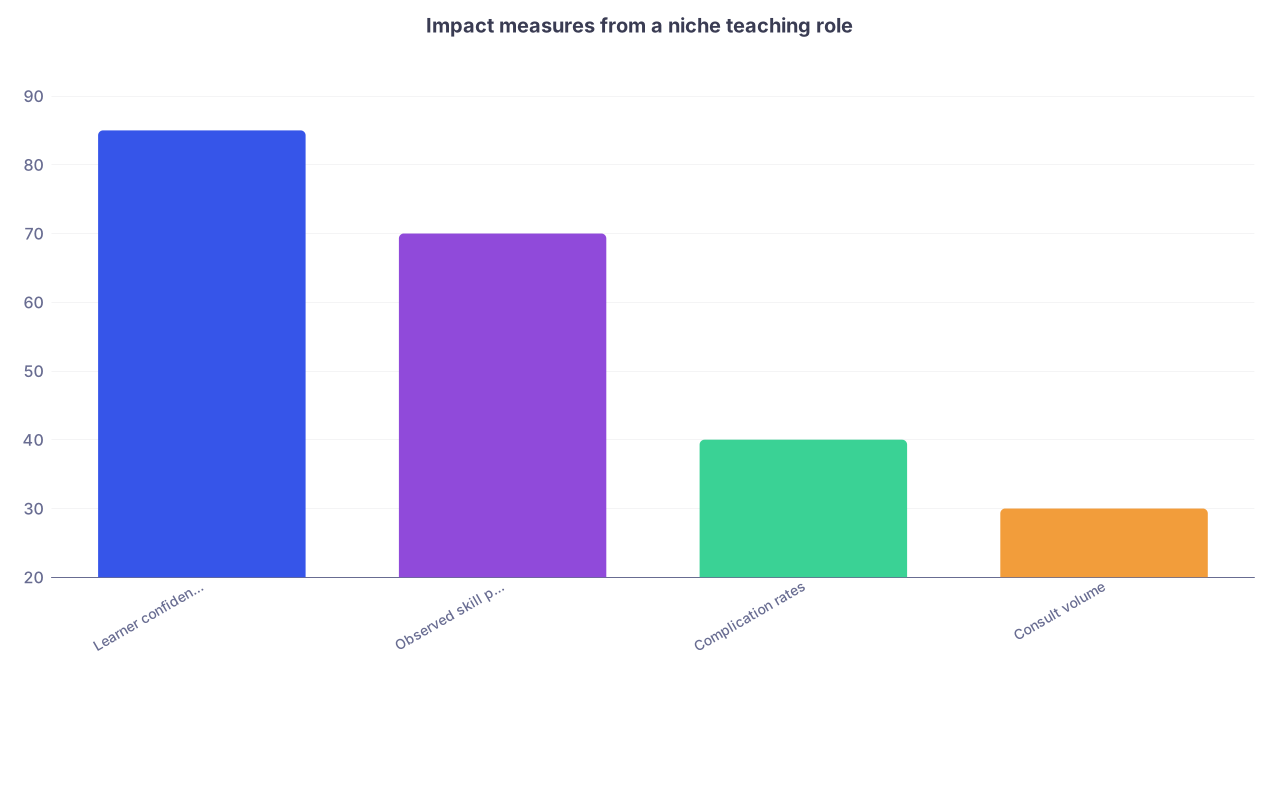
| Category | Value |
|---|---|
| Learner confidence | 85 |
| Observed skill performance | 70 |
| Complication rates | 40 |
| Consult volume | 30 |
You need numbers and narrative, not just “people like the session.”
For every session/series:
- Pre/post confidence scores (“Rate your confidence in managing LVAD alarms from 1–5”)
- A simple checklist for observed skills (“performed sterile prep,” “identified target,” “interpreted image correctly”)
- Follow-up surveys 3–6 months later: “Have you applied this skill? How often?”
- Tangential system data if possible: reduction in unnecessary consults, fewer errors, better documentation
Store all of this:
- In a simple spreadsheet
- With a folder of anonymized comments
- With sample teaching materials
This becomes:
- A teaching portfolio
- Evidence for promotion as “educator with a focused expertise”
- Leverage for later negotiation: “Here’s the impact we’ve had over 3 years.”
Even if your institution doesn’t ask for a teaching portfolio yet, build one. Programs are slowly catching up; you’ll be ahead.
Step 6: Broaden the Circle Just Enough
You don’t want to hoard the niche so hard you become a bottleneck and burnout case.
You also don’t want to “train yourself out of a job.”
The middle ground: position yourself as the architect and lead of the niche, then deliberately create associate faculty who can co-teach, take call for workshops, and sustain the program.
Strategies:
- Identify 1–2 junior faculty or senior fellows interested in your niche.
- Co-teach sessions with them; gradually hand off parts.
- Put their names in your materials: “Co-Faculty: Dr. Y.”
- Ask for a micro-title for them too: “Assistant Director, Bronch Skills Curriculum.”
This:
- Protects you from being the only one ever called
- Strengthens your case that this is a real program, not a one-person hobby
- Builds good will (you’re the person who gave someone else a role)
You remain the name most associated with the niche. The person they invite to regional talks. The one publishing on this teaching innovation.
Speaking of which…
Step 7: Turn the Niche Into Scholarship Without Writing a Textbook
You do not need a randomized trial to get academic mileage out of this.
You need small, focused educational scholarship:
Possibilities:
- A brief “How we built X curriculum” article in a specialty-ed journal
- A workshop at a national meeting (CHEST, ACC, ACR, etc.)
- A poster on outcomes of your teaching program
- A short piece on using simulation/POCUS/case-based learning for your niche area

This does two things:
- Raises your profile beyond your institution.
- Makes it clear to your promotions committee that this is not “extra teaching,” it’s your academic lane.
If you’re short on time, start with:
- One poster at your own institution’s education day
- One short workshop at your specialty’s annual meeting
- One co-authored paper with a med-ed colleague who likes study design
Step 8: Have the Conversation With Your Boss the Right Way
Here’s how people often do it wrong:
“I’m doing a lot of this niche teaching and I’m burned out. I need protected time.”
That gets you sympathy, not structure.
Better:
“Over the past 2 years, I’ve become the referral point for advanced bronchoscopy skills. I’ve developed a structured curriculum with 3 workshops annually, direct observation checklists, and we’ve documented improved fellow confidence and a 20% drop in avoidable consults. I’d like to formalize this as ‘Director, Complex Airway and Bronchoscopy Skills Curriculum’ reporting to the PD. Here’s a one-page outline of deliverables and how it supports our ACGME milestones and departmental goals. To sustain it, I’ll need one half-day per month carved out during workshop weeks and about $X for sim supplies. Can we talk about where this might fit in the division structure?”
You’ve:
- Brought data
- Connected to mission
- Presented a specific, modest ask
- Handed them a pre-packaged win
If they say no to FTE, push at least for:
- The formal title
- Written recognition in your annual review
- Use of this role in your promotion letter
If they won’t even grant a title for a well-run, useful program with data? That’s not a great sign about the institution long-term. File that away.
Step 9: Watch for Common Traps
Three I see all the time:
The “sure, do it” trap
Leadership “approves” your role but nothing is on paper, no FTE, and your clinic load doesn’t change. You’ve just added a second job.
Fix: Ask, “Where should this time come from?” and refuse to start an ongoing program without a clear tradeoff, even if small at first.
The “dumping ground” trap
Once you’re labeled, every random thing vaguely related to your niche lands on you: admin committees, protocols, extra teaching with no support.
Fix: Define your lane early. “My role is focused on hands-on ultrasound training for rheum fellows and residents, not general ultrasound policy for the hospital.”
The “invisible labor” trap
You run everything, but no one outside your unit knows.
Fix: 1–2 times per year, send a short report: outcomes, participation, key quotes. Copy your chair, PD, maybe the DIO. Visibility matters.
Step 10: If You’re Early-Career vs Mid/Late-Career
This strategy looks a little different depending on where you are.
Early-career (0–5 years out)
You’re building an identity. The risk is saying yes to too many things.
Aim for:
- One clear niche teaching lane
- One structured offering well done
- One small piece of scholarship around it
Say no to unrelated teaching roles unless they connect back to that lane.
Mid-career (5–15 years out)
You might already be the go-to person informally. You’re tired.
Your move is formalization and delegation:
- Turn the chaos into a named role with scope
- Peel off the garbage (“I will not be the default reviewer for every device document”)
- Pull in junior people as co-faculty and succession plan
Late-career
You have gravitas. Use it.
- Get the role named at departmental or institutional level
- Write/record your curriculum so it lives on
- Turn your “weird skill” into a legacy: grand rounds series, written manual, recorded teaching modules
FAQ (Exactly 3 Questions)
1. What if my niche is super small and only used a few times a year?
Then you probably don’t build a whole curriculum; you build a just-in-time training + consult model. Example: rare transplant complication management. Formalize it as:
- A brief online module or microlearning resource
- A clear consult/teaching pathway (“When X happens, here’s how I get involved and what learners see/learn”)
- A yearly case review session for fellows/residents
Still document it. Still name it. “Lead, Transplant Complication Teaching Consults” is unusual, but when written in your CV with outcomes and teaching examples, it counts.
2. Can I do this if I’m in private practice or a community hospital, not an academic center?
Yes, but your “students” might mostly be:
- APPs
- Community physicians (via CME)
- Nurses and allied health staff
You turn your niche into:
- CME workshops your hospital markets
- In-service training programs
- Regional courses (often sponsored by device companies or societies, carefully managed for COI)
You may not get a formal academic title, but you absolutely can become the regional name associated with that skill. That helps career security, referral volume, and future academic opportunities if you ever move.
3. What if my leadership isn’t interested in giving any title or time, no matter the data?
Then you have three options:
- Scale back to what’s sustainable for you and stop trying to build a full program. Protect yourself.
- Take your niche partly outside: national workshops, society committees, online teaching. Build your identity externally.
- Quietly start looking at other institutions that actually reward niche educational leadership. When you interview, lead with: “I developed and ran a focused X curriculum that improved Y outcomes, but it wasn’t supported structurally. I’m looking for a place that values this kind of role.”
You cannot force a culture to care. You can absolutely take your skill, your data, and your story somewhere that does.
Key points to remember
- A niche clinical skill becomes a signature teaching role only when you name it, structure it, and align it with someone else’s needs.
- Titles and protected time follow clear deliverables and documented impact, not vague “extra teaching.”
- You’re not “the person who does the weird thing.” You’re the architect of a focused educational program. Start acting—and documenting—accordingly.