
You finish a full clinic day—RVUs look good, patients mostly happy—but the part that sticks with you is the 15 minutes you spent explaining heart failure to a college student shadowing you. Driving home, you realize that tiny teaching moment was the best part of your day. And it hits you: you miss teaching more than you thought.
If that’s you—already embedded in private practice, mortgage, kids, partnership track—but feeling the pull back toward academia, this is your playbook. Not theory. Concrete moves.
Step 1: Get Honest About What You Actually Miss
Before you start emailing every program director within 100 miles, you need clarity. “I miss teaching” is too vague. Different academic roles fix that itch in very different ways.
Ask yourself, in unfiltered terms, what you miss most:
- Standing in front of a room giving structured talks?
- Bedside teaching and clinical reasoning with learners?
- Being part of an academic community and case discussions?
- Research and publications?
- The status of a faculty title and academic affiliation?
Write down your answers. Literally, in a notes app or on paper. Be specific:
- “I want to run a teaching clinic with residents.”
- “I miss pre-rounds teaching and chalk talks.”
- “I don’t care about research at all.”
- “I want to do some teaching but keep my income.”
Those sentences will decide how you re-enter academia and how far you go:
- Volunteer clinical faculty with a half-day per week?
- Paid adjunct/clinical educator with defined sessions?
- Full-blown switch back to academic full-time employment?
If you skip this, you’ll end up saying yes to the first offer that sounds “academic,” which is how people get trapped in unpaid, time-sucking roles they hate.
Step 2: Understand the Academic Entry Points From Private Practice
You are not starting from zero. You’re a practicing physician. Programs need you, but they won’t rearrange their world to figure out where you fit. You have to know the usual doors in.
These are the main paths, from lightest touch to full commitment:
| Option | Time/Week | Pay |
|---|---|---|
| Volunteer Clinical Faculty | 0.5–4 hrs | Unpaid / small |
| Preceptor for Students | 2–8 hrs | Usually unpaid |
| Adjunct Clinical Faculty | 4–12 hrs | Modest hourly |
| Part-time Faculty | 0.2–0.6 FTE | Salary + benefits (pro-rated) |
| Full-time Academic Faculty | 0.8–1.0 FTE | Full academic salary |
Volunteer / Community Faculty
Low barrier, low control, usually low pay.
How it looks in real life:
- You let your local medical school know you’ll take students for outpatient rotations.
- You might do occasional lectures, OSCE evaluations, or serve on a teaching panel.
- You keep your full private practice schedule.
Pros: Easy to start, minimal disruption, gets your foot back in the door, CV line, letters, parking access, maybe CME.
Cons: Often disorganized. Learners rotated to you when convenient for the school, not for you. Little influence on curriculum. Often unpaid.
Clinic / Inpatient Preceptor
Common for FM, IM, peds, psych, EM, OB/Gyn, many subspecialties.
You:
- Take students or residents into your clinic several sessions per month.
- Or you serve as a teaching attending on an academic service a week or two per year.
Pros: Real teaching, face-to-face; you’ll know quickly if this scratches the itch. Strong relationship builder with the department.
Cons: Slows clinic. If you’re in pure RVU-compensation, this hits your pocket unless negotiated.
Adjunct / Clinical Educator Roles
This is where “I teach sometimes” becomes “I am part of the faculty.”
What it often looks like:
- 0.1–0.3 FTE appointment.
- Duties: precepting, small group facilitation, simulation lab, OSCEs, some lectures.
- Paid, but not enough to replace a full private practice schedule.
Part-Time or Full-Time Academic Return
Now we’re talking serious shift.
- You join a university or teaching hospital as faculty (assistant/associate professor).
- Your job plan includes: clinics, teaching, maybe research or admin.
- You probably take a pay cut relative to a busy private practice, sometimes a big one.
You don’t jump straight here without testing the waters, unless you’re truly done with private practice.
Step 3: Map Your Local Academic Ecosystem
Before you “apply” anywhere, you need intelligence.
Make a list:
- Medical schools within a 60–90 minute radius.
- Residency programs (even at community hospitals) in your specialty.
- PA, NP, and allied health programs if MD/DO options are thin.
Now, do some targeted reconnaissance.
Look up:
- “Clinical faculty,” “community faculty,” or “volunteer faculty” on their website.
- Clerkship director and program director names in your specialty.
- Office of Medical Education / Faculty Affairs contacts.
Ask around:
- Any of your partners already precepting? They’re often the best backdoor.
- Hospital CMO / GME office: “Do we have any affiliation with a med school or residency? Who runs it?”
Pay attention to where:
- Students already rotate in your hospital.
- Residents cover call or outpatient clinics.
Your goal: Identify 1–3 target programs and 1–2 actual humans you’ll contact at each (clerkship director, program director, APD, or director of community faculty).
Step 4: Fix Your Academic CV and Story
You probably haven’t updated your CV since fellowship or your last job change. Academic people care about different things than private practice partners.
You need two things:
- A clean, academic-style CV.
- A tight, believable story that explains why you’re back.
What to put on your CV (even if it feels thin)
Include:
- Current clinical role: size and nature of your practice, procedures, patient volume.
- Any teaching you already do: students shadowing, talks at local hospitals, CME presentations, M&M conferences.
- Leadership: medical directorships, QA committees, EMR committees, guideline work.
- Past academic involvement: chief resident, course leader, research during training.
- Certifications: board status, any teaching/education certificates, CME relevant to education.
Don’t fake research. Don’t pad abstracts into full papers. If you’re light on pubs, fine. You’re the seasoned clinician; lean into that.
Your story (and it has to be honest)
You’re going to get some version of: “So why now?”
Bad answer: “I just kind of miss it.”
Better answer: “I’ve been in private practice X years. I love my patients and my partners, but I realized the most energizing parts of my week are the times I’m teaching—talks to our new APPs, case discussions, mentoring. I want a defined role where teaching is an explicit expectation, not just something I squeeze in.”
Or, if you want only part-time:
“I have no intention of leaving my practice, but I want 0.1–0.2 FTE in structured teaching to complement what I do clinically.”
Write your own version out. Use it in emails. Keep it consistent.
Step 5: Start With Low-Risk, High-Access Roles
Your first move should not be, “Can I have a 0.5 FTE faculty contract?”
You start small, prove you’re reliable and good, then build leverage.
Here are three concrete first steps.
1. Offer to Take Learners in Your Current Practice
Send an email to the appropriate clerkship director or program director. Something like:
Dear Dr. Smith,
I’m a board-certified [specialty] in private practice at [Clinic/Hospital], [City]. I completed residency/fellowship at [Institution] in [Year].
I’ve realized over the past few years that the most fulfilling part of my work is teaching. I’d like to explore becoming a clinical preceptor for your [students/residents] in my outpatient practice.
My practice sees a broad mix of [key conditions/population], and I can offer [X half-days] per month with protected teaching time.
If you’re open to it, I’d appreciate a brief call to see whether there’s a fit.
Best,
[Name, credentials]
[Practice]
[Contact details]
Key points: short, specific, signals reliability.
2. Volunteer for Discrete, Time-Boxed Teaching
Examples:
- One afternoon a month doing simulation lab for residents.
- OSCE examiner days.
- One lecture per block in a pre-clinical course if you’re in a field like cardiology, pulmonology, endocrine, psychiatry, etc.
You can literally email: “If you ever need lecturers or OSCE examiners in [topic], I’d be happy to help.” Educational offices always need bodies for this.
3. Join an Existing Affiliation Through Your Hospital
Many hospitals already have:
- Teaching agreements with med schools.
- Core faculty shifting in and out.
Talk to:
- GME office (if your hospital has residents).
- CMO or director of medical education.
Ask directly: “What would it take for me to become clinical or core faculty for [Program]?” Make them spell out the steps.
Step 6: Protect Your Time and Your Income (or You’ll Resent It)
This is where people in private practice get burned. They start teaching “on the side,” their days get longer, and no one adjusts the schedule or comp.
You need to think like a business owner, because you are one.
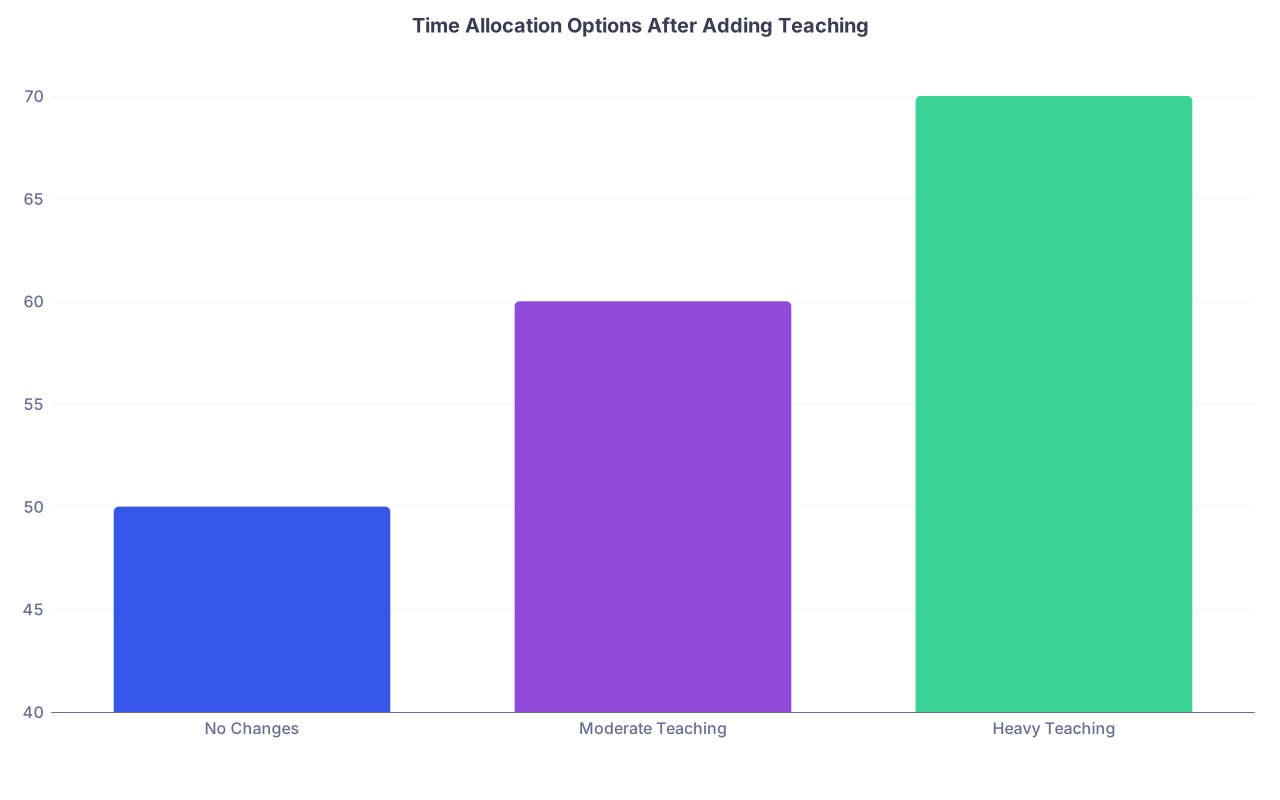
| Category | Value |
|---|---|
| No Changes | 50 |
| Moderate Teaching | 60 |
| Heavy Teaching | 70 |
Imagine those are your weekly hours. If your teaching time pushes you from 50 to 60 or 70 hours without any offset, you’ll hate it in six months.
You have three levers:
- Adjust your clinic schedule.
- Adjust your compensation structure.
- Adjust your teaching scope.
Inside Your Practice
You need a frank conversation with your group:
- “I want to add 0.1 FTE teaching with [Institution]. That means I need one half-day a week blocked off clinic. Here’s how I propose we handle call/coverage/overhead.”
Sometimes:
- Partners cover that session in exchange for your covering something else.
- You accept slightly lower RVUs in exchange for personal satisfaction (and possibly improved recruitment/marketing for the practice—“teaching practice” is attractive to some patients and hires).
- You negotiate a small stipend from the academic side to at least offset overhead.
If you’re employed by a hospital or large system, show them:
- How a faculty title can help with recruitment.
- That learners in clinic improve throughput down the line (future hires).
- That there’s institutional value in affiliation and teaching.
With the Academic Institution
Ask, directly and early:
- “Is there compensation for this role?”
- “Is it per session, per half-day, or stipend?”
- “Is there administrative support—scheduling, evaluation templates?”
Do not be shy. Universities routinely underpay or not pay community faculty. Sometimes that’s fine if the commitment is tiny and you’re wealthy and happy. But if you’re carving out serious time, you need something in return: money, protected time, title, CME, real involvement.
Step 7: Build a Reputation Fast (This Is Your Leverage)
Once you’re in—even modestly—you have 6–12 months to either become “that person we always call” or “that person we forget exists.”
You want the first.
Do three simple things:
Be absurdly reliable.
- Show up. On time. Every time.
- Answer emails quickly.
- Submit evaluations promptly. Departments will tolerate mediocre teachers who are reliable before they’ll tolerate brilliant teachers who are flaky. Sad but true.
Be structured.
- Have a consistent approach: “On day one with me we set goals. Every patient we see we’ll hit diagnosis, management, and patient communication. At the end of the day we’ll debrief.”
- Learners will comment on this in evaluations. “Super organized, great teacher” spreads faster than you think.
Ask for feedback early.
- After a couple months, ask the clerkship director or program director: “I want to be genuinely useful to you. What do you need more of from community faculty? Where could I fit in better?”
- Then actually do it.
Step 8: Decide How Far Back Into Academia You Actually Want To Go
After 6–18 months of part-time teaching, you’ll have real data.
You’ll know:
- Do I actually enjoy regular teaching, or did I like the idea more than the reality?
- Do I miss being fully academic, with conferences, hallway consults, and residents around all the time?
- Or is one half-day with learners enough?
If the itch is mostly scratched, great. Maintain that role, maybe gradually grow it. You’re done.
If you still feel under-satisfied, then you consider:
- Increasing your FTE with the academic institution.
- Decreasing clinical days in private practice.
- Or fully switching back to an academic appointment.
Here’s where the uncomfortable tradeoffs show up: money, autonomy, bureaucracy.
| Factor | Private Practice | Academic Full-time |
|---|---|---|
| Income | Higher (usually) | Lower |
| Schedule | You set more | More fixed |
| Teaching Time | Must carve out | Built into role |
| Admin/Bureau | Practice-level | Heavy institutional |
| Titles/Promotion | Minimal formal ladder | Clear promotion path |
If you want to move partially or fully back:
- Talk to your now-known academic contacts about open roles.
- Ask specifically: “Is there a track for clinician educators without heavy research expectations?”
- Negotiate hard on protected teaching time vs pure RVU clinic.
Clinician-educator tracks exist at most med schools now. Some departments genuinely value master teachers. Others say they do and then treat teaching as a hobby. You’ll feel the difference quickly.
Step 9: Use Your Private Practice Experience as a Selling Point (Not a Liability)
Academic folks sometimes look sideways at long-term private practice physicians: “Are they up to date? Can they teach? Are they just here for the title?” You can control that narrative.
Position yourself like this:
- You see high volume, real-world bread-and-butter + weird stuff.
- You know which guidelines matter at the bedside and which are fantasy.
- You can teach efficiency, documentation realities, difficult conversations with patients who have deductibles and no time.
Do things like:
- Offer a lecture on “Real-world [specialty] practice: what I wish I’d known as a PGY-3.”
- Volunteer to host sessions on billing, coding, practice management, or patient communication in outpatient settings.
- Suggest cases for M&M or teaching conferences that came out of your practice.
Suddenly you’re not the outsider. You’re the bridge.
Step 10: Watch for These Red Flags (And Walk Away If Needed)
I’ve seen more than a few doctors get sucked into terrible arrangements because they were flattered to be “back in academia.” Don’t be one of them.
Red flags:
- They want you to precept or lecture regularly but “we don’t have a formal title or appointment for that.”
- No clarity on expectations: “Just help when you can” turns into an open-ended time sink.
- No administrative support—you are supposed to coordinate learners, schedule them, figure out EMR access.
- They balk or get irritated when you ask about compensation, title, or protected time: “Our community faculty don’t usually ask those questions.”
You’re not a resident desperate for a line on a CV. You’re an experienced physician bringing real value. It is entirely reasonable to ask for:
- A clear role description.
- A faculty title commensurate with your years in practice.
- At least token compensation or benefits for recurring, structured work.
If they act like you’re lucky they’re even talking to you, that’s not your institution.
A Simple, Concrete Next Step for Today
Do one thing right now that moves this from wishful thinking to action:
Open your email and draft a three-paragraph message to either:
- The clerkship director or program director of your specialty at the nearest med school or residency, or
- Your hospital’s GME office or CMO asking, “Who oversees teaching/affiliated faculty for [specialty]?”
In that email, say who you are, what you do now, and exactly what you’re asking: “I’d like to explore serving as a clinical preceptor / volunteer clinical faculty for your learners one half-day per week.”
Do not overthink it. Do not wait until your CV is “perfect.” Send the email. That’s the real re-entry point.