
The belief that “my clinic is too busy to teach” is wrong. The real problem is that the clinic is busy and unstructured, so teaching feels like adding chaos. You fix that by building a system, not by slowing down.
You do not need a half-day protected “academic clinic” to teach well. You need a blueprint that fits right into a 15‑minute visit template without wrecking your schedule or your sanity.
Here is that blueprint.
Step 1: Redesign Your Clinic Flow Around Teaching (Not After It)
If you try to “add teaching” on top of your existing clinic structure, you will burn out in two weeks. You redesign the structure so teaching is baked into how patients move through the visit.
1.1 Start With a Simple Flow Map
Do this once on paper (or whiteboard) before you touch your schedule.

| Step | Description |
|---|---|
| Step 1 | Patient check in |
| Step 2 | Medical assistant intake |
| Step 3 | Direct to attending |
| Step 4 | Learner previsit huddle |
| Step 5 | Learner sees patient |
| Step 6 | Brief case presentation |
| Step 7 | Attending focused teaching + exam |
| Step 8 | Plan explained to patient |
| Step 9 | Orders, follow up, documentation |
| Step 10 | Learner involved? |
You are adding exactly two teaching-specific steps:
- Learner previsit huddle (60–90 seconds)
- Focused presentation + micro‑teaching (2–4 minutes)
That is it. Everything else already exists. You are just putting some structure around it.
1.2 Time-Box the Key Touchpoints
Use hard limits. If you do not, the whole thing collapses by patient 4.
- Learner previsit huddle: ≤ 90 seconds per new patient
- Learner in room alone: 7–10 minutes for new; 5–7 for follow‑ups
- Case presentation in hall or workroom: ≤ 3 minutes
- Teaching point: ≤ 2 minutes, directly tied to this patient
This keeps you from the classic trap:
“I’ll just explain heart failure guidelines quickly…” — 8 minutes later you are quoting trial acronyms and your MA is knocking because three rooms are waiting.
1.3 Set a Default Teaching Mode for Each Visit Type
Stop deciding on the fly. Decide in advance:
| Visit Type | Learner Role | Time Alone | Teaching Focus |
|---|---|---|---|
| New patient | Full H&P | 7–10 min | Assessment & plan |
| Chronic followup | Focused problem | 5–7 min | Prioritization |
| Acute visit | Targeted history | 5–7 min | Differential |
| Results visit | Joint visit only | 0–3 min | Communication skills |
If you want to stay sane in a 15‑minute template, not every visit is a full student-driven encounter. Define which ones are.
Step 2: Build a 5-Minute Pre‑Clinic Huddle That Changes Everything
The biggest mistake I see: teaching attendings and learners walk into clinic cold. No expectations, no plan, vague promises of “we’ll see how it goes.” That is how you end up finishing notes at 8 p.m.
You fix this with a 5‑minute huddle at the start of every teaching clinic. Non‑negotiable.
2.1 Your Exact 5-Minute Script
Stand by the computer with the schedule open. Out loud, with the learner:
Level set (60 seconds)
- “You’re a PGY‑1 / MS3 / NP student, correct?”
- “What do you most need from this month—efficiency, diagnosis, procedures, notes?”
Define today’s teaching target (60 seconds)
- Pick one theme for the session:
- Acute visits: “Today we will sharpen your differential and testing thresholds.”
- Chronic disease: “Today your job is medication optimization.”
- Communication: “Today we are focusing on explaining plans clearly.”
- Pick one theme for the session:
Mark which patients are learner-first (2 minutes)
- Scroll the list and mark 3–5 patients:
- “You will see rooms 2, 4, 6 before me today.”
- “For room 5, you are only doing the focused history, I will do the exam with you.”
- Tell the MA or RN:
- “If there’s a resident listed on the board, please put the patient in their room first.”
- Scroll the list and mark 3–5 patients:
Set presentation expectations (60 seconds)
- “Every presentation today must start with a one-sentence summary.”
- “I want you to commit to a primary diagnosis and a plan—even if you are unsure. I will not be upset if it is wrong. I will be upset if you say ‘I don’t know’ without trying.”
This 5 minutes saves you 20–30 minutes of chaos later.

Step 3: Use a Structured, 3-Part Case Presentation Every Time
The hallway presentation is where teaching clinics live or die. Without structure, you get sprawling monologues that destroy your schedule.
You enforce one simple, consistent format. I have used this with students, residents, APPs—it works across all levels.
3.1 The 3-Part, 3-Minute Template
Tell learners this is the only allowed format in your clinic:
- One‑sentence summary
- “Mr. Lopez is a 58‑year‑old man with diabetes and hypertension here for 3 days of worsening shortness of breath.”
- Problem list with stance
- “Problem 1: Dyspnea, I think likely COPD exacerbation over heart failure exacerbation because…
Problem 2: Diabetes, reasonably controlled.
Problem 3: Tobacco dependence.”
- “Problem 1: Dyspnea, I think likely COPD exacerbation over heart failure exacerbation because…
- Plan by problem with commitment
- “For dyspnea, I propose…
For diabetes, I would…
For tobacco use, I suggest…”
- “For dyspnea, I propose…
If they start reciting the full review of systems, cut in politely but firmly:
“Stop. Start again with a one‑sentence summary and a problem list. I do not want the full ROS unless it changes your differential.”
You are not rude. You are training them to be efficient clinicians.
3.2 The 60-Second Teaching Add-On
After their presentation and before you go back in the room, do one of these. Not all.
- “Give me your top 3 diagnoses and 1 no‑miss for this presentation.”
- “Tell me the single highest‑yield physical exam maneuver you will do and why.”
- “Name one test you are NOT ordering and why it is unnecessary today.”
You are building clinical reasoning, not lecturing.
Step 4: Turn Routine Clinical Tasks into Teaching Moments
If teaching is separate from work, it will get dropped every busy afternoon. So you weld teaching to things you must do anyway: documentation, orders, and patient communication.
4.1 Notes as a Teaching Tool, Not a Burden
The usual pattern: the learner writes a note, you rewrite half of it at 10 p.m., everyone resents everyone.
Fix it like this:
Create one standard note template for your clinic.
Make clear “must-haves” by section:
- HPI: “I want a timeline and clear symptom description. Not a transcription of the patient.”
- Assessment: “Each problem needs a one‑sentence ‘why’ behind your diagnosis.”
- Plan: “Every plan must include meds, labs/imaging (if any), follow up interval, and patient education.”
Use “note coaching” for 2 patients per clinic
- After seeing the patient, open their note with the learner right there.
- Say: “Dictate your assessment and plan out loud, and I will edit in real time.”
- Highlight specifically:
- “Change ‘will monitor’ to exactly what you are monitoring and when.”
- “Add a sentence about ruling out pneumonia given their cough.”
This takes 2–3 minutes per coached note. You save that on the back end ten‑fold.
4.2 Orders as Instant Clinical Reasoning Checks
Every order is a quiz you do not have to design:
- “You ordered a chest X‑ray. What exact question do you want it to answer?”
- “You ordered an A1c. How will it change your management today?”
- “You added lisinopril. What specific side effects are you going to warn them about?”
You are not embarrassing them; you are forcing them to connect actions to reasoning. Do this especially when they order “everything.”
Step 5: Protect Your Own Sanity with a Load-Balancing System
Teaching in a busy clinic fails when attendings play martyr. You do not need to see every patient with the learner first. You need a predictable rule for how to share the load.
5.1 Use a Simple “Red–Yellow–Green” Patient Triage
In your head (or on your schedule), label each patient:
- Green – Stable, straightforward, safe for learner to lead
- Yellow – Some complexity or time pressure; shared visit
- Red – You lead, learner observes or does a tiny piece
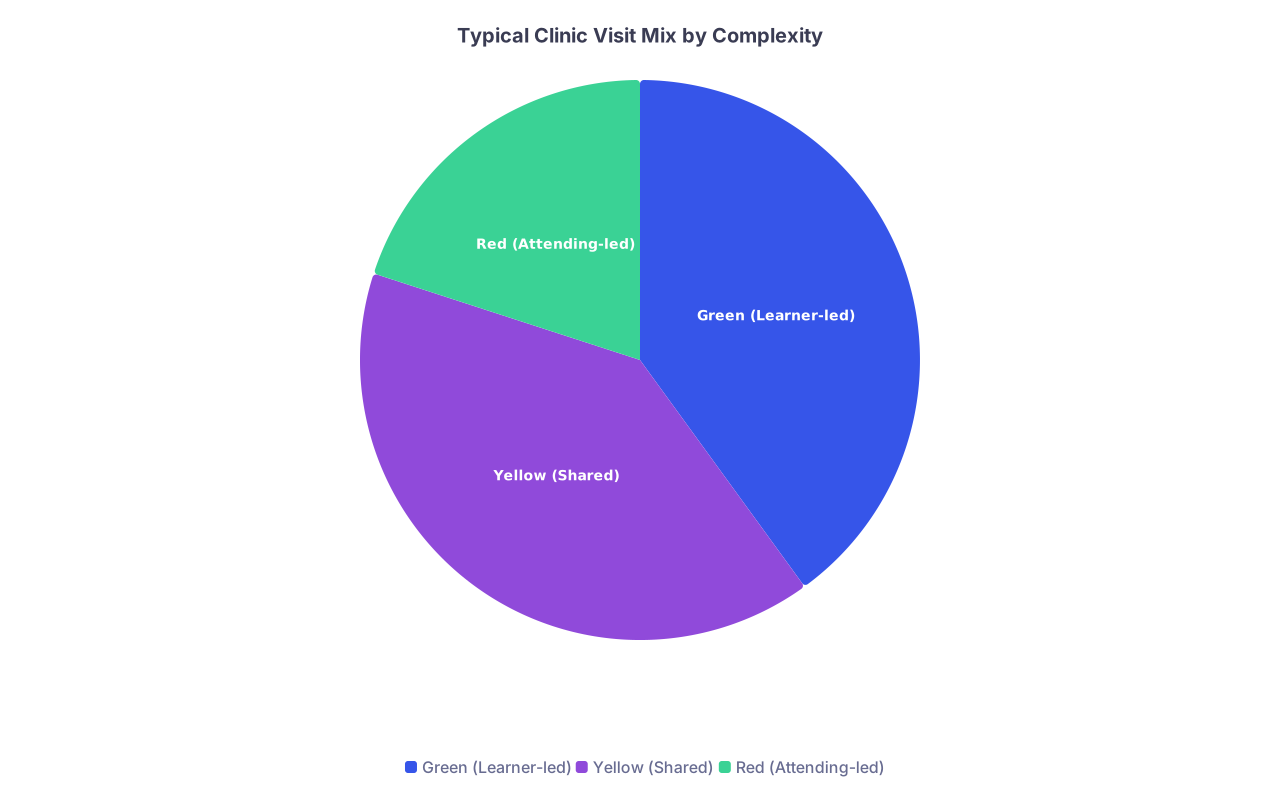
| Category | Value |
|---|---|
| Green (Learner-led) | 40 |
| Yellow (Shared) | 40 |
| Red (Attending-led) | 20 |
You can even tell the learner:
- “Today, about 4 patients will be fully yours, 4 we will share, and 2 I need to lead because of complexity or time.”
That sentence alone lowers everyone’s anxiety.
5.2 Create a Clear Rule for Running Behind
You will get behind at some point. The difference between a teaching clinic that recovers and one that implodes is what happens at the first sign of trouble.
Here is my rule set that works:
If we are 15 minutes behind:
- Learner stops seeing new patients alone. They join you for joint visits.
- Teaching shifts to ultra‑brief “one question per patient” in the room or doorway.
If we are >30 minutes behind:
- You tell the learner directly: “We are in recovery mode for the next hour. I will be doing most of the talking. Watch how I manage time and redirect patients. We will debrief one case at the end.”
What you do not do: pretend everything is fine and let the learner keep doing 10‑minute solo visits while the waiting room fills.
Step 6: Build a 2-Minute Feedback Habit That Actually Sticks
Most feedback in clinic is vague, late, or both. “You are doing fine” helps nobody. End-of-rotation evals are too late to change anything.
You solve this with targeted, microscopic feedback given several times per clinic, not one big speech at the end.
6.1 Use the “One Strength, One Tweak, One Next Patient” Formula
After 1–2 key patients, outside the room:
- One strength (10–20 seconds)
- “You did a nice job summarizing the key risk factors quickly.”
- One specific tweak (20–30 seconds)
- “Next time, move your differential earlier in your presentation; do not wait until the end.”
- One next-patient focus (10 seconds)
- “For the next visit, I want you to try starting with ‘My main concern is…’ in your one‑liner.”
Total: under 1 minute. Repeat 3–4 times in a half-day.
6.2 End-of-Clinic 3-Minute Debrief
Right before you both leave, not by email:
- “Tell me one thing you think you improved today.”
- “Here is one pattern I saw that we should work on tomorrow.”
- “Tomorrow, your specific goal is ____. I will be watching for it.”
This guards against the problem where learners experience your clinic as random chaos. You are showing that there is a throughline.
Step 7: Align Teaching with Metrics You Actually Care About
This is where many clinicians get nervous: “If I teach, my productivity, RVUs, patient satisfaction… everything will suffer.”
That is only true if your teaching fights your metrics. Done correctly, it improves them.
7.1 Teach Directly to Quality and Safety Metrics
Look at your clinic’s dashboards. You probably see some combination of:
- Diabetes A1c control
- Hypertension control
- Cancer screening rates
- Vaccination rates
- Readmission or ED visit reduction
Choose 1–2 metrics and integrate them into your teaching script:
- “Every diabetic patient today, I want you to state their last A1c, goal A1c, and one concrete change we are making.”
- “For any smoker over 50, I want you to tell me if they qualify for lung cancer screening and what our plan is.”
You are turning quality measures into automatic teaching prompts. That is efficient.
7.2 Track One Teaching Metric of Your Own
Keep it brutally simple. Over each month:
- Number of learner-led visits per clinic session
- Number of specific feedback moments per clinic
- One learner self-rated confidence score pre/post block (0–10)
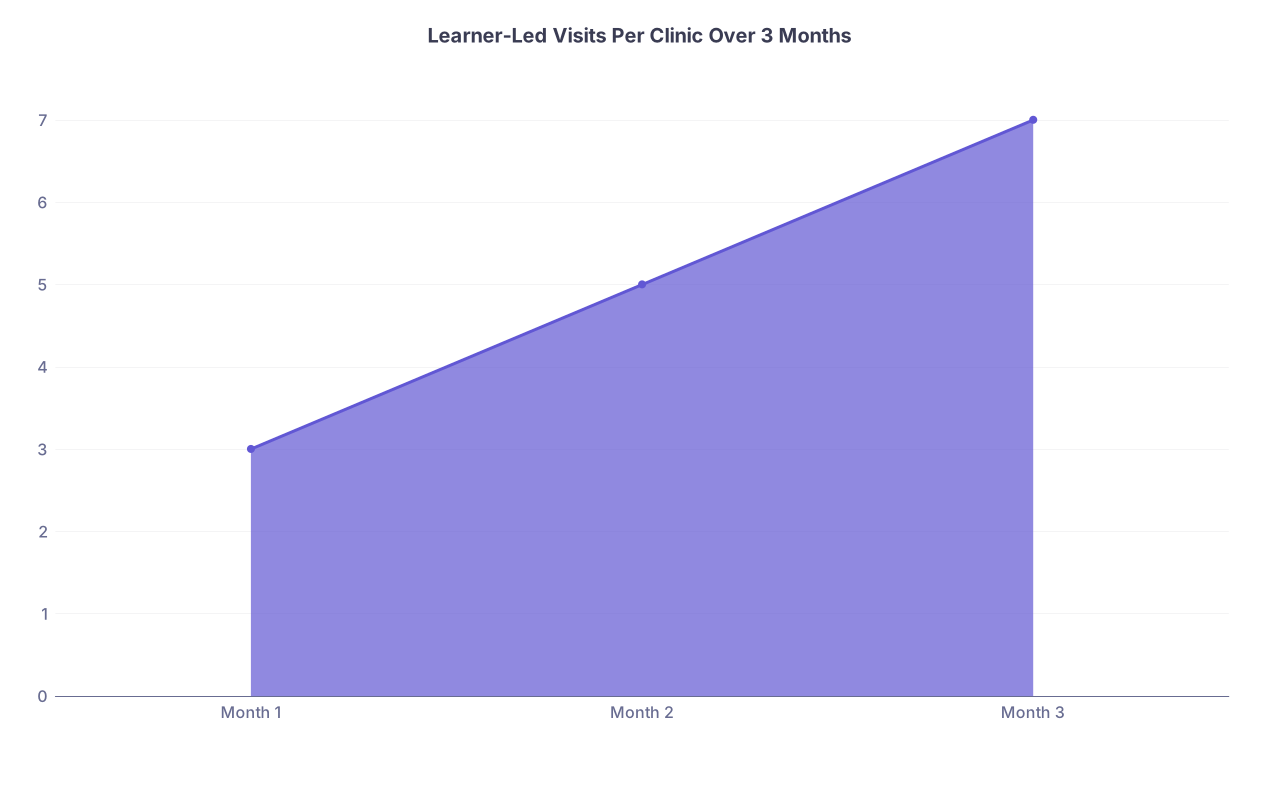
| Category | Value |
|---|---|
| Month 1 | 3 |
| Month 2 | 5 |
| Month 3 | 7 |
You do not need a full educational research project. You just need to know if your blueprint is actually sticking.
Step 8: Different Blueprints for Students vs Residents vs APPs
One size does not fit all. But the structure is identical. You just adjust autonomy and expectations.
| Learner Level | Encounter Ownership | Presentation Focus | Attending Oversight |
|---|---|---|---|
| MS3/MS4 | History, basic exam | Data gathering, one plan | High |
| PGY1 | Full encounter, simple plans | Prioritization, safety | Moderate–high |
| PGY2+ | Full encounter, complex care | Efficiency, risk-benefit | Moderate |
| NP/PA student | Similar to MS4 | Protocols, guidelines | High |
Key move: tell them your expectation day 1. Out loud.
- “As a PGY‑1, I expect you to see 3–4 patients alone this morning, present concisely, and propose a full plan. I will refine it.”
- “As a senior resident, I expect you to identify one patient where I do not need to go into the room; you just staff with me and I co‑sign the note.”
That last one is how you buy back time when you have strong learners. Use them.
Step 9: Train Your Team, Not Just Yourself
You cannot run a teaching clinic if your MAs, front desk, and nurses do not know what you are doing. They will work against your flow without meaning to.
9.1 One 15-Minute Staff Huddle, Once
Gather your front desk, MAs, and nurses. Tell them plainly:
- “On clinic days when I have learners, here is what will look different.”
- “Here is how to know which patients the learner will see first” (e.g., a flag in the schedule, a note on the board).
- “Here is when it is OK to interrupt us because we are behind.”
Then involve them:
- “If the resident is in room 3, please still knock if we are >15 minutes delayed for the next patient.”
- “If a patient seems anxious about being seen by a trainee, let me know before you room them.”
You are building a teaching culture, not just teaching encounters.

Step 10: Script How You Introduce Learners to Patients
Awkward introductions waste time and erode patient confidence. You need a rehearsal-ready script that works in 99% of situations.
Use something like this:
“This is Dr. Patel, a physician in training working with me today. We work as a team on your care. Dr. Patel will start by talking with you and examining you, and then I will join you both so we can make a plan together. You are getting two brains for the price of one.”
If the patient hesitates:
“If you are comfortable, this is part of how we train good doctors and it helps us take excellent care of you. If you prefer just me for today, that is also completely fine.”
You have:
- Affirmed the learner’s role.
- Emphasized team care and benefit.
- Given the patient real choice.
Patients almost always say yes when it is framed this way.
Step 11: Build a Simple Half‑Day Teaching Template
Let me give you a concrete skeleton for a 4‑hour teaching clinic with 12–14 patients. Adjust numbers, but keep the structure.
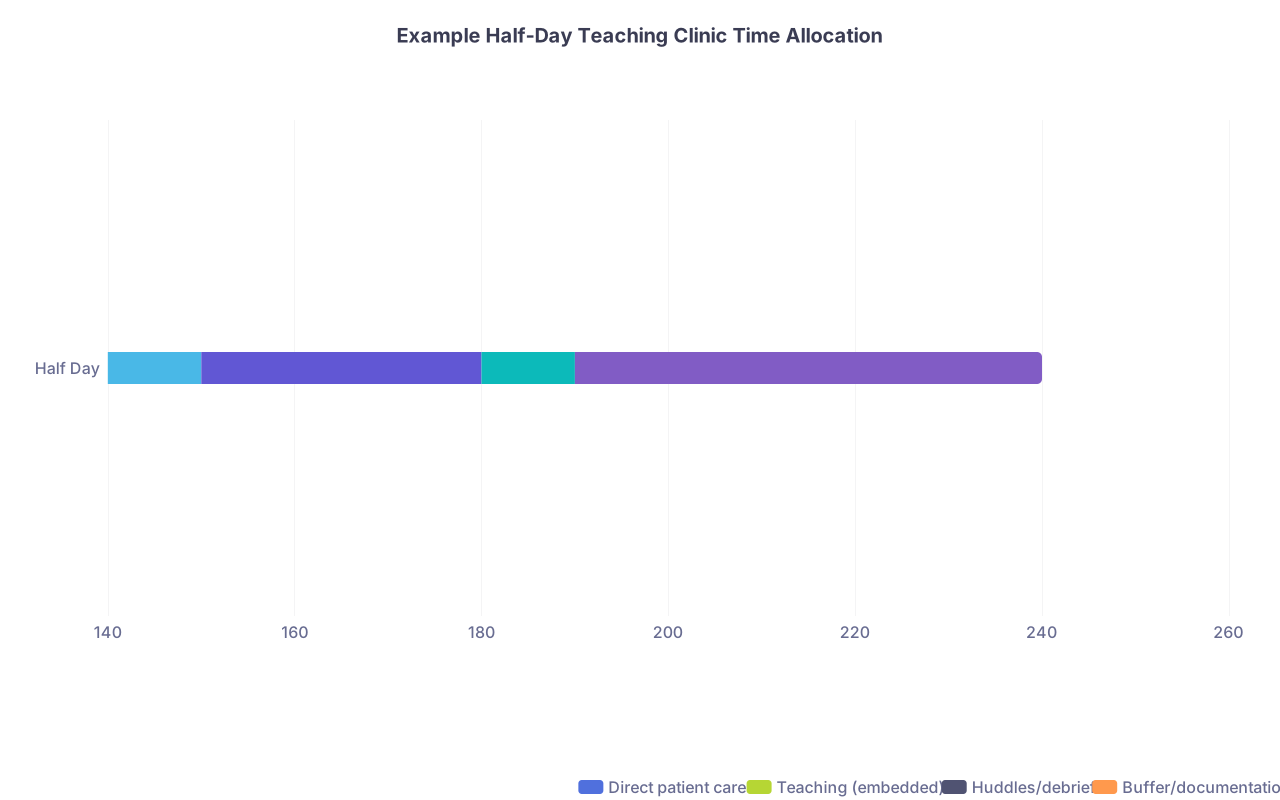
| Category | Direct patient care | Teaching (embedded) | Huddles/debrief | Buffer/documentation |
|---|---|---|---|---|
| Half Day | 150 | 30 | 10 | 50 |
Example:
- 08:00–08:05 – Pre‑clinic huddle with learner
- 08:05–09:30 – 5–6 patients
- 3 learner-first (green/yellow)
- 2–3 attending-led or joint (yellow/red)
- Brief feedback after 1–2 key patients
- 09:30–09:35 – Micro‑debrief and adjust:
- “We are a bit behind. Next 3 patients I will lead more, but you will still present in the room.”
- 09:35–11:15 – 6–8 patients
- Continue mix; use your 15–30 minute behind rule if needed.
- 11:15–11:20 – End-of-clinic 3-minute debrief and next-day goal
- 11:20–12:00 – Documentation buffer (you will still need it)
The difference is that teaching is pre‑planned and structured, not squeezed into random 30‑second bursts.
Step 12: Avoid the Classic Teaching Clinic Failure Modes
You will see these patterns. Stop them early.
The endless case presentation
- Fix: Interrupt kindly. “I am stopping you because I know you have more details, but for clinic you must start shorter. One sentence, then problems.”
The “I don’t know” learner
- Fix: Ban pure “I don’t know.”
- Replace with: “I am not sure, but my best guess is ___ because ___.”
- Praise the attempt, then correct.
The attending who rescues every silence
- Fix: Count to 5 silently after asking “What is your plan?” Let them struggle just a bit.
The learner wandering aimlessly from room to room
- Fix: At the start of each block, assign: “Your first patient is room 2, then 5. Do not pick up another until we staff.”
You doing all the talking in rooms
- Fix: Designate specific tasks:
- “You explain the diagnosis.”
- “You do the med reconciliation.”
- “You counsel on lifestyle changes.”
- Fix: Designate specific tasks:

FAQ (Exactly 2 Questions)
1. How many extra minutes per patient should I expect to spend when I first turn my clinic into a teaching clinic?
Expect an extra 2–3 minutes per learner-led patient in the first 2–3 weeks, especially with junior trainees. That overhead drops quickly once you enforce tight presentation structure and a consistent flow. By week 3–4, most attendings I have worked with are back to baseline throughput, sometimes better, because learners take real work off their plate (med rec, patient education, initial documentation). The key is to cap teaching at the door: 1–3 minutes of focused reasoning per patient, not hallway lectures.
2. What if my institution does not give me any official “teaching time” or credit in my productivity metrics?
Then you design your teaching so it directly supports your productivity: learners pre‑chart, gather history, update med lists, and start notes that you would otherwise do yourself. You also align teaching with quality metrics—hypertension control, diabetes management, screening—so you can document that your “teaching clinic” improves exactly the numbers administration cares about. When you can say, “My clinics with residents have better A1c control and slightly higher throughput because I use them to pre‑work charts,” you have leverage to argue for formal recognition later.
Open your next clinic schedule right now and mark 3 specific patients who will be learner‑led, then plan a 5‑minute pre‑clinic huddle to explain that plan to your trainee. That single change will be your first real step from “too busy to teach” to a true teaching clinic.