
The rotation is not “just having a rough block.” It is failing—and if you do not intervene deliberately, it will keep failing next year too.
You can turn it around in 90 days. But not with another faculty meeting and a pep talk. You need structure, data, and a simple operating system for the rotation.
Here is how to fix it, step by step.
Step 0: Confirm It Is Actually Failing (1 Week)
Before you go into fix-it mode, prove to yourself that this is not just one loud complaint or one weak resident.
You are looking for three kinds of red flags:
Outcome problems
- Below-benchmark exam or in‑training scores for this rotation’s content.
- Remediation rates higher than the rest of the program.
- Repeated clinical safety concerns or near misses tied to this service.
Experience problems
- Consistent low evaluations from learners over multiple blocks.
- Frequent off‑service residents begging not to rotate here.
- Faculty grumbling that “we never get good residents” (translation: the system is broken).
Process problems
- No clear goals or expectations given on day 1.
- Chaotic daily schedule; everyone learns “how things work” by guessing.
- Feedback given once at the end, if at all.
If you see patterns across at least two of those three categories, you are not dealing with a blip. You are dealing with a failing rotation.
Fast data pull (1 week, minimal pain):
- Last 12–18 months of:
- Learner evaluations of the rotation.
- Rotation-specific competency ratings (EPAs, milestones, or local tools).
- Any exam or OSCE mapping to this rotation’s objectives.
- Short, focused conversations (15–20 minutes each) with:
- 2–3 recently rotated learners (ask: “What consistently did not work?”).
- 2–3 core faculty (ask: “If you had a magic wand for this rotation, what would you change?”).
- The chief resident / program coordinator (they see all the pattern failures).
You are not doing a dissertation. You are looking for obvious structural defects.
Step 1: Define the 90‑Day Rescue Mission (Week 2)
You cannot fix everything. Choose 3–5 measurable targets that matter.
Use this constraint: If it does not impact learning quality, safety, or faculty sustainability, it is a second‑order problem. Park it.
A. Choose 3–5 concrete outcomes
Example set for a struggling inpatient medicine rotation:
- Raise mean learner evaluation of “quality of teaching” from 3.1 to ≥ 3.8 / 5.
- Ensure 100% of learners receive documented mid‑rotation feedback.
- Decrease average work‑hour violations by 50%.
- Align at least 80% of teaching encounters with 5–7 clearly defined learning objectives.
Make them visible. Write them on a whiteboard in the team room or in the faculty office. Share them with the rotation director and core attendings.
B. Decide your level of intervention
You have three levers, and you likely need all three:
- Structure – schedules, expectations, checklists, templates.
- People – coaching, role clarity, occasionally removing the wrong person.
- Content – what is taught, how it maps to competencies, and how it is assessed.
If you try to fix only “content” without fixing structure, you will fail. That is the classic mistake. The rotation stays chaotic, just with nicer PowerPoints.
Step 2: Install a Simple Operating System for the Rotation (Weeks 2–4)
Failing rotations almost always share one defect: there is no operating system. Everyone improvises.
You are going to implement one. It does not need to be pretty. It needs to be consistent.
A. Create a one‑page Rotation Blueprint
One page. Not a 23‑page syllabus no one reads.
Include:
- Rotation purpose (2–3 sentences).
- Top 5–7 learning objectives, tied to competencies / EPAs.
- Expectations for learners (punctuality, notes, presentations, handoffs).
- Expectations for faculty (feedback schedule, bedside teaching minimums, supervision rules).
- Daily/weekly structure (see below).
- Escalation path – who to contact for problems.
Here is what that looks like side by side with a traditional “syllabus”:
| Feature | Rotation Blueprint (1 page) | Traditional Syllabus (20+ pages) |
|---|---|---|
| Length | 1 page | 20–40 pages |
| Usability on day 1 | High | Low |
| Clear expectations | Yes | Often buried |
| Daily structure visible | Yes | Rarely |
| Feedback plan explicit | Yes | Sometimes |
Print it. Hand it out on day 1. Email it with the schedule. Tape it to the wall.
B. Fix the daily structure
If the day is chaos, learning is an accident.
You want a predictable backbone. For clinical rotations, that usually means:
- Fixed report/start time (e.g., 7:00 pre‑rounds, 8:00 team rounds).
- Protected micro‑teaching block (10–20 minutes) once per day.
- Standard handoff windows a.m. and p.m.
- Daily check that learning objectives are being met.
Example daily template:
- 7:00–8:00 – Pre‑rounds / data gathering.
- 8:00–10:00 – Bedside / team rounds (aim for teaching during patient care).
- 10:00–12:00 – Orders, discharges, consults.
- 12:00–12:15 – Micro‑teaching: 1 problem, 3 teaching points.
- 12:15–13:00 – Lunch / conferences.
- 13:00–16:00 – Procedures, follow‑ups, new admissions.
- 16:00–17:00 – Handoffs, final questions, quick debrief.
Adjust times as needed, but keep the skeleton.
C. Hard‑wire a feedback protocol
Most “bad rotations” are feedback deserts. Learners flounder for four weeks then get blindsided.
Install a non‑negotiable, calendar‑bound feedback protocol:
Day 1 expectations talk (10–15 minutes):
- “Here is how we work on this rotation.”
- “Here is what I expect of you.”
- “Here is what you can expect of me.”
Day 3–5 check‑in (5–10 minutes):
- “What is going well?”
- “One thing you want more of?”
- “One thing you want less of?”
Week 2 mid‑rotation feedback (15–20 minutes):
- Document it on a 1‑page form.
- Specific behaviors. Clear plan.
Final week summary feedback (15–20 minutes):
- Tie to objectives and milestones.
- Identify next steps.
This can be visually enforced:

| Step | Description |
|---|---|
| Step 1 | Day 1 Expectations Talk |
| Step 2 | Day 3-5 Check in |
| Step 3 | Week 2 Mid Rotation Feedback |
| Step 4 | Final Week Summary Feedback |
You will get resistance: “We do not have time.” The actual problem is not time; it is lack of habit and structure. Block these into the daily template.
Step 3: Attack the Three Usual Failure Points (Weeks 3–6)
Every failing rotation I have seen breaks down on the same three fronts:
- Teaching is ad hoc and misaligned with goals.
- Workload is misbalanced—either crushing or mind‑numbingly idle.
- Faculty are unsupported, underprepared, or mis‑assigned.
1. Standardize the teaching core
You do not need a full curriculum in 90 days. You need a high‑yield spine.
This is where most people overthink. Do less, better.
a. Define 6–10 “must‑teach” topics
Pick topics that:
- Appear frequently in your patients.
- Are mapped to critical competencies or EPAs.
- Historically trip learners up on assessments.
Example for a general pediatrics inpatient rotation:
- Bronchiolitis management.
- Pediatric sepsis recognition and initial management.
- Failure to thrive workup.
- Asthma exacerbation pathway.
- Pediatric pain and fever management.
- Discharge planning and parent communication.
b. Create micro‑teaching scripts
For each topic, prep a one‑page “teaching script” that faculty can use in 5–10 minutes:
- 1–2 clinical vignettes.
- 3–5 key teaching points.
- 1 “try this tomorrow” behavior (e.g., “Tomorrow, you will lead the asthma discharge teaching using the teach‑back method.”).
Put them in a shared folder; print a slim binder for the workroom. Low friction is the goal.
c. Build these into the daily schedule
Require at least one micro‑teaching session per day. That is it. No massive noon conferences. No extra meetings. Just consistent, focused teaching.
Use a simple tally on a whiteboard:
- Monday: ✓ Topic 1
- Tuesday: ✓ Topic 5
- …
If three days go by without a tick mark, you know teaching is slipping.
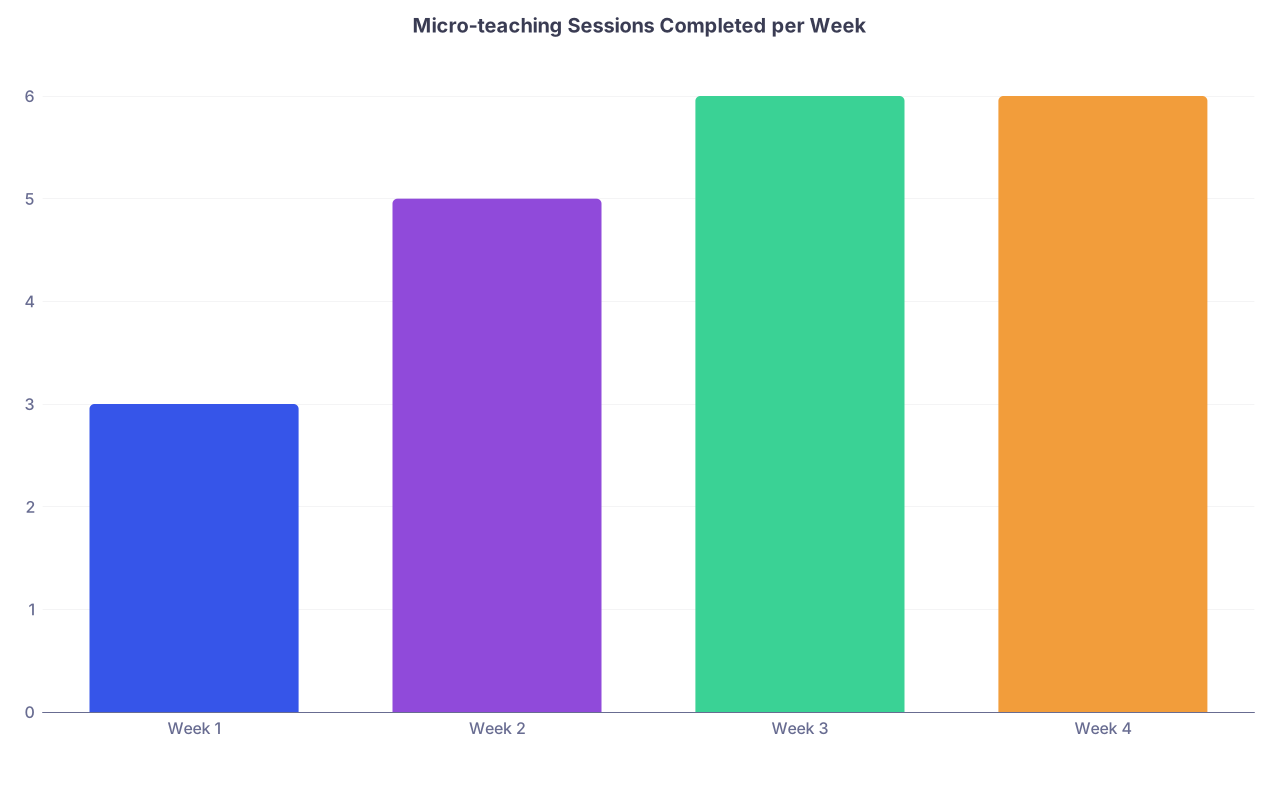
| Category | Value |
|---|---|
| Week 1 | 3 |
| Week 2 | 5 |
| Week 3 | 6 |
| Week 4 | 6 |
Your aim over 90 days: get to 5–6 micro‑teaching sessions per week, every week.
2. Rebalance workload with explicit rules
A failing rotation is usually either a sweatshop or a ghost town. Both kill learning.
You need:
- Clear caps (patients per resident, consults per day, etc.).
- A backup system when volume explodes.
- A plan for low‑volume days.
a. Set and communicate caps
Example for an inpatient service:
- Intern cap: 8–10 patients.
- Resident cap: 12–14 total under supervision.
- No more than 2 new admissions per intern after 20:00.
Put this in the Rotation Blueprint. Share it with bed control, admitting, and the chiefs. If you do not, the hospital will quietly ignore it.
b. Backup systems
When volume spikes:
- Have a “swing” resident or float who can be re‑assigned for 24–48 hours.
- Or, offload some stable follow‑ups to clinics/other teams with clear criteria.
The rotation director should have authority to activate backup. If they must beg three layers of admin, the system will fail under stress.
c. High‑yield plan for slow days
Idle teams drift to phones and TikTok. Learning decays.
Have a default list:
- 1 chart audit or QI micro‑project.
- 1 observed history and physical with immediate feedback.
- 1 simulation or role‑play (e.g., breaking bad news, difficult consult calls).
- Self‑study modules mapped to this rotation’s objectives.
Formalize it: “If census < X by 13:00, we will do one of these three.”
3. Fix the faculty side
Sometimes the rotation is not failing because of “the program.” It is failing because two or three key faculty are burned out, untrained as educators, or outright toxic.
You cannot ignore this if you want a real turnaround.
a. Identify core faculty and expectations
List your core attendings for this rotation. For each, define:
- Number of weeks per year they staff.
- Their explicit responsibilities:
- Give all four feedback encounters per learner.
- Use at least 3 micro‑teaching scripts per week.
- Adhere to caps and schedule structure.
- Respond to learner concerns professionally.
If this is not written, it does not exist.
b. Rapid faculty development (not a 3‑hour workshop)
Faculty do not need another lecture on adult learning theory. They need:
- 30–45 minute practical sessions focused on:
- “How to give formative feedback in 5 minutes.”
- “How to run efficient bedside rounds with teaching.”
- “How to use the micro‑teaching scripts.”
- 1–2 observed sessions with feedback from a peer or the rotation director.
Offer CME credit if you can. Keep it tight and focused.
c. Deal with misaligned faculty
Everyone hopes this step is optional. Often, it is not.
If a faculty member:
- Repeatedly violates work‑hour rules.
- Fails to provide feedback despite support.
- Is consistently flagged in learner evaluations for disrespect, bullying, or unsafe practice.
Then you must:
- Give specific, documented feedback with clear expectations.
- Offer support (coaching, shadowing, reduced weeks).
- If no change, take them off the rotation or limit their involvement.
Leaving one toxic attending on a fragile rotation wipes out most of your structural fixes. I have watched that show too many times.
Step 4: Add Minimal but Real Assessment (Weeks 4–8)
You cannot know if your 90‑day rescue is working without data beyond satisfaction scores.
You need three streams:
- Learner performance.
- Rotation process adherence.
- Experience (but interpreted correctly).
A. Learner performance
Pick 2–3 things that connect to your objectives:
- A brief pre‑/post‑quiz (5–10 questions) tied to the must‑teach topics.
- One observed clinical encounter per learner with a simple checklist:
- Data gathering.
- Clinical reasoning clarity.
- Communication.
- A case presentation rating rubric used consistently.
You are not judging the learner as much as judging whether your rotation actually teaches what it claims.
B. Process adherence
Track a few simple behaviors:
- % of learners with documented mid‑rotation feedback.
- % of days that roughly followed the agreed schedule.
This can be as low‑tech as a clipboard in the workroom. The goal is to see whether your system runs as designed.
C. Experience data (interpreted like an adult)
Learner evaluations are noisy but not useless.
Look mainly at:
- Trends (3–6 months), not single blocks.
- Open comments that repeat:
- “No feedback.”
- “Never knew expectations.”
- “Toxic environment.”
Do not chase one angry comment. Look for patterns.
Step 5: Run the 90‑Day Cycle and Iterate (Weeks 6–12)
By now you have:
- A Rotation Blueprint.
- A daily structure.
- A feedback protocol.
- A teaching spine and micro‑scripts.
- Rebalanced workload rules.
- A faculty plan.
- Basic assessment.
Now you run the rotation through 2–3 full cycles and watch what breaks.
A. Weekly huddles (20–30 minutes)
With rotation leadership (director, key faculty, maybe chief resident):
- Review process metrics:
- Did everyone get feedback?
- How many micro‑teaching sessions?
- Any cap violations?
- Review any early evaluation trends or major incidents.
- Identify 1–2 micro‑adjustments for the next week.
Do not let this become a whine session. Stay laser‑focused on the rotation system, not personalities.
B. Mid‑90‑day checkpoint (~Day 45)
Pull:
- First 4–6 weeks of:
- Learner ratings.
- Pre‑/post‑quiz performance (if you started that early).
- Process adherence data.
Ask three blunt questions:
- What is clearly better?
- What is still broken in a predictable way?
- What did we design that people are completely ignoring?
Then adjust:
- If nobody is using a complicated form, simplify it to half a page.
- If micro‑teaching is not happening because conferences always interrupt, move it earlier or later.
- If caps are constantly exceeded because of external forces, renegotiate with hospital leadership or adjust patient flow.
C. End‑of‑cycle review (~Day 90)
At 90 days, compare against your original targets.
Example:
| Metric | Baseline | 90 Days Target | 90 Days Actual |
|---|---|---|---|
| Teaching quality rating (1–5) | 3.1 | ≥ 3.8 | 3.9 |
| Learners with mid‑rotation feedback | 20% | 100% | 92% |
| Work‑hour violations per block | 6 | ≤ 3 | 2 |
| Micro‑teaching sessions per week | 1 | ≥ 5 | 5.5 |
If you fell short, you do not throw everything out. You refine and run another 90‑day cycle. But usually, if you have been disciplined, you will see at least moderate improvement across all domains and dramatic improvement in 1–2 of them.
Common Pitfalls That Will Derail the Rescue
You are not special; you are going to run into the same traps every other program does.
1. Over‑designing and under‑implementing
People love building the perfect syllabus, elaborate online modules, shiny dashboards.
Then nobody uses them.
Bias toward the smallest, ugliest tool that people will actually use daily. A one‑page Blueprint beats a 30‑page PDF that lives in email purgatory.
2. Letting one vocal faculty member veto everything
There is always someone who says:
- “We cannot standardize; every day is different.”
- “The learners need to toughen up.”
- “I have been doing this for 20 years; the problem is the new generation.”
You listen, then you decide. Rotations are not democracies. If you let the most resistant person govern your change pace, the rotation will rot.
3. Ignoring learner voice beyond numeric scores
Most programs obsess about the 3.4 vs 3.7 mean score and ignore narrative comments.
Learners will tell you exactly what is broken if you ask targeted questions:
- “What part of the day felt like a waste of your training time?”
- “When did you feel most unsafe or unsupported?”
- “What did the best attending on this rotation do differently?”
Collect 5–10 short interviews; you will see patterns almost instantly.
4. Pretending culture is “too hard” to change in 90 days
You cannot rebuild an entire institutional culture in 3 months. But you can absolutely set the tone for one rotation:
- Expectations about respect.
- Zero tolerance for public shaming.
- Prompt response to unprofessional behavior.
One well‑publicized incident handled decisively changes more behavior than 12 policy memos no one reads.
What This Looks Like in Real Life
I will give you a composite case that mirrors what I have seen repeatedly.
A large teaching hospital had a notorious surgical ICU rotation. Residents called it “the black hole.” Evaluations said:
- “No feedback.”
- “Rounds are 5 hours of humiliation.”
- “I learned to avoid asking questions.”
Performance on ICU‑related questions on the in‑training exam was below national mean for three years straight.
They did a 90‑day rescue, focusing on:
- One‑page Rotation Blueprint with clear expectations.
- Rounds capped at 2.5 hours; daily micro‑teaching at 14:00.
- Mandatory mid‑rotation feedback documented.
- 8 core topics with 1‑page teaching scripts (vent settings, shock, sepsis bundles, etc.).
- One attending, widely recognized as toxic, was taken off the rotation for a year of coaching and reduced clinical teaching.
In 3 months:
- Mean evaluation score for “quality of teaching” went from 2.7 to 3.8.
- 95% of residents reported receiving mid‑rotation feedback.
- ICU content questions on the next exam cycle moved to slightly above national average.
- The nickname “black hole” disappeared from off‑hand conversations. No memo. It just stopped being said.
Same hospital. Same physical space. Mostly the same patients. Different operating system.
Your 7‑Day Action Plan to Start the Rescue
If you want to move from theory to action, here is what you can do this week:
Day 1–2: Gather quick data
- Pull last year’s evaluations and any hard performance metrics.
- Do two 15‑minute learner interviews and two faculty interviews.
Day 3: Draft a one‑page Rotation Blueprint
- Purpose, 5–7 objectives, expectations, daily skeleton, feedback plan.
Day 4: Identify 6–10 must‑teach topics
- Start 1–2 micro‑teaching scripts.
Day 5: Meet with rotation director / chiefs
- Present Blueprint and 90‑day target list.
- Agree on caps, feedback schedule, and micro‑teaching requirement.
Day 6–7: Build the minimal tracking tools
- One feedback form.
- One tally sheet for micro‑teaching and caps.
- A simple pre/post quiz if feasible.
Then launch with the next block, and commit to weekly 20‑minute huddles.
FAQ (Exactly Four Questions)
1. What if the main problem is toxic culture, not structure?
You still start with structure, because it gives you leverage. Clear expectations, feedback protocols, and daily routines expose who is misaligned. When you have written standards (“no public humiliation,” “mid‑rotation feedback required”), you can confront toxic behavior with something concrete: “You violated X, which you agreed to.” Without structure, culture conversations dissolve into “he said / she said” and nothing changes.
2. How do I get faculty buy‑in when everyone is already burned out?
Show them what is in it for them: smoother days, fewer crises, less constant remediation. Emphasize that you are simplifying, not adding: one page instead of twenty; one short micro‑teaching instead of a scattered mess of ad hoc teaching. Also, start with the willing 30% of faculty. Once they are seen doing efficient rounds and getting better evaluations with less pain, others usually follow. Peer pressure works faster than top‑down mandates.
3. Do I really need assessment tools like quizzes for a clinical rotation?
You do not need a 50‑question exam. But some objective check on whether learners are actually gaining the knowledge and skills the rotation claims to teach is non‑negotiable if you are serious about rescue. A 5‑question pre/post quiz, a standardized case presentation rubric, or one observed encounter with a checklist is enough to start. It also arms you with data when someone says “But our learners are doing fine” despite every other sign that they are not.
4. What if I am a single faculty member without formal authority over the rotation?
You still have influence. You can:
- Use your own one‑page expectations with learners when you are attending.
- Implement your micro‑teaching scripts and feedback protocol on your weeks.
- Collect your own small set of data (learner comments, pre/post questions) and bring it to the program director or rotation lead.
Often, rotations start to change because one attending quietly proves that a better way of running the service is possible. Your job is not to wait for perfect authority. It is to model a better micro‑system and then use that to push for wider changes.
Open your current rotation schedule and your last set of learner evaluations right now. Identify one structural defect you could correct this month—a missing feedback routine, an unstructured day, or a missing one‑page Blueprint—and start designing the fix today.