The way most clinical rotations “teach” is broken. Not because people do not care, but because everyone is pulling in a different direction with no shared map.
You see it every day: medicine teaches X, surgery reteaches X but differently, pediatrics assumes X is mastered when it is not, and nobody can show you how it all fits together. Students get whiplash. Faculty get frustrated. And your “curriculum” is really just a pile of unrelated experiences with a logo on the front.
Let us fix that.
Below is a concrete, step-by-step playbook to build a coherent curriculum across rotations—one that survives turnover, busy services, and faculty preferences. This is not theory. This is the same structure I have seen work in internal medicine, EM, surgery, and even in small community programs with limited bandwidth.
Step 1: Admit the Problem – And Define It Precisely
Fragmentation is not “we should communicate better.” That is vague and useless.
Fragmentation is when:
- Each rotation invents its own priorities
- No one can show you where core skills are taught, reinforced, and assessed
- Students hear different answers to the same question on different services
- Assessments test things nobody explicitly taught
- Residents are expected to “figure it out” through osmosis
You cannot fix what you have not named. So name what you are seeing with specificity.
Here is the language I use when walking into a department that knows things are messy but cannot quite articulate why:
- “We do not have shared longitudinal learning outcomes across rotations.”
- “We do not have an explicit spiral structure—just random exposure.”
- “We are not mapping teaching to assessment in any systematic way.”
- “No one owns cross-rotation consistency.”
You want leaders to feel the discomfort of those sentences. Then you immediately change gears to solutions: “We can fix this in six to nine months with a small, focused curriculum group and some guardrails.”
Step 2: Build a Compact, Responsible Curriculum Core Team
Do not invite everybody to the first table. That is how you guarantee nothing happens.
You need a small core team that will own cross-rotation coherence. Then you can loop in others at defined checkpoints.
Minimum viable team:
- 1 “clinical curriculum director” (or equivalent)
- 3–5 rotation leads (medicine, surgery, peds, EM, OB/GYN, etc.)
- 1 resident or senior student who has rotated through most core services
- 1 admin / coordinator who can actually track versions, send reminders, and keep the trains running
Their job is not to micromanage each clerkship. Their job is to:
- Set shared program-level outcomes
- Decide what is taught where (and what is not)
- Align assessments
- Create simple tools faculty can actually use on busy days
Give this team a clear mandate and a deadline, for example:
“By December 1, this group will produce:
• A set of 10–15 program-level clinical clerkship outcomes
• A cross-rotation curriculum map for those outcomes
• A shared assessment framework and draft tools
• A one-page teaching guide for each rotation”
If no one is explicitly responsible, fragmentation wins by default.
Step 3: Decide What Actually Matters – Program-Level Outcomes
You cannot have a coherent curriculum if you are not clear about what you are building toward. Most schools drown in 150+ “objectives” that no one reads.
You want 10–15 program-level outcomes that every rotation contributes to. Think in domains:
- Clinical reasoning
- Data gathering
- Patient communication
- Teamwork and handoffs
- Procedures (if relevant)
- Professionalism
- Systems-based practice
- Teaching / feedback (for residents)
Here is a sample set for core clerkships:
- Elicit a focused, hypothesis-driven history and physical.
- Construct and justify a prioritized problem list and differential.
- Present a patient clearly and efficiently in multiple formats (oral, written, handoff).
- Write safe, appropriate orders and basic documentation.
- Communicate diagnoses, plans, and uncertainty in language patients understand.
- Collaborate effectively with interprofessional team members.
- Recognize and respond appropriately to acutely unstable patients (at student level).
- Demonstrate reliability, accountability, and ethical behavior.
- Use evidence and guidelines to update care plans.
- Reflect on performance and integrate feedback into improvement.
These are not rotation-specific. They are your spine. Every rotation touches each of them to different degrees.
Now stop. Before you move on, you:
- Get explicit agreement from all core rotation leads that these are real, non-negotiable program outcomes.
- Get endorsement from your education leadership (DME, clerkship director group, etc.).
If rotations want to add their own objectives, fine. But nobody gets to ignore the shared list.
Step 4: Map Outcomes Across Rotations – Precisely, Not Vaguely
Now you turn abstract outcomes into a concrete cross-rotation map.
Use a simple framework: Introduce – Develop – Reinforce – Assess.
For each of your 10–15 outcomes, decide for every core rotation: will you primarily introduce it, develop it, reinforce it, or formally assess it?
| Outcome | IM | Surgery | Peds | OB/GYN | EM |
|---|---|---|---|---|---|
| Focused history & physical | D/A | D | D | R | R |
| Prioritized problem list & differential | D/A | D | D | R | R |
| Clear oral and written presentations | D/A | D | D | R | R |
| Communication with patients/families | D | D | D/A | D | R |
| Recognize unstable patient | I/D | R | R | R | D/A |
Legend:
I = Introduce, D = Develop, R = Reinforce, A = Primary formal assessment
You will argue about these letters. Good. That argument is the work.
Key rules:
- Every outcome has at least one A (primary assessor) rotation.
- Every outcome appears in multiple rotations, but not everyone is the primary.
- No rotation is the primary for everything. That is how you prevent scope creep.
When you are done, you should be able to answer:
- “Where is clinical reasoning really assessed?”
- “Who owns teaching safe handoffs?”
- “If EM is assessing acute instability recognition, what is medicine’s responsibility?”
Without this map you are guessing. With it, you can start fixing redundancy and gaps.
Step 5: Strip Rotations Down to Their True Teaching Identity
Now look at each rotation through a brutal, honest lens: what is distinctive about what this service can teach?
For example:
- Internal Medicine: diagnostic reasoning, longitudinal management, inpatient systems
- Surgery: pre-op risk, acute abdomen, perioperative care, sterile technique, OR teamwork
- Emergency Medicine: undifferentiated complaints, triage, early stabilization, time-critical decisions
- Pediatrics: developmentally appropriate exams, family-centered communication, dosing and calculations
- OB/GYN: normal vs. abnormal pregnancy, labor management basics, consent under time pressure
You should be able to write 3–5 sentences describing each rotation’s curricular “brand” in plain language a third-year student would understand.
Then do the ruthless work:
- Kill bloated objective lists nobody teaches.
- Align rotation-specific objectives with the shared outcomes and the rotation’s specific strengths.
- Cut the noise so faculty know what to focus on.
For each rotation, build a one-page curriculum snapshot that includes:
- 3–5 key rotation-specific objectives
- Which program-level outcomes they are primary for (A) and which they support (D/R)
- The main settings where learning happens (rounds, OR, clinic, ED)
- The tools faculty should actually use (see below)
If your rotation needs more than one page to explain its teaching plan, you are overcomplicating it.
Step 6: Standardize a Minimal, Shared Assessment Framework
Multiple-choice exams are not your main fragmentation problem. The real fragmentation shows up in:
- Narratives that contradict each other
- Rating scales used wildly differently between rotations
- Students being praised on one service and slammed on another for the same behavior
You fix that by standardizing how you talk about performance across rotations.
Do this:
Create a single institution-wide clinical evaluation form for all core clerkships, built around your program-level outcomes.
- Same domains everywhere: e.g., History/Physical, Clinical Reasoning, Communication, Teamwork, Professionalism.
- Same behaviorally anchored rating scale across all rotations.
Under each domain, list 3–5 concrete behavioral anchors at the performance level you expect by end of clerkships. Use actual phrases people use:
- “Presents patients with a clear assessment and plan rather than reciting data”
- “Anticipates next steps and follows through without needing repeated reminders”
- “Owns mistakes and corrects them promptly”
Train faculty and residents on how to use the same language:
- 30–45 minute calibration sessions by department.
- Show 2–3 example student performances (video or written vignettes).
- Have everyone score them, then discuss differences.
If you skip calibration, your standard form becomes another piece of performative paperwork. If you do it well, students start hearing the same words and expectations across services.
At the same time, align high-stakes assessments:
- Common OSCE stations linked to the same outcomes you assess on the wards.
- NBME or other exams mapped visibly to your outcome set.
- Narrative evaluations structured by shared domains, not free-form rants.
Students should be able to look at any assessment and see: “Oh, they are evaluating the same core things, just in a different context.”
Step 7: Build Micro-Tools For Busy Faculty (Not Wish Lists)
Most “faculty development” fails because it asks already-overloaded clinicians to do more abstract work.
You need to hand them tiny, highly usable tools that plug into existing workflow.
Start with three items per rotation:
Pocket / badge card of rotation teaching priorities
- Front: 3–5 rotation-specific objectives in plain language
- Back: 3 short feedback prompts tied to shared outcomes, for example:
- “Ask them their top 3 problems and why”
- “Have them do the first 2 minutes of a family update”
- “Ask them to write an assessment and plan for one new patient, then review together”
5-minute “micro-teach” scripts
- One-page list of 8–10 quick teaching moves faculty can use between patients:
- “On the next admit, you will lead the H&P; I will only ask questions.”
- “Give me a 60-second one-liner and assessment for this patient.”
- “Walk me through your differential for chest pain starting with what can kill someone.”
Each micro-teach is tagged to program-level outcomes (e.g., #2, #3).
- One-page list of 8–10 quick teaching moves faculty can use between patients:
-
- Short script faculty can use at end-of-day:
- “One specific thing you did well today was…” (linked to an outcome)
- “One specific thing to work on tomorrow is…” (linked to an outcome)
- This might live as:
- Lines on the back of the badge card
- An auto-text in the EMR
- A sticky note template
- Short script faculty can use at end-of-day:
You are not creating more work; you are giving structure to conversations that are already happening chaotically.
Drop an example:
- On IM: “Today I want you to focus on presenting with an explicit prioritized problem list. For each patient, start with ‘My top three problems are…’ and why.”
- On Surgery: “For the next consult, your job is to get a focused history and exam aimed at answering a specific surgical question. We will compare your approach to mine.”
Say this enough times across rotations and you will watch coherence grow without giant new initiatives.
Step 8: Use Data Ruthlessly – And Share It Back
You will not know if you are fixing fragmentation unless you track it.
Start simple. Track:
- Where students feel redundancy vs. gaps (short end-of-rotation survey tied to your shared outcomes).
- Where assessments disagree wildly about the same student.
- Where students consistently underperform on OSCE stations mapped to specific outcomes.
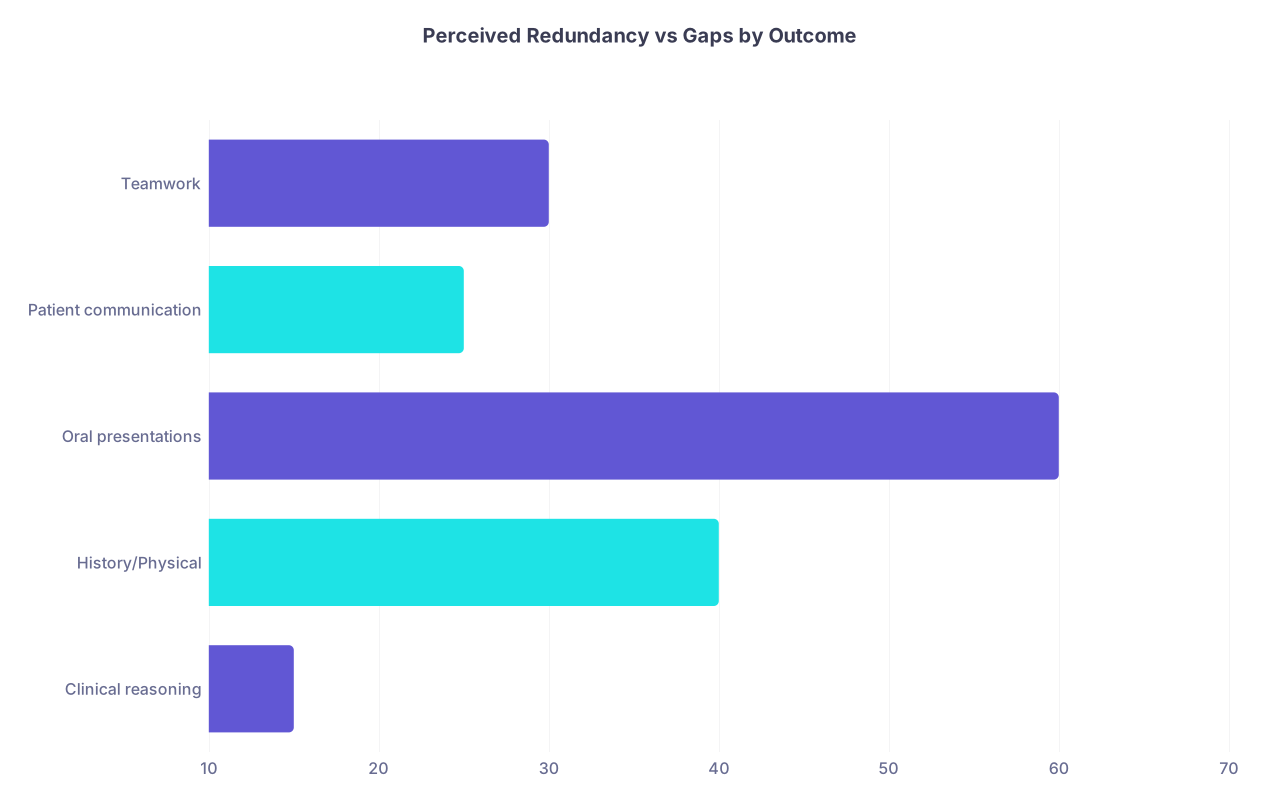
| Category | Value |
|---|---|
| Clinical reasoning | 15 |
| History/Physical | 40 |
| Oral presentations | 60 |
| Patient communication | 25 |
| Teamwork | 30 |
Example interpretation:
- 60% of students say “oral presentations” feel redundant and conflicting across rotations.
- Only 15% say that about clinical reasoning.
So you target presentations first.
Use your evaluation form data:
- Look for outcomes where ratings are inflated on one rotation and harsh on another. That is a red flag for misaligned expectations, not student difference.
- Look for outcomes where nearly everyone is rated “meets expectations” from month 1. Either your scale is broken or you are not challenging students.
Then close the loop:
- Share these patterns with rotation leads in a quarterly 60-minute curriculum huddle.
- Pick one concrete alignment project each quarter:
- “This quarter, we will align how we teach and evaluate oral presentations across IM, Surgery, and EM.”
- “Next quarter, we will standardize expectations for end-of-rotation feedback conversations.”
Avoid giant, vague goals like “improve communication across clerkships.” They evaporate by Monday.
Step 9: Create a Visible, Longitudinal Narrative For Learners
Students experience fragmentation most acutely because nobody shows them the map.
You fix that by making the curriculum visible and longitudinal.
Do three things:
Clerkship Kickoff Session (before core rotations start)
- 60–90 minutes.
- Show them the 10–15 shared outcomes.
- Show the rotation map: “Here is where you will mostly learn, here is where you will mostly be assessed.”
- Use a simple visual with arrows building over time.

Clinical Curriculum Spiral Across Rotations Step Description Step 1 Preclinical Foundations Step 2 Internal Medicine Step 3 Surgery Step 4 Pediatrics Step 5 OB GYN Step 6 Emergency Med Step 7 Clinical Reasoning Outcome Step 8 Presentation Skills Outcome
flowchart LR A[Preclinical Foundations] --> B[Internal Medicine] B --> C[Surgery] C --> D[Pediatrics] D --> E[OB GYN] E --> F[Emergency Med] B --> G[Clinical Reasoning Outcome] C --> G D --> G E --> G F --> G B --> H[Presentation Skills Outcome] C --> H D --> H E --> H F --> H
Rotation-specific orientation slide deck (5–10 minutes)
- Not 40 slides of logistics.
- One slide: “On this rotation, we are the primary teachers of Outcome X and Y. You will get repeated practice on A, B, C.”
Student-facing progress trackers
- Simple checklist or digital portfolio showing:
- Which outcomes they have had feedback on.
- Where they have not yet been observed.
- Encourage them to ask for observation:
“I still need more feedback on my patient communication outcome. Can I do the next family meeting with you watching?”
- Simple checklist or digital portfolio showing:
If students can describe the curriculum in a coherent way, you are winning. If they still describe it as “hoping to see enough stuff,” you are not done.
Step 10: Institutionalize It So It Survives Turnover
This is where most good ideas die. One champion leaves; fragmentation returns.
You prevent that by embedding coherence into your structures, not personality.
Lock in at least these:
A standing “Clinical Curriculum Committee” with:
- Representation from each clerkship
- At least one trainee
- Direct reporting line to the Undergraduate / GME education leadership
- Written charge: maintain, review, and refine cross-rotation outcomes, maps, and assessments annually.
An annual curriculum review cycle:
- Each rotation submits:
- Their one-page snapshot updated
- Any changes to learning activities
- Proposed changes to how they contribute to shared outcomes
- The committee checks for knock-on effects (you cannot just drop being the primary site for an outcome without someone else picking it up).
- Each rotation submits:
Onboarding for new rotation directors that includes:
- The shared outcomes and map
- The standardized evaluation tool
- Expectations for participation in cross-rotation alignment
Formal requirement that:
- Any major change to a rotation (duration, sites, assessments) addresses: “How will this affect our shared curriculum map?”
If coherence is optional, it will lose. You have to make it “how we do business here.”
A Realistic 6–9 Month Implementation Timeline
If you want this done in your lifetime, time-box it. Here is a workable schedule:
| Month | Main Task |
|---|---|
| 1–2 | Form core team, define outcomes |
| 3 | Build cross-rotation outcome map |
| 4 | Rewrite rotation snapshots |
| 5 | Design shared assessment tool |
| 6 | Build faculty micro-tools |
| 7 | Faculty calibration sessions |
| 8–9 | Launch with students + collect data |
Do not stretch this over three years. Momentum will die, and everyone will go back to their silos.
Two Common Pitfalls – And How To Avoid Them
Pitfall 1: Letting Perfect Kill Good
You will be tempted to:
- Over-specify every objective
- Build giant, beautiful curriculum maps nobody uses
- Wait until every clerkship buys in 100%
Resist it.
Aim for a minimum viable coherent curriculum:
- 10–15 shared outcomes
- Simple I/D/R/A map
- One evaluation form
- One page per rotation
Then improve from there every year. Coherence is iterative.
Pitfall 2: Turning This Into a Compliance Exercise
If faculty experience this as more forms, more meetings, more “education-speak,” they will quietly ignore it.
You have to sell the selfish benefits:
- “You will not have to reteach basic skills that should have been covered.”
- “You can give clearer, simpler feedback because students know the expectations.”
- “Your rotation will stop getting blamed for things that are not your responsibility.”
And you must show up in their world:
- Short, targeted workshops built into existing faculty meetings.
- Tools that cut cognitive load, not add to it.
- Early quick wins—like aligning how presentations are taught across just two rotations.
Your First Concrete Move – Do This This Week
Do not “plan to think about this.” That is how it dies.
Here is the specific next step:
Schedule a 60-minute meeting with 3–5 rotation leads and 1 resident, with this agenda:
- On one slide, show a draft list of 10–15 program-level outcomes you think matter across all rotations.
- Spend 25 minutes arguing them into a final list.
- Spend 25 minutes starting an I/D/R/A map for just three of those outcomes across your core rotations.
- End by assigning:
- One person to refine the map
- One person to draft a single, shared evaluation form using those outcomes
Get that on the calendar today. Send the agenda. Attach the draft outcomes.
Once that meeting happens, fragmentation stops being “just how it is” and becomes a problem you are actively, structurally fixing. That is the turning point.