
The jump from “I like teaching on rounds” to “I run the core clerkship” is not magical. It is built, step by step, by people who quietly do the unglamorous work most clinicians avoid.
If you want to be a core clerkship director, you need a plan. Not vibes. Not hoping someone notices you. A deliberate 10-step campaign.
Below is exactly how I would do it if I were starting as a clinician with strong teaching interests and zero formal role.
Step 1: Get Ruthlessly Clear on the Job You Actually Want
Most people who say “I want to direct a clerkship” have a fuzzy picture in their head. That is how careers stall.
You are not aiming for “teach more.” You are aiming for a specific, formal role:
- Internal Medicine Core Clerkship Director
- Surgery Clerkship Director
- Pediatrics Core Clerkship Director
- Whatever your specialty’s required third-year rotation is
Each of those jobs has 3 overlapping components:
Operations
- Build the schedule
- Place students on teams and sites
- Coordinate with GME and hospital services
- Handle emergencies: preceptor quits mid-block, a site loses accreditation, a student fails professionalism
-
- Design clerkship goals and objectives
- Choose or create didactic content
- Build OSCEs, written exams, workplace-based assessment tools
- Ensure alignment with LCME / school competencies, EPAs, and Step/Level requirements
People & Politics
- Manage faculty and residents as teachers
- Run evaluations and feedback
- Sit in education leadership meetings
- Negotiate with department chairs and clinical operations when education collides with RVUs
If you read that list and feel energized instead of exhausted, you are in the right lane.
Two concrete actions in this step:
Identify the current clerkship director in your specialty.
- Look at your med school’s website
- Or ask the UGME (Undergraduate Medical Education) office
Pull the official job description.
- Ask the director or department admin for the actual role description used when hiring/appointing
- Highlight the words that repeat: “assessment,” “LCME,” “evaluation,” “remediation,” “curriculum,” “accreditation,” “interprofessional”
That is your target skill set. You will now reverse-engineer your next 2–4 years to match it.
Step 2: Build Teaching Credibility Where You Already Stand
You will never be given a clerkship if you are mediocre at the frontline teaching most people can see.
So you start by being undeniably excellent at:
- Bedside teaching
- Case-based discussions
- Feedback and assessment documentation
Do not just “be good.” Make it visible and trackable.
Specific moves:
Become the attending everyone wants to rotate with.
- Always know the clerkship’s stated objectives for your rotation block and quote them
- Give students a 5-minute orientation on day one: expectations, how they are evaluated, how to succeed
- Mid-rotation check-in: “Here is how you are doing relative to the form that will be submitted”
Document your teaching. Aggressively.
- Keep a running list of:
- Blocks staffed as attending
- Lectures given (title, audience, date)
- Small groups led
- Save anonymous learner comments from course evaluations in a file
- Keep a running list of:
Fix at least one small, annoying gap.
- Example: Students always arrive to your service confused about how to write consult notes
- You create a 1-page quick guide and a 15-minute orientation
- You share it with the clerkship director: “I noticed this recurring problem and built this. Feel free to use or adapt.”
That last step is not about credit. It is about signaling: “I see systems. I fix systems.”
Step 3: Attach Yourself to the Existing Clerkship Director (Without Being Weird)
You want proximity to the job you eventually want. That means working with the current director long before you think about replacing them.
Do this deliberately.
Ask for a 20-minute meeting.
Script you can adapt:“I truly enjoy teaching on service and I am interested in medical student education as a serious part of my career. I would like to understand your role better and see where I might contribute in a way that actually helps you.”
You are not asking for a title. You are asking how to make their life easier.
In that meeting, ask targeted questions:
- “What are the top 2–3 problems that take too much of your time?”
- “Where do you consistently feel understaffed or unsupported?”
- “Are there specific parts of the clerkship (orientation, OSCEs, remediation) that you would gladly hand off if you trusted someone?”
Volunteer in a narrow, defined lane. Examples:
- Run one recurring small-group series
- Take over part of the orientation
- Help manage mid-rotation feedback compliance
You want to become the default person for something inside the clerkship. Even if it is small.
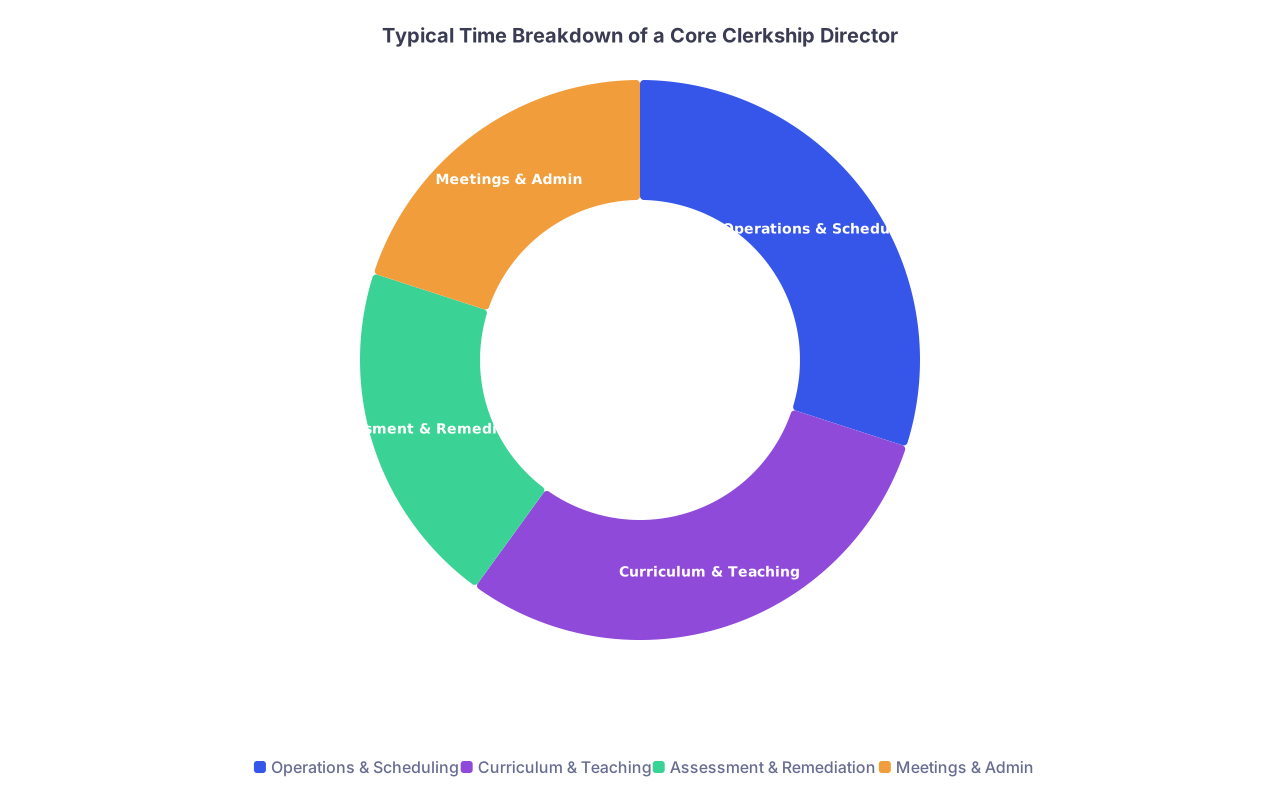
| Category | Value |
|---|---|
| Operations & Scheduling | 30 |
| Curriculum & Teaching | 30 |
| Assessment & Remediation | 20 |
| Meetings & Admin | 20 |
The chart above is rough, but accurate enough: directors are overloaded. Your leverage is taking a slice off their plate and doing it well.
Step 4: Take Ownership of a Chunk of the Clerkship (And Run It Like It Is Yours)
Once you have a foot in the door, you stop thinking like a volunteer. You think like a mini-director for your portion.
Here is a 4-part play:
Choose your domain.
Pick something that:- Recurs every block
- Is operationally annoying
- Has clear deliverables
Examples:
- Physical exam workshop series
- Weekly case conference
- OSCE day logistics and faculty training
- Student orientation for one site or service
Map the process.
Do not wing it from memory. Build the system.- Who needs to be emailed and when?
- What templates do we use?
- What is the “Plan B” if something fails (faculty no-show, room change, AV disaster)?
Document the flow.

Mini Clerkship Component Ownership Process Step Description Step 1 Identify Clerkship Component Step 2 Meet with Clerkship Director Step 3 Define Scope and Goals Step 4 Map Process and Timeline Step 5 Create Templates and Materials Step 6 Run First Cycle Step 7 Collect Feedback and Data Step 8 Refine and Standardize Step 9 Report Outcomes to Director Gather hard data.
- Pre/post learner confidence ratings for your workshop
- Attendance rates before and after you took over
- Timeliness/completeness of evaluations in your area
- Number of last-minute crises prevented because you had a checklist
Report up. Briefly and concretely.
Email every 6–12 months:“Quick update on the exam skills workshops – attendance has risen from 65 percent to 92 percent since standardizing reminder emails and shifting to a flipped format. Attached are summary learner evaluations and the checklist I am using.”
This builds a paper trail that says: “I already run things that look like small clerkships.”
Step 5: Get the Right Educational Credentials (Without Losing Years to a Degree You Do Not Need Yet)
You do not automatically need a full MEHP, MHPE, or M.Ed. to be a clerkship director. Many people burn 2–3 years on degrees before they have any meaningful responsibility. That is backwards.
Do this in stages:
Short, targeted training first. Look for:
- Your institution’s Faculty Development series
- A “Teaching Certificate” program through the medical school
- Workshops on:
- Writing objectives
- Assessment and feedback
- OSCE design
- Remediation
Put these on your CV under “Formal Training in Medical Education.”
National-level programs second. Good examples:
- Clerkship director bootcamps or academies at your specialty’s national meeting
- AAMC’s MedEdPORTAL webinars and resources
- Specialty-specific education tracks (like AAIM’s for Internal Medicine, AAP for Pediatrics, etc.)
Degree programs when it is strategic. Consider a formal master’s (MHPE, MEHP, M.Ed. in Health Professions Education) only when:
- You already have a defined leadership role or very clear path to one
- Your department is willing to fund some or all of it
- The curriculum focuses on:
- Assessment
- Curriculum design
- Program evaluation
- Leadership in education
Otherwise, you are collecting coursework without leverage.
| Option Type | Time Cost | Best Timing | Primary Benefit |
|---|---|---|---|
| Local workshops | Low | Immediately | Practical skills, CV boost |
| Teaching certificate | Moderate | After 6–12 months | Demonstrated commitment |
| National bootcamp | Low | After some teaching | Networking, role insight |
| Formal master’s | High | With leadership role | Long-term career capital |
The mistake I see constantly: early-career clinicians with no formal role but a shiny degree. Then they cannot actually get the job because they lack local political capital and hands-on operational experience.
Do it in the opposite order.
Step 6: Become Indispensable to Students and Residents
Clerkship directors are student-facing. If students do not trust you, you will have an uphill battle every term.
You want your name to appear repeatedly in course evaluations with comments like “approachable,” “clear expectations,” “fair.”
Tactics that actually work:
Be the rare attending who is explicit and honest about evaluation.
- Tell students exactly how the form is structured
- Share what an “Honors” level performance looks like in observable behavior
- Give mid-rotation feedback tied to that language: “Right now you are solidly at ‘Meets Expectations’ in data gathering and borderline in clinical reasoning. Here is what you need to change in the next 2 weeks.”
Respond to student issues fast.
- If a student emails about a preceptor not showing up, reply the same day
- Copy the clerkship admin and director when appropriate, with a proposed solution
- Document patterns of problems so you can fix the system, not just patch the one-off
Be visible beyond your own teams.
- Regularly lecture in core didactics
- Volunteer to lead debriefs after OSCEs
- Attend at least some clerkship-wide meetings, orientations, or wrap-up sessions
Over time, students and residents will view you as “one of the people who actually runs this clerkship,” long before your title says so. That helps when leadership eventually asks, “How will students react if we change directors?”
Step 7: Learn the Unsexy Parts: LCME, Policy, and Assessment Systems
Most aspiring teachers ignore this piece. That is why they stay “great clinician educators” but never get the big jobs.
Clerkship directors live in the land of:
- LCME standards and citations
- Institutional policies on grading, remediation, and professionalism
- Assessment systems (EPAs, milestones, workplace-based tools, OSCE scoring)
Here is how to get fluent without drowning:
Ask to sit on one curriculum or assessment committee.
- Clerkship committee
- Assessment committee
- Promotions or competency committee
Do not just “attend.” Read the materials. Notice how your clerkship is evaluated by the school. Pay attention to repeated complaints or citations.
Shadow one LCME or internal accreditation process.
- When your school does an LCME self-study, ask the clerkship director how your course’s data are prepared
- Volunteer to help pull evaluation reports or summarize comments
- Learn what metrics actually matter:
- NBME or final exam performance
- Duty hour compliance
- Mistreatment reports
- Evaluation return rates
- Student satisfaction scores
Get interested in assessment design.
- Read at least a few key papers or chapters on:
- Workplace-based assessment
- Validity of entrustment decisions
- Rater training
Then practice where you can:
- Help redesign your clerkship’s evaluation form
- Run brief rater calibration sessions with residents before a block starts
- Read at least a few key papers or chapters on:
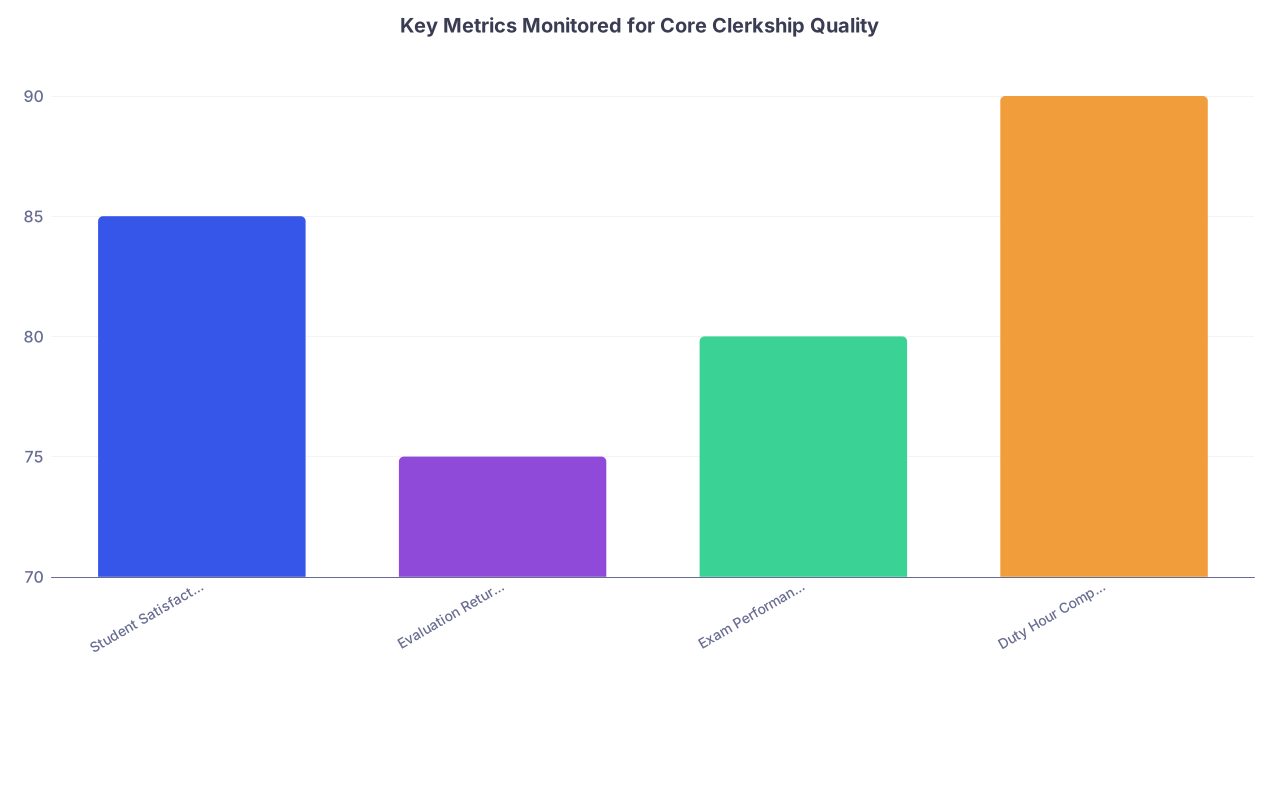
| Category | Value |
|---|---|
| Student Satisfaction | 85 |
| Evaluation Return Rate | 75 |
| Exam Performance | 80 |
| Duty Hour Compliance | 90 |
You want to be the clinician who, in a meeting, can say: “If we change X, here is what might happen to duty hour compliance and student satisfaction.” That is the mindset of a director, not just a teacher.
Step 8: Build a Political and Support Network Before You Need It
You will not become a clerkship director by impressing only one person. You need a small coalition that sees you as the obvious choice when the position opens.
At minimum, you want:
- The current clerkship director
- The department chair or vice chair for education
- The UGME dean or associate dean overseeing clerkships
- A few highly respected clinician educators or APDs in your department
Concrete moves:
Quarterly touchpoints, not random asks.
- Send 1–2 page yearly summaries of your educational activities to your chair and clerkship director
- Brief: teaching hours, initiatives you lead, outcomes, any regional/national presentations
Public wins.
- Present a short clerkship-related quality improvement project at your department or education day
- Example: “Standardizing mid-rotation feedback on the wards increased student satisfaction by 18 percent and improved narrative evaluation quality.”
Be visibly aligned with departmental pain points.
- If residents are burning out from evaluation overload, propose and pilot a streamlined system and show data
- If the chair cares about recruitment, show how stronger clerkship experiences are feeding more high-quality applicants into the residency
Your job is not to be a lone hero. Your job is to be the person who solves problems your leaders care about using the lever of medical student education.
Step 9: Position Yourself as the Next Clerkship Director Without Alienating the Current One
This is the part everyone gets anxious about and then either overplays or underplays.
You need to communicate ambition and respect. Both.
Here is a clean, direct approach:
Have a transparent conversation with the current director.
When there is enough trust (usually after 1–2 years of consistent contributions), say something like:“I want to be candid about my long-term goals. I am very interested in eventually serving as a core clerkship director, whether here or elsewhere. I have really valued learning from how you run this course. If you are open to it, I would like to intentionally develop toward that role under your mentorship. That includes taking on more longitudinal responsibilities and learning the administrative and accreditation side, not just the fun teaching pieces.”
You have explicitly stated your goal. You have also not implied you are after their job tomorrow.
Ask for a development plan, not a title.
- “What would you want to see from someone before you would feel comfortable recommending them as your successor?”
- “Are there components of the role you think I should start shadowing or owning?”
Then actually do those things.
Signal readiness to leadership when timing is right. There are key moments:
- Director hints at stepping down in 1–3 years
- Department starts talking about “succession planning” for educational roles
- A new associate dean for UGME asks who the future leaders are
At that point, a simple email or conversation with the chair:
“I am very interested in being considered when the Internal Medicine Clerkship Director position opens. Over the past three years I have done X, Y, and Z in the clerkship, completed [training], and I am eager to take on full responsibility for the course.”
Short. Direct. You have receipts.
Step 10: When the Role Opens, Act Like a Candidate—Not a Volunteer
If the position is filled by a formal search, treat it like any serious leadership job. If it is informal, behave the same way anyway.
You should already have 80 percent of this built beforehand.
A. Prepare a concrete vision document (2–3 pages, max)
Sections:
Current State Snapshot
- Brief: strengths of the current clerkship
- Acknowledge what is working (no one wants to hear you trash your predecessor)
Priority Areas for Improvement (1–3 only) Examples:
- Create more reliable, structured mid-rotation feedback
- Improve exam performance while maintaining clinical emphasis
- Standardize assessment across sites to reduce grading variability
Specific First-Year Initiatives For each priority:
- One or two specific, achievable changes
- How you will measure success
- What support/resources you will need
Your Preparation
- Summarize your contributions: components you already run, data you have collected, training completed, committees served on
This is not a glossy “strategic plan.” It is a credible, realistic action list.
B. Sharpen your interview story
You need to clearly answer these questions:
- Why you? Why now?
- How will you balance clinical duties and clerkship demands?
- What will you do if LCME dings your clerkship next year?
- How will you handle difficult faculty who do not like students or evaluations?
- How will you respond to student mistreatment concerns?
Think through specific examples from the last few years where you:
- Solved a messy problem with students or preceptors
- Changed a process and measured improvement
- Navigated conflict without burning bridges
C. Negotiate your support upfront
If you act like a martyr and accept the job with no time or support, you will burn out and the clerkship will stagnate. Do not do that.
Before saying yes, be explicit about:
- Protected time (FTE) for the role
- Administrative support (a coordinator who actually exists and has time)
- Access to data and IT support for reports and dashboards
- Budget for faculty development / resident teacher training

You are not being difficult. You are setting the clerkship up to succeed.
Putting It All Together: A Realistic 3–5 Year Timeline
If you execute the 10 steps intentionally, here is what a plausible timeline looks like.
| Year | Focus | Concrete Outcomes |
|---|---|---|
| 1 | Build teaching excellence | Strong evals, small role in clerkship |
| 2 | Own a clerkship component | Run workshop/OSCE/orientation with data |
| 3 | Expand scope, committee work | Committee membership, system improvements |
| 4 | Formal leadership in clerkship | Assistant/associate director role |
| 5 | Step into director position | Official clerkship director appointment |
This does not require political genius. It requires consistency.

| Step | Description |
|---|---|
| Step 1 | Clinician with Teaching Interest |
| Step 2 | High Quality Ward Teaching |
| Step 3 | Small Clerkship Role |
| Step 4 | Own Major Component |
| Step 5 | Committee and Assessment Work |
| Step 6 | Assistant or Associate Director |
| Step 7 | Core Clerkship Director |
Common Ways People Sabotage This Path (And How to Avoid Them)
Let me be blunt about the mistakes I see all the time.
Waiting to be tapped on the shoulder.
Fix: You design your own development plan and explicitly state your ambitions to the right people.Collecting degrees instead of responsibilities.
Fix: Only enroll in long programs once you have or are about to have a leadership role that will benefit from them.Doing invisible work.
Fix: Summarize your efforts and outcomes in short, data-driven updates. Present at local education days. Make sure your chair knows.Clashing with the current director.
Fix: Treat them as a mentor and ally. If you genuinely cannot, consider that you might need to move institutions to advance.Underestimating operations and politics.
Fix: Deliberately lean into scheduling, policies, LCME, and conflict management. That is the price of admission to clerkship leadership.

How to Start This Month
If you have read this far and want something to do now, here is a simple 30-day plan:
- Email the current clerkship director in your specialty to request a short meeting about how you can contribute.
- Commit to one specific improvement on your current service related to student experience (orientation, feedback process, a mini-teaching curriculum).
- Register for one faculty development session related to teaching, feedback, or assessment.
- Start a simple tracking document of every educational activity you do this year, including dates, topics, and any available feedback.
That is it. You do not need to fix your whole career this month. You just need to stop drifting.

Key Takeaways
- Treat clerkship leadership as a multi-year, intentional build, not a lucky accident. You are reverse-engineering a job description and growing into it piece by piece.
- Own visible, high-impact chunks of the existing clerkship, collect data on what you improve, and make sure the right people see those outcomes.
- Balance educational skills with operational and political competence—LCME, assessment systems, and department priorities are as important as being “a good teacher” if you want the director title.