The way most clinicians “teach on the fly” is broken. If you want learners to actually improve, you need structure. That is exactly what an Objective Structured Teaching Session gives you—and you can build your first one from scratch without a curriculum committee or a grant.
You just need a clear blueprint and the discipline to follow it.
What an Objective Structured Teaching Session Actually Is
Forget the jargon for a second.
An Objective Structured Teaching Session (OSTS) is:
- A set of stations (physical or virtual)
- Each with a precise teaching objective
- A reproducible format (timed, scripted, checklists)
- Usually with small groups rotating through
Think “OSCE energy,” but for teaching instead of assessment. The same DNA:
- Stations
- Standardization
- Clear criteria
- Tight timing
But the goal is learning, not grading.
You are going to build:
- 3–6 stations
- 10–20 minutes each
- Each with a scripted task, a simple checklist, and a short debrief
If you have ever watched residents bounce between different attendings hearing 10 different ways to do the same thing, you know why this matters. The structured session fixes that chaos.
Step 1 – Pick ONE Narrow Skill and Define Success
Most first-time educators blow it right here. They try to cover “management of sepsis” in a single session. That is a lecture, not an objective structured session.
You must pick something tight and behavioral.
Examples that work:
- “Deliver a 3‑minute handover using SBAR for a deteriorating patient.”
- “Counsel a parent on starting inhaled steroids for pediatric asthma.”
- “Write a safe insulin sliding scale order for a type 1 diabetic.”
- “Perform and interpret a focused lung ultrasound for pneumothorax.”
Notice the pattern:
- Clear start and end
- Observable behavior
- A product you can judge (spoken script, written order, exam steps)
Use this 3-question filter
If your topic passes these three, you are good to go:
- Can a complete novice do a “bad version” of this in 3–5 minutes?
- Can an expert do a “good version” of this in 3–5 minutes?
- Can I describe what “good” looks like in a simple checklist of 8–15 items?
If you cannot say yes to all three, your topic is too broad. Slice it smaller.
Write a single session goal
Write it in plain language. One sentence. Non-negotiable.
- “By the end of this session, interns will be able to deliver a structured, concise, and safe overnight handover using SBAR for an acutely deteriorating patient.”
Put it at the top of your planning document. If an idea does not serve that goal, cut it.
Step 2 – Map the Session Skeleton Before Any Content
Do not start writing cases or printing checklists yet. You need a skeleton.
You will choose:
- Total duration
- Number of stations
- Station types
- Group size
For a first attempt, this is the safest template that actually works:
| Parameter | Recommended Starting Point |
|---|---|
| Total Duration | 60–90 minutes |
| Number of stations | 3–4 |
| Learners per group | 3–5 |
| Time per station | 15 minutes (10 work + 5 debrief) |
| Faculty needed | 1–2 (plus possible SPs) |
This gives you enough repetition to make it feel like a true structured session, but not so much complexity that you drown in logistics.
Example skeleton for 60 minutes, 3 stations
- 0–5 min: Brief intro, expectations
- 5–20 min: Station 1
- 20–35 min: Station 2
- 35–50 min: Station 3
- 50–60 min: Group debrief, quick written feedback
Once that spine exists, you can hang content on it.
Step 3 – Design Your Stations: One Job Per Station
Each station gets one clear job. Not two. One.
Say your central skill is “structured overnight handover using SBAR.” Your stations might look like this:
Station 1 – Content selection
Identify what information must be included in an SBAR handover for a given case.Station 2 – Live handover
Deliver a spoken SBAR handover to a “night registrar.”Station 3 – Rescue and repair
Critique and improve a flawed example handover recording or script.
You just decomposed “be better at handover” into 3 concrete, trainable tasks.
Use a simple station design template
For each station, answer these on paper:
- Station name
- Specific objective (what they can do at the end of this station)
- Task description (what they actually do during the station)
- Materials needed (case sheet, timer, checklist, SP instructions, etc.)
- Timing breakdown (e.g., 2 min read, 5 min task, 3 min feedback)
- Assessment/teaching tool (checklist, rating scale, “plus-delta” prompts)
- Debrief script (2–3 key questions, 2–3 key teaching points)
Do this before you get fancy with cases.
Step 4 – Build Cases the Right Way: Backwards
Most people start by writing a long flowery case, then chop pieces out. That is how you end up with 3 pages of irrelevant history and no time left to teach.
You will build cases backwards:
Start with the checklist.
Write down the 8–12 things a competent learner must do or say.Then decide what minimal information they need to be able to do those things.
Only then write the case in 1–2 short paragraphs.
Example – Station 2: Live SBAR handover
A. Write your checklist first
Items might include:
- States patient name, age, location
- States primary problem / reason for admission
- Clearly labels each SBAR section out loud or via structure
- Gives objective vital signs and key labs
- Explicitly states current concern / deterioration
- Gives a clear recommendation or what they are asking for
- Checks back for questions or confirmation
You can expand this, but keep it under ~15 items. You are not building a board exam.
B. Decide what info they need
- Admission diagnosis and brief course
- Current vital signs and trend
- New concerning symptom
- Relevant recent labs and imaging
- What has already been tried
- What they want from the night registrar
C. Now write the case
One tight paragraph. Not a novel.
Step 5 – Standardize With Checklists and Simple Rating Scales
The “O” in OSTS is Objective. You get there with:
- Behaviorally anchored checklists
- Simple global ratings
Do not overcomplicate this. Here is a basic structure that works almost everywhere.
Checklist design rules
- 8–15 items
- Each item is binary: Done / Not done (or Yes / No)
- Each described in observable terms, not vague qualities
Bad: “Communicates clearly.”
Better: “Uses short, complete sentences without trailing off” or “Avoids unexplained jargon; explains acronyms.”
Add a 3–5 point global rating
After the checklist, add:
- 1 – Unsafe / unacceptable
- 2 – Major gaps, needs close supervision
- 3 – Adequate for level, some improvement needed
- 4 – Good, independent with minor guidance
- 5 – Outstanding, model for peers
This lets you:
- Track progress across sessions
- Have something quick to discuss in debrief
- Generate simple data if you want to present this later as an education project
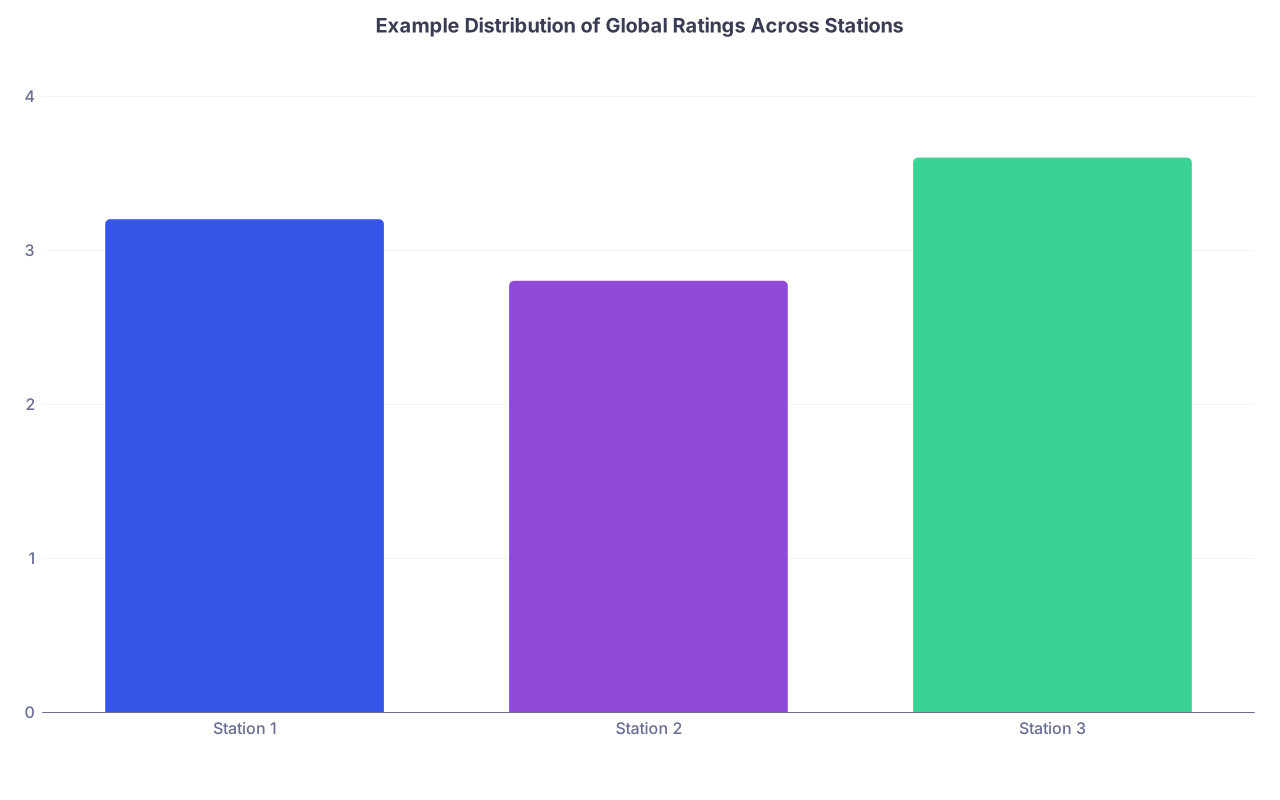
| Category | Value |
|---|---|
| Station 1 | 3.2 |
| Station 2 | 2.8 |
| Station 3 | 3.6 |
(Values here represent average global ratings out of 5 for a pilot run.)
Step 6 – Script the Learner Experience
If you want consistency, you script more than you think.
You will create four micro-scripts:
Opening script (2–3 minutes)
- Why they are here
- What they will do
- How they will be observed
- The ground rules (respect, psychological safety, time discipline)
Example language (steal this):
“Today we are going to work on one thing: safer, more efficient overnight handovers using SBAR.
You will rotate through three stations in small groups. Each station will have a timed task and immediate feedback using a simple checklist.
This is low-stakes—no grades, no impact on your evaluations. The goal is repetition and feedback. I will keep us on time; if I cut you off mid-sentence, that is just the clock, not a judgment.”Pre-brief for each station (30–60 seconds)
- What the task is
- How long they have
- What “product” you expect (spoken handover, written order, etc.)
In-station timing prompts
- “You have 2 minutes left.”
- “Last 30 seconds—wrap up your recommendation.”
Debrief script (3–5 minutes per station)
Use a consistent pattern:- Self-assessment: “What went well for you?”
- Peer observation: “What did you notice that worked?”
- Facilitator feedback: “Here are 2 specific things you did well, and 1 to try next time.”
Step 7 – Plan the Logistics Like You Are Running an OSCE
This is where first-time organizers leak time and credibility. Learners wandering around asking “Where am I supposed to be?” kills the whole vibe.
You will handle four domains: rooms, people, materials, and time.
Rooms
You need:
- 1 room per station if in-person, or
- 1 breakout room per station if online (Zoom/Teams)
Clarity beats comfort. Whiteboard markers matter more than comfortable chairs.
People
Minimum:
- 1 facilitator per “active feedback” station
- 1 timekeeper / coordinator (can be one of the facilitators)
- Optional: 1 standardized patient (SP) for communication/procedural realism
Manageable first run:
- 3 stations
- 2 faculty (one double-covers two lower-intensity stations)
- 1 admin/educational fellow as timekeeper and traffic control
Materials checklist
For each station, list exactly what you need. Paper, electronic, props—everything.
For example:
- Station 1:
- Case handout (x10)
- SBAR template sheets
- Red/green pens
- Checklist copies
- Station 2:
- Stopwatch or visible timer
- Checklist copies
- Name badges (Role tags: “Intern”, “Night Reg”)
- Station 3:
- Pre-written flawed script
- Highlighters
- Printed “improvement guide”
Timing discipline
Use a visible timer on a screen or a cheap kitchen timer. And be ruthless.
- If you constantly “give them another 2 minutes,” you destroy rotation flow.
- End the task when the bell rings. Debrief fast. Rotate.
A simple flow diagram for you or your coordinator:

| Step | Description |
|---|---|
| Step 1 | Intro |
| Step 2 | Round 1 - Station 1 |
| Step 3 | Round 1 - Station 2 |
| Step 4 | Round 1 - Station 3 |
| Step 5 | Round 2 - Station 2 |
| Step 6 | Round 2 - Station 3 |
| Step 7 | Round 2 - Station 1 |
| Step 8 | Round 3 - Station 3 |
| Step 9 | Round 3 - Station 1 |
| Step 10 | Round 3 - Station 2 |
| Step 11 | Group Debrief |
Print a version of this and tape it to the wall.
Step 8 – Train Faculty and Standardized Patients (Briefly but Properly)
You do not need a 2‑hour workshop, but you cannot throw colleagues into this cold.
15–20 minute faculty briefing
Cover:
- Purpose: What this session is for and what it is not for
- Their role: Coach, not examiner. Use the checklist as a teaching tool.
- How to give feedback:
- 2 positives, 1 specific suggestion
- Reference checklist items explicitly
- Avoid global labels (“You’re bad at this”)
Give them:
- Station description
- Case materials
- Checklist + global rating scale
- Debrief questions
Walk them through one mock run if possible. Even 5 minutes helps.
10–15 minute SP briefing (if used)
- Who they are playing (demographics, attitude, basic script)
- How to respond to common learner behaviors
- What to avoid (teaching, giving away answers, improvising new major problems)
You are after standardization, not acting awards.
Step 9 – Run a Micro-Pilot Before Going Live
You do a test dose before giving a new medication. Same idea here.
If you skip this, you will discover problems in front of learners. That is painful.
How to pilot in 30 minutes
- Grab 1–2 colleagues or senior residents.
- Run them through a single station as if they are learners.
- Ask them to:
- Follow all instructions exactly
- Be honest about timing (did it feel rushed? too slow?)
- Comment on clarity of cases and checklists
Watch for:
- Confusing wording in the case
- Items on the checklist that no one can remember to score
- Unrealistic expectations (e.g., 12 tasks in 3 minutes)
Edit ruthlessly after the pilot. Cut anything that does not pull its weight.
Step 10 – Collect Feedback Intelligently and Iterate
You are not just running a one-off session. You are building a reusable teaching tool.
So you measure. A little. Not obsessively.
Simple post-session learner form (5 minutes, 5 questions)
Ask for:
- “How confident are you in [central skill] before this session?” (1–5)
- “How confident are you in [central skill] after this session?” (1–5)
- “Which station was most helpful, and why?”
- “What one thing should we change for next time?”
- “Would you recommend this session to next year’s cohort?” (Yes/No)
Capture this with a QR code and a 1‑page online survey. Do not hand out paper if you can avoid it.
Then look at:
- Confidence shift (1–5 before vs. after)
- Which stations they actually valued
- Recurrent complaints (e.g., “too rushed,” “unclear expectations”)
Use that to refine:
- Timing
- Instructions
- Debrief focus
Over 2–3 cycles, your “prototype” becomes a polished machine.
A Worked Example: Your First OSTS in 60 Minutes
Let me put it all together with a specific clinical example: “Objective Structured Teaching Session – Safe Opioid Prescribing for Acute Pain (Interns).”
Session goal
“By the end of this 60‑minute session, interns will be able to prescribe and counsel safe short-term opioid regimens for uncomplicated acute pain in otherwise healthy adults.”
Skeleton
- Learners: 9 interns
- Stations: 3
- Group size: 3 per group
- Time per station: 15 minutes (8 task + 5 debrief + 2 transition)
- Faculty: 2 attendings, 1 chief resident as coordinator
Stations
Station 1 – Write the order
- Objective: Write a safe opioid prescription (drug, dose, quantity, duration, adjuncts).
- Task: Given a brief ED discharge case with acute ankle fracture, write the discharge orders.
- Tool: Checklist (e.g., avoids long-acting opioids, includes non-opioid analgesics, limits quantity, includes follow-up plan).
Station 2 – Counsel the patient
- Objective: Communicate key safety points to a standardized patient.
- Task: 5-minute verbal counseling on how and when to take the medication, red flags, storage, and disposal.
- Tool: SP + checklist + 1–5 global rating.
Station 3 – Spot the errors
- Objective: Identify unsafe elements in sample opioid prescriptions.
- Task: Review 3 pre-written sample charts, mark unsafe or suboptimal elements, rewrite one correctly.
- Tool: Answer key + structured discussion.
Track average global ratings over time to see if your teaching is actually improving performance:
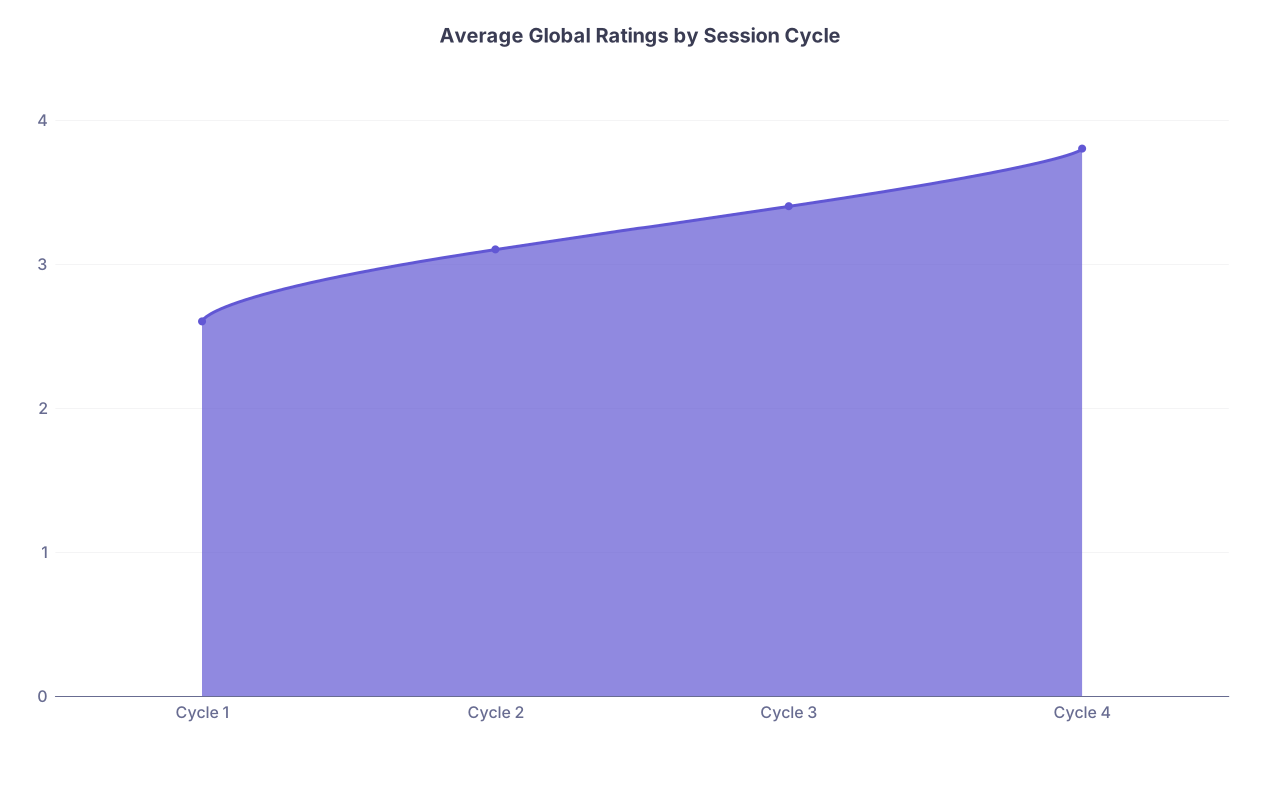
| Category | Value |
|---|---|
| Cycle 1 | 2.6 |
| Cycle 2 | 3.1 |
| Cycle 3 | 3.4 |
| Cycle 4 | 3.8 |
You can present this at a medical education meeting. This is real, publishable curriculum development work once you document it.
Common Pitfalls and How to Avoid Them
You are not the first person to build one of these. I have seen the same mistakes repeat across hospitals.
Here is how to dodge them.
Pitfall 1 – Trying to cover too much
- Fix: Ruthlessly narrow your objective. If you hear yourself saying “and we will also touch on…”, you are already off track.
Pitfall 2 – Stations that are just mini-lectures
- Fix: Every station must involve learners doing something observable. If the faculty talks for 10 minutes straight, you designed it wrong.
Pitfall 3 – Over-engineered checklists
- Fix: Cap at 15 items. If two items always get ticked together, merge them.
Pitfall 4 – No time discipline
- Fix: External timer. Pre-warn faculty you will cut them off if needed. Learners respect tight sessions more than rambling ones.
Pitfall 5 – Untrained facilitators changing the rules
- Fix: Short briefing, written station guide, and explicit request: “Please stick to this structure for this first cycle; you can suggest improvements afterwards.”
FAQs
1. How many stations do I really need for it to count as an “objective structured” session?
Three is the practical minimum if you want it to feel like a true structured rotation rather than just a single skills demo. With three stations, learners experience repetition of the central skill in slightly different contexts, and you can meaningfully compare performance across stations. For a first build, stay between three and four; more than that adds a lot of complexity without much added value until your team has more experience.
2. Do I have to use standardized patients for my first session?
No. SPs are useful for communication-heavy skills, but they are not mandatory. For your first attempt, you can use peer role-play or even faculty playing the “patient” if you keep the scenario simple. I often recommend one SP-heavy station at most in an initial run, with the other stations focused on written products (orders, notes, prioritization lists) that are easier to standardize and score.
3. Can I run an objective structured teaching session online over Zoom or Teams?
Yes, and it can work surprisingly well if you keep the tech simple. Use breakout rooms as stations, create digital checklists (Google Forms or similar) for faculty to complete, and share cases as single-page PDFs or slides. The main adaptations are: shorter stations (10–12 minutes), clear naming of breakout rooms (“Station 1 – Handover,” etc.), and one person dedicated to moving groups between rooms on time.
4. How do I get credit or academic value from building this session?
Document everything from the start: your objectives, station designs, checklists, pilot feedback, and any pre/post or global rating data. After a couple of cycles, you have the bones of a scholarly project: needs assessment, intervention design, implementation, and evaluation. You can present it at your institution’s education day, a specialty conference, or even write it up as an innovation paper. But do not design it to be publishable first—design it to work. The rigor you build in for functionality is the same rigor reviewers look for.
Open a blank document right now and write a single, tight session goal and three station names underneath it. If you can do that in the next 10 minutes, you have already built the backbone of your first objective structured teaching session.