
You are here
You have just opened your end-of-year teaching evaluations.
Your stomach drops.
Comments like:
- “Knows a lot but hard to follow.”
- “Good clinician, but bedside teaching feels rushed.”
- “Slides are too dense. I stopped listening halfway through.”
- “Does not always make expectations clear.”
And of course, the number that matters for promotion and reappointment: 3.7 / 5.0. Your chair wants at least 4.3 next year “to be competitive.” You have 9–12 months before the next promotion packet.
Here is the good news: teaching evaluations are not magic, and they are not random. You can move them. Systematically. In one academic year.
I am going to walk you through exactly how.
Step 1: Diagnose the Problem With Surgical Precision
Most people glance at their evaluations, feel annoyed or vaguely ashamed, then promise to “try harder.” That fixes nothing. You need a structured diagnostic.
1. Sort your data into four buckets
Print or export your evaluations for the last 1–2 years. Sit down with a pen. No laptop distractions.
Mark each comment into one of four categories:
Clarity & organization
- “Hard to follow.”
- “Jumps around.”
- “Objectives unclear.”
Engagement & teaching methods
- “Lectures are dry.”
- “Reads off slides.”
- “Monotone. Hard to stay awake.”
- “Too much content; not enough application.”
Feedback & expectations
- “Not sure how I was doing.”
- “Got feedback only at the end.”
- “Expectations for the rotation unclear.”
Climate & professionalism
- “Sometimes dismissive.”
- “Not approachable.”
- “Seems annoyed by questions.”
You will quickly see a pattern. Most faculty have 1–2 dominant problem buckets. That is where you will focus.
2. Separate signal from noise
Some comments are garbage:
- “Too much work on this rotation” when the workload is standard.
- “Unfair grading” with zero specifics.
Ignore purely affective, content-free complaints. Look for:
- Repetition: same issue mentioned across different learners, months, or courses.
- Cross-level issues: med students and residents saying the same thing.
- Alignment with your own gut sense.
If three students in different blocks say:
- “I never knew what I was supposed to know for the exam,”
you have a clarity/expectations problem.
If residents consistently say:
- “Bedside teaching is rushed; not much teaching during rounds,”
you have a feedback/methods problem, not a personality problem.
3. Benchmark where you stand
You need a baseline number and a realistic target.
| Metric | Below Target | Solid | Strong | Outstanding |
|---|---|---|---|---|
| Mean overall rating (1–5) | < 4.0 | 4.0–4.2 | 4.3–4.5 | > 4.5 |
| % learners rating ≥ 4 | < 70% | 70–80% | 80–90% | > 90% |
| Written comments tone | Mixed/negative | Neutral | Mostly positive | Highly positive |
If you are at 3.6–3.9, a one-year jump to 4.3 is very doable with focused work.
If you are already at 4.3 and want 4.6+, you will need more refinement and consistency, but the same method applies.
Step 2: Build a One-Year Improvement Plan (Not a Vague Intention)
You are not going to “be a better teacher.” You are going to execute a specific improvement protocol.
Break your academic year into three phases:
- Quarter 1 (Months 1–3): Fix clarity and expectations.
- Quarter 2 (Months 4–6): Upgrade methods and engagement.
- Quarter 3 (Months 7–9): Tighten feedback, climate, and consistency.
- Months 10–12: Consolidate, collect data, document improvement.
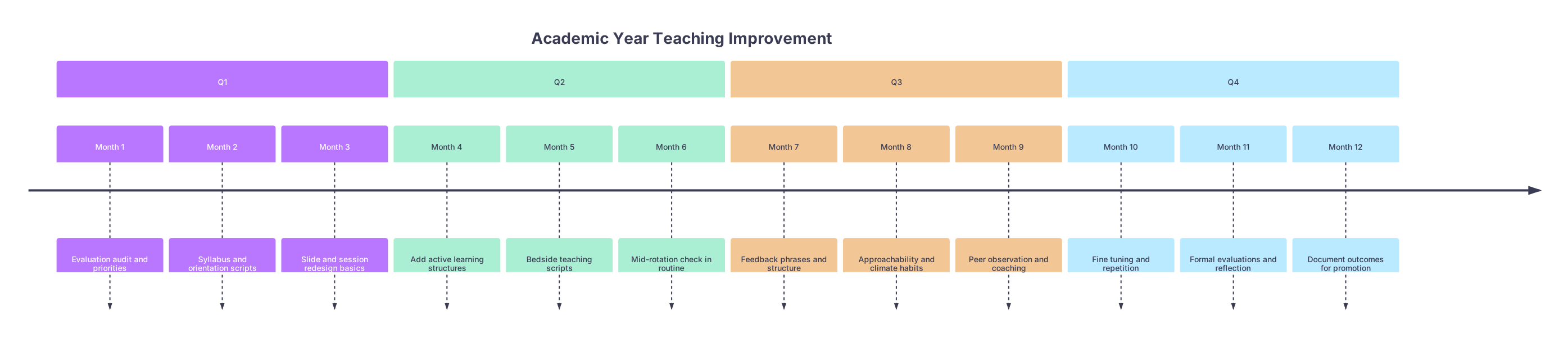
| Period | Event |
|---|---|
| Q1 - Month 1 | Evaluation audit and priorities |
| Q1 - Month 2 | Syllabus and orientation scripts |
| Q1 - Month 3 | Slide and session redesign basics |
| Q2 - Month 4 | Add active learning structures |
| Q2 - Month 5 | Bedside teaching scripts |
| Q2 - Month 6 | Mid-rotation check in routine |
| Q3 - Month 7 | Feedback phrases and structure |
| Q3 - Month 8 | Approachability and climate habits |
| Q3 - Month 9 | Peer observation and coaching |
| Q4 - Month 10 | Fine tuning and repetition |
| Q4 - Month 11 | Formal evaluations and reflection |
| Q4 - Month 12 | Document outcomes for promotion |
You will touch all three major levers of teaching evaluations:
- What learners experience (clarity, organization, fairness).
- How they feel (respected, safe to ask questions, seen).
- How much they believe they learned (perceived learning).
Step 3: Fix Clarity and Expectations in 4 Weeks
If learners are confused about what you want, nothing else will save your scores.
1. Craft a one-page “This is how I teach” document
One page. Not a novella.
Include:
3–5 learning objectives in plain language.
- “By the end of this rotation you will confidently present a new admission using a structured format.”
- “You will be able to start and titrate first-line therapy for common conditions we see on this service.”
Your expectations:
- Rounds start time, pre-round expectations, basic reading.
- How often they should see patients independently.
- How to contact you for questions.
How you evaluate performance:
- What “meets expectations” looks like.
- What “exceeds expectations” looks like, in behavioral terms.
Hand this out on day 1, and post it on the LMS or rotation site.
2. Script your day-1 orientation
Do not wing it. Ten-minute scripted micro-briefing. You can literally read it the first few times.
Structure:
Welcome and framing
- “My job is to get you from where you are now to being safe, thoughtful interns / residents. I am going to be very explicit about expectations and feedback.”
What this rotation / course is for
- “In four weeks, you will be able to independently manage basic ward patients, present clearly, and recognize when you need help.”
Your role as learners
- “You see patients first. You propose plans. I will not be impressed if you say ‘I do not know’ and stop there. I will be impressed if you say ‘I do not know, but I thought about X and Y. Here is my question.’”
How feedback will happen
- “You will get quick feedback most days, and formal mid-rotation feedback in week 2. If you feel like you are not hearing how you are doing, tell me.”
Do this every block. Without fail.
Evaluations climb just from this. Learners equate clarity with quality.
Step 4: Make Your Teaching Sessions Actually Work (Not Just Dump Content)
You cannot rescue bad teaching design with charisma. You need simple, repeatable structures.
1. Redesign one session at a time
Do not try to overhaul 12 lectures in one month. Start with your most visible or lowest-rated session.
For that single session:
- Cut content to 50–60% of what you are currently trying to cover. Yes, you are over-teaching.
- Convert at least 30–40% of time into active work by learners.
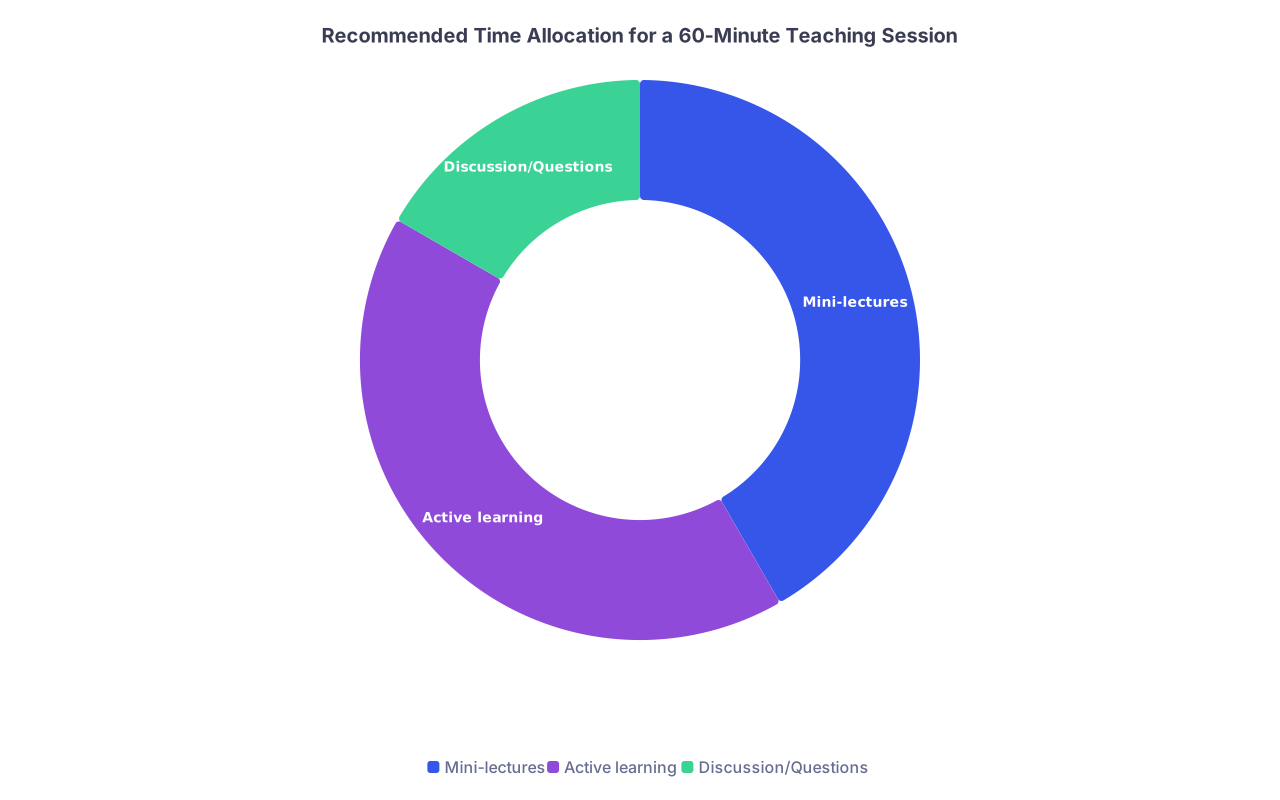
| Category | Value |
|---|---|
| Mini-lectures | 25 |
| Active learning | 25 |
| Discussion/Questions | 10 |
A simple 60-minute structure that works almost everywhere:
- 5 min: Case vignette or hook.
- 10 min: Mini-lecture 1 (key concept).
- 10 min: Small-group or pair work (apply concept to a case or question set).
- 10 min: Debrief and short mini-lecture 2 (clarify misconceptions).
- 15 min: Second case or problem set in groups, with cold call or volunteers.
- 10 min: Summary, “If you remember only three things…” and questions.
You do not need “innovative pedagogy.” You need consistent, basic active learning.
2. Use simple active learning tools
You do not need fancy tech; you need structure.
-
- Ask a question.
- 30 seconds silent thinking.
- 2 minutes sharing in pairs.
- Cold-call 2–3 pairs to share out.
One-slide problems instead of 25-slide theory.
- Show a brief clinical scenario.
- Ask: “What is your next step and why?”
- Force commitment before explanation.
Index cards or polls:
- 2–3 MCQs mid-session using Poll Everywhere, Mentimeter, or paper.
- Show distribution. Discuss why wrong answers are tempting.
Your goal is simple: learners must frequently have to do something with the material.
3. Clean up your slides ruthlessly
Slide sins kill evaluations.
Fix them with three rules:
- One idea per slide. If you have to say “I know this is a busy slide,” you failed.
- Big fonts, minimal text. 24–28 pt text minimum. No dense paragraphs.
- Use visuals and structure. Algorithms, tables, and arrows beat prose.
A quick slide triage system:
- Open your deck.
- For each slide, ask: “Is this essential for the learner to see, or is it my speaker notes?”
- If notes → remove or move to hidden/backup slides.
- If essential → simplify to key bullets or diagram.
Yes, this takes time. Do one lecture per month. Over a year, your teaching portfolio looks completely different.
Step 5: Bedside and Workplace Teaching That Scores Well
Most faculty’s worst evaluations come from clinical rotations, not lecture halls. That is fixable with scripts and micro-structures.
1. Adopt a simple bedside teaching pattern
Use this 5-step pattern on rounds for teaching moments (takes 3–5 minutes):
Set the question
- “In this patient with new atrial fibrillation, the key question is: rate vs rhythm control first?”
Ask for commitment
- “What would you do, and why?” (to the student or intern first)
Probe reasoning
- “Walk me through your logic. What data are you using?”
Teach 1–2 key points
- “Here is how I think about it: In young patients without structural disease, X. In older with comorbidities, Y.”
Check understanding
- “So tomorrow, if you see a 65-year-old with AF and HFpEF, what would you likely recommend and why?”
This does three things evaluations love:
- Shows you care about their reasoning.
- Provides clear, digestible teaching pearls.
- Reinforces that you are systematic, not random.
2. Make expectations explicit on rounds
Before the first patient encounter:
- “For each patient, I will ask you for three things: a focused one-liner, your top two problems, and your primary plan. We will adjust from there.”
And then you actually do that. Patient after patient. The consistency alone boosts perceived structure and fairness.
Step 6: Make Feedback Unavoidable (So They Stop Saying You Never Gave It)
A horrifying number of faculty actually give feedback but learners do not perceive it as such. That kills evaluations.
You fix this by labeling feedback, making it routine, and keeping it small.
1. Adopt daily micro-feedback
Twice a day. Takes 60 seconds.
Morning:
- “Before we start, what is one thing you want to work on today? Presentation structure, differential building, or time management?”
- Learner chooses. You observe with that in mind.
Afternoon debrief:
- “Quick feedback: One thing you did well today is ____. One thing to work on for tomorrow is ____.”
Use the exact phrase “Quick feedback.” Learners then recognize it as feedback.
Concrete examples:
- “One thing you did well today is your clarity in lab interpretation on the pancreatitis patient.”
- “One thing to work on: commit to a plan earlier, even if you are not 100% sure. Say, ‘I would likely do X because Y.’”
2. Schedule a formal mid-rotation feedback conversation
Put it in your calendar for every block: Week 2, Wednesday 1 pm, 10 minutes. Non-negotiable.
Script:
- “We are halfway through. I want to be sure there are no surprises at the end.”
- “Here is where you are meeting expectations: ___.”
- “Here are 1–2 areas I want you to focus on for the second half: ___.”
- “What feedback do you have for me so far? Anything I can do differently to help you learn?”
That last question scares people. Do it anyway. A few benefits:
- It discharges resentment early.
- It gives you real-time corrective data.
- Learners feel heard → they rate you higher. They just do.
Step 7: Fix Climate and Approachability Without Becoming a Camp Counselor
You do not need to be everyone’s favorite attending. You do need to be perceived as fair, respectful, and safe to speak around.
1. Watch your micro-behaviors
Things that tank evaluations:
- Sighing or checking your watch while a student presents.
- Cutting off questions with “We do not have time for that.”
- Sarcastic comments about knowledge gaps.
Replace with:
- “Let us pause there. What do others think?” instead of “No, that is wrong.”
- “We can’t dive deep into that now, but it is an important question. Make a note and we can talk after rounds / later today.”
- “You are not expected to know that yet; you are expected to think out loud. Show me your reasoning.”
Decide on 2–3 replacement phrases and use them until they are automatic.
2. Open every new group with a brief values statement
Example:
- “I do not expect you to know everything. I do expect effort, honesty about what you do not know, and basic professionalism. In return, I will push you, and I will never embarrass you on purpose.”
Learners remember that line about not embarrassing them. It buys a lot of goodwill when you ask hard questions later.
3. Be explicit after a tough moment
If you just corrected someone sharply or had a tense interaction:
- Pull them aside: “I was direct because the situation was serious, but I am not upset with you personally. I want you to be safe and solid with this. How are you feeling about it?”
This 30-second repair can save your evaluation from a burning one-star comment.
Step 8: Get Eyes on Your Teaching (Peer Coaching That Actually Helps)
Trying to fix your teaching in a vacuum is like trying to correct your golf swing without video. You will plateau fast.
1. Pick one trusted colleague to watch you
Preferably:
- Someone with good evaluations.
- Someone who actually teaches, not just someone who talks about teaching.
Invite them:
- “Can you watch one of my teaching sessions / a half-day of rounds and give me 2–3 specific things to change this month?”
Give them a focus, based on your problem buckets:
- “I am working on engaging learners, not just talking at them.”
- “I want you to watch how I give feedback and how I respond to questions.”
2. Use a simple observation tool
Ask them to track:
- How many minutes you talk vs learners talk.
- How often you ask open-ended questions.
- How often you explicitly label feedback.
Then meet for 20 minutes afterwards to review. One or two specific behavior changes per month is plenty.
Step 9: Track Your Progress Like a Quality Improvement Project
If you want a promotion committee to believe you improved, you need data. And you need early warning if you are not improving.
1. Collect brief, mid-course learner feedback
Do not wait until the end-of-year institutional evaluations. Use a 3-question anonymous survey halfway through a rotation or course:
- “One thing that is helping your learning on this rotation / in this course.”
- “One thing that is getting in the way of your learning.”
- “One specific suggestion for me as a teacher for the rest of this block.”
You can do this on paper index cards or an online form. Five minutes, end of a session.
Your job: look for patterns and implement at least one visible change quickly, then tell them:
- “You told me X was not working, so I am changing Y this week.”
Learners feel heard. Evaluations go up.
2. Quantify your behavior changes
For 2–3 weeks at a time, keep a tiny log:
- Number of sessions where you:
- Did a day-1 orientation.
- Used active learning ≥ 30% of the time.
- Gave labeled daily feedback.
- Did a mid-rotation feedback talk.
You are not doing this forever. You are doing it long enough to make new habits normal.
Step 10: Protect Your Time and Sanity While You Improve
You are already stretched. The fastest way to fail is to try to overhaul everything simultaneously.
Here is a realistic, sustainable workload:
| Month Range | Focus Area | Time Investment / Week |
|---|---|---|
| 1–2 | Day-1 orientation + expectations doc | 1–1.5 hours |
| 3–4 | Redesign one key lecture/session | 1–2 hours |
| 5–6 | Bedside teaching scripts + feedback | 30–45 minutes |
| 7–8 | Climate phrases + mid-rotation feedback | 30 minutes |
| 9–10 | Peer observation + fine-tune slides | 1–1.5 hours |
| 11–12 | Collect data + promotion documentation | 1 hour total |
That is it. We are talking 1–2 focused hours per week for 6–8 months, then maintenance.
If you cannot find that, you do not have a teaching problem. You have a workload / boundary problem. Different conversation.
Putting It All Together: A Sample 4-Week Mini-Plan
To make this concrete, here is what the first month could look like if you start next block.
Week 1
- Draft your one-page expectations/learning objectives sheet.
- Write a 10-minute day-1 orientation script and practice it once.
Week 2
- Deliver day-1 orientation to new block.
- Start using the phrase: “Quick feedback: one thing you did well, one thing to work on…” once per day.
Week 3
- Choose one lecture or recurring teaching session.
- Cut content by 40%; add two think–pair–share moments and one short case.
Week 4
- Run a 3-question anonymous mid-block feedback survey.
- Meet with one trusted colleague to schedule a future observation.
If you only did that for one month, your evaluations would start to move. If you repeat this kind of incremental change over an academic year, they shift substantially.
Three Things to Remember
Teaching evaluations are malleable. They respond to specific, visible behaviors: clear expectations, structured sessions, and labeled feedback. You can move your numbers in one year.
Do less, but do it consistently. One cleaned-up lecture, one standard orientation script, and a daily 60-second feedback habit will beat an ambitious but chaotic overhaul every time.
Treat this like a QI project, not a personality makeover. You are adjusting processes, scripts, and structures. Small changes, applied reliably across an academic year, are what get you from “mixed reviews” to “strong teacher” on paper—and in reality.