
Poor learner engagement is not a personality problem. It is a design problem—and you can fix it.
I have sat in too many resident conferences where half the room is on their phones, one person answers every question, and the presenter walks out muttering, “They just do not care.” That interpretation is convenient. It is also wrong most of the time. Medical trainees care a lot. You are just losing them.
This is a practical toolkit for medical educators who want to stop wasting time on dead rooms and start building sessions that residents and students actually lean into.
1. Diagnose the Kind of “Disengagement” You Have
You cannot fix what you have not named. “They are disengaged” is useless. You need a clinical-level differential.
Look around your next session and be brutally specific:
- Are they distracted (phones, laptops, side conversations)?
- Are they silent but attentive (eyes on you, minimal participation)?
- Are they openly checked out (heads down, leaving early, cameras off on Zoom)?
- Are they overwhelmed (glazed eyes during dense content, lots of note-taking but no questions)?
- Are they performing (a few talk a lot, others hide)?
Different problem, different intervention.
Here is a simple diagnostic matrix you can use before you start changing everything:
| Pattern | Likely Primary Cause |
|---|---|
| Phones, side chats | Low relevance, low accountability |
| Silent but listening | Psychological safety, unclear role |
| Glazed, overwhelmed | Cognitive overload, poor scaffolding |
| Few dominate discussion | Structure problem, not enough turn-taking tools |
| Cameras off (online) | Zoom fatigue, lack of interaction design |
Do this once for your teaching portfolio:
- List your main teaching activities (e.g., noon conference, small-group seminars, bedside rounds, journal club).
- For each, write one sentence describing what disengagement looks like there.
- Circle the worst offender. Start your fixes there.
Stop telling yourself “they are just burned out” as a blanket explanation. Burnout is real, but so is bad teaching design.
2. Fix Relevance First: Make Every Minute Clinically Expensive
If adult learners do not see immediate usefulness, they will ration attention. Rightfully so.
Your job is to make disengagement feel more uncomfortable than participation because the content is obviously valuable for their real work.
Quick Relevance Audit
Take a session you already teach and force yourself to answer:
- In the first 60 seconds, do I clearly state how this will:
- Save them time on the wards?
- Help them not miss something dangerous?
- Make exams or boards easier?
- Within the first 5 minutes, do they see a case that looks like what they actually see?
If not, you have a relevance problem. Fix it with these moves.
Protocol: Open Every Session with a “Costly” Case
Day-of implementation:
- Pick a real or slightly modified case where:
- A common mistake is made.
- The consequences are uncomfortable: harm, angry consultant, bad call night.
- In the first minute, say:
- “We are going to talk about X, not because the guidelines changed, but because THIS happened on our service last month.”
- Present the case only up to the critical decision point.
- Ask a specific, concrete question:
- “You are the senior on cross-cover. CT is pending. The nurse calls with new vitals. What is the exact next step you would take and what do you say to the nurse?”
- Make them commit:
- Hand-raising multiple choice.
- Poll on Zoom.
- Short write-down-then-share.
You have now:
- Shown consequence.
- Tied content to identity (“good senior,” “safe doc”).
- Forced early engagement.
Use the rest of the session to build backward:
- “Here is why half of you chose B and why C would keep you out of trouble.”
3. Reduce Cognitive Overload: Shrink the Load, Sharpen the Focus
Medical educators drown learners in information, then complain they are not interactive. If you present 90 slides in 45 minutes, engagement is impossible.
Hard Rule: One Session = Three Takeaways
Not ten. Three.
Write them like this, before you touch PowerPoint:
- “After this session, residents will be able to:
- Recognize X in < 60 seconds from triage note and vitals.
- Order the minimum effective initial workup for Y.
- Call for help early using this specific language.”
Then ruthlessly cut anything that does not feed directly into these three. Background epidemiology that does not change management? Move to pre-work or one summary slide.
Use the 10–2 Microstructure
Humans cannot sustain focused listening for 40 minutes straight, regardless of how “compelling” you are.
Use this structure:
- 10 minutes: mini-lesson or case segment.
- 2–3 minutes: active processing.
That “processing” can be:
- One-minute paper: “Write the one thing you will do differently tomorrow.”
- Think-pair-share: “In pairs, decide how you would explain this to an intern.”
- Quick board work: “Somebody come write the three must-not-miss diagnoses.”
If you are online, same rhythm:
- Use polls.
- Drop a focused question in chat.
- Breakout rooms with a single, clear task and a time limit.
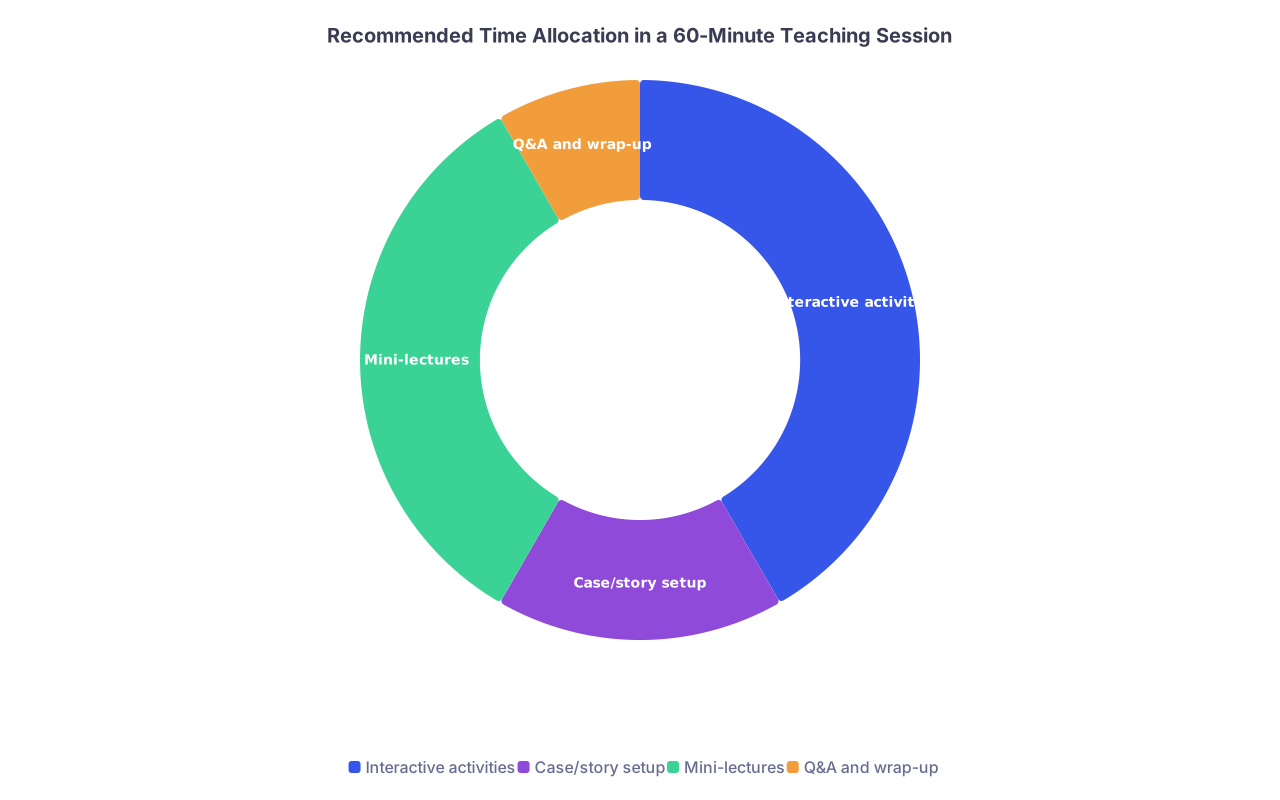
| Category | Value |
|---|---|
| Interactive activities | 25 |
| Case/story setup | 10 |
| Mini-lectures | 20 |
| Q&A and wrap-up | 5 |
You are aiming for at least 40–50 percent of the time in some form of learner activity. If your “activities” are just, “Any questions?” you have not changed anything.
4. Build Psychological Safety without Losing Rigor
Silence is not always disengagement. Often it is fear. Learners are not stupid; they have watched peers get humiliated for wrong answers.
Your job is to create a space where they will risk being wrong. Without turning everything into a feel-good circle where no one can say “That is unsafe.”
Script Your Opening Norms (Takes 90 Seconds)
At the start of a new course, rotation, or recurring conference, say:
- “You will get questions from me that you cannot fully answer. That is deliberate. I am not testing you, I am testing how our system trains you.”
- “Wrong answers are part of the work. If something is dangerous, I will say it clearly. Otherwise, we treat everything as material to refine, not a reason for shame.”
- “If you are not sure, say ‘draft answer’ and we will work with it.”
Then stick to it. When someone is wrong:
- Start with the piece that is right: “Yes, calling early is exactly right.”
- Then add, do not smash: “We need one more step before that so you do not miss X.”
Swap “Pimping” for Structured Questioning
Cold-calling random people with “What’s the dose of…” is lazy teaching. You can keep questioning and pressure without humiliation.
Use a protocol like this during rounds or small group:
- Ask a question that has multiple reasonable answers.
- Give thinking time: “Take 20 seconds and write down your best guess.”
- Then call: “Jordan, read yours.”
- Ask others: “Who got something different?”
- Compare answers to the standard, not to each other.
This:
- Normalizes differences.
- Reduces the “spotlight” on a single person.
- Converts questioning into collective problem-solving.
On Zoom, same idea:
- Have everyone type answers in chat but not hit enter.
- Say “3, 2, 1, send.”
- Then walk through a few, grouping themes.
5. Stop Lecture-Only Teaching: Use Simple, Repeatable Active Learning Structures
You do not need to redesign your entire curriculum into problem-based learning. You do need a small toolkit of active structures you can use tomorrow.
Here are four that actually work with residents and attendings, not just undergrads.
1. Commit–Discuss–Reveal (for Clinical Decision Points)
Use when you have a key management choice.
Steps:
- Pose a clear decision: “You are on night float. Do you admit this patient to ICU or floor?”
- Give options (A/B/C). Have them commit individually (hands, poll, index cards).
- In pairs or trios: “Convince your partner your answer is better.”
- Then reveal the evidence/your reasoning.
Why it works:
- People defend what they have already chosen.
- Peer discussion exposes reasoning gaps without you lecturing for 20 minutes.
2. “Teach the Intern” (for Prioritization and Simplification)
Use near the end of content.
Steps:
- Assign each small group a microtopic (e.g., “initial workup,” “disposition criteria,” “when to call surgery”).
- Task: “Create a 2-minute teaching script you would give a new intern at 3 a.m.”
- Timebox: 5–7 minutes.
- Each group presents. You refine and correct in real time.
This forces:
- Synthesis.
- Translation from guideline-speak to usable language.
- Identification of what actually matters under time pressure.
3. “Worst Case First” (for Safety and High-Yield Thinking)
Use when learners anchor on common benign diagnoses.
Steps:
- Present complaint: “35-year-old with abdominal pain.”
- Ask: “Name the single worst thing this could be that you cannot miss.”
- List 3–5 on the board.
- Work through: “What in the H&P would help us rule these down? What test changes your management fastest?”
You are rewiring their default from “What is most likely?” to “What could kill them?”—which is exam- and practice-relevant.
4. Rapid-Fire Error Review (for Engagement in Morbidity & Mortality, QA)
Instead of a long narrative:
- Pre-identify 3–5 micro-errors from recent cases (communication, diagnosis, handoff, documentation).
- Put each on a slide: just the moment of error.
- Ask:
- “What did we believe that was wrong at this moment?”
- “What system made this belief reasonable?”
- “What is one tiny change that would have prevented it?”
This keeps attention because:
- Each case segment is short.
- They are analyzing, not passively absorbing.
6. Design for Online and Hybrid Reality, Not 2010
If your approach to Zoom teaching is “share slides, talk, ask if any questions,” you are essentially running a radio show and hoping people stay off email. They will not.
Do not overcomplicate this. Use three core tools well: polls, chat, and breakout rooms.
Minimal Online Engagement Setup
For any 45–60 minute online session, plan:
- 3–5 polls (commitment + temperature checks).
- At least 1 breakout activity with a tightly defined task.
- Chat prompts every 8–10 minutes.
Example template:
Minute 0–5:
- Cold-open clinical scenario.
- Poll: “What would you do first?”
Minute 5–15:
- Short teaching segment.
- Chat: “Type one pitfall you have seen with this.”
Minute 15–25:
- Breakout rooms (3–4 per room) with a case and a 2-question task.
- You post the questions in chat and broadcast halfway reminders.
Minute 25–35:
- Debrief 2–3 groups.
- Clarify, correct, highlight.
Minute 35–50:
- Second teaching segment with another poll midway.
- “On a scale of 1–5, how confident are you managing X now?”
Minute 50–55:
- Wrap with three key takeaways in chat.
- Ask each learner: “What will you try this week?”

| Step | Description |
|---|---|
| Step 1 | Cold-open clinical case |
| Step 2 | Poll - initial decisions |
| Step 3 | Mini lesson 1 |
| Step 4 | Chat prompt |
| Step 5 | Breakout rooms with task |
| Step 6 | Group debrief |
| Step 7 | Mini lesson 2 |
| Step 8 | Poll - confidence check |
| Step 9 | Key takeaways and commitments |
If cameras must be off (night shifts, large groups), then your polls and chat are non-negotiable. They are your only visible engagement.
7. Use Accountability That Is Fair, Explicit, and Baked In
You cannot demand engagement while signaling that it does not matter if they engage or not. No grades, no attendance checks, no feedback? They will do the math.
You need light-touch accountability mechanisms that respect adults but make disengagement noticeable.
Options That Work in Clinical Education
Entry Tickets
- 3-minute pre-session task: a 3-question quiz or “What is your biggest question about X?”
- You review patterns and explicitly address them early in the session.
Exit Tickets
- One question: “Name one thing you will do differently this week and where.”
- You skim after and open the next session: “Last week, 70 percent of you said you would change your approach to Y. Who actually tried it?”
Rotating Roles in Small Groups
- Assign: talk-timer, scribe, spokesperson, evidence-finder.
- Rotate weekly. Now students are not just “participants,” they have roles that require attention.
Micro-Assignments Linked to Real Work
- Example: For residents on wards, after an EBM teaching session:
- “Before tomorrow, pick one patient and write a one-sentence clinical question and your answer with 1–2 references. Email or post in the shared doc.”
- Then you highlight 2–3 in the next session (with permission).
- Example: For residents on wards, after an EBM teaching session:
Accountability is not punishment. It is telling learners, “This matters enough that we are going to expect something observable from it.”
8. Measure Engagement Like You Would Any Other Clinical Outcome
Most educators claim they want better engagement but never actually check if their changes work. You should treat your teaching like QI.
Here is a simple engagement dashboard that does not require a PhD in education research.
| Domain | Metric Example |
|---|---|
| Participation | % of learners speaking at least once |
| Interaction | Number of polls/chat prompts per session |
| Attendance | Show-up rate vs. roster |
| Preparation | % completing pre-work |
| Perception | 1-question rating on relevance |
Implementation:
- Before changes, run 2–3 sessions as usual and quickly log:
- How many people spoke at least once.
- How many interactive elements you used.
- Attendance.
- After implementing 2–3 of the toolkit strategies, track the same for the next 4–6 sessions.
- Add one micro-survey at the end of each session, anonymous:
- “On a scale of 1–5, how useful was this for your actual work this week?”
- Optional: “One thing that made this session better than typical” (or “worse”).
Review monthly. Adjust. Just like you would with CLABSI rates or readmissions.
9. A 4-Week Fix Plan: From Dead Room to Active Learning
If you like structure, here is a straightforward 4-week upgrade path for a recurring teaching series (noon conference, weekly seminar, etc.).
Week 1: Baseline and Micro-Changes
- Do the disengagement diagnosis for this session.
- Implement:
- Cold-open clinical case with consequence.
- One structured active element (Commit–Discuss–Reveal).
- Start logging your simple engagement metrics.
Week 2: Cognitive Load and Safety
- Rewrite session objectives into three concrete takeaways.
- Cut 20–30 percent of slides or content that does not support those takeaways.
- Add:
- 10–2 rhythm (mini-lesson + quick activity).
- Opening norms about wrong answers and “draft thinking.”
Week 3: Structure Group Work
- Plan one 10–15 minute small-group activity that uses:
- Clear roles.
- A product (script, checklist, one-slide summary).
- Use “Teach the Intern” or “Worst Case First” as your pattern.
- Add an exit ticket question.
Week 4: Online / Hybrid Optimization
- If online, implement:
- Minimum 3 polls.
- One breakout with a very tight prompt.
- Chat prompts every 8–10 minutes.
- If in person, simulate this with:
- Show-of-hands mini-polls.
- Turn-and-talk every 10 minutes.
By the end of 4 weeks, you will have:
- Shortened and sharpened your content.
- Baked in relevance, safety, and accountability.
- Concrete data that things have improved (or where they have not).
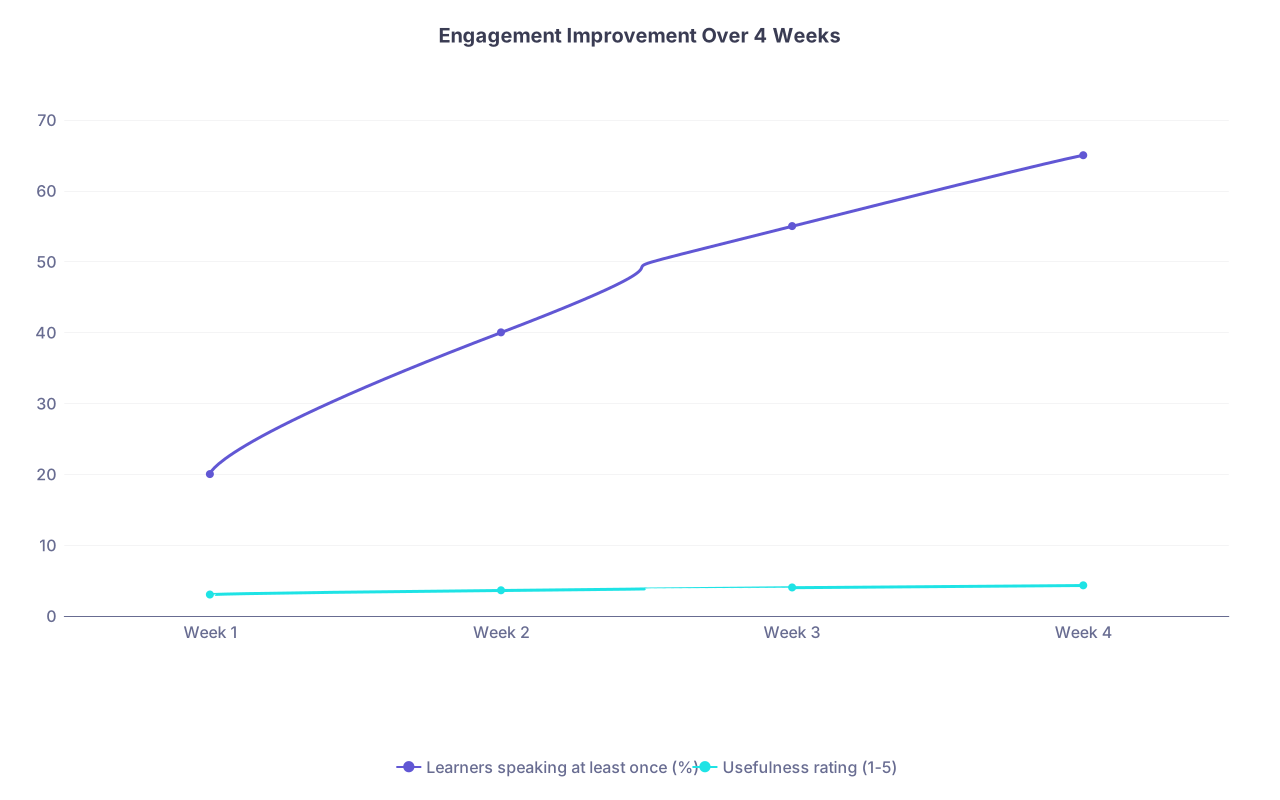
| Category | Learners speaking at least once (%) | Usefulness rating (1-5) |
|---|---|---|
| Week 1 | 20 | 3 |
| Week 2 | 40 | 3.6 |
| Week 3 | 55 | 4 |
| Week 4 | 65 | 4.3 |
Is this exact curve guaranteed? Of course not. But if those numbers do not move at all after these changes, the problem is usually structural (scheduling, institutional culture), not your session design.
10. Protect Your Own Bandwidth and Sanity
One last point that most “engagement” conversations ignore: if you are exhausted, resentful, or overbooked, your teaching will feel like an afterthought. Learners will respond accordingly.
Do three things to protect yourself:
Create Reusable Templates
- Build one high-quality case with all the elements (cold open, decision points, “worst case first” list, “teach the intern” task).
- Use that as a skeleton for other topics rather than reinventing the wheel every time.
Stop Over-Preparing Slides
- cap yourself: 1 hour of slide making per 1 hour of teaching.
- Put extra time into thinking through questions and activities instead.
Ask for Structural Support
- If your teaching session is habitually scheduled at 12:00 with pager coverage unclear, you will lose half the room to calls.
- Push for protected time, clear coverage plans, and leadership backing that participation is expected.
You are allowed to set boundaries. High engagement does not mean you martyr yourself for your learners.
You can turn disengaged, glassy-eyed learners into active participants without becoming an entertainer or blowing up your curriculum.
Remember three things:
- Engagement starts with design, not charisma. Shorten the content, sharpen the relevance, and build in interaction every 10 minutes.
- Psychological safety and accountability are not opposites. You need both if you want honest participation and follow-through in real clinical work.
- Treat your teaching like clinical practice. Diagnose the problem, apply targeted interventions, and track simple outcomes until the room changes.
You are not stuck with dead rooms. You just need better tools—and now you have them.