
You’re an MS3 on surgery call. It’s 11:30 p.m., your pager is finally quiet, and you catch yourself doing something dangerous: enjoying teaching the new MS3 how to tie knots more than closing the skin yourself.
You like explaining. You like watching the lightbulb go on. And you’re starting to think, “How do I make this my actual job? Like…assistant professor, real contract, protected teaching time, office with my name on the door.”
Here’s the blunt truth: people do not “fall into” academic teaching jobs. The ones who land them have been quietly building toward that role for 8–12 years. You can either wander and hope, or you can run a deliberate, year‑by‑year plan.
Let’s do the second one.
Big Picture: Your Teaching Career Timeline
From MS3 to Assistant Professor, you’re looking at roughly this arc:
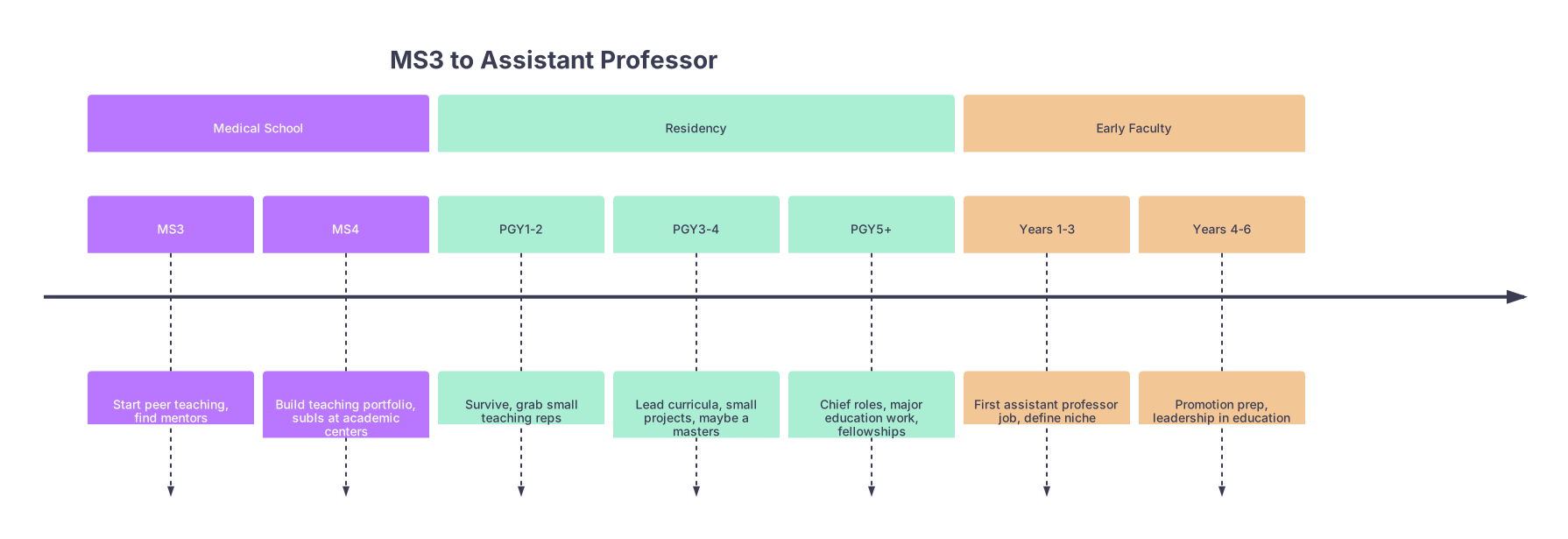
| Period | Event |
|---|---|
| Medical School - MS3 | Start peer teaching, find mentors |
| Medical School - MS4 | Build teaching portfolio, subIs at academic centers |
| Residency - PGY1-2 | Survive, grab small teaching reps |
| Residency - PGY3-4 | Lead curricula, small projects, maybe a masters |
| Residency - PGY5+ | Chief roles, major education work, fellowships |
| Early Faculty - Years 1-3 | First assistant professor job, define niche |
| Early Faculty - Years 4-6 | Promotion prep, leadership in education |
At each point, you should be doing exactly two things:
- Getting better at teaching
- Getting receipts that prove it (titles, evaluations, outputs, degrees)
We’ll go year by year. Assume a “standard” path (4 years med school, 3–5 years residency, optional fellowship). Adjust the labels for your specialty, but the sequence stands.
MS3–MS4: Laying the Foundation
MS3: Realizing You Actually Like Teaching
At this point you should:
Say out loud you’re interested in med ed.
Not in some vague “I like academics” way. Tell people: “I’m interested in a teaching‑focused career.” Say it to:- Clerkship directors
- Residents who obviously like teaching
- The one attending who runs the M3 didactics and actually cares
Grab every low‑stakes teaching rep you can.
Things that count:- Tutoring MS1/2 in anatomy, physiology, or systems blocks
- Leading review sessions through student orgs (SNMA, AMSA, specialty interest groups)
- Teaching simple procedures to classmates on skills day
Track all of it in a running document: date, role, audience, approx. hours.
Start watching teachers like a hawk.
On rounds, in small group, in the OR:- What did that senior do that made you suddenly “get” heart failure?
- Which noon conference made time fly instead of inducing coma?
- Who uses the whiteboard well? Who asks good questions?
You are building your internal “teaching playbook.” Good future faculty notice this stuff early.
Collect your first feedback.
After you run a tiny teaching session, email the faculty coordinator:- “If you have any feedback on my session, I’d really appreciate 1–2 lines. I’m hoping to build a career in medical education.”
Screenshot or save anything even mildly positive.
At the end of MS3, you should have:
- 2–5 documented teaching activities
- 1–2 faculty who know you’re serious about teaching
- A simple Word/Google doc titled “Teaching Portfolio – [Your Name]”
MS4: Converting Interest to a Track Record
Fourth year gives you time. Do not waste it on 7 “advanced electives” that are just vacation with a badge.
At this point you should:
Choose rotations that signal “future educator.” Not just high‑yield for boards. High‑yield for a teaching career:
- Sub‑I at your home academic department (where you might eventually work)
- A rotation with the clerkship director or program director
- Teaching electives (anatomy TA, clinical skills precepting, OSCE examiner roles if allowed)
Formalize teaching roles.
Look for official titles like:- “Clinical Skills Teaching Assistant”
- “Anatomy Prosector/Teaching Fellow”
- “Peer Tutor – Cardiology Block”
These look much better on a CV than “sometimes helped friends before exams.”
Do one small education project.
Example scale that actually fits MS4:- Create a 1‑hour M3 shelf review session and collect pre‑/post‑session confidence surveys
- Develop a quick reference handout for your rotation and survey a few students
- Help a faculty member revamp a single workshop
Turn the findings into a poster at your med school education day or a regional meeting.
Write a teaching‑focused personal statement paragraph.
Not “I like teaching.” Concrete:- “As an MS4, I co‑led weekly small‑group exam reviews for MS2 students and helped redesign the anemia case discussion. My long‑term goal is an academic career with a focus on undergraduate medical education.”
Get explicit letters mentioning teaching.
When you ask for LORs, say:- “If you’re willing, I’d be grateful if you could comment specifically on my teaching skills and potential for a career in medical education.”
By the time you submit ERAS, you should have:
| Component | Target Level by MS4 End |
|---|---|
| Documented teaching | 5–10 small activities |
| Formal roles | 1–2 titled positions (TA, tutor) |
| Education project | 1 small project, ideally a poster |
| Mentors | 2–3 faculty in your chosen specialty |
Residency PGY1–PGY2: Survive First, Then Teach
Intern year is chaos. You will not run a longitudinal curriculum while cross‑covering 60 patients. But you still build toward assistant professor.
PGY1: Micro‑Teaching and Reputation
At this point you should:
Be the resident students want to work with.
That means:- You explain your thought process on rounds
- You ask them questions that are challenging but not humiliating
- You give them 2 minutes of feedback daily (“Tomorrow, focus on…”)
Word gets back to the program. Programs notice. I’ve seen residents get pulled into formal teaching roles purely because students kept naming them on evals.
Say “yes” to manageable teaching invites. Typical PGY1‑level asks:
- Lead 1‑2 didactics for MS3s on your service
- Facilitate a problem‑based learning (PBL) case once a month
- Run an intern‑led EKG or ABG review for students
Take 1–2. Not 10. You’re still an intern.
Keep expanding your teaching portfolio document.
After each teaching session:- Log date, topic, audience, duration
- Save any slide decks or handouts
- Download any evaluations from the med school system
Tell your program leadership your long‑term goal.
Short email to APD or PD:- “I’m interested in a future academic career with a focus on teaching and curriculum development. If there are small-scale opportunities appropriate for a PGY1, I’d love to participate when time allows.”
By the end of PGY1, your only real teaching deliverables:
- Solid reputation with students
- A few logged sessions
- One faculty who knows this is your thing
PGY2: First Real Responsibilities
You now know where the bathrooms are and how to triage pages. Time to step it up.
At this point you should:
Own a recurring teaching role.
Examples:- Monthly small group leader for MS2 clinical reasoning course
- Standing lecturer for an M3 rotation orientation or shelf review
- Co‑facilitator of simulation sessions with faculty
Recurring is the keyword. It shows commitment and allows improvement over time.
Start one contained education project.
Nothing massive. Think 6–12 month timeline:- Improve an existing lecture by introducing active learning and measure satisfaction
- Build a brief “student survival guide” for your rotation and track usage
- Create a structured intern‑to‑student feedback tool and pilot it on one service
Present it locally: department grand rounds (education focus) or hospital education day.
Learn basic education science.
You can’t call yourself a future med educator and know zero about:- Learning objectives (good vs garbage)
- Assessment basics
- Feedback models (Pendleton, ask‑tell‑ask, etc.)
Minimum:
- Take a free online course or internal workshop series
- Read 3–5 foundational papers (your med ed office probably has a list)
Start collecting phrases for your future educator CV.
You want bullets that look like:- “Facilitated monthly small groups for 16 second-year medical students in clinical reasoning.”
- “Co-developed and delivered a new interactive workshop on acute chest pain for MS3 students; improved session ratings from 3.4 to 4.2/5.”
Write in that style now so your CV reads like someone already acting as junior faculty.
Residency PGY3–PGY4(+): Becoming “That Teaching Resident”
Here’s where you separate from everyone who “likes teaching” but never built anything.
At this point you should:
Lead something, not just participate.
Leadership‑level roles:- Resident director/leader of a recurring course or series
- Chief resident for education (in some programs, a formal role)
- Organizer of an intern teaching curriculum
Upgrade your education project to scholarship.
The minimum bar for scholarship:- A structured curriculum or innovation
- Data (even small‑n satisfaction or knowledge pre/post)
- Presentation outside your institution
Aim for:
- Regional SGIM, APDIM, SAEM, PAS, etc.
- Or a med education conference (e.g., COMSEP for peds, STFM for family)
Consider formal training (certificate or degree).
Look at options like:
Common Graduate Med Ed Paths Program Type Typical Timing Duration Goal Teaching Certificate PGY2–PGY4 Months Core skills, minimal time MS in Med Education Late residency/fellowship 1–2 yrs Deeper theory & research MPH with Ed Focus Fellowship/early faculty 1–2 yrs Broader academic profile You do not need a master’s to get an assistant professor job. But it helps, especially if you want leadership in education.
Get on committees. Carefully.
Good committees:- Medical school curriculum committee
- Clerkship or residency education committee
- Assessment or simulation committees
Bad committees:
- Anything with 12 subcommittees and zero deliverables
Pick ONE serious committee where you will actually do work and meet people who hire future faculty.
Refine your niche.
By now, you should be drifting toward specific areas:- Level: UME (med students) vs GME (residents) vs CME
- Modality: Simulation, bedside teaching, curriculum design, assessment
- Content: Your specialty, professionalism, communication, procedural skills, etc.
You don’t need to lock this in, but your activities should start to rhyme.
Senior Resident / Chief / Fellow: Final Prep for Faculty
These are the years when people start asking, “So where are you going to be faculty?”
At this point you should:
Hold a recognized “education” title if possible. Examples:
- Chief Resident for Education
- Resident Scholar in Medical Education
- Simulation Fellow (if your specialty has it)
- Formal fellowship in medical education (EM, IM, peds, etc.)
Produce at least one substantial, name‑attached product. Things that get attention in hiring meetings:
- A curriculum used by your med school or residency every year
- A simulation scenario suite
- An assessment tool or OSCE station bank
- A published med ed paper (even short form: innovation report, research brief)
Stack your med‑ed CV sections properly.
By the end of training, your CV should have:
- “Teaching Activities” – multi‑page, clearly organized
- “Curriculum Development” – with your role and scope
- “Educational Leadership” – roles and dates
- “Education Scholarship” – presentations, posters, publications
If your “Teaching Activities” section is 3 lines, you’re not ready for a teaching‑heavy assistant professor role. Keep building.
Network with education leaders where you want to work.
Do this at least a year before you need a job:- Email clerkship directors and vice chairs for education when you present at conferences: “I enjoyed your session on X – I’m finishing residency next year and looking for education‑focused positions. Would you be open to a brief conversation about career paths at your institution?”
- Ask your PD and mentors to connect you with their education colleagues elsewhere.
The hiring conversations for real education jobs often start quietly, long before HR posts anything.
Transition to Assistant Professor: The Job Hunt (Year 0)
You’re now finishing residency or fellowship. Time to convert all that slow, deliberate work into a position.
At this point you should:
Target the right kind of job.
You’re looking for:- Academic medical centers with significant medical student or resident presence
- Departments that actually value teaching (ask residents privately)
- Job ads that mention:
- “Significant role in medical student education”
- “Protected time for curriculum development”
- “Assistant professor, clinician‑educator track”
Read job ads like a skeptic.
Many ads claim they “value teaching” but are 90% service with 10% lip service. Watch the balance:

Time Allocation in Early Faculty Roles Category Value Clinical 65 Teaching 25 Admin/Scholarship 10 In reality, early faculty often land around something like the above. You want a position where teaching is explicitly part of your FTE, not just “of course we all teach.”
Prepare a teaching‑heavy application package. You need:
- CV with strong teaching, curriculum, leadership, scholarship sections
- Teaching statement (1–2 pages)
- Optional but powerful: A short teaching portfolio with 2–3 examples (slides, curriculum outline, evaluation summaries)
Your teaching statement should not be philosophy fluff only. Include:
- What you’ve actually taught
- How your teaching changed across training
- Your specific interests (e.g., “simulation for acute care decision‑making”)
Expect a teaching audition.
Many places will ask you to:- Give a 30–45 minute talk to students or residents
- Run a case‑based discussion
Treat it like a job talk:
- Clear objectives
- Interactive elements
- Timing tight
- Evaluation forms if they provide them (they often do)
You want people in the room walking out saying, “We need this person.”
Ask the right questions on interview day.
Do not ask, “Do you value teaching?” Everyone says yes. Ask:- “How is teaching effort measured and rewarded here?”
- “Who currently leads the MS3 clerkship curriculum? How could a new faculty member get involved?”
- “What proportion of your recent promotions have been on a clinician‑educator or teaching track?”
- “Is there protected time for curriculum development, and how is it funded?”
Take notes. Vague answers usually mean vague support.
Early Assistant Professor Years 1–3: Acting Like the Educator You Claimed to Be
You signed. You have a badge with “Assistant Professor” on it. Now you prove the department did not make a mistake.
At this point you should:
Get clarity on expectations immediately.
First month:- Meet with vice chair for education, clerkship/residency directors, and your section chief.
- Ask: “By the end of year 1 and year 3, what should I have accomplished to be considered successful as a clinician‑educator here?”
Write their answers down. Build your plan around those.
Choose a small set of core teaching roles and do them extremely well. Examples:
- Consistent small‑group precepting every block
- Longitudinal teaching in a specific course (e.g., clinical reasoning, OSCE prep)
- A recurring residency conference you own
Depth beats breadth. The promotion committee cares more about a clear narrative than 27 disconnected one‑offs.
Align your scholarship with your day job.
Every teaching role is potential scholarship if you:- Define a specific problem
- Change something
- Measure something
- Share it (presentation/publication)
That’s it. Do not invent separate “research” that has nothing to do with your actual teaching.
Get on the right promotion track.
Many institutions distinguish:
- Tenure track
- Clinician‑scholar track
- Clinician‑educator track
For a teaching‑heavy career, you almost always want some version of clinician‑educator. Ask explicitly which criteria you’ll be judged on and get a copy of them in writing.
Keep your teaching portfolio current.
Once a year:- Update your list of activities
- Collect global teaching evaluations and summarize them in 1–2 charts
- Add new curricula, handouts, OSCE stations as artifacts
By the time you go up for promotion, you want a clean, pre‑assembled package.
Early Assistant Professor Years 4–6: Positioning for Promotion
At this point you should:
Consolidate your niche into a recognizable brand.
You want people in your department to say:- “She’s our go‑to for simulation.”
- “He leads almost all the resident communication skills training.”
- “They basically rebuilt the MS3 clerkship.”
That kind of clarity gets you leadership titles when they open.
Take on one significant leadership role. Reasonable targets by year 5–6:
- Associate clerkship director
- Assistant residency program director with education focus
- Director of simulation/skills curriculum
Back up leadership with visible outcomes.
You should be able to say:- “We improved X metric from A to B over 3 years.”
- “We implemented Y curriculum now adopted by Z other sites.”
Plan backward from promotion criteria.
If your institution expects:- X peer‑reviewed publications
- Y national presentations
- Z years of successful teaching/leadership
Then map out what you need annually. Do not wake up in year 6 and hope.
Your Next Action: Today, 20 Minutes
You do not build a teaching career by “being generally interested.” You build it by acting like an educator at each stage, at the scale that fits your life.
Today, right now, do this:
- Open a new document titled:
“Teaching Career Roadmap – [Your Name]” - Create four headers:
- Medical School
- Residency
- Fellowship (if applicable)
- Early Faculty
- Under your current phase, write:
- One concrete teaching activity you’re already doing
- One new activity you can realistically add in the next 3 months
- One faculty/staff member you’ll email this week to say, “I’m interested in a future teaching career and would love your advice.”
That’s it. Start the file. Get one person aware of your goal. The assistant professor title you want a decade from now starts with that tiny move tonight.