It’s September of your PGY-2 year. You just gave a noon conference that actually went well, your interns keep asking you to explain things because “you’re really good at teaching,” and suddenly three different people have said the same sentence to you: “You know, you should think about a medical education fellowship.”
You google a few programs—Harvard HMS Academy, UCSF, Stanford, local university programs—and then realize: most posts say “apply 9–12 months in advance.”
You look at the calendar. That’s… now.
Here’s the timeline I’d use if you told me you’re serious about applying to medical education fellowships during residency and you don’t want to scramble like everyone else on December 31st.
Big Picture: When These Fellowships Run and When You Apply
Medical education fellowships are all over the place structure‑wise, but most fall into three buckets:
- 1-year full-time post-residency med ed fellowship
- 1–2 year part-time fellowship during residency (often built into chief year or electives)
- Degree/Certificate programs (MEHP, MHPE, MEd) with fellowship-like structure
Most full-time fellowships start July 1. Application cycles are usually:
- Priority / early: August–October (preceding year)
- Regular: November–January
- Late / ad hoc: February–April (spots that remain or open late)
Let me anchor this around the most common scenario:
Goal: Start a 1-year medical education fellowship July 1, 2027
You: Currently PGY-2 in 2025–26
So yes, you apply during late PGY-2 / early PGY-3 for a post-residency fellowship.
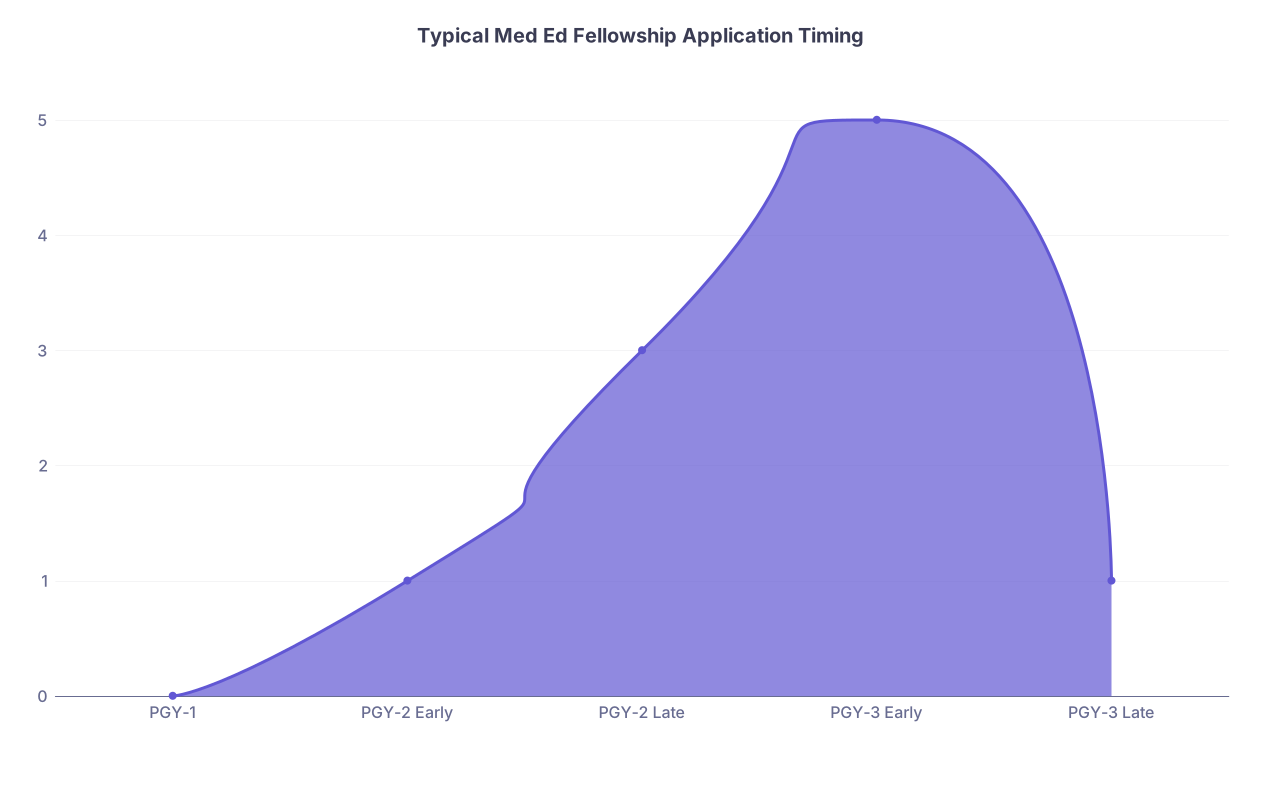
| Category | Value |
|---|---|
| PGY-1 | 0 |
| PGY-2 Early | 1 |
| PGY-2 Late | 3 |
| PGY-3 Early | 5 |
| PGY-3 Late | 1 |
(Scale here is just “how many application tasks hit you at once.” Notice the PGY-2 late / PGY-3 early spike. That’s where burnout happens if you don’t plan.)
PGY-1: Quiet Positioning (You’re Not Applying Yet)
At this point you’re not “applying.” You’re laying down obvious signals that you care about teaching so you’re a credible applicant later.
Months 1–3 of PGY-1: Just Get Your Feet Under You
At this point you should:
- Not obsess about fellowships. Survive. Learn.
- Start noticing:
- Which residents/faculty are clearly “the teaching people”
- Any existing “resident as teacher” tracks, clinician-educator pathways, or education committees
Keep a tiny list in your notes app: “Teaching moments I liked / hated,” “People to talk to about med ed.” That’s it.
Months 4–6: Start Saying Yes to Small Teaching Roles
Now you’re less terrified of writing orders. Good.
At this point you should:
- Volunteer for clear, low-risk teaching tasks:
- 10–15 minute chalk talk for medical students
- Short evidence-based medicine blurb on rounds
- Helping with M1/M2 physical exam sessions if your institution uses residents
- Introduce yourself (briefly) to:
- Program’s Associate PD for education
- Clerkship director(s) in your specialty
- Any “Director of Resident Teaching” type
You’re not asking for a letter yet. You’re putting your name in their head as “interested in education.”
Months 7–12: Document and Sample Different Types of Teaching
At this point you should:
- Try at least 2–3 types of teaching:
- Bedside teaching with students
- Small-group facilitation
- A noon or morning conference
- Start a living CV and track:
- Teaching sessions (title, audience, date)
- Any feedback you get (evals, comments)
If your program has an education track, figure out what the entry timing is. Some only let you “apply” at the end of PGY-1. Mark that deadline.
PGY-2: The Real Setup Year (Exploration → Planning → Early Apps)
Now we’re in the critical year. This is where most people either set themselves up nicely or wake up way too late.
PGY-2, Quarter 1 (July–September): Clarify Your Angle
At this point you should:
- Decide if you actually want a formal fellowship
Ask yourself bluntly:- Do you see yourself as a career clinician educator?
- Or do you just enjoy teaching and want to be better at it?
If you want formal training, you’re probably looking at:
- Academic med ed fellowships (UCSF, Stanford, BIDMC, etc.)
- Home-institution education fellowships (e.g., your IM or EM med ed program)
- Degree-based programs (MHPE, MEd) that integrate with a fellowship year
- Meet with 2–3 key people:
Schedule 30-minute chats with:
- Your program director or APD who knows education
- A faculty clinician educator you respect
- A recent grad who did a med ed fellowship (even at another institution—Zoom them)
Ask them:
- Which programs are actually high-yield vs. just a “gap year” with a title
- Whether you should also apply for chief year
- How they’d judge your current CV for med ed
- Identify 6–12 target programs
Make a simple spreadsheet:
| Program | Type | Start | App Opens | Deadline |
|---|---|---|---|---|
| UCSF Med Ed | Post-res | Jul 27 | Aug 26 | Nov 26 |
| Local Univ IM | In-res | Jul 27 | Oct 26 | Jan 27 |
| Stanford MedEd | Post-res | Jul 27 | Aug 26 | Dec 26 |
| MHPE Degree | Mixed | Jul 27 | Sep 26 | Feb 27 |
| EM Med Ed Prog | Post-res | Jul 27 | Aug 26 | Jan 27 |
Check each website. Write down real numbers, not guesses.
PGY-2, Quarter 2 (October–December): Build the Application Core
This is when serious prep starts, even if no application is technically open.
At this point you should:
- Lock in your letter writers (yes, this early)
You want 3 strong letters:
- Program director / APD
- Education-focused faculty who’s seen you teach
- Another faculty who can vouch for work ethic + teaching potential
By December of PGY-2 you should:
- Tell them explicitly: “I’m applying to med ed fellowships for July 2027. Apps will go out Aug–Dec 2026. Can I list you as a letter writer?”
- Ask what they’d like from you: updated CV, draft of personal statement, list of programs
- Build a teaching portfolio skeleton
You don’t need perfection; you need a structure:
- Sections:
- Teaching activities (by year, by role)
- Curriculum or session design you’ve done
- Evaluation data / feedback excerpts
- Education scholarship (posters, workshops, QI with teaching component)
Even if you only have 3–4 items, putting them in a portfolio format now saves you months later.
- Draft your med ed personal statement (Version 0.5)
Do not wait until the night before your first deadline.
At this point your PS should cover:
- A specific moment when you realized teaching was “your thing”
- Concrete experiences:
- “I redesigned the morning report format for our interns”
- “I developed a short teaching script for chest pain”
- What you want from fellowship:
- Curriculum design skills
- Assessment and evaluation training
- Mentorship in education research
You’ll refine this later. Just get 800–1000 words down.
PGY-2, Quarter 3 (January–March): Strengthen and Show a Track Record
While others are coasting midyear, this is where you quietly build your case.
At this point you should:
- Own one recurring teaching commitment
Examples:
- Be the “resident coordinator” for a student rotation
- Run a monthly intern teaching session
- Co-lead a recurring workshop (e.g., feedback skills for peers)
- Start (or join) an education project
Do not aim for a randomized trial of curricular interventions at three campuses. Keep it moveable and finite:
- Pre–post study of a new teaching tool on your service
- Short module on diagnostic reasoning with simple surveys
- Revising and evaluating your program’s sign-out teaching
You want one thing you can describe in interviews as “a project I led that changed something.”
- Ask for structured feedback
After major teaching sessions, ask 1–2 faculty outright:
- “I’m applying for med ed fellowships next year. If you had to describe my teaching style in a letter, what would you say? And what should I work on before I apply?”
Yes, that’s direct. It’s also how you get real feedback instead of vague “you’re doing great.”
PGY-2, Quarter 4 (April–June): Narrow, Confirm, Pre-Write
This is the “quiet heavy lifting” phase.
At this point you should:
- Update your target list with real deadlines
By now, many programs have posted at least rough dates.
- Fill in:
- Application open date
- Priority & final deadlines
- If they require Step scores, chief year status, sample teaching videos, etc.
- Refine your CV and portfolio
- CV: Move “Teaching and Education” way up, not buried behind 12 bullet points of “Presented on rounds.”
- Portfolio: Add:
- Learner eval comments
- Short reflection on a failed teaching experience (yes, that can be powerful in interviews)
- Create 2–3 tailored personal statement variants
You’ll likely need slightly different angles:
- For heavily research-focused med ed fellowships
- For clinically heavy, teaching-focused programs
- For local / in-residency programs
Keep a core story, but pivot emphasis.
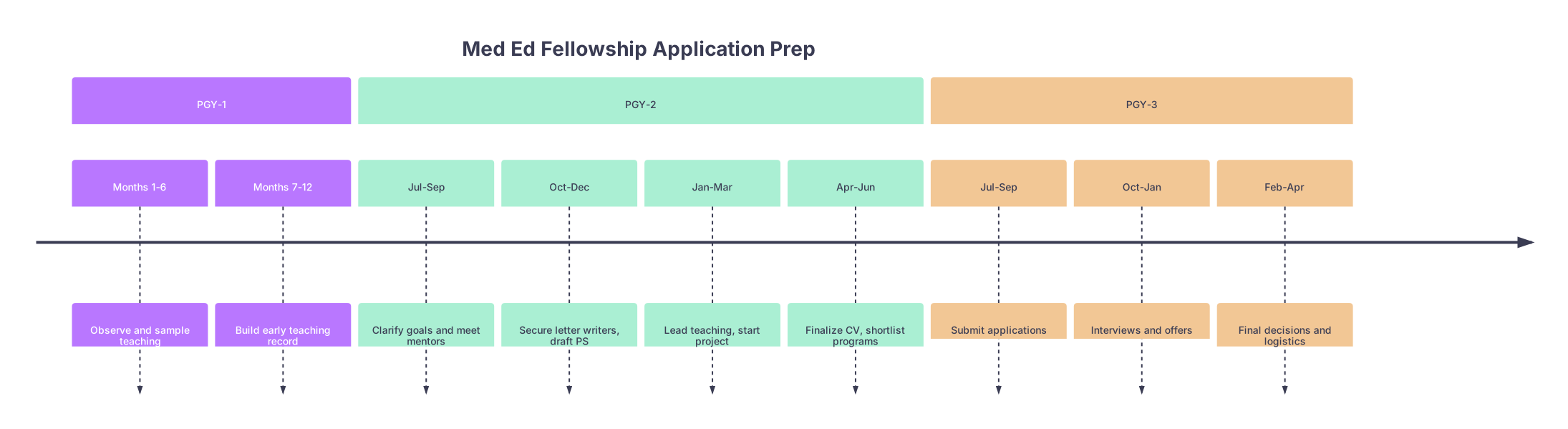
| Period | Event |
|---|---|
| PGY-1 - Months 1-6 | Observe and sample teaching |
| PGY-1 - Months 7-12 | Build early teaching record |
| PGY-2 - Jul-Sep | Clarify goals and meet mentors |
| PGY-2 - Oct-Dec | Secure letter writers, draft PS |
| PGY-2 - Jan-Mar | Lead teaching, start project |
| PGY-2 - Apr-Jun | Finalize CV, shortlist programs |
| PGY-3 - Jul-Sep | Submit applications |
| PGY-3 - Oct-Jan | Interviews and offers |
| PGY-3 - Feb-Apr | Final decisions and logistics |
PGY-3: Application Execution and Interviews
If your fellowship is post-residency, PGY-3 is your application year. If your specialty is longer (IM subspecialty, EM 4-year, etc.), just shift “application year” to your penultimate training year.
PGY-3, Quarter 1 (July–September): Applications Go Out
This is the brutal overlap: senior responsibilities, maybe chief interviews, AND fellowship apps.
At this point you should:
- Have 90% of your written materials DONE by July 31
That includes:
- Final CV
- General personal statement + two variants
- Teaching portfolio PDF (if asked)
- Project summary paragraph
If you’re writing new content in August, you’re late. August/September should be mostly form-filling and program-specific tweaks.
- Formally request letters (with details)
Even though you already asked informally, now you send:
- Exact list of programs and deadlines
- Your final CV
- Your personal statement
- Any specific points you’d like them to highlight (e.g., “my work with students on the cardiology rotation”)
Give them at least 4 weeks lead time. This is non-negotiable if you want good letters.
- Submit early to top-choice programs
Do not aim for the final deadline. For competitive places (UCSF, Stanford, Harvard, Mayo, etc.), you want to be:
- In the first 1–2 weeks of their application window, not the last
- On their radar before they’ve already mentally filled the class
PGY-3, Quarter 2 (October–December): Interview Season
Schedules vary, but most interviews cluster here.
At this point you should:
- Be ready to talk like an educator, not just a resident
Common med ed fellowship interview questions:
- “Tell me about a teaching session that went badly and what you learned.”
- “Describe a curriculum you’d like to build here and how you’d evaluate it.”
- “What do you think most residents get wrong about teaching students?”
Prepare 5–6 tight stories:
- One failed teaching attempt
- One curriculum or capstone project
- One conflict or tough feedback moment
- One example of adapting to a learner who was struggling
- Clarify what you want from THEM
During interviews, you’re also evaluating programs. You should be asking:
- How much protected time is genuinely protected?
- Who actually mentors fellows (names, not generic “faculty”)?
- How many grads have real educator roles now (APDs, clerkship directors, etc.)?
If a program can’t name where their last 3 fellows ended up, that tells you something.
- Track offers and timelines
Some med ed fellowships are…structured. Others are chaos.
Create a column in your spreadsheet:
- Interview date
- Decision date (if they gave one)
- Whether they expect early commitment
Do not let yourself get pressured into committing early without at least rough clarity on other programs’ timelines.
PGY-3, Quarter 3 (January–March): Decisions and Backup Plans
At this point you should:
- Rank your options based on YOUR priorities
Forget prestige for a second. Ask:
- Will I actually learn curriculum design and assessment here?
- Will I be mentored into real roles (course director, site lead), not just “extra resident”?
- Is there structured training (certificate, degree, MEHP, MHPE), or is it just clinical work with a fancy title?
- Decide on chief year vs. fellowship vs. both
Some programs combine chief + med ed fellowship. Others don’t.
- If you’re offered chief and med ed fellowship at the same place, clarify:
- Is chief integrated into the fellowship, or are you basically doing two jobs for one salary?
- If you’re choosing between chief and external fellowship:
- Chief year is not a replacement for formal med ed training, but it’s valuable for leadership and scheduling credibility.
- I’ve seen strong educators skip fellowship and use chief + local certificate work to land great clinician-educator jobs.
- Lock in a backup
If you don’t match your top med ed choices:
- Look at:
- Local or regional certificate programs (MERC, teaching academies)
- Online MHPE/MEd pathways
- Building an unofficial “fellowship year” with 0.5 FTE clinical + 0.5 FTE protected ed work at your institution
I’ve seen people build phenomenal careers with a patchwork that looked like this: 0.6 FTE hospitalist + 0.4 FTE simulation center + online MHPE. Don’t get boxed into thinking only titled “fellowships” count.

If You’re Late: Compressed 9–12 Month Timeline
Some of you are reading this in January of your PGY-3 year thinking, “Well, this is useless, I already missed everything.”
Not necessarily. Here’s the condensed version if you’re inside 12 months:
9–12 Months Before Start Date
- Rapidly identify 4–6 programs still open
- Email program directors directly to ask if they’re still accepting applications
- Scramble:
- CV updated within 3 days
- Personal statement draft within 7 days
- Letters requested ASAP with clear deadlines
6–9 Months Before Start Date
- Focus only on programs that:
- Have confirmed open spots
- Can process applications quickly
- Leverage:
- Home institution med ed roles
- Any faculty who can pick up the phone for you
3–6 Months Before Start Date
- If formal fellowship doesn’t land:
- Negotiate protected education time in your first attending contract
- Enroll in a certificate program or online MHPE/MEd track
- Seek an “education scholar” or “junior faculty educator” role instead of formal fellowship
You’re not dead in the water. You’re just taking a slightly different road.

Key Takeaways
- The real work for a med ed fellowship starts in PGY-2, not three weeks before applications are due. Treat that year as your setup phase.
- You need a visible, documented teaching track record: recurring teaching, at least one small education project, and 2–3 faculty who can credibly call you an educator.
- Fellowships are one path, not the only path. A smart mix of chief year, structured certificate/degree work, and real teaching responsibility can get you to the same place—if you’re deliberate and you start early enough.