
You are here
It’s July 5th. Your ID/Cardiology/Heme-Onc/whatever fellowship just started.
Your badge still says “Fellow,” but your attending just looked at you on rounds and said:
“Why don’t you walk the team through this case?”
You freeze for half a second. Because you know the clinical answer.
But turning that into something that actually teaches the intern and the MS3? Different skillset.
This year is when you stop being the super-trainee who crushes notes and consults and start becoming the person who shapes how others think. You don’t magically become a teacher when you land an attending job. You build it during fellowship.
Here’s a fellowship-year plan, month by month and then week by week, to turn you into a real medical teacher instead of just “the fellow who talks a lot on rounds.”
Big Picture: Your Fellowship Teaching Timeline
Let’s map the year first. Then we’ll zoom in.
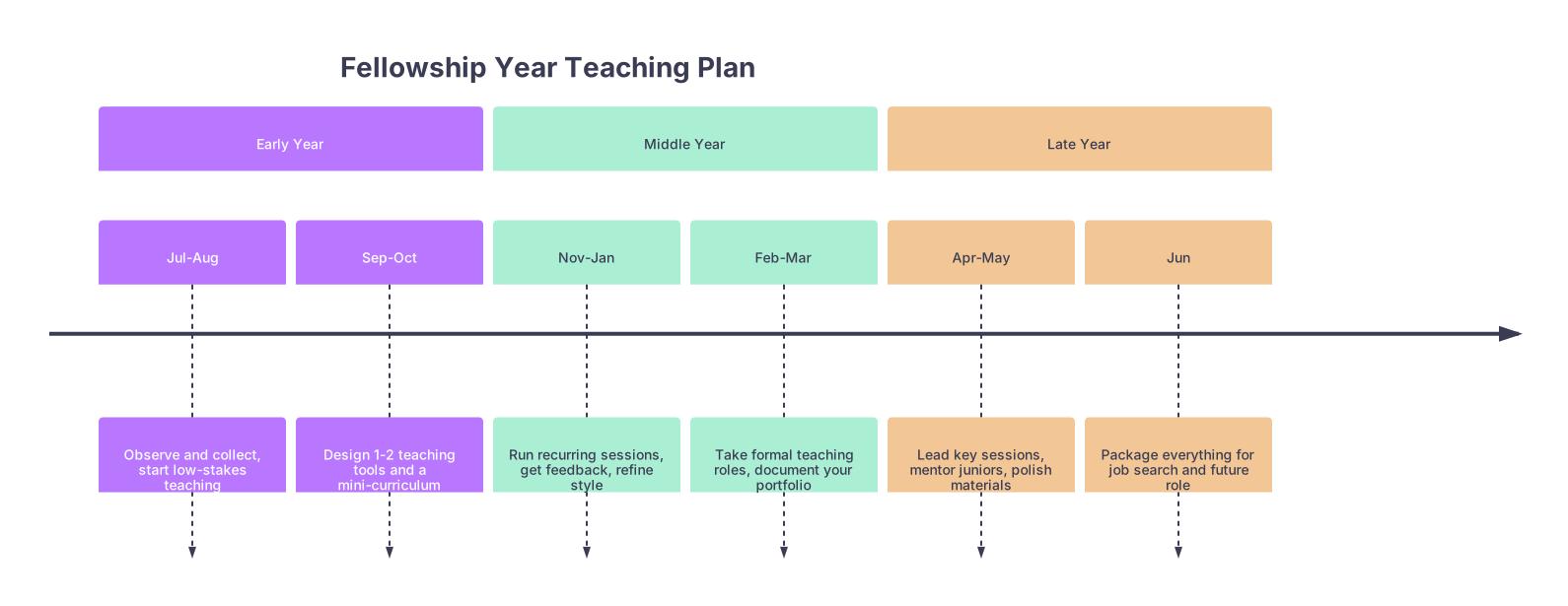
| Period | Event |
|---|---|
| Early Year - Jul-Aug | Observe and collect, start low-stakes teaching |
| Early Year - Sep-Oct | Design 1-2 teaching tools and a mini-curriculum |
| Middle Year - Nov-Jan | Run recurring sessions, get feedback, refine style |
| Middle Year - Feb-Mar | Take formal teaching roles, document your portfolio |
| Late Year - Apr-May | Lead key sessions, mentor juniors, polish materials |
| Late Year - Jun | Package everything for job search and future role |
Now let’s walk through what you should actually do at each point.
July–August: Stop Performing, Start Observing
At this point you should treat yourself like a new attending-in-training for education, not just clinical care.
Week 1–2: Baseline yourself
At this point you should:
Do a brutally honest self-assessment
- On a notes app or paper, make three quick lists:
- “I already do well when teaching”
- “Learners have complained / I feel weak at”
- “Stuff I’ve never even tried (lectures, small groups, feedback, bedside teaching, chalk talks)”
- Be specific:
- Good: “Can explain AKI pathophysiology clearly on the fly”
- Weak: “I ramble when I try to answer broad questions like ‘how do you approach anemia?’”
- On a notes app or paper, make three quick lists:
Identify your primary learner group this year
- Residents on consults?
- MICU teams?
- Third-year students on core rotations?
- Pharmacists/NPs in a multidisciplinary clinic?
- Write it down. Your teaching plan should match your actual environment, not some abstract ideal.
Tell your program director or mentor your goal
- One sentence in a quick email or in person:
- “I want to come out of fellowship ready to be a strong clinician-educator. This year I want to intentionally develop as a teacher—can you point me toward opportunities and feedback?”
- This one sentence changes how they think about you. They’ll start sending things your way.
- One sentence in a quick email or in person:
Week 3–4: Become a teaching anthropologist
At this point you should watch how people teach with the same focus you used to watch how they manage septic shock.
Pick 2–3 teachers you see regularly:
- The attending who does three perfect chalk talks a week
- The older fellow who somehow teaches while staying on time
- The chief resident who gets every intern engaged
For one week, every time you’re on rounds or in a conference, ask yourself:
- What exactly did they do in the first 60 seconds?
- Did they use a question? A one-liner? A goal for the session?
- How did they handle wrong answers?
- How did they end the teaching moment?
Write down at least 5 concrete moves they use. For example:
- “Attending starts every case with: ‘What’s your problem representation in one sentence?’”
- “Chief always asks the student to commit to an answer before saying anything.”
Those moves are your building blocks.
September–October: Build Your First Teaching Tools
By now, you’ve watched others, you’ve survived a few “teach this” moments, and you know your main learner population.
At this point you should create 1–2 structured, reusable teaching tools. Not a 40-slide PowerPoint. Things you can whip out at the bedside in 5 minutes.
Step 1 (early September): Pick 2–3 high-yield topics
Choose topics you are:
- Seeing constantly
- Comfortable with clinically
- Likely to encounter as teaching moments
Examples:
- PCCM fellow: “Approach to new hypoxemia,” “Vent basics,” “ICU delirium”
- Cards fellow: “Chest pain in the ED,” “Basic EKG interpretation,” “HF exacerbation”
- GI fellow: “Upper GI bleed,” “Approach to elevated LFTs,” “Abdominal pain triage”
Do not overthink. Just pick 2–3. You can expand later.
Step 2 (mid September): Turn each topic into a 5–10 minute mini-session
For each chosen topic, at this point you should create:
A one-sentence goal
- “By the end, you can give a 30-second differential for new hypoxemia.”
- “By the end, you can name three categories of elevated LFTs and give one example for each.”
A simple structure Think in 3 parts:
- Hook (1 minute)
- Core content (5–7 minutes)
- Application (2 minutes)
Example for “Upper GI bleed”:
- Hook: “Let’s say it’s 2 a.m., Hgb from 10 to 6, BP 85/50. What’s the first question in your head?”
- Core: 3 buckets – Resuscitate, Risk score, Refer (endoscopy timing)
- Application: “Give me a plan for this patient in 4 sentences.”
One tangible visual per topic
- A small index card you keep in your coat
- A single-page handout
- A note on your phone with a simple schema You are building your personal “teaching cards” library.

Step 3 (October): Test in the wild, not in your head
At this point you should run each mini-session at least twice in real life.
When you do:
- Time yourself. If it regularly takes 20 minutes, you’re doing too much.
- During the last 60 seconds, ask:
- “What stuck with you?”
- “What was confusing or too fast?”
- Write down 1 fix after each time.
This is your first real loop of “plan → teach → adjust.” That loop is the whole game.
November–January: Become the Fellow Everyone Wants on Service
Middle of the year. You know the system. You know the attendings. You’re not just surviving.
At this point you should build a recurring teaching presence.
November: Claim recurring, low-resistance teaching slots
Look around your program and grab consistent micro-roles:
- “Can I run a 10-minute weekly ‘ECG of the Week’ for the residents?”
- “Can I do a 15-minute ‘ICU skills pearls’ once a week after rounds?”
- “Can I take over one noon conference a month for consult cases?”
You’re aiming for something like:
| Type | Frequency | Audience |
|---|---|---|
| Bedside micro-teach | Daily | Team on rounds |
| 10-min case chalk talk | Weekly | Residents |
| Noon conference | Monthly | Residents/Students |
| Student small group | Monthly | MS3/MS4 |
You do not need all of these. But you should own at least one recurring format.
December: Tighten your feedback and questioning skills
This is where most fellows plateau. They can present nice content, but they do not teach in real time.
At this point you should work on two specific skills:
Ask better questions
- Stop asking: “Any questions?”
- Start asking:
- “If this same patient came back six months from now with X, what would you change?”
- “What’s your one-liner for this case?”
- “Tell me your top three differentials and why.”
- Use “wait time.” Ask. Then stay silent for 5 seconds. Do not bail them out.
Give short, specific feedback After a student presents, say one of:
- “One thing you did well was…”
- “One thing to tweak next time is…”
- “For tomorrow, try doing X differently.”
Keep it:
- Behavior-based (“You organized by problem, which was clear”)
- Specific (“Next time, open with the one-line summary before the vitals”)
- Small (one change, not ten)
January: Collect real feedback on you as a teacher
At this point you should stop guessing if you’re effective.
Use at least two of these:
- After a month on service, ask a senior resident:
- “What should I keep doing when I teach? What should I change?”
- Send a 3-question anonymous Google Form to residents you’ve worked with:
- “What teaching thing I did was most helpful?”
- “What should I do less of?”
- “What’s one topic or skill you wished I’d covered?”
- Ask one trusted attending:
- “Can you watch me run a 10-minute session this week and critique me like you would a new faculty?”
Write their comments down. You’re building a living “teaching improvement note.”
February–March: Start Building Your Educator Identity
You’re over halfway. Time to stop thinking of yourself as “fellow who teaches sometimes” and more like “junior clinician-educator.”
At this point you should take on at least one formal teaching project or role.
February: Choose one “anchor project”
Pick one of these (or something similar):
- Design a 3–4 session mini-curriculum (e.g., “ICU night float survival,” “Consulting 101,” “Approach to abnormal imaging”).
- Lead a case-based elective for students or residents.
- Create a teaching tool:
- Pocket card
- Algorithm
- Simulation scenario
- OSCE station
- Join or start a resident teaching skills workshop.
Map it out on a simple Gantt chart:
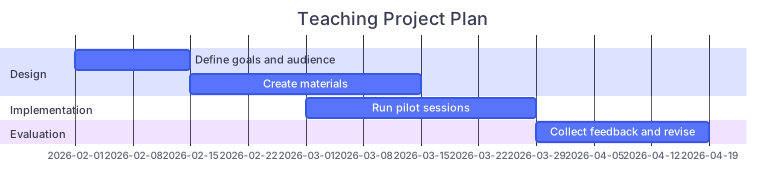
| Task | Details |
|---|---|
| Design: Define goals and audience | a1, 2026-02, 2w |
| Design: Create materials | a2, after a1, 4w |
| Implementation: Run pilot sessions | a3, 2026-03, 4w |
| Evaluation: Collect feedback and revise | a4, after a3, 3w |
March: Document and measure impact
At this point you should start acting like you’ll need this for a job talk or CV. Because you will.
For your anchor project, collect:
- Attendance / number of sessions
- Brief pre/post self-rated confidence from learners (1–5 scale on “comfort managing X”)
- 2–3 representative quotes from feedback
- A one-paragraph summary:
- “Developed and led a 4-part case-based series on [topic] for [audience], reaching [N] learners; >80% reported improved confidence in [skills].”
This becomes a line on your CV and a story in your future interviews: “Tell me about a time you led an education initiative.”
April–May: Transition From “Doing” to “Leading and Mentoring”
Now you’re senior. Even if it’s a one-year fellowship, by April you’re the one everyone expects to know what’s going on.
At this point you should shift from only teaching yourself to helping others teach.
April: Teach someone else how to teach something you created
Pick a resident or junior fellow and:
- Hand them one of your structured sessions or tools.
- Say:
- “Next week, you’re going to run this 10-minute session for the team. I’ll be there and have your back.”
- After they do it, debrief:
- “What felt smooth?”
- “Where did you get stuck?”
- “Here’s one thing you did that really worked.”
Now you are not just a teacher. You are a teacher of teachers. That’s the transition from super-trainee to faculty mindset.
May: Polish your signature teaching moves
By now, you know what you like:
- Bedside rounds?
- Whiteboard/chalk talks?
- Case-based small groups?
- Quick “one-page” frameworks?
At this point you should intentionally sharpen 2–3 signature moves you want to be known for.
Examples:
- “I’m the person who always turns messy cases into a simple 3-bucket framework on the whiteboard.”
- “I’m the fellow who does precise, kind, rapid-fire feedback after presentations.”
- “I’m the person who can turn any ICU patient into a 5-minute teaching case about physiology.”
Pick the moves. Practice them weekly. They should feel natural by the end of the year.
June: Package Yourself as a Medical Teacher
End of fellowship. Job applications, faculty positions, maybe another fellowship, maybe a hospitalist year.
At this point you should pull everything together into a coherent teaching identity.
Step 1: Build a simple teaching portfolio
Keep it short. No one wants to read a 40-page portfolio from a brand-new attending.
Include:
- 1–2 paragraph teaching philosophy
- Not fluff. Anchor it in your experience this year.
- Example:
- “I teach by starting with what learners already know, forcing them to commit to a plan, and then tightening their reasoning with simple, repeatable frameworks. On ICU rounds, that looks like…”
- List of teaching activities this year
- Bedside rounds: “Daily micro-teaching, typical topics X/Y/Z”
- Conferences: “Led 4 noon conferences on [topics]”
- Projects: Your anchor project with outcomes
- Selected teaching materials
- 1 example handout / one-pager
- 1 example schema or index card
- Feedback snapshots
- 3–5 anonymous comments from learners that are specific
- Any teaching awards or nominations, if applicable (if you have none, that’s also fine—signals honesty)
Step 2: Translate this into job-search language
You will get questions like:
- “What is your role as a teacher on the team?”
- “How have you developed as an educator during fellowship?”
- “What kind of teaching do you enjoy most?”
At this point you should have 2–3 clean stories ready:
- A story about a time your teaching changed a learner:
- Intern who went from terrified to comfortable managing GI bleeds after your mini-series.
- A story about a time your teaching changed a system:
- The ICU “night float checklist” you created that the program adopted.
- A story about a time you improved as a teacher:
- You used to lecture for 25 minutes. Feedback taught you to cut it to 8 and add questions, and now engagement is higher.
Ongoing: Weekly and Daily Habits of a Clinician-Educator Fellow
Let’s zoom down to the routine that actually makes all this real.
Weekly: The 30-minute teaching reset
Once a week (Sunday evening, post-call day, whatever), at this point you should:
- Spend 10 minutes planning:
- Pick two specific teaching targets for the coming week:
- “Do one new 5-minute session on Approach to Hyponatremia.”
- “Ask for feedback on my bedside style from at least one resident.”
- Pick two specific teaching targets for the coming week:
- Spend 10 minutes reviewing:
- What teaching actually happened last week?
- What “stuck” moment do you remember?
- One thing to change this week.
- Spend 10 minutes refining:
- Update one index card/one-pager.
- Add one pearl or better example.
That 30 minutes weekly is more powerful than a once-a-year teaching course.
Daily: Micro-checklist on rounds
Before or during rounds/consults, run this short mental list:
- Have I:
- Asked at least one learner to commit to a plan today?
- Turned at least one patient into a structured teaching moment?
- Given one piece of specific feedback to someone?
- Asked for one piece of feedback about my teaching this week?
If the answer is “no” across the board for several days in a row, you’re drifting back into pure service mode. It happens. Just use the checklist to pull yourself out.
A Quick Reality Check
You will have weeks where:
- You barely keep up with notes and pages.
- Teaching feels like a luxury.
- You put in effort and the learners stare blankly or check their phones.
That does not mean you’re a bad teacher. It means you’re in clinical medicine.
The difference between the fellow who becomes a teacher and the one who stays a super-trainee is not talent. It is:
- Intentionality (you plan to teach, not just “if there’s time”)
- Iteration (you change based on feedback)
- Documentation (you actually record what you did and learned)
Everything else is reps.
Your Next Step Today
Do one concrete thing now, not “later when I have time.”
Open a note on your phone and:
- Title it: “Fellowship Teaching Plan.”
- Write three lines:
- Primary learners this year: _______
- Three topics I can teach in 5–10 minutes by next month: ______, ______, ______
- One person I’ll tell about my goal to become a strong teacher: ______
Then send a message or email to that person:
“I want to intentionally grow as a teacher this fellowship year. Can we talk for 10 minutes sometime this month about teaching opportunities and feedback?”
That’s the moment you stop being just a super-trainee and start the shift to medical teacher.