You are here
It is January 3rd. You just walked out of a faculty meeting where the clerkship director said, half‑joking, “If you want students to stop complaining about that rotation, build them a better elective.”
You have an idea. A good one. Maybe it is a Point‑of‑Care Ultrasound elective. Maybe “Medicine and the Carceral System.” Maybe a real longitudinal QI elective instead of the usual check‑the‑box project.
You told people you would “pilot it next academic year.”
Translation: you have 6–9 months to turn a vague idea into something that appears in the curriculum catalog, has clear objectives, meets LCME/COCA requirements, passes the curriculum committee, and actually runs without catching fire.
At this point you need a timeline. Month by month. Week by week when it gets tight. Otherwise this will die in the land of good intentions.
Here is how to launch a new medical student elective over one academic cycle.
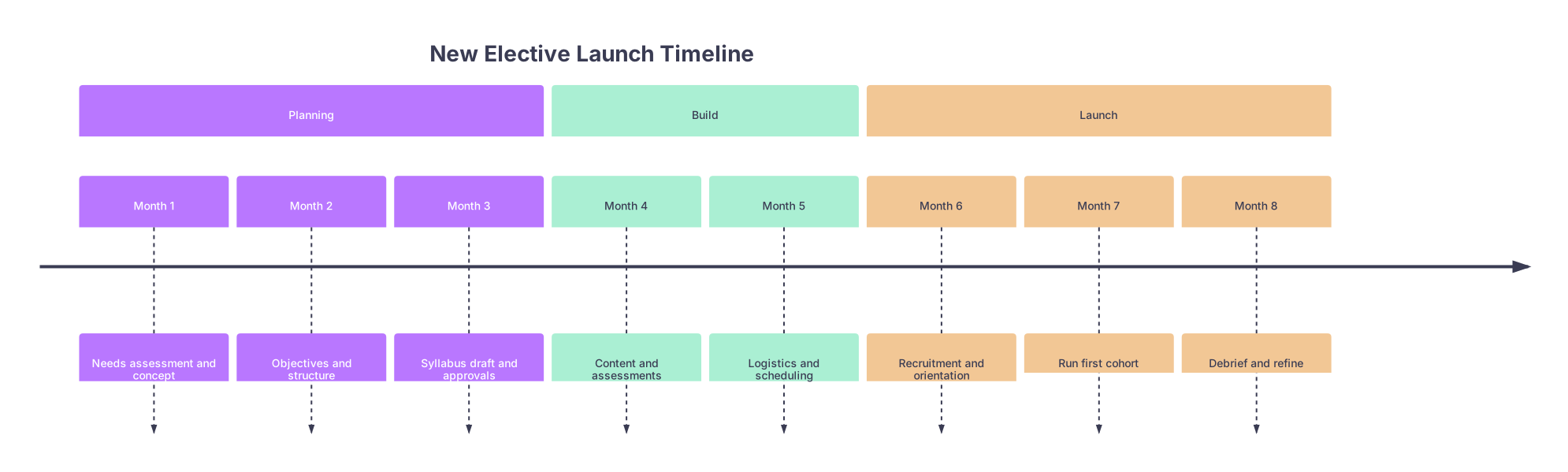
| Period | Event |
|---|---|
| Planning - Month 1 | Needs assessment and concept |
| Planning - Month 2 | Objectives and structure |
| Planning - Month 3 | Syllabus draft and approvals |
| Build - Month 4 | Content and assessments |
| Build - Month 5 | Logistics and scheduling |
| Launch - Month 6 | Recruitment and orientation |
| Launch - Month 7 | Run first cohort |
| Launch - Month 8 | Debrief and refine |
Month 1: Clarify the need and define the concept
You are 6–9 months before planned launch.
At this point you should stop saying “I have an idea for an elective” and start saying “I am designing a 2‑week MS3/MS4 elective with X objectives that fills Y curricular gap.”
Week 1: Quick, focused needs assessment
Do not send a 30‑question SurveyMonkey to the whole school. You do not have time and nobody wants it.
Instead:
- Pull current electives list (from the registrar or curriculum office).
- Identify:
- Obvious overlap (you do not want to duplicate an existing offering).
- Gaps your elective would fill (e.g., no palliative care option for MS3s).
Then talk to real people:
- 3–5 students (recently on relevant rotations).
- 1–2 clerkship directors.
- 1 curriculum dean or associate dean.
Ask blunt questions:
- “If this elective existed next year, would anyone take it?”
- “What would make this actually useful vs. just transcript decoration?”
- “What would be a non‑starter for the curriculum committee?”
Document short quotes and key pain points. You will need them for your proposal.
Week 2: Define scope and level
At this point you should answer five non‑negotiable questions:
Who is this for?
- MS1–2 preclinical?
- MS3–4 clinical?
- Mixed level (usually a headache; avoid for your first elective).
How long?
- Common formats: 1‑week, 2‑week, or 4‑week blocks.
- If your school uses 2‑week “selectives,” align with that. Do not fight the calendar.
How many students per offering?
- Most sane first‑run caps: 4–8 students.
- More than 10 and you will drown in logistics.
Is this in‑person, hybrid, or mostly virtual?
- LCME schools will be more skeptical of fully virtual electives unless clearly justified.
Where will it live administratively?
- Under a department (e.g., Medicine, Pediatrics).
- Under a center (Global Health, Bioethics).
- This affects funding, faculty credit, and who has to sign the forms.
Write a two‑paragraph concept statement now. Concrete, not fluffy.
Week 3: Stakeholder alignment
At this point you should stop quietly planning and go public with the right people.
Minimal stakeholder list:
- Department chair or section chief (for political cover).
- Course or clerkship directors whose turf you might be touching.
- Curriculum office / undergraduate medical education (UME) leadership.
Your goal:
- A clear verbal “Yes, you should move forward, and I will support this” from at least:
- One educational leader with committee voting power.
- One operational ally (clerkship coordinator, UME administrator).
If you skip this and just send a polished syllabus later, someone will kill it with one email (“We already do this in our clerkship”).
Week 4: Draft high‑level learning objectives
Do not obsess over perfect Bloom’s taxonomy yet, but you do need a backbone.
Aim for:
- 4–6 course‑level objectives.
- Each:
- Specific.
- Assessable in 1–4 weeks.
- Clearly mapped to:
- Medical knowledge.
- Skills.
- Professionalism / systems‑based practice.
Example (for a POCUS elective):
- Perform focused cardiac, lung, and abdominal ultrasound examinations on adult patients under supervision.
- Interpret common ultrasound findings relevant to acute care decision‑making.
- Integrate point‑of‑care ultrasound into patient presentations and documentation.
- Demonstrate appropriate infection control and patient communication during ultrasound examinations.
Send these to 2–3 trusted colleagues for brutal feedback.

Month 2: Design the structure and assessments
Now you move from “idea” to “course skeleton.”
Week 5–6: Build the daily/weekly structure
At this point you should open a calendar and map actual days.
Decide:
- Contact hours per day (usually 4–6 for an elective).
- Mix of:
- Seminars / small groups.
- Clinical experiences.
- Independent work.
- Simulation / skills sessions (if applicable).
Take a 2‑week elective as example:
Week 1:
- Mon:
- AM: Orientation, pre‑test, introductory session.
- PM: First clinical session or skills lab.
- Tue–Thu:
- AM: Clinical or experiential activities.
- PM: Case‑based seminar + debrief.
- Fri:
- AM: Student presentations or journal club.
- PM: Reflective writing / independent project time.
- Mon:
Week 2:
- Similar rhythm, with progression in complexity and more student‑led elements.
- Final half‑day reserved for:
- Post‑test.
- Final feedback.
- Course debrief.
Make this into a simple grid. You will reuse it in the syllabus and proposal.
| Day | Morning (3 hours) | Afternoon (3 hours) |
|---|---|---|
| Mon W1 | Orientation + Intro Talk | Skills Lab 1 |
| Tue W1 | Clinical Session 1 | Case Discussion 1 |
| Wed W1 | Clinical Session 2 | Journal Club |
| Thu W1 | Clinical Session 3 | Small-Group Workshop |
| Fri W1 | Student Prep Time | Reflective Session |
| Mon W2 | Clinical Session 4 | Skills Lab 2 |
Week 7: Assessments and grading
Curriculum committees get twitchy when “elective” sounds like “vacation.” The cure is explicit assessment.
You need:
- At least one direct observation of performance (Mini‑CEX, skills checklist, etc.).
- At least one knowledge or application assessment:
- Short quiz.
- Case write‑up.
- Structured oral presentation.
- Professionalism / participation rubric.
Decide on grading scheme:
- Honors / Pass / Fail vs. Pass / Fail.
- If your school insists on narrative only, you still need internal criteria.
Create simple tools:
- 1‑page faculty evaluation form.
- 1‑page student evaluation of course.
- Rubric for any written or project work (3–4 criteria, 3‑level scale).
Week 8: Alignment with institutional competencies
At this point you should map your elective to the school’s competency framework. Not because you love bureaucracy, but because this is how proposals get approved fast.
Typical buckets:
- Patient Care / Clinical Skills.
- Medical Knowledge.
- Interpersonal and Communication Skills.
- Professionalism.
- Systems‑Based Practice.
- Practice‑Based Learning and Improvement.
For each course objective, mark 1–2 competencies it supports. Keep a short mapping table ready; curriculum office staff will love you for it.
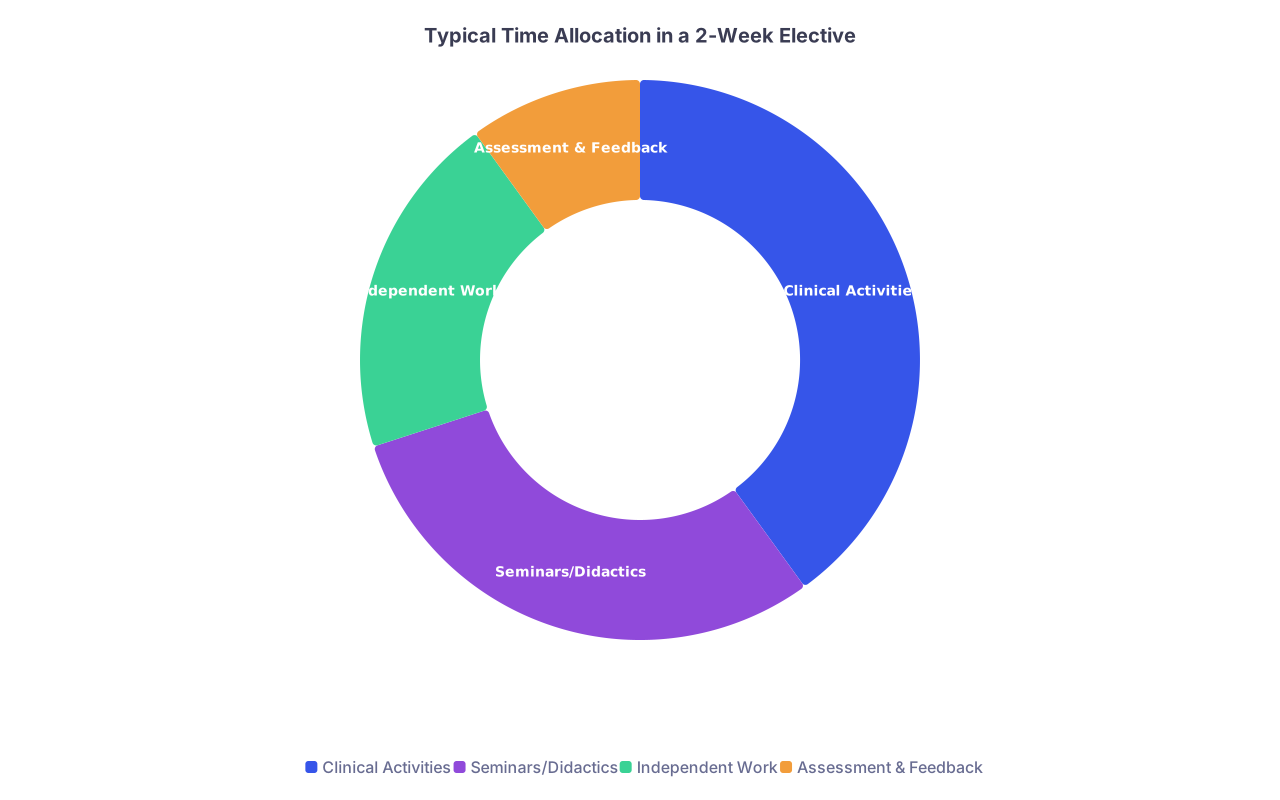
| Category | Value |
|---|---|
| Clinical Activities | 40 |
| Seminars/Didactics | 30 |
| Independent Work | 20 |
| Assessment & Feedback | 10 |
Month 3: Write the syllabus and secure approvals
This is your paperwork month. Not glamorous, but decisive.
Week 9–10: Draft the full syllabus
At this point you should have a near‑final, committee‑ready syllabus.
Minimum components:
- Course title (short, clear, searchable).
- Course description (1 short paragraph, no marketing fluff).
- Audience and prerequisites:
- Which year(s).
- Required prior rotations or skills.
- Duration and typical schedule:
- Block length.
- Days and hours expectations.
- Learning objectives (the 4–6 you refined).
- Teaching methods:
- Bullet list: small groups, bedside teaching, simulation, etc.
- Assessments and grading:
- What, when, and how each piece contributes to final grade.
- Attendance policy:
- Be explicit; electives are notorious for “flexible” attendance.
- Faculty list and roles:
- Course director.
- Key faculty / preceptors.
- Resources and required materials:
- Readings.
- Websites.
- Equipment (e.g., stethoscope, laptop).
Use a prior approved elective’s syllabus as a template. There is no award for originality in formatting.
Week 11: Administrative forms and curriculum committee
Now you convert your syllabus into whatever bureaucratic format your school demands.
Typical steps:
Complete new course proposal form:
- Credit hours.
- Contact type (clinical vs. non‑clinical).
- Maximum and minimum enrollment.
- Offered months / blocks.
Attach:
- Syllabus.
- Competency mapping.
- Assessment plan.
Obtain signatures:
- Department chair.
- Course director(s).
- Sometimes clerkship director if there is overlap.
Submit to:
- Electives subcommittee or full curriculum committee.
- Then registrar for catalog inclusion.
Timeline reality: committees often meet monthly. If you miss a meeting, you lose 4–6 weeks. Aim to get your materials in at least 1–2 weeks before the next scheduled meeting.
Week 12: Plan for evaluation and quality improvement
While the proposal churns through committees, set up your evaluation plan. Future you will be very grateful.
Decide:
- Which outcomes you will track:
- Student satisfaction (standard course eval).
- Self‑reported confidence change.
- Skills checklists.
- How you will collect them:
- Electronic forms (Qualtrics, internal system).
- Paper in a pinch, but someone must enter the data.
Set a calendar reminder for “Month 8: debrief” with “pull evaluation data” in the description. Otherwise it will vanish.

Month 4: Build the content and recruit faculty
Your elective is probably approved or at least provisionally accepted. Now you must prove you can actually run it.
Week 13–14: Develop core sessions
At this point you should build the 3–5 anchor sessions that define the elective.
For each anchor session:
- Write 3–4 session‑level objectives.
- Create:
- Slides or handouts.
- Pre‑reading (short; no one reads 40‑page PDFs).
- Instructor guide with:
- Timings.
- Discussion questions.
- Common pitfalls.
Examples of anchor sessions:
For a Global Health elective:
- “Ethics of Short‑Term Medical Work Abroad.”
- “Health Systems and Financing in Low‑Resource Settings.”
For a QI elective:
- “Introduction to PDSA Cycles.”
- “Run Charts and Basic Data Visualization.”
Do not overbuild every single hour. Get the anchor sessions right and leave room for iterative tweaks during the first run.
Week 15: Recruit and brief teaching faculty
Electives die when the director assumes “people will step up later.” They often do not.
You need:
- 2–4 committed faculty who:
- Agree to specific dates / times.
- Know what they are expected to teach.
- 1 key coordinator (could be you) who:
- Manages schedule.
- Communicates with students.
- Troubleshoots logistics.
For each faculty member, send:
- Short course overview.
- Assigned sessions with dates and times.
- Expected preparation (slides, cases, etc.).
- How their teaching will be evaluated (yes, tell them).
Week 16: Build your course shell (LMS / learning platform)
At this point you should stop living in your personal laptop folder and move to the institution’s learning platform (Canvas, Moodle, etc.).
Set up:
- Course homepage with:
- Description.
- Contact info.
- Key documents (syllabus, schedule).
- Modules organized by:
- Week.
- Or session.
- Upload:
- Readings.
- Slides.
- Assessment tools.
- Evaluation links (hidden until end).
This is also when you create any online quizzes or pre‑work using the platform’s tools.
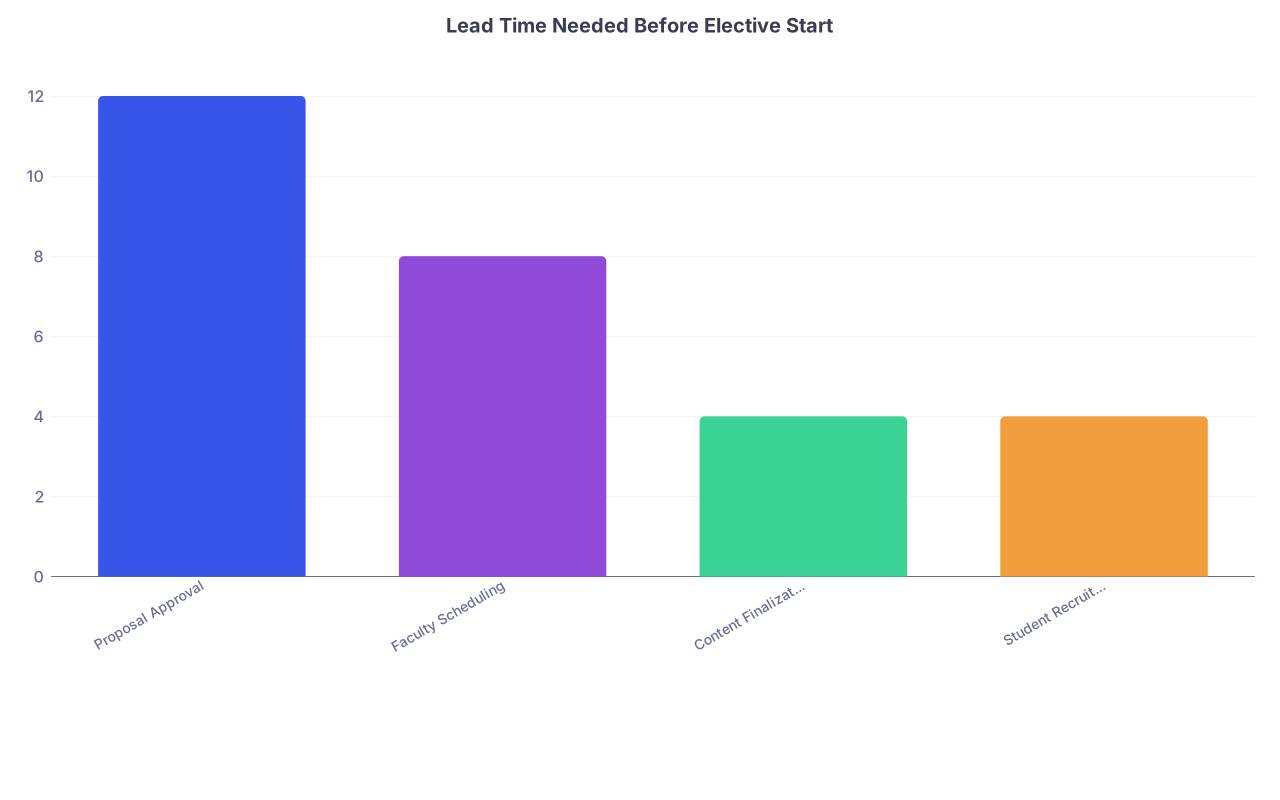
| Category | Value |
|---|---|
| Proposal Approval | 12 |
| Faculty Scheduling | 8 |
| Content Finalization | 4 |
| Student Recruitment | 4 |
Month 5: Lock in logistics and advertise
Now you are 1–2 months from launch. Details will make or break you.
Week 17–18: Scheduling and capacity
At this point you should finalize:
- Which blocks or months the elective will run.
- Maximum enrollment per block.
- Any pre‑assigned clinical sites or rooms.
Coordinate with:
- Registrar / scheduling office to:
- Open the course in the registration system.
- Set caps.
- Add prerequisites or restrictions.
Confirm physical logistics:
- Classrooms:
- Reservation numbers.
- AV needs.
- Clinical sites:
- Preceptor schedules.
- Student access (badges, EMR training, etc.).
- Special equipment:
- Ultrasound machines.
- Simulation lab time.
- Community site agreements.
Week 19: Student‑facing materials and recruitment
You cannot rely on “if we build it, they will come.” Students choose from a catalog full of electives that all sound similar.
Prepare:
- A 1‑page student info sheet:
- What the elective is.
- Who it is for.
- What a typical day looks like.
- What they will walk away able to do.
- A short pitch for:
- Class meetings.
- Student listservs.
- Interest groups (e.g., EMIG, global health group).
Emphasize:
- Concrete skills gained.
- Fit with residency applications (yes, they care).
- Any unique experiences (simulation, community work, etc.).
If your school has an electives fair, show up. With a printed schedule and something more compelling than “you will learn about X.”

Month 6: Final prep and pre‑course orientation
You are 2–4 weeks from launch. This is “tighten the bolts” time.
Week 20–21: Confirm everything
At this point you should run a pre‑flight check.
Confirm:
- Student roster:
- Names.
- Emails.
- Any accommodations that need planning.
- Faculty availability:
- Reconfirm dates.
- Identify backup coverage for at least 1 session.
- Rooms and access:
- Double‑check reservations.
- Test AV in critical rooms.
- Clinical logistics:
- Ensure students have:
- EMR access.
- Required online modules done.
- Badge access to relevant areas.
- Ensure students have:
Send students a concise welcome email:
- Attach syllabus.
- Share:
- First‑day schedule.
- Required pre‑reading or pre‑work (keep it light).
- Clarify:
- Start time.
- Location.
- Dress code (clinic vs. classroom).
Week 22: Run a brief virtual orientation (optional but smart)
Especially for more complex electives (multi‑site, community‑based), schedule a 30‑minute orientation call the week before.
Agenda:
- Overview of goals and expectations.
- What a typical day looks like.
- How attendance, grading, and professionalism will be handled.
- Q&A.
This cuts down on first‑day confusion and early frustration.
Month 7: Launch and run the first cohort
Now you stop planning and start teaching.
Week 23: Week 1 of the elective
At this point you should treat the first week as both teaching and live usability testing.
Day 1:
- Briefly revisit goals and expectations.
- Do a quick pre‑assessment:
- 5–10 item quiz.
- Short “what I hope to learn” note.
- Set tone:
- This is an actual course with standards.
- But also a pilot where their feedback matters.
During Week 1:
- Take notes after each day:
- What ran over time.
- What fell flat.
- What students seemed engaged by.
- Have 1:1 micro‑check‑ins with students:
- “What is working so far?”
- “Anything surprising?”
Do not change the entire course mid‑week based on one comment, but small real‑time adjustments are fine.
Week 24: Week 2 and closure
At this point, focus on consolidation and evaluation.
In the second week:
- Shift more responsibility to students:
- Case presentations.
- Leading discussions.
- Peer teaching segments.
On the last day:
- Post‑assessment:
- Same or similar quiz as pre‑assessment.
- Self‑rated confidence on objectives.
- Gather feedback:
- Standard course evaluation.
- 10–15 minute facilitated debrief:
- “What should we absolutely keep?”
- “What should we cut or change?”
- “Would you recommend this to a classmate? Why or why not?”
Capture specific examples. You will forget by next week.
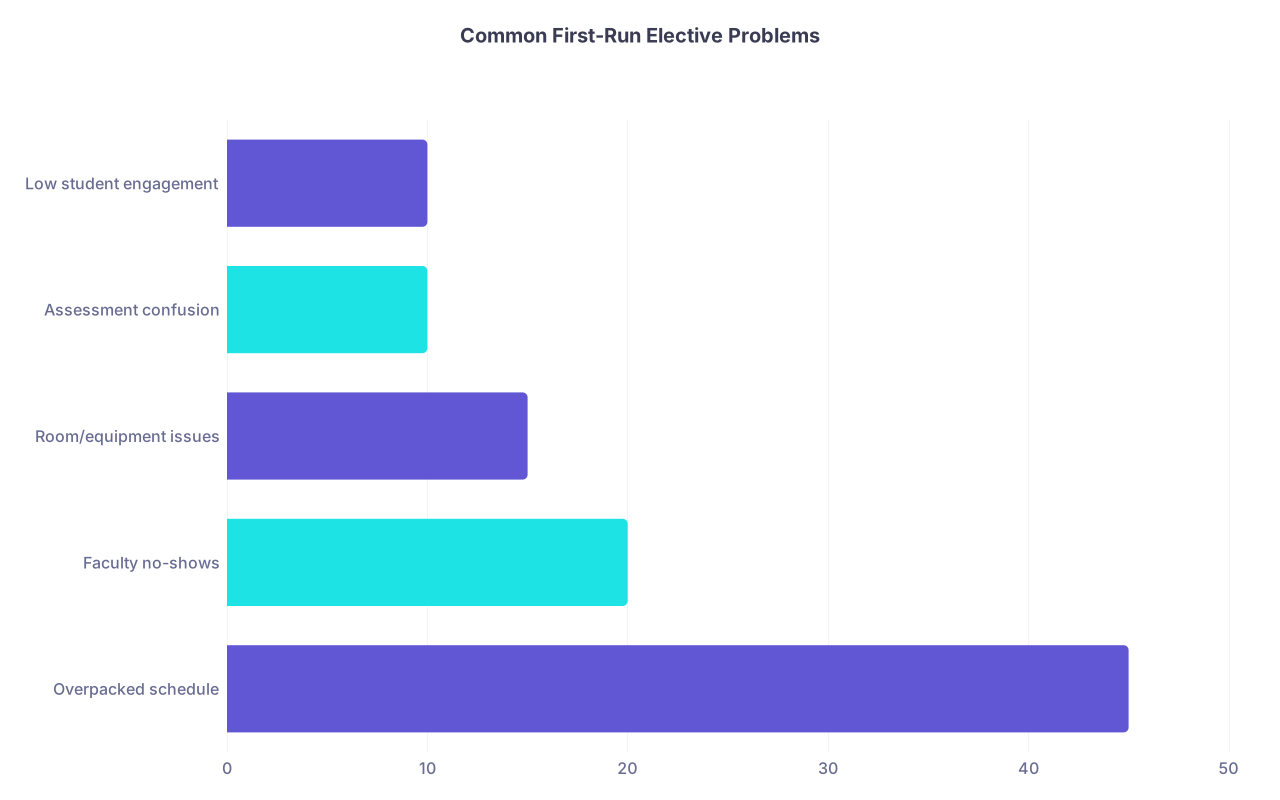
| Category | Value |
|---|---|
| Overpacked schedule | 45 |
| Faculty no-shows | 20 |
| Room/equipment issues | 15 |
| Assessment confusion | 10 |
| Low student engagement | 10 |
Month 8: Debrief, refine, and plan the next run
The danger now is walking away and not touching the course again until the night before the next cohort. Do not do that.
Week 25: Faculty and coordinator debrief
At this point you should gather key players for a short, honest post‑mortem.
Agenda (60 minutes max):
- What worked better than expected?
- What clearly did not work?
- Any logistical nightmares to fix now:
- Scheduling.
- Access.
- Overloaded days.
- Assessment sanity check:
- Were grading criteria realistic?
- Did evaluations capture meaningful differences in performance?
Decide on 3–5 concrete changes for the next offering. Not 20. You will not implement 20.
Week 26: Update materials and documentation
Implement the changes while the experience is fresh:
- Revise:
- Schedule grid.
- Slides and handouts.
- Instructions for students and faculty.
- Update:
- LMS shell.
- Syllabus (version/date clearly marked).
- Proposal file with a brief note:
- “Year 1 modifications based on evaluation.”
If your school expects annual course reports, you now have a clean packet:
- Enrollment numbers.
- Evaluation summaries.
- Action steps.
If your timeline is shorter (or longer)
Real life is messy. Maybe you are given 3 months instead of 8. Or you are planning a year out.
3–4 month crash build:
- Combine Month 1–2 into “Weeks 1–3.”
- Push approvals and syllabus in Weeks 4–6.
- Build content and faculty in Weeks 7–10.
- Logistics and launch in Weeks 11–16.
- Be ruthless about scope. Small, focused electives are survivable; sprawling ones will fail.
12+ month leisurely build:
- Use the extra time to:
- Pilot single sessions as workshops.
- Gather more stakeholder input.
- Secure small grant funding for materials or evaluation.
- Do not delay approvals; committees forget you exist.
- Use the extra time to:
Three things to remember
- Get institutional alignment early. One short meeting with the right curriculum leader in Month 1 will save you three angry emails in Month 7.
- Lock down structure and logistics by the middle of the timeline. Content can iterate; room reservations and faculty schedules cannot.
- Treat the first run as both course and pilot study. Collect data, debrief hard, and make a few focused changes before the next cohort. That is how good electives become great ones.