
The biggest mistake new medical faculty make is saying “yes” to everything and learning teaching on nights and weekends. That’s backwards.
Your first 90 days should be a ruthless triage of educational tasks—what to front‑load, what to defer, and what to quietly ignore.
Below is a week‑by‑week, then month‑by‑month guide focused specifically on education. Not your research. Not your RVUs. Just the teaching side of your new job and what you should actually be doing, in order.
Week 1–2: Stop the Bleeding and Map the Terrain
At this point you should not be “improving” anything. You should be figuring out what already exists so you don’t break it.
Days 1–3: Clarify Your Teaching Load (In Writing)
You need a clean, simple answer to: What am I actually responsible for teaching this year?
Get this nailed down early. Ideally by day 3.
Ask (and write down the answers):
- Which courses/rotations am I assigned to?
- What percent of my FTE is officially “teaching”?
- Do I have required lectures, small groups, bedside teaching, simulations, OSCEs?
- Are there course director / clerkship leadership roles attached?
- What evaluation responsibilities do I have (milestones, EPA ratings, narrative assessments)?
Push for specifics. “You’ll help with the clerkship” is vague; “You’ll lead four small groups per month and give two 60‑minute lectures per block” is actionable.
| Topic | Exact Question to Ask |
|---|---|
| Teaching Time | What % FTE is protected for teaching? |
| Settings | Which courses/rotations am I formally assigned to? |
| Deliverables | How many lectures, small groups, or sessions per block? |
| Evaluations | Which learners do I evaluate, and in what system? |
| Leadership | Any director, co-director, or committee roles expected this year? |
Days 2–5: Meet the Key Education People
You don’t have to meet everyone. Just the people who can tank your life if you ignore them.
At this point you should schedule short, targeted meetings with:
- Course/clerkship directors you’ll work under
- Program director (if GME heavy role)
- Vice Chair / Associate Dean for Education
- Department admin who runs schedules and evaluations
In these meetings, you should:
- Ask for current syllabi, schedules, and objectives
- Clarify grading and evaluation timelines
- Ask how communication with learners usually happens (LMS, email, announcements)
- Find out who actually fixes problems (LMS access, room scheduling, AV)
Do not promise new curricula yet. Your only goal now is intel.

| Step | Description |
|---|---|
| Step 1 | You - New Faculty |
| Step 2 | Course Directors |
| Step 3 | Program Director |
| Step 4 | Education Leadership |
| Step 5 | Department Admin |
| Step 6 | Existing Syllabi |
| Step 7 | Schedules and Rooms |
| Step 8 | Promotion and Expectations |
Days 3–10: Get Your Systems Access and Basic Training
At this point you should make the tech work for you before you start building anything.
You need:
- Access to the LMS (Canvas, Blackboard, Moodle, whatever)
- Access to the evaluation system (MedHub, New Innovations, E*Value, homegrown horror)
- Your institutional slide template and branding rules
- Room booking / AV contacts
- Simulation center contacts (if relevant)
Book or request:
- A 15–30 minute LMS walk‑through with someone who actually uses it for teaching
- A quick demo of the evaluation system from your program or clerkship coordinator
- A test run of classroom tech where you’ll most often teach (log in, run slides, try the mic)
Do this now. Not the night before your first lecture.
Weeks 3–4: Stabilize Your First Teaching Deliverables
At this point you should know your first three concrete teaching events. Name them. Date, time, audience, length.
Your job in weeks 3–4 is to make those inevitable events safe and functional, not world‑class.
Week 3: Lock Down Your First Three Sessions
List out explicitly:
- First lecture or large‑group session
- First small group / case‑based session
- First clinical teaching block (ward month, clinic afternoon, etc.)
For each one, answer:
- Who are the learners (MS2? PGY‑1? Mixed level?)
- What are the published objectives, if any?
- How will they evaluate you, if at all?
- What content existed last year, and can you reuse it?
If there’s an existing slide deck:
- Read it with a red pen (digital or literal) and mark:
- What’s clearly outdated
- What’s obviously overstuffed
- What learners always miss or complain about (ask the director)
Your first pass improvement goal: cut 20–30% of the “nice‑to‑have” slides and sharpen the must‑know content.
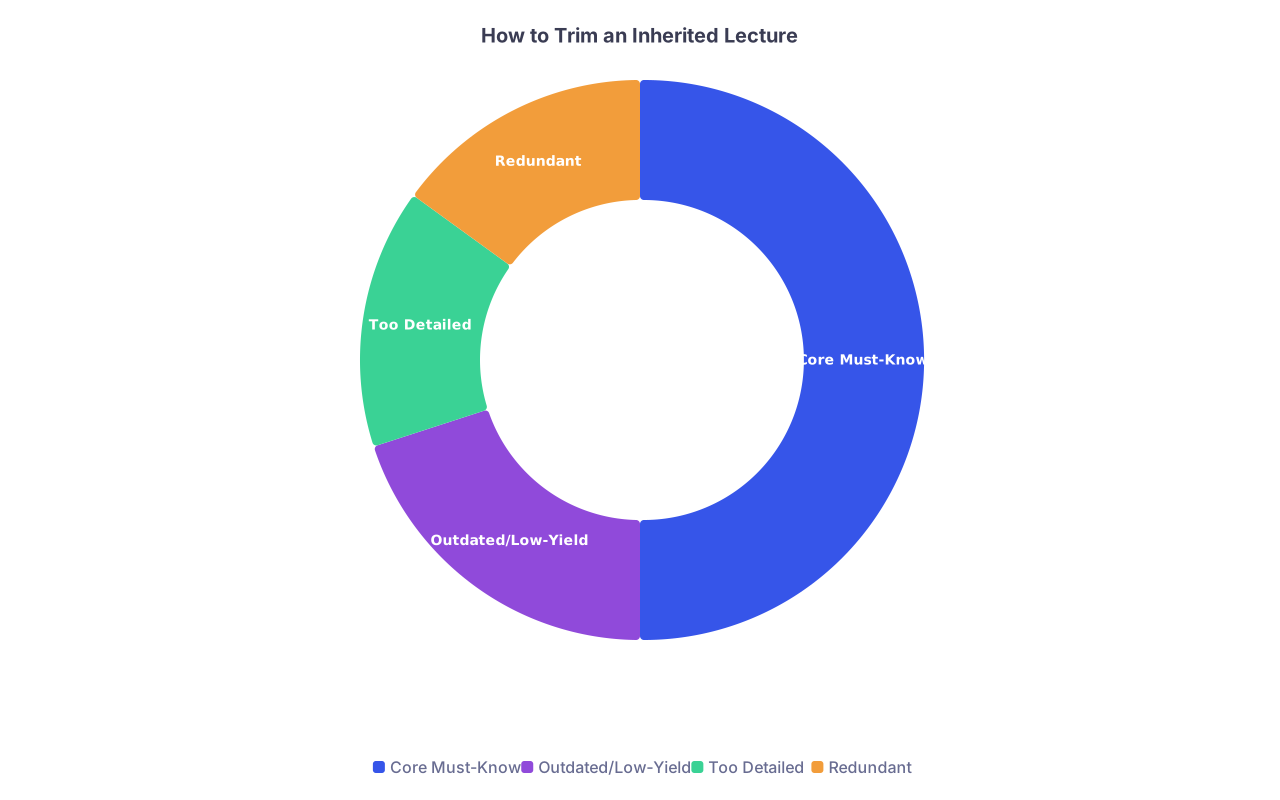
| Category | Value |
|---|---|
| Core Must-Know | 50 |
| Outdated/Low-Yield | 20 |
| Too Detailed | 15 |
| Redundant | 15 |
Week 4: Build Minimal‑Viable, Learner‑Centered Sessions
Now you build, but you keep it lean.
For your first lecture:
- Start with 3–5 clear objectives, tied to the course objectives
- Plan no more than 1–2 key concepts per 15 minutes
- Insert at least:
- One case vignette
- One short polling question (even if it’s just a show of hands)
- One pause for “turn to the person next to you and…” type discussion
For your first small group:
- Get or create:
- A 1‑page session plan (timing, questions, transitions)
- Clear expected preparation for learners (pre‑reading, videos)
- Decide in advance:
- What you’ll do if nobody prepared
- How you’ll handle a dominant talker
- How you’ll draw out a quiet learner
For your first clinical block:
- Draft a one‑page orientation sheet you can hand or email to learners:
- Start/end times
- Expectations (presentations, notes, reading)
- How feedback will be given (and when)
Month 1 Summary: What Must Be Done by Day 30
By the end of the first month, the educational side of your job should have:
- Clear written list of teaching responsibilities and % FTE
- Access to all relevant systems (LMS, evaluations, rooms)
- Contact list of 3–4 go‑to education people
- Prepared and tested materials for your first three teaching events
- A repeatable orientation script for clinical learners
If you do not have these by day 30, this is where you push. Politely. But firmly.
Month 2 (Days 31–60): Improve the Experience, Protect Your Time
At this point you should be teaching in real time and seeing your own weak spots. Good. Now you start tightening.
Weeks 5–6: Tighten Feedback and Evaluation Habits
New faculty routinely underestimate how much time evaluation will eat. Fix that early.
At this point you should:
- Decide when you’ll do learner evaluations:
- End of each clinic day?
- Friday afternoons?
- End of a rotation block?
- Block that time on your calendar as a recurring appointment
Adopt a simple system:
- During the week:
- Keep a running note on each learner (3 bullets: strength, growth area, example)
- During your evaluation block:
- Open the system
- Transfer those bullets into the formal evaluation
- Add 1–2 solid narrative sentences
To make your feedback actually useful, use a simple formula:
- “You did X, which shows strength in Y. Next time, try Z so that you can improve Q.”
Example:
“You consistently stepped up to present new admissions, which shows strength in initiative. Next time, try organizing your assessment into problem‑based subheadings so your plan is easier to follow for the team.”
Weeks 5–6: Establish a Teaching Rhythm on the Wards/Clinic
At this point you should standardize how you teach clinically so you’re not reinventing every day.
Pick a basic framework and stick to it:
On inpatient:
- Morning: 5–10 minute micro‑teach on a case‑based topic
- During rounds:
- 1–2 teaching moments per patient, max
- Ask learners to teach back key points
- End of day: 5‑minute debrief + one piece of actionable feedback per learner
In clinic:
- First two patients: focus on direct observation
- Mid‑session: 5‑minute whiteboard teaching based on a seen case
- End: brief feedback huddle
You’re not trying to be fancy. You’re building predictable patterns your learners and you can rely on.

Weeks 7–8: Clean Up and Standardize Your Materials
By now, you’ve probably given at least one session. Maybe it went fine. Maybe it was chaos.
At this point you should iterate:
For each lecture or small group you’ve already done:
- Spend 20–30 minutes right after (or that evening) to:
- Delete or mark dead weight slides/questions that didn’t work
- Add a slide with “common questions from this session”
- Shorten any segment that consistently ran long
Then create a simple session template you’ll reuse:
- Title slide with your contact info
- Objectives slide
- 1–2 content blocks
- Case(s) or question(s)
- Summary slide with 3 key takeaways
- “What to read next” slide (1–3 resources max)
This upfront standardization saves you many hours later when your schedule explodes.
Month 3 (Days 61–90): Build Credibility and Start Saying “No”
At this point you should be functional as a teacher. Next you want to be strategic.
Month 3 is when people really start approaching you for “just a quick session” or “could you help with this curriculum committee?” If you say yes to everything now, you’ll regret it for years.
Days 61–70: Get Your First Pieces of Teaching Feedback
You need honest data before you start optimizing.
At this point you should:
- Pull formal learner evaluations from the first month or two (if available)
- Ask one trusted person (course director, senior faculty) to:
- Sit in on one lecture or small group
- Give specific feedback on structure, clarity, and engagement
- Ask 2–3 learners you trust for one thing that helped, one thing to change
Do not overreact to a single bad comment. Look for patterns:
- Are you consistently “too fast”?
- Slides too dense?
- Not enough cases?
- Feedback too vague?
Pick one teaching behavior to deliberately improve over the next 4–6 weeks. Not ten. One.

| Category | Value |
|---|---|
| Too Fast | 35 |
| Too Dense Slides | 30 |
| Not Interactive | 25 |
| Unclear Expectations | 20 |
| Great Cases | 40 |
Days 71–80: Protect Your Educational Time and Set Boundaries
This is where new faculty either stabilize or drown.
At this point you should:
- Look at your calendar for the next 3–6 months
- Identify:
- Recurring teaching commitments
- Peak clinical weeks
- Windows for preparation time
Then:
- Block prep time on your calendar before every major teaching event
- For a 60‑minute new lecture, block at least 2–3 hours ahead of time
- For a small group, at least 1–2 hours the week before
When someone asks you to take on a new educational task, your default response for now should be:
- “Let me check my teaching and clinical schedule and get back to you.”
And when you do get back:
- Say yes to:
- Opportunities clearly aligned with your interests (e.g., simulation, assessment, curriculum design)
- Roles with protected time or explicit credit (FTE, title, promotion criteria)
- Say no (or “not this year”) to:
- Standing roles with vague expectations
- Projects where you’re the worker bee with no authorship or recognition

Days 75–85: Connect with the Education Community Deliberately
By this point you should not just be a random person who gives a couple lectures. You should be on the radar of the people who build and protect educational careers.
Concrete steps:
- Attend at least one:
- Department or institutional education grand rounds
- Curriculum committee or clerkship meeting (if you have a role there)
- Introduce yourself to:
- Someone doing medical education scholarship in your area
- A recognized master teacher in your department
Ask exactly two targeted questions:
- “If you were me, new faculty focused on teaching, what would you prioritize this year?”
- “What education committees or projects are actually worth my time here?”
Write down their answers. These folks have already seen which efforts translate into promotion, respect, and sanity at your institution.
Days 85–90: Reset, Plan, and Document
You don’t want to look up in year three and realize you’ve done a ton of education work with nothing documented.
At this point you should spend half a day on a 90‑day reset.
- Inventory your teaching so far:
- Lectures (titles, dates, audiences, hours)
- Small groups
- Simulation/OSCE roles
- Clinical teaching (approximate weeks, learners)
- Start a basic educator portfolio file (Word, OneNote, Notion, whatever):
- List teaching activities
- Drop in representative slides, session plans, evaluation summaries
- Write a one‑page teaching philosophy draft:
- How you like to teach
- How you give feedback
- How you handle struggling learners
This doesn’t have to be perfect. But in 2–3 years, when you’re going up for promotion or an education role, you’ll be extremely glad you started this now.
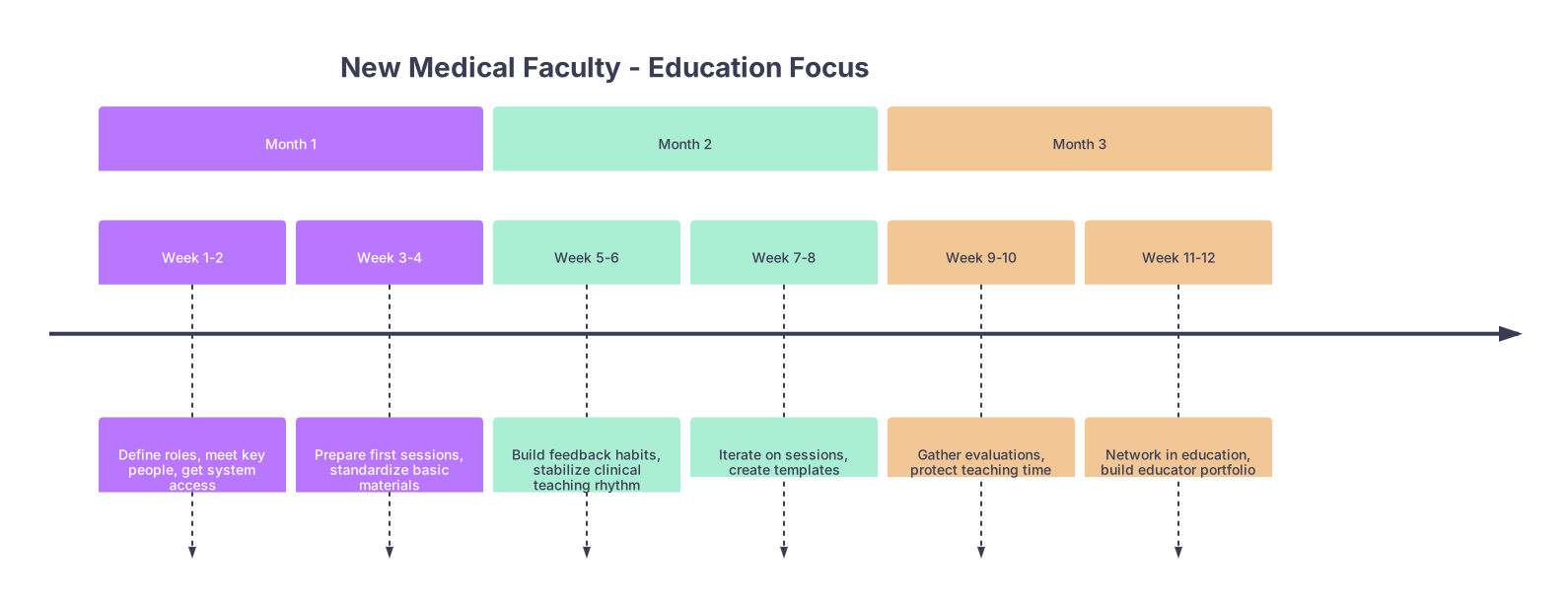
| Period | Event |
|---|---|
| Month 1 - Week 1-2 | Define roles, meet key people, get system access |
| Month 1 - Week 3-4 | Prepare first sessions, standardize basic materials |
| Month 2 - Week 5-6 | Build feedback habits, stabilize clinical teaching rhythm |
| Month 2 - Week 7-8 | Iterate on sessions, create templates |
| Month 3 - Week 9-10 | Gather evaluations, protect teaching time |
| Month 3 - Week 11-12 | Network in education, build educator portfolio |
Quick Priority Map: What Matters Most in the First 90 Days
| Time Frame | Top Education Priority | What You Actually Do |
|---|---|---|
| Days 1–14 | Define role & access | Clarify load, meet directors, get LMS/eval access |
| Days 15–30 | Stabilize early teaching | Prepare first 3 sessions, standardize basic formats |
| Days 31–60 | Improve delivery & feedback | Build clinical teaching rhythm, set evaluation habits |
| Days 61–90 | Protect time & build trajectory | Say strategic yes/no, seek feedback, start portfolio |
Bottom Line: Your First 90 Days as Medical Faculty
Keep three things straight:
- Clarity beats enthusiasm. Get your teaching role, expectations, and systems crystal clear before you start “innovating.”
- Standardization saves you. Simple templates and routines for lectures, small groups, and clinical teaching will protect your time and sanity.
- Think like future you. Document your teaching, seek specific feedback, and say yes only where it builds the educator you actually want to become.