
The biggest barrier between you and a formal educator title isn’t your CV. It’s the fact that nobody can see your teaching yet.
You’re already informally teaching—on rounds, at the bedside, on night float. But when promotions committees sit down with a spreadsheet of “Educator Roles,” your name isn’t even on the first tab. That gap is fixable. And you fix it with a timeline, not wishful thinking.
Below is a stepwise, time-based plan: what to do this month, what to do over the next year, and what to have in place before you walk into any meeting asking for “Assistant Professor of X Education” or “Clerkship Site Director.”
Phase 0 (Now – Month 1): Take Inventory and Define the Target
At this point you should stop thinking “I like teaching” and start thinking “I’m building a teaching portfolio for a specific title.”
Week 1: Clarify your target role
Decide what “formal educator role” actually means for you over the next 2–3 years:
- Site or rotation director (IM ward team, EM shift director, ICU rotation)
- Course or clerkship leadership (block leader, small-group coordinator)
- Program-level education role (APD for education, simulation director)
- Institutional educator title (Clinician Educator track, Academy of Medical Educators member)
Do a quick, targeted search:
- Your institution’s:
- Promotion guidelines
- GME policies
- Academy of educators or teaching awards pages
- 2–3 peer institutions’ job postings for:
- “Assistant Professor Clinician Educator”
- “Clerkship Director”
- “Residency Associate Program Director”
You’re looking for patterns:
| Requirement | How Often Seen |
|---|---|
| Documented teaching hours | Almost always |
| Formal teaching evaluations | Almost always |
| Participation in faculty development | Very common |
| Curriculum development | Very common |
| Education scholarship | Preferred |
By the end of Week 1 you should have:
- 1–2 realistic target roles
- A rough sense of criteria they care about
Week 2: Map your current teaching footprint
Now you quantify what’s been invisible.
Make a simple spreadsheet with columns:
- Activity
- Audience (MS3, PGY1–3, APPs, nurses)
- Format (bedside, didactic, sim, small-group)
- Frequency
- Duration
- Any available evaluations or emails
Pull from:
- Call schedules and rotation calendars
- Conference schedules
- Old emails (“Can you give the sepsis talk next Wednesday?”)
- Online evaluation systems (MedHub, New Innovations, One45, etc.)
By the end of Month 1, you should answer confidently:
- How many hours a month you teach
- To whom
- In what settings
If you can’t, that’s your first red flag. Commit: from now on, everything you teach gets logged.
Phase 1 (Months 1–3): Turn Informal Teaching into Documented, Visible Work
At this point you should assume nothing “counts” unless it’s trackable.
Month 1–2: Start intentional documentation
Every teaching interaction, no matter how small, should generate something:
- A calendar event labeled “Teaching – [Topic] – [Audience]”
- An emailed schedule confirmation
- A brief feedback form link
If your institution has a teaching log, use it. If not, use a personal one.
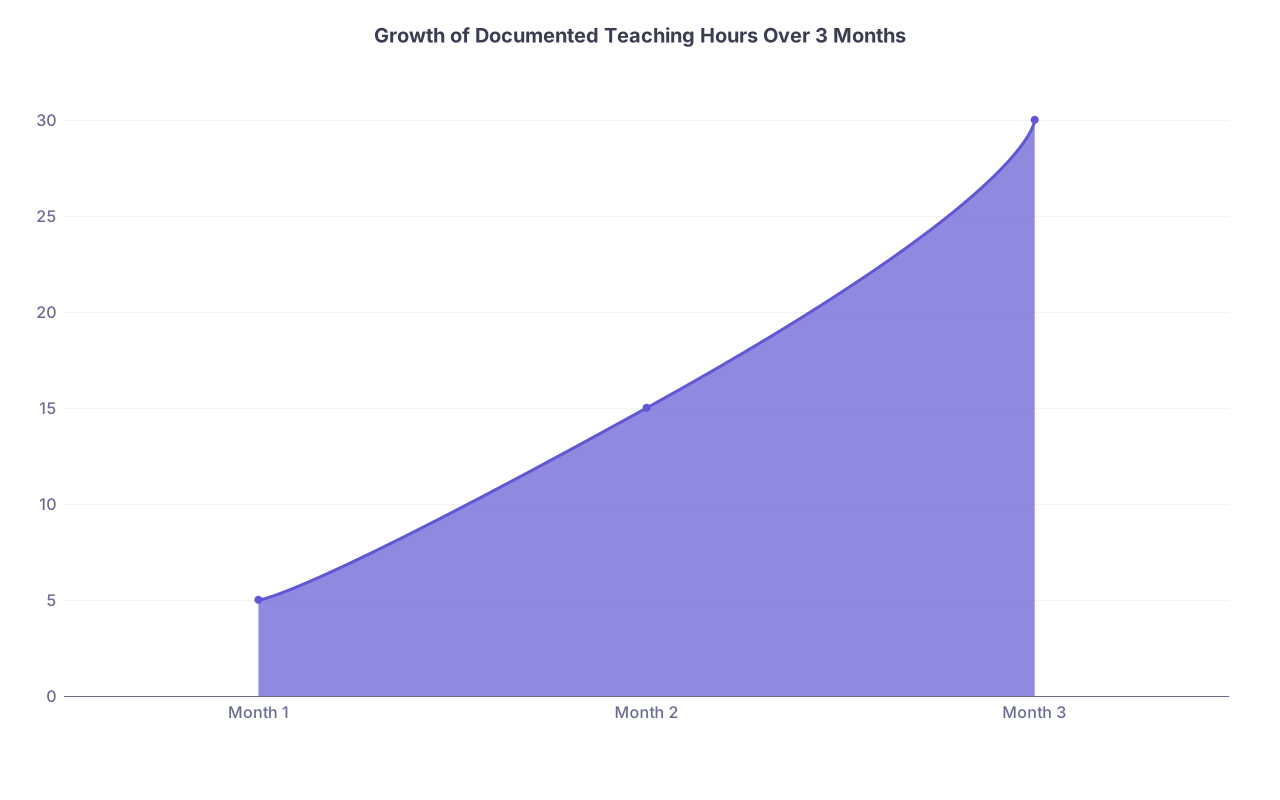
| Category | Value |
|---|---|
| Month 1 | 5 |
| Month 2 | 15 |
| Month 3 | 30 |
Aim by end of Month 3:
- At least 20–30 documented hours of teaching
- At least 2 different learner groups (e.g., students + residents)
Month 2: Get real teaching evaluations
Promotions committees don’t care that the interns “love your chalk talks” if it only lives in group texts.
At this point you should:
- Ask your program coordinator or clerkship office:
- “Can we add me as a teaching faculty in the evaluation system for this rotation?”
- If that’s a dead end, create simple anonymous forms:
- Google Form / Qualtrics link with:
- 3–4 rating questions (clarity, engagement, relevance)
- 1 open-ended (“What helped your learning?”)
- Google Form / Qualtrics link with:
After a session, say something direct but low-pressure:
- “I’m building my educator portfolio. I’d appreciate if you could fill this 1-minute feedback form about today’s session.”
Do this consistently for 2–3 months. Don’t cherry-pick only your best talks. Volume matters.
Month 3: Clean up and standardize at least one teaching product
Pick ONE thing you already do informally and make it “curriculum-like”:
- Your sepsis teaching on wards → a 20-minute structured case with:
- Learning objectives
- 2–3 discussion questions
- 1-page handout or slide set
- Your intern teaching on ABG interpretation → a repeated, scheduled teaching session
- Your impromptu “how to call consults” speech → a mini-workshop with a script and example phrases
Put it in a shared folder:
- Departmental shared drive
- Clerkship faculty folder
- Your personal teaching folder with version control
Now you’re not “giving random talks.” You’re “delivering a structured, recurring curriculum.”
Phase 2 (Months 3–6): Add Formal Training and Named Responsibilities
At this point you should stop being a “good citizen teacher” and start accumulating formal educator credentials.
Month 3–4: Complete at least one faculty development program
You need something you can list under “Formal Training in Medical Education.”
Options (depending on where you are):
- Internal:
- “Foundations of Teaching” or “Clinical Educator Series” (many med schools have this)
- Simulation instructor training
- OSCE examiner training
- External:
- Harvard Macy, Stanford Clinical Teaching Seminar, or regional teaching academies
- Online certificate programs in health professions education
Minimum expectation:
- 6–10 hours of structured training
- A certificate or verifiable record
You time-block this:
- 1 hour/week for 2–3 months
- Or 1–2 intensive workshop days
If you keep pushing this “until things slow down,” you will be an informal teacher forever.
Month 4–5: Take on one small, official education role
Not clerkship director yet. You’re going for “assistant to…” roles first.
Examples:
- Small-group leader in pre-clinical course
- Site coordinator for a single rotation week or block
- Simulation case facilitator
- Morning report or core conference organizer (not just speaker)
How to get it:
- Email the right person with a clean, 5–6 line email:
- Subject: “Interest in [Course/Clerkship] Teaching Role”
- Body:
- 1 line: who you are
- 2 lines: what you already do in teaching
- 2 lines: specific role you’d like
- 1 line: ask for brief meeting
If they say, “We’ll keep you in mind,” don’t let that hang. Respond:
- “Can I at least be added to the teaching faculty list for X rotation starting next block?”
You’re trying to convert vague interest into an actual line item in someone’s spreadsheet.
Month 5–6: Start basic education scholarship
You don’t need to be a PhD in education. But you do need something scholarly tied to teaching.
Realistic starter moves:
- Turn your structured teaching session into:
- A poster at regional education day or SGIM/SHM/peds/EM conference
- A short “work in progress” abstract
- Collect pre/post data on:
- Learner comfort with a topic (simple Likert scale)
- Number of procedures performed after a skill workshop
Timeline:
- Month 5: Design your simple evaluation and start collecting data
- Month 6: Submit abstract to the next reasonable deadline you can find
Phase 3 (Months 6–12): Build a Portfolio That Justifies a Title
At this point you should be transitioning from “I teach” to “I lead something educational.”
Months 6–8: Consolidate your educator brand
Pick a focus area instead of being generically “good at teaching”:
- Clinical reasoning on wards
- Point-of-care ultrasound teaching
- Simulation-based resuscitation training
- Communication skills and difficult conversations
- Feedback and assessment
Center your activities around this:
- 1–2 recurring sessions on that theme
- A small curriculum or workshop
- One scholarly product (poster/abstract)
Start telling people clearly:
- “My main focus is teaching clinical reasoning to early trainees.”
- “I’ve been building our point-of-care ultrasound curriculum for residents.”
This is how your name starts circulating when someone says, “We need an educator for X.”
Months 7–9: Construct your formal teaching portfolio
By now you should have:
- Documented teaching hours (spreadsheet or institutional export)
- Teaching evaluations (summaries, not raw data dumps)
- List of curricular activities you lead
- Faculty development certificates
- Any education-related posters/papers/workshops
Organize it into sections:
- Teaching Activities
- Curriculum Development
- Learner Assessment / Feedback
- Education Leadership (even small roles)
- Education Scholarship
- Teaching Philosophy (1–2 pages max)
You want this ready before you ask for any title so that when a chair says, “Can you send me your educator CV?” you reply within an hour, not three weeks.

Months 9–10: Request feedback and a sponsor, not just advice
You need one or two people ahead of you on the educator track.
At this point you should:
- Identify:
- Clerkship director
- APD for education
- Academy of Educators leader
- Ask for a 30-minute targeted meeting:
- Send your CV and draft teaching portfolio ahead of time
- Be explicit: “I’m aiming for a formal educator role such as X in the next 12–18 months.”
In that meeting, your script is something like:
- “Here’s what I’ve been doing and documenting.”
- “Here are the roles I’m targeting.”
- “What 2–3 things would make me an obvious choice when a position opens?”
Then shut up and write down what they say. Do not argue. Do not explain your constraints. Just log the action items.
Common answers I’ve seen:
- “You need to be formally listed as teaching faculty for at least a year.”
- “You should lead one block of the clerkship rather than just give lectures.”
- “We need to see some consistent teaching evaluations.”
These now become your next 6-month goals.
Months 10–12: Increase leadership level by one notch
You’re now close to asking for a formal title. Before you do, you want at least one responsibility that looks like leadership, not just participation.
Examples, in ascending order:
- You coordinate the schedule for a recurring teaching series
- You own a specific module of a course (e.g., the “shock and sepsis” week)
- You co-lead a simulation course
- You’re the “site champion” for students on your service
If you’re not offered these, propose one:
- “Right now, our residents get ad-hoc teaching on X. I’d like to formalize a monthly 30-minute session, take responsibility for scheduling it, and track attendance and feedback.”
Put that in an email to:
- Your PD
- Your section chief
- Clerkship/course director
You’re not asking for permission to teach. You’re asking to be the named owner of a small educational piece.
Phase 4 (Year 2+): Translate Work into an Official Title
At this point you should have 12+ months of:
- Documented teaching activity
- Formal evaluations
- At least one small leadership role
- Some faculty development
- A starter education scholarship
Now you pivot from “doing” to “asking.”
Months 12–18: Time your ask strategically
You don’t just walk in randomly and say “Can I be called an educator now?”
You align with existing institutional rhythms:
- Annual review with division chief or chair
- Contract renewal discussions
- Promotion cycle deadlines
- When someone steps down from a role
Before that meeting:
- Send an email:
- “For our annual review, I’ve attached my updated CV and teaching portfolio. I’d like to specifically discuss a formal educator role such as X and how my current activities align with that.”
During the meeting:
- Open with impact, not volume:
- “Over the past year, I’ve:
- Led X recurring sessions for residents and students
- Developed Y curriculum
- Completed Z hours of faculty development
- Presented A/B at conference C.”
- “Over the past year, I’ve:
- Then ask clearly:
- “I’d like my role to be formally recognized as [Assistant Clerkship Director / Site Director / Clinician Educator title]. What would it take to make that happen this year?”
Force a specific answer:
- “What’s missing?”
- “Who else needs to sign off?”
- “What timeline is realistic?”
Months 18–24: Lock in the title and renegotiate your job description
Once someone agrees “yes, we can give you X role,” do not let the details stay vague.
You should clarify:
- Title wording (matters for promotion):
- “Assistant Program Director for Curriculum”
- “Clinical Educator Track, Assistant Professor”
- FTE allocation:
- 0.1–0.2 FTE for education is common
- Specific responsibilities:
- What you own
- What metrics you’ll be judged on
Put it in writing:
- Follow-up email summarizing:
- “As we discussed, starting July 1, my role will include:
- [Title]
- [0.X FTE for educational activities]
- [Responsibility list].”
- “As we discussed, starting July 1, my role will include:
If they resist protected time or title, but still expect leadership-level work, say calmly:
- “I’m excited to do this. To sustain it long-term and meet promotion criteria, I’ll need the role and time reflected in my job description. Can we revisit that piece?”
You’re not being difficult. You’re acting like a professional educator, not a volunteer.
A Simple Chronological Snapshot
To make this painfully clear, here’s the stripped-down timeline:
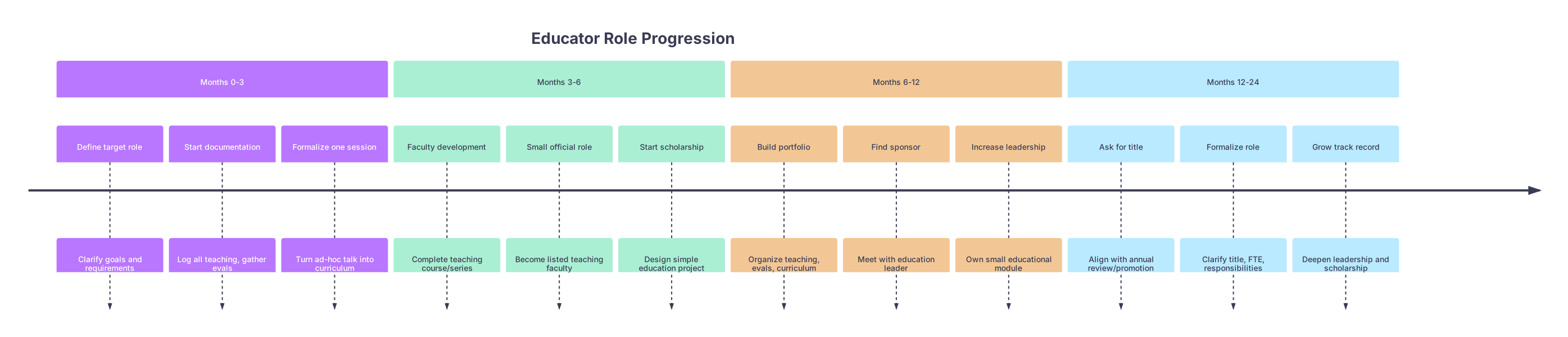
| Period | Event |
|---|---|
| Months 0-3 - Define target role | Clarify goals and requirements |
| Months 0-3 - Start documentation | Log all teaching, gather evals |
| Months 0-3 - Formalize one session | Turn ad-hoc talk into curriculum |
| Months 3-6 - Faculty development | Complete teaching course/series |
| Months 3-6 - Small official role | Become listed teaching faculty |
| Months 3-6 - Start scholarship | Design simple education project |
| Months 6-12 - Build portfolio | Organize teaching, evals, curriculum |
| Months 6-12 - Find sponsor | Meet with education leader |
| Months 6-12 - Increase leadership | Own small educational module |
| Months 12-24 - Ask for title | Align with annual review/promotion |
| Months 12-24 - Formalize role | Clarify title, FTE, responsibilities |
| Months 12-24 - Grow track record | Deepen leadership and scholarship |
Final Key Moves
Three core points, and then you can get back to work:
- At every stage, convert invisible teaching into documented, trackable work—logs, evaluations, and concrete products.
- Move in small, deliberate steps from “participant” to “owner” of at least one educational activity before you ever ask for a title.
- Time your ask around institutional cycles, show a coherent portfolio, and push—politely but firmly—for the title and time that match the work you’re already doing.