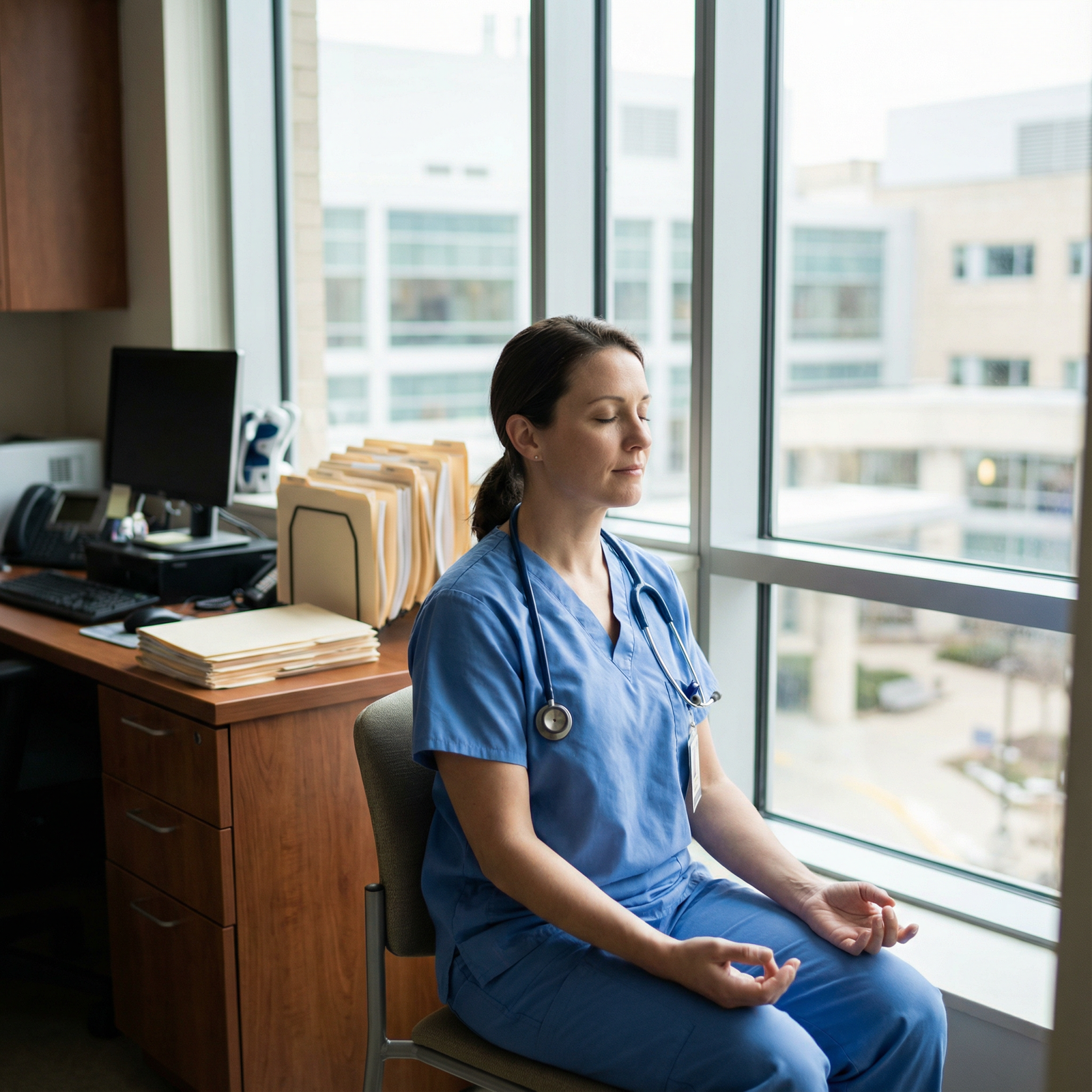
Discover practical Meditation techniques specifically adapted for doctors and other Healthcare professionals to support Stress Reduction, sharpen focus, and deepen Empathy in clinical care.
Why Meditation Matters for Physicians in Modern Healthcare
In contemporary clinical practice, physicians operate in an environment defined by constant urgency, increasing administrative burden, and emotional complexity. Long shifts, frequent exposure to trauma and suffering, and the pressure to avoid errors create a perfect storm for stress and burnout.
Meditation offers an evidence-informed, accessible way for doctors to support their own mental health while also enhancing the quality of patient care.
The Hidden Costs of Chronic Stress in Medicine
Physicians and trainees are particularly vulnerable to chronic stress:
Burnout and emotional exhaustion
High clinical loads, electronic documentation, and limited recovery time can leave physicians feeling detached, exhausted, and cynical. This state not only harms the clinician but can also affect decision-making and quality of care.Impaired concentration and decision fatigue
When cognitive resources are depleted, even experienced doctors can struggle with attention, memory, and complex problem-solving—a serious concern in high-stakes environments such as emergency medicine, surgery, and critical care.Erosion of empathy and compassion
Over time, emotional overload may push physicians toward emotional numbing or “autopilot” interactions. Patients sense this, which can undermine trust, adherence, and satisfaction.
Meditation, particularly when integrated into daily routines, has been shown in multiple studies to reduce perceived stress, support emotional regulation, and improve attention—all critical for sustainable medical practice.
How Meditation Supports Clinical Excellence
Meditation is not about detaching from patients or “emptying” the mind; it is about training attention and awareness in a deliberate way. For physicians, this yields several key benefits:
Stress Reduction and Emotional Regulation
- Lowers physiological stress responses (e.g., heart rate, blood pressure)
- Helps physicians notice early signs of overwhelm and intervene before burnout escalates
- Builds resilience after difficult encounters, errors, or adverse outcomes
Enhanced Focus, Cognitive Flexibility, and Presence
- Improves sustained attention, working memory, and response inhibition
- Enables clearer thinking under pressure, such as during codes, complex procedures, or diagnostic uncertainty
- Supports rapid “reset” between patients to be fully present in each encounter
Strengthened Empathy and Compassion in Patient Care
- Meditation practices that cultivate loving-kindness and perspective-taking help physicians remain connected to the human side of medicine
- Empathy grounded in self-awareness is less likely to lead to compassion fatigue and more likely to sustain meaningful connection over time
- Patients often report feeling more heard, understood, and respected when clinicians practice mindful presence
Ethical Grounding and Professional Identity
- Mindfulness can help physicians reconnect with their core values and reasons for choosing medicine
- This alignment supports ethical decision-making and protects against “moral injury” in resource-constrained or high-demand settings
Core Meditation Techniques Tailored for Doctors
Below are practical Meditation techniques that fit into the realities of Healthcare. Each can be modified for use during a clinic day, on call, or in between procedures.

1. Mindfulness Meditation for Clinical Focus and Presence
What It Is
Mindfulness meditation is the intentional practice of paying attention to present-moment experience—thoughts, emotions, bodily sensations, and external stimuli—without judgment or reactivity. For physicians, it is a way to practice being fully present with patients and with oneself.
How to Practice (5–10 Minutes Before or After Clinic)
Posture and Setting
- Sit upright in a chair, feet flat on the floor, hands resting on your lap.
- Choose a relatively quiet space: an empty exam room, call room, or your car before entering the hospital.
Anchor to the Breath
- Close your eyes or lower your gaze.
- Bring attention to the sensations of breathing—air passing through the nostrils, the rise and fall of the chest or abdomen.
Notice and Label Distractions
- When thoughts arise (“I’m behind on notes,” “I still need to call that consultant”), silently label them: thinking, planning, worrying.
- Gently redirect attention back to the breath, without self-criticism.
Expand Awareness
- After a few minutes, broaden awareness to include sounds, physical sensations (e.g., tension in shoulders), and emotional tone (e.g., anxious, tired, neutral).
- Observe these experiences without trying to change them.
Close the Practice
- Take three slower, deeper breaths.
- Intentionally set an aim for the next part of your day: “May I be focused and kind with each patient I see.”
Clinical Application Example
Between two emotionally intense encounters—such as giving bad news and then seeing a patient with a routine issue—a 2–3 minute mindfulness reset can prevent emotional spillover and allow you to show up fresh for the next patient.
2. Guided Imagery for High-Stakes Situations
What It Is
Guided imagery uses mental visualization of calming scenes or successful outcomes to reduce anxiety and optimize performance. This is especially useful before procedures, difficult conversations, or examinations.
How to Practice (3–10 Minutes, Before a Challenge)
Choose Your Focus
- Option A: A calming environment (mountain, beach, favorite park, a quiet room at home).
- Option B: A specific clinical scenario (e.g., leading a code, performing an intubation, having a goals-of-care conversation).
Engage the Senses
- Visual: Colors, light, and shape of the environment.
- Sound: Waves, birds, or the soft background hum of the hospital.
- Touch: The feeling of your clothing, a chair, or the OR table.
- Smell: Fresh air, antiseptic, or coffee—whatever is natural to the scenario.
Visualize Calm Competence
- If focusing on a clinical scenario, picture yourself grounded, breathing steadily, listening carefully, and responding skillfully.
- Imagine obstacles arising and see yourself handling them with clarity and composure.
Anchor the Feeling
- Notice how “calm confidence” feels in your body—perhaps in the chest or abdomen.
- Take a few breaths intentionally reinforcing that sensation.
Clinical Application Example
Before a particularly complex family meeting, a physician might spend 5 minutes visualizing the room, the family members’ faces, potential emotional responses, and their own steady, compassionate presence throughout the interaction.
3. Body Scan Meditation for Somatic Awareness and Stress Relief
What It Is
Body scan meditation systematically brings awareness to different parts of the body, helping you notice and release accumulated tension. Physicians often override physical signals of stress; this technique helps reclaim that awareness.
How to Practice (5–20 Minutes, After a Shift or Before Sleep)
Position and Environment
- Lie on your back on a bed, couch, or yoga mat, or sit reclined in a chair.
- Close your eyes and take a few slow, deep breaths.
Systematic Scan
- Start with the toes of one foot. Notice sensations: tingling, pressure, warmth, or numbness.
- Slowly move attention upward: foot, ankle, calf, knee, thigh, hip.
- Continue up through the pelvis, abdomen, lower back, chest, upper back, shoulders, arms, hands, neck, and head.
Release with the Breath
- When you detect tension (e.g., tight jaw, clenched shoulders), imagine exhaling tension out of that region.
- You don’t need to “fix” anything; simply noticing without resistance often softens tension naturally.
Integrate and Close
- After scanning the whole body, hold awareness of the entire body as a single field of sensation.
- Take a few deeper breaths and gently open your eyes.
Clinical Application Example
After a long call shift, a brief body scan before sleep can help transition from hypervigilance to rest, allowing your nervous system to downshift more efficiently and improving sleep quality.
4. Loving-Kindness Meditation (Metta) to Cultivate Empathy
What It Is
Loving-kindness (Metta) meditation explicitly trains the mind in compassion, goodwill, and empathy—toward oneself, colleagues, and patients. It is especially valuable for physicians who feel emotionally drained or disconnected.
How to Practice (5–15 Minutes, Anytime)
Begin with Yourself
- Sit comfortably, close your eyes, and bring to mind your own image.
- Silently repeat phrases such as:
- “May I be safe.”
- “May I be healthy.”
- “May I be peaceful.”
- “May I live with ease.”
Extend to a Benefactor or Loved One
- Bring to mind someone who has supported you (mentor, family member, friend).
- Repeat: “May you be safe… healthy… peaceful… live with ease.”
Extend to Neutral Persons and Colleagues
- Think of someone you interact with but don’t know well (e.g., a lab tech, clerk, or colleague).
- Offer the same phrases, noticing any softening in judgment or distance.
Extend to Difficult Individuals or Challenging Patients
- When ready, you may bring to mind a particularly challenging patient, colleague, or situation.
- Without justifying their behavior, acknowledge their humanity and repeat: “May you be safe… May you be at peace.”
Extend to All Patients and Communities
- Finally, broaden your scope: “May all my patients be safe and supported. May all who suffer in this hospital/clinic find relief.”
Clinical Application Example
Before starting clinic, a 3-minute loving-kindness practice focusing on “today’s patients” can shift your mindset from transactional to relational, strengthening your capacity for patient-centered care even on busy days.
5. Breathing Techniques for On-the-Spot Stress Reduction
What It Is
Breathing exercises are simple, rapid tools that physicians can deploy in real time during stressful moments. They help regulate the autonomic nervous system and can be done discreetly, even while walking down a corridor.
Box Breathing (4–4–4–4)
- Inhale through your nose for a count of 4.
- Hold your breath for a count of 4.
- Exhale slowly through your mouth for a count of 4.
- Hold empty for a count of 4.
- Repeat for 3–5 cycles.
Use this before entering a stressful encounter or while washing your hands.
Extended Exhale Breathing (4–6 or 4–8)
- Inhale gently through your nose for 4 seconds.
- Exhale slowly through pursed lips for 6–8 seconds.
- Repeat for 1–3 minutes.
This pattern activates the parasympathetic nervous system, promoting calm and clarity.
Clinical Application Example
Waiting on hold with a consultant or standing outside a patient’s room before delivering serious news is an ideal micro-moment for 30–60 seconds of extended exhale breathing.
Integrating Meditation into a Busy Medical Schedule
Even when convinced of the benefits, many physicians worry: “Where will I find the time?” The goal is not to create additional burden, but to embed meditation into existing routines in realistic, sustainable ways.
Start Small and Make It Doable
- Begin with 2–5 minutes a day rather than aiming for long sessions. Consistency beats intensity.
- Choose a specific anchor:
- Before opening your first chart
- After scrubbing in but before incision
- Right after signing out at the end of your shift
Use “Hidden” Downtime
- While hand-washing or sanitizing: Focus on the sensations of water or sanitizer and take 3 conscious breaths.
- During elevator rides or walking between wards: Practice mindful breathing or brief body awareness.
- While waiting for labs or imaging: Instead of defaulting to your phone, spend 1–2 minutes breathing or doing a mini body scan.
Build Supportive Habits and Culture
Create cues and reminders
- Place a small sticker, bracelet, or note in your workspace to remind you to pause and breathe.
- Use phone alarms or calendar events labeled “60-second reset.”
Engage colleagues and teams
- Suggest a 3-minute “quiet start” before morning sign-out or multidisciplinary huddles.
- Join or start a wellness or mindfulness group for residents, attendings, and staff.
Use digital tools strategically
- Meditation apps (e.g., Insight Timer, Headspace, Calm, Ten Percent Happier) offer short, physician-friendly practices.
- Consider brief guided meditations specifically designed for Healthcare professionals or physicians.
Bringing Mindfulness Directly into Patient Encounters
Small shifts in attention can transform how patients experience care:
- Take one conscious breath before entering each exam room.
- Practice active listening: for 30–60 seconds, listen without interrupting, planning, or typing.
- During physical exams, synchronize your attention with your touch—notice the sensation of your hands and the patient’s breathing.
- At the end of each visit, pause mentally and reflect briefly: “Did this patient feel heard?” This builds ongoing empathic awareness.
Safeguards and Considerations for Physicians
Meditation is generally safe, but physicians should be mindful of:
- Uncomfortable emotions: As you slow down, grief, anger, or anxiety may surface. This is normal. Consider brief practices and, if needed, seek professional support or peer debriefing.
- Not a replacement for clinical care: Meditation can complement, but never replace, therapy, medication, or systemic interventions needed to address burnout or mental health conditions.
- System-level change still matters: Individual Stress Reduction does not remove the need for institutional efforts around workload, staffing, and humane scheduling. Meditation is one tool—not the entire solution.

Frequently Asked Questions (FAQs) About Meditation for Physicians
1. How much meditation do I need to see benefits as a physician?
Research suggests that even 10–15 minutes a day, practiced most days of the week, can lead to measurable improvements in stress, attention, and well-being over several weeks. However:
- Immediate effects: Many doctors notice reduced tension and clearer thinking after a single 3–5 minute session.
- Sustained benefits: These typically emerge over 4–8 weeks of regular practice.
- You can start with 2–5 minutes daily and gradually increase as it becomes more comfortable.
2. I can’t seem to “clear my mind.” Am I doing meditation wrong?
No. Meditation is not about having no thoughts:
- The mind naturally generates thoughts; this is normal and expected.
- The practice is to notice when your attention has wandered and gently return to your chosen anchor (breath, body, sounds, or phrases).
- Every time you notice wandering and return, you are training the “attention muscle”—similar to reps at the gym.
Struggling with distraction does not mean you are failing; it means you are doing the work.
3. Can meditation realistically improve my empathy and patient care?
Evidence and clinical experience suggest yes:
- Mindfulness and loving-kindness practices have been associated with increased empathy, improved bedside manner, and better patient satisfaction.
- Physicians who meditate often describe:
- Feeling more present and less rushed during encounters
- Hearing more of what patients are really worried about
- Greater patience with difficult or non-adherent patients
Enhanced Empathy does not mean absorbing all suffering; rather, it supports compassion with boundaries, which helps prevent compassion fatigue.
4. What if I feel too exhausted or burned out to start meditating?
If you’re deeply exhausted, meditation might initially feel like “one more thing to do.” Try:
- Ultra-short practices: 30–60 seconds of conscious breathing before bed or upon waking.
- Gentle, non-demanding approaches like body scan while lying down—no need to sit upright or exert effort.
- Consider pairing meditation with existing rest habits: after a shower, before scrolling on your phone, or right before sleep.
If burnout is severe, meditation should be part of a broader plan that may include formal mental health support, schedule adjustments, or institutional resources.
5. Are there meditation resources specifically geared toward healthcare professionals?
Yes. Examples include:
- Apps and programs that feature Healthcare- or physician-specific tracks, often with modules on Stress Reduction, difficult conversations, or compassion.
- Many hospitals and academic centers now offer mindfulness courses for residents and faculty, brief workshops during grand rounds, or wellness curricula in GME.
- Peer groups or Balint-style groups sometimes incorporate mindful reflection into case discussions, focusing on the physician–patient relationship and emotional impact.
Check your institution’s wellness or GME office, or your specialty society, for tailored offerings.
By integrating Meditation into the daily rhythm of medical practice—even in brief, practical ways—physicians can cultivate sharper focus, more sustainable Stress Reduction, and deeper Empathy. These skills not only enhance personal well-being but also enrich every patient interaction, supporting a more humane, ethical, and satisfying practice of medicine.