
The 2 a.m. Text That Starts the Trouble
It's 2 a.m. You're post-call, running on bad coffee and sheer spite. Your phone buzzes. A local urgent care needs coverage this weekend. "Easy money," they say. "Just bring your license." You assume your visa, training status, and hospital approval can be sorted out later. Stop right there. I've seen this scenario play out too many times, and it rarely ends well.
Many J-1 and H-1B residents treat moonlighting like a simple scheduling problem. It's not. It is an immigration, licensing, credentialing, and compliance minefield. One wrong assumption can jeopardize your visa status, employment authorization, program standing, and future immigration options. I'm going to walk you through the common errors J-1 and H-1B residents make, the red flags they miss, and the safer step-by-step way to proceed. Don't throw away your career for a weekend shift.
Disclaimer: This article is for educational purposes only and does not constitute legal, financial, or immigration advice. Regulatory rules and contract outcomes vary widely by state and institution. Readers should consult qualified professionals before making employment decisions.
Mistake #1: Assuming J-1 and H-1B Rules Are Basically the Same
This is the first major error. Residents hear generic moonlighting advice from their citizen colleagues and assume it applies to them. It doesn't. There is a high-risk distinction here. J-1 physicians are usually limited to the educational activities authorized by their training program and sponsor (like ECFMG). H-1B physicians may need separate, employer-specific authorization for any outside work.
"But my co-resident does it!" is not evidence of legality. Their visa, sponsor, institution, or job setup may be entirely different. Maybe they have a Green Card pending. Maybe they're on an O-1. Immigration status does not care about informal precedent, verbal reassurance, or local hospital culture. If you violate your visa terms, "everyone else was doing it" won't save you from a revoked status or a denied future visa application.
Verify the rules through official channels before you even discuss pay rates. Call your sponsor. Talk to your international office. Do not pass Go until you have the specific rules for your specific visa in your specific situation.
Mistake #2: Thinking Program Approval Automatically Makes It Legal
Never rely on a chief resident, attending, scheduler, or even a supportive program director as the final authority on moonlighting. They are not immigration lawyers. Getting the "okay" from your PD is just one layer of a multi-layered compliance cake. Program approval, GME approval, hospital credentialing, malpractice coverage, state licensure, and immigration authorization are entirely separate issues.
Here is the common trap: a program says moonlighting is allowed in general, and the resident takes that as a green light. But that institutional policy does not override federal visa restrictions. Some institutions explicitly ban internal or external moonlighting for certain visa categories, regardless of how ready the resident is clinically.
If you get caught working without proper authorization, you are the one who gets deported or penalized, not the program director. You need written confirmation, not casual hallway reassurance. If it's not in writing, it didn't happen.
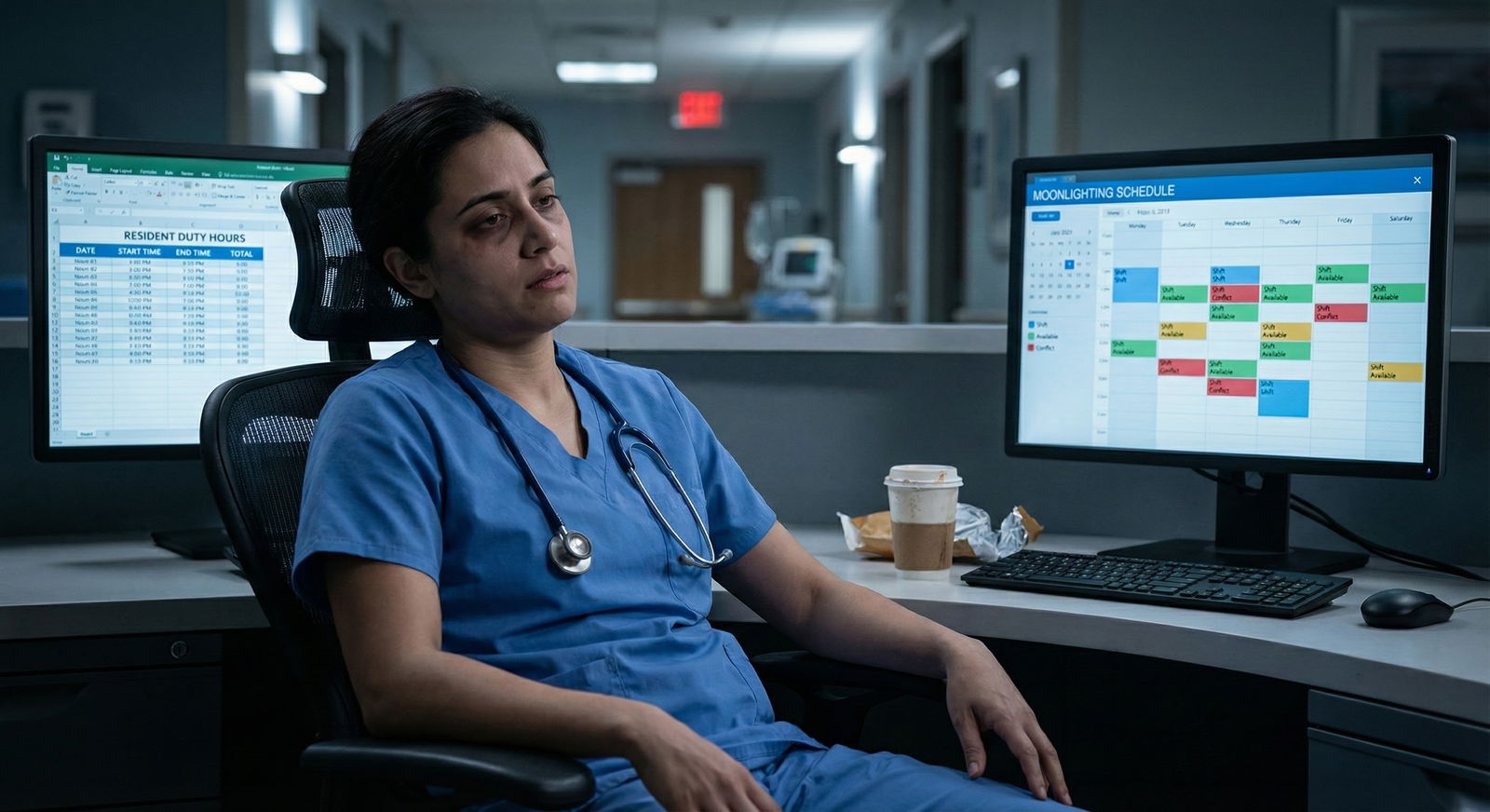
Mistake #3: Ignoring the Difference Between Internal and External Moonlighting
Let's define terms. Internal moonlighting is extra paid clinical work within your training institution. External moonlighting is work for an outside entity. Residents get this wrong constantly.
Internal moonlighting feels like "just more residency work." You're in the same hospital, using the same EMR, seeing the same type of patients. But it can still trigger policy, credentialing, and immigration concerns. External moonlighting usually adds far more risk. You have a new employer, a separate worksite, different malpractice arrangements, and employer-specific immigration implications.
Even if a shift at an outside clinic is clinically identical to your residency duties, the fact that it is separately paid and outside your designated institution changes how it is treated under immigration law. Do not assume a shift is permissible just because it's "easy" or clinically relevant. You must ask exactly how each shift is classified before accepting it.
Mistake #4: Forgetting That State License, DEA, Credentialing, and Malpractice Can Stop You First
Immigration is only one gatekeeper. Many residents are blocked much earlier by basic licensing and employment logistics. Some moonlighting jobs require a full, unrestricted medical license. A training license or institutional permit won't cut it. Then you have credentialing delays, background checks, payer enrollment issues, and DEA requirements that can make a "quick start" completely impossible.
But the real danger here is malpractice. Residents sometimes assume their residency malpractice coverage extends automatically to outside paid work. It does not. If you moonlight at an outside urgent care and get sued, your training program's insurance might leave you hanging out to dry. That is a serious and expensive mistake.
Ask exactly who covers you, for what setting, and in writing. Do not practice bare.
Mistake #5: Overlooking Duty Hours, Fatigue, and Performance Consequences
Let's shift from legal risk to training risk. Even if your moonlighting is technically permitted, it can still backfire if it harms your performance or violates duty-hour limits. Moonlighting hours often count toward your weekly duty hour calculations, depending on institutional and ACGME rules.
The hidden pattern I've watched unfold: a resident picks up extra income, becomes profoundly sleep-deprived, misses educational opportunities, and starts triggering remediation concerns. Visa-holding residents are especially vulnerable here. Professional problems can have massive downstream consequences for contract renewal and immigration planning. A bad evaluation or a patient safety event because you were exhausted from a moonlighting shift can destroy your career trajectory.
Set a conservative threshold. If moonlighting compromises patient safety, board preparation, fellowship applications, or your basic wellness, it is not worth the risk.
Red Flags That Should Make You Stop Immediately
Watch out for these warning signs:
- "Everyone does it."
- "We can just pay you as an independent contractor."
- "We'll fix the paperwork later."
- "It's under the table, so it doesn't count."
- "It doesn't matter because it's just a few shifts."
Include immigration-specific red flags: no written review of visa implications, no employer legal counsel involved for H-1B outside work, or vague statements about J-1 exceptions without sponsor documentation. Institutional red flags: no malpractice certificate, no credentialing timeline, no written duty-hour policy, no clarification of internal versus external classification.
Treat urgency as a danger signal. Legitimate moonlighting opportunities can survive a proper review process. Fast money is not worth a slow-motion immigration disaster.
What To Do Instead: A Safer Pre-Moonlighting Checklist
Here is the practical sequence to protect yourself:
- Identify your visa category.
- Ask whether moonlighting is institutionally allowed for your specific visa type.
- Determine if the shift is internal or external.
- Confirm state license requirements (training license vs. full license).
- Review malpractice coverage to ensure you are insured for that specific site.
- Verify duty-hour impact with your coordinator.
If you are a J-1 resident, check directly with the official sponsor (like ECFMG) and program leadership before accepting any paid clinical work. Do not assume your program knows the sponsor's rules.
If you are an H-1B resident, confirm whether the outside work requires separate employer-sponsored H-1B authorization before you perform any services. Amending an H-1B takes time and money.
Collect all approvals in writing. Keep personal records of contracts, authorization notices, schedules, and insurance documents. Consult GME, immigration counsel, or your institutional immigration office, and the hiring site before your first shift.
Bottom Line: Protect Your Training Before You Chase Extra Income
J-1 and H-1B residents get moonlighting wrong when they move faster than the rules. The biggest pitfalls are false equivalence between visa types, assuming program approval is enough, overlooking external-work restrictions, and underestimating licensing and malpractice barriers.
The safest resident is the one who pauses, verifies, and gets every approval before saying yes. If any part of the arrangement is unclear, the default answer is not "probably fine." It is "not yet." Protect your status first.