
Last year, a PGY‑3 medicine resident pulled me aside after sign-out, closed the door, and said: “I’m getting paid $75 an hour to cover nights at the community affiliate. My co-residents think it’s $45. Don’t say anything.” He wasn’t lying—and he wasn’t the only one.
If you think resident call pay, moonlighting rates, and “extra shift” deals are standardized and fair, you’re living in fantasy land. There’s the official policy—and then there’s what senior residents quietly negotiate once they know where the levers are.
Let me walk you through what actually happens. Not the handbook version. The version chiefs, program directors, and administrators talk about behind closed doors when they think you are not listening.
The Two Economies of Resident Work
On paper, your residency has one economy: your base salary plus whatever token call pay or moonlighting structure HR recognizes.
In reality, there are two overlapping economies:
- The visible one: what’s in the contract, GME handbook, and those “PGY salary” slides on interview day.
- The shadow one: ad-hoc deals, “special arrangements,” and shifts that get quietly created when a service is desperate and someone senior knows how to ask.
Senior residents who benefit from this know a few key truths:
- Hospitals panic about uncovered nights long before they’ll admit it.
- Some revenue streams (ED boarders, obs, cross-cover at community sites) are cheap to cover with residents compared to NPs/locums.
- There’s almost always more money on the table than what’s publicly posted.
The trick is understanding who actually controls the money, what problems they’re trying to solve, and how to structure your request so you’re seen as the solution—never as “the entitled resident.”
Who Really Controls Call Pay and Extra Shifts
Here’s the first secret: your program director doesn’t control most of the money.
They control permission. But not payment.
The dollars typically come from one of four buckets:
| Source | Typical Controller |
|---|---|
| Department moonlighting | Department chair/vice chair |
| Hospital night coverage | Hospitalist/ED medical director |
| Community affiliate sites | Site medical director |
| Research/administrative | Division chief or project PI |
What senior residents figure out by PGY‑3 or PGY‑4 is:
- The department cares about RVUs and attendings’ sanity.
- The hospital cares about empty call schedules and compliance on coverage.
- The program cares about ACGME rules, fatigue, and reputation.
So when a service is bleeding—too many open nights, attendings burnt out, locums too expensive—that’s where you slide in as the “cost-effective, flexible solution.”
Notice what’s missing here: “fair compensation for residents.” That’s never the primary driver. You get paid more when your ask aligns with their pain point.
How the “Quiet” Negotiations Actually Start
It almost never begins with, “I want more money.”
It usually starts something like this:
- “We had three uncovered night shifts last month. How are we covering those?”
- “I heard we’ve been using locums at the community site—what does that cost us?”
- “I’m graduating in a year and interested in more autonomy with backup. Any chance to help with night coverage?”
You’re not asking yet. You’re fishing.
You’re trying to surface two things:
- Is there a coverage problem? Unfilled call. Angry attendings. Overloaded NPs.
- Is there money already flowing? Locums, PRN hospitalists, overtime for APPs.
Once you hear something like, “We’ve been paying a locums $180/hour to cover nights,” a smart senior resident thinks: there’s margin there.
I watched a PGY‑4 at a big Midwest IM program walk this in slow motion. They were paying locums to cover a satellite hospital’s nights. He went to the hospitalist director and said:
“I know locums are expensive. If you can clear it with GME and PD, I’d be willing to cover some of those nights at a lower rate than locums, with an attending backup from home. We get more experience, you save money. Worth a conversation?”
Notice the framing. Resident benefit second. Hospital savings and service stability first. That conversation turned into a $90/hour internal moonlighting pool for PGY‑3+.
And yes, only the residents who were paying attention got in early.
The Four Common Quiet Deals Senior Residents Cut
Let’s go through the ones I keep seeing, over and over, across programs.
1. Upgrading “Volunteer” Extra Call to Paid Call
Many programs start with this line: “We don’t pay for extra call. It’s part of your training.”
That line gets repeated until a critical mass of things go wrong: schedule gaps, people out on leave, or a new service opens.
Then, suddenly, the policy becomes flexible.
I’ve watched this exact pattern:
- Chief realizes the call schedule has multiple holes.
- PD doesn’t want to force last-minute coverage and create mutiny.
- Hospitalist group is threatening to refuse resident coverage unless nights are stable.
A senior resident comes in and says something like:
“I’m willing to pick up two extra weekend calls a month for the next three months to stabilize the schedule. Could we set a standard stipend for voluntary extra calls, so it’s sustainable and transparent?”
What usually happens behind the scenes:
- PD sighs, calls department admin: “Can we find $X per extra call from the department budget?”
- They run numbers, compare to what they’d pay a moonlighter/hospitalist.
- They pick a number that’s cheaper than alternatives. Often somewhere like $200–$400 per 24‑hour inhouse call depending on region and specialty. Sometimes more.
Is that “fair”? No. But it’s more than zero. And it’s how the first call pay structure gets born.
The senior who initiated that? They typically get first dibs on those shifts.
2. Setting the Rate at Affiliated Community Hospitals
This is where the real money usually is.
Academic main campus: everyone’s watching. GME, finance, compliance, ACGME fellows. Anything you do there tends to be standardized, slow, and tightly controlled.
Community affiliate down the road? Different story.
Those sites are under pressure to:
- Maintain 24/7 admitting coverage
- Staff low-volume nights without hemorrhaging money
- Keep their attending corps from quitting
At one large East Coast system, the community site was paying a nocturnist $220/hour. They were running 1–5 admits a night. Cost-prohibitive.
A savvy senior resident approached the site medical director, not the PD, and said:
“I’m credentialed at main campus. If we built a structured moonlighting program for seniors here—with clear caps, supervision, and GME signoff—you’d pay far less than locums and we’d get fantastic experience. We’d need X dollars an hour to make this worth taking on.”
He dropped the first anchor: $110/hour.
They landed at $95/hour with in-house resident presence, attending at home, low-admit cap, and strict eligibility criteria.
The PD’s role? Approve the idea, ensure duty-hour compliance, and make sure it wasn’t exploitative. But the rate was essentially set in that first conversation with the site director, framed around cost compared to locums.
That’s a pattern:
- Residents quietly benchmark themselves against locums/NP rates.
- They propose a number that saves the hospital money but feels high compared to base salary.
- The first group through the door cements the going rate.
3. “Project Stipends” That Are Really Paid Call
Sometimes money can’t be justified as “call pay,” but it can appear as “project support,” “QI stipend,” or “administrative supplement.”
Here’s how that looks from the inside.
A program is drowning on a particular front—maybe:
- Discharge summaries are chronically late.
- A new observation unit needs resident involvement for a pilot period.
- A complex QI or throughput project needs someone to be on-call to troubleshoot.
Officially, there’s “no budget” for call pay.
An upper-level resident with rapport goes to the associate program director or division chief and says:
“I’m willing to take primary responsibility for X nights of coverage for this new obs pilot, including being the point person for throughput. That’s significant additional work. Could this be structured as a project with a stipend instead of informal ‘extra duty’?”
Departments have more flexibility paying for “admin/QI time” than “extra clinical work” for residents. It goes through different buckets, sometimes grant funds.
I’ve seen $3,000–$7,500 “project stipends” attached to what is, functionally, a handful of extra nights or weekends on a new service.
Is that formally “call pay”? No.
Does the resident understand perfectly well that they’re being compensated for stepping into a gap nobody else wants? Absolutely.
4. The Quiet Differential for Unpopular Shifts
Not every shift gets the same rate, regardless of what the flyer says.
In some departments, there’s an unpublished tiering system that only the seniors and chiefs know:
- Friday/Saturday night cross-cover pays more than a Tuesday.
- Holiday weekends have an unofficial bump.
- Last-minute coverage (“SOS shifts”) get offered at a higher rate to a small trusted pool.
How that gets negotiated is usually very direct and very off-the-record.
I sat in a call room when a chief texted a PGY‑4: “I’ll get them to bump this to $600 for the 24 if you take Christmas Eve. Interested?”
The official moonlighting sheet listed $400/24. But the chief knew the hospitalist director had some discretionary flexibility and was desperate to fill a holiday. So the chief advocated for a “one-time exception.”
Those “exceptions” quietly set informal precedents. The resident who took the hit now knows the real range. Next time, they’re not taking $400 for a major holiday unless they want to.
How Senior Residents Actually Negotiate (Step by Step)
Let’s strip this down. You want to be one of the people who gets better rates, better shifts, and isn’t the last to know.
Here’s the underlying playbook I see successful seniors use again and again.
1. They Become “Safe Hands” First
No one pays you more if they don’t fully trust you.
The residents who get these deals:
- Are known to show up and not implode.
- Do not constantly complain to admin about every inconvenience.
- Have at least one attending champion who will say, “Yes, they can handle more responsibility.”
You don’t have to be the superstar. You just cannot be the headache.
2. They Collect Intel Quietly
They ask questions, not demands.
- “Who covers nights at the affiliate now?”
- “Do we ever use locums? Any idea what they cost?”
- “Are there ever unpaid extra calls that keep going unfilled?”
They talk to chiefs, senior residents, that one cynical hospitalist who has been there 15 years and knows exactly where the bodies are buried.
Sometimes they’ll literally hear, “We’re paying an NP $80/hour to sit here overnight and do almost nothing, but it’s safer than leaving it uncovered.”
Now you have a reference point.
3. They Anchor Against Alternatives, Not Against “Fairness”
When they finally propose a number, they don’t say:
“I think $X is fair for my time.”
They say something like:
“I know we’re currently paying locums about $190/hour and NPs around $70/hour for nights. If we structured resident coverage at, say, $85/hour with proper supervision, that saves the hospital money and gives us excellent experience.”
See the difference?
You’re not begging for worth. You’re making a business argument. Admins respond to that.
4. They Offer Structure, Not Chaos
What kills these discussions faster than anything is the impression that residents want a Wild West extra-shift free-for-all.
The smart senior resident walks in with a proposed structure already thought out:
- Eligibility: PGY‑3+ only, in good standing, specific competency checks.
- Caps: Max extra hours per month, clear duty-hour protection.
- Supervision model: In-house vs at-home attending, clear scopes.
- Scheduling: How sign-ups work, how to avoid cannibalizing regular rotations.
I’ve literally seen a PGY‑3 show up to a meeting with a one-page outline:
- Proposed hourly rate
- Eligibility criteria
- Max shifts per month
- Supervision plan
- Draft language for GME approval
Admin looked at it and said, “You just did half my work.” That’s how you get a yes.
5. They Never Make It Just About Themselves
Another pattern: the senior doesn’t ask for something that benefits only them.
They frame it as:
“This would create a sustainable option for senior residents.”
“This could become a structured moonlighting pool for future classes.”
Ironically, they’re the ones who benefit most early on. But PDs and division chiefs say yes when it looks like a program-wide win, not a one-off handout.
How Much Are People Actually Getting Paid?
Let me give you some ballpark numbers I’ve seen, so you know what’s reality and what’s fantasy. This is not “official data.” This is what lands in my inbox and what residents tell each other at conferences and away rotations.
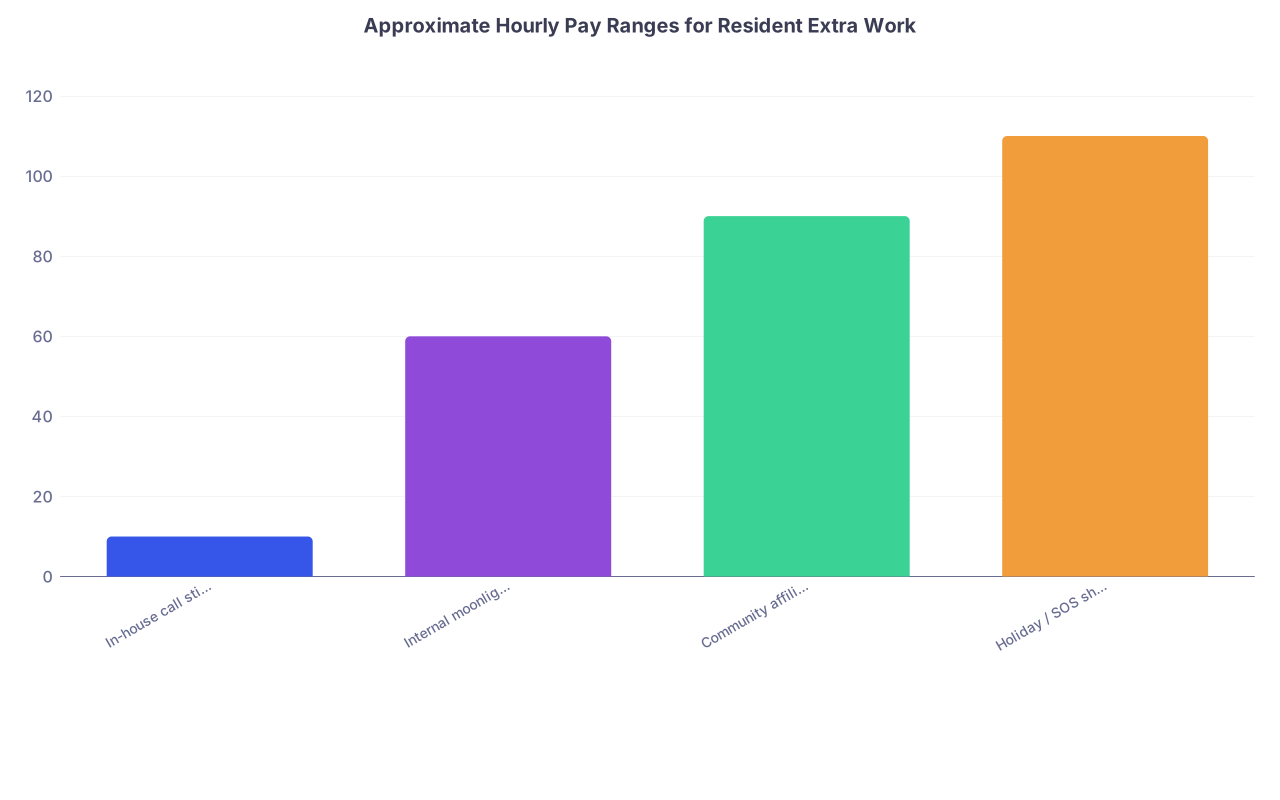
| Category | Value |
|---|---|
| In-house call stipend | 10 |
| Internal moonlighting | 60 |
| Community affiliate moonlighting | 90 |
| Holiday / SOS shifts | 110 |
Translate that:
- In-house call “pay” often ends up around $10–$20/hour effective when you break a $200–$400 stipend over a brutal 24.
- Internal moonlighting on busy services often sits in the $50–$80/hour range.
- Community affiliate moonlighting with low volume and home backup can climb into the $80–$120/hour range in many regions.
- Holiday/SOS shifts sometimes get quiet bumps above the posted rates, especially if arranged last minute.
Again: these are patterns, not guarantees. Some places are much lower. A few are higher. What matters is that the first resident to anchor the conversation usually shapes the bracket for years.
Where Residents Get Burned (And How Not to)
For every senior who pulls off a quiet win, there’s someone who screws this up and ends up exhausted, underpaid, or on the PD’s bad side.
The self-inflicted wounds all look the same.
Overcommitting and Violating Duty Hours
This is the easiest way to get your new “deal” killed.
If you’re picking up extra nights, you must be militant about:
- 80‑hour workweek caps
- Day-off requirements
- Post-call rest
Programs and hospitals will happily benefit from your extra work… right up until an ACGME site visit catches them out. Then suddenly everyone pretends they had no idea and the moonlighting program gets frozen “pending review.”
Smart residents:
- Track their own hours.
- Say no when it conflicts.
- Document that moonlighting was logged properly.
Undercutting Your Co-residents
Nothing poisons trust faster than one resident quietly accepting lower rates that pull the whole market down.
Hospital offers $55/hour. You know they pay NPs $70 and have used locums at $180. You take it anyway because you “need the money.” Next year, when someone else tries to negotiate up, admin says: “But your colleague last year was fine with $55.”
If you’re going to negotiate, at least ask around so you’re not setting a bad precedent for those coming behind you.
Going Around the PD in a Dumb Way
Yes, I said the PD doesn’t control the money. That does not mean you blindside them.
If the PD hears about your new night shift directly from the CMO or, worse, from an ACGME alert, your informal deal dies instantly.
The residents who succeed keep the PD looped in:
“Dr. X and I talked about a potential moonlighting option at the community site. Before anything moves, I want to make sure you’re comfortable and that it fits within ACGME rules.”
You don’t ask permission at step one, but you don’t finalize anything without them either. PDs hate being bypassed. They’re also your shield if admin tries to squeeze more out of you than is safe.
The Future: This Is Going to Get Bigger, Not Smaller
The direction of travel is clear if you’re paying attention.
- Hospitals are squeezed on margins.
- Locums and APP costs keep climbing.
- Residents remain, frankly, cheap.
So you’re going to see more of:
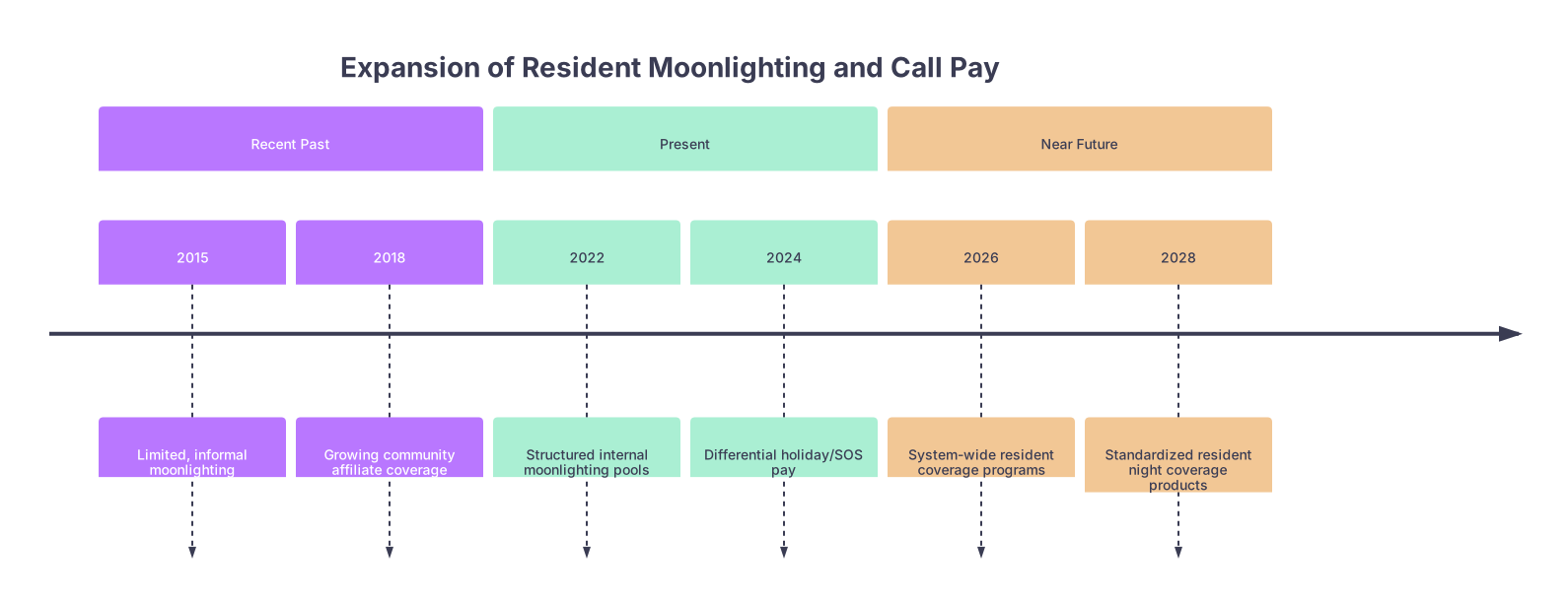
| Period | Event |
|---|---|
| Recent Past - 2015 | Limited, informal moonlighting |
| Recent Past - 2018 | Growing community affiliate coverage |
| Present - 2022 | Structured internal moonlighting pools |
| Present - 2024 | Differential holiday/SOS pay |
| Near Future - 2026 | System-wide resident coverage programs |
| Near Future - 2028 | Standardized resident night coverage products |
Some systems are already piloting what is essentially a resident-based internal locums pool: credentialed seniors floating between affiliates, paid at a fixed rate, filling exactly the slots they can’t staff at full attending cost.
The risk, of course, is exploitation—residents plugging chronic staffing failures while being told it’s “great experience.”
That’s where your generation has leverage. If you understand that your work has real market value, and you negotiate with your eyes open—anchored to what the hospital is actually paying others—you can get more out of this than a little side cash.
You can get:
- Substantial autonomy with backup, which is gold for your first attending job.
- A meaningful financial cushion in training.
- A lasting structure that benefits the classes behind you.
Or you can be the person who shrugs, signs up for unpaid extra call “for the team,” and wonders why everyone else seems to be making side money.
Your choice.
FAQs
1. When in residency is it realistic to start negotiating call pay or moonlighting?
Real negotiation power usually starts around late PGY‑2 or PGY‑3, once you’re trusted and independently functional on nights. Before that, you can ask questions and gather intel, but you’re unlikely to be the one they build a program around. Most programs require at least PGY‑2 completion and “good standing” for any formal internal moonlighting anyway, partly for safety and partly for optics.
2. How do I avoid looking “greedy” to my PD or attendings?
You frame every conversation around service stability and training value, not your bank account. “This could reduce our dependence on locums and give seniors structured autonomy with supervision” lands very differently from “I want to get paid more for nights.” You can absolutely care about the money, but the pitch has to solve their problem first. Also, do your job well on regular rotations—that buys you credibility.
3. What if my program swears there is zero budget for any extra pay?
Sometimes that’s true. Often it’s lazy. You can test it. Ask about whether they’re using locums, NPs, or PRN staff and what coverage gaps keep them up at night. If they truly have no budget, even for locums, your leverage is low and you may be stuck with unpaid extra call if you choose to take it. In that case, the smarter play may be external moonlighting once you’re licensed, at a different institution that values your time properly.
4. Should I tell co-residents the exact rate I negotiated?
That depends on your culture and how fragile your relationships are. Ethically, I lean toward transparency—otherwise you entrench inequity and let admin play residents off each other. Practically, I’ve seen residents share ranges rather than exact numbers: “It’s in the $80–$100/hour ballpark, based on what locums make.” At minimum, don’t quietly accept a garbage rate that drags everyone else down. If you’re going to set a precedent, make it one the next class will thank you for.
Key points: the money for call pay and extra shifts almost never starts with formal policy—it starts when a senior resident spots a coverage problem and offers a structured, cheaper alternative to locums or NPs. The residents who win are the ones who understand who actually controls the dollars, anchor their ask against real market rates, and keep their PD in the loop while quietly shaping how their time is valued.