
If your benefits change mid‑contract after a hospital merger, you’re not overreacting—this is a real breach of trust, and you need to treat it like one.
I’ve watched residents lose 403(b) matches overnight, have childcare subsidies vanish, and see “guaranteed” CME money evaporate after a merger. Admin will smile and call it “harmonization.” You will feel the financial gut punch.
This isn’t just annoying. It can mean thousands of dollars lost over your contract term and real damage to your future plans.
Here’s how to handle it—step by step—if your benefits change mid‑contract after a hospital or system merger.
Step 1: Get Exactly What Changed, in Writing
Do not rely on hallway conversations or town halls.
You need three documents in front of you:
- Your signed contract
- The benefits summary (the one that was in effect when you signed)
- The new benefit policy post‑merger
If you do not already have them:
- Download your executed contract from GME/HR or your email.
- Email HR: “Please send me the benefits summary that applied to residents/fellows hired for the [20XX–20XX] academic year.”
- Ask for the “post‑merger benefits summary” or “current employee benefits guide” in writing.
Then do a simple comparison.
| Benefit Area | Before Merger Example | After Merger Example |
|---|---|---|
| Retirement Match | 4% dollar-for-dollar | 0% match for trainees |
| Health Insurance | Low deductible PPO | High deductible + HSA |
| CME Funds | $1,500 per year | $0 or shared departmental pool |
| Meal Stipend | $250 per month | Cafeteria discount only |
| Leave | 4 weeks vacation + 1 week CME | 3 weeks total PTO |
Print it out or open it side by side and literally mark:
- What was promised (or clearly implied) when you signed
- What’s different now
- The date each change took effect
You are building your evidence file. You will need it.
Step 2: Check Your Contract Language For the “Trap Door”
Almost every hospital contract has some version of one of these clauses:
- “Benefits are subject to change at the discretion of the employer.”
- “Employee shall be eligible to participate in benefit plans as may be offered to similarly situated employees from time to time.”
- “This document does not guarantee continuation of any particular benefit.”
This is the trap door admin uses to say, “We can do this.”
You want to look for:
Explicit benefits written into the contract body
Example: “Employer shall provide up to $1,500 per contract year in CME funds and 5 paid days for CME.”
This is stronger and harder for them to walk away from.Benefits only referenced as ‘per policy’ or ‘subject to change’
Example: “Resident is eligible for benefits in accordance with Employer’s policies as may be amended.”
That’s weaker; they gave themselves wiggle room.Any language about ‘material changes’ or ‘notice’
Sometimes you’ll find: “Material changes to benefits will be communicated at least 30 days in advance.”
If they didn’t give you notice, that can matter.
You’re looking for a foothold. If your contract explicitly lists a benefit and they’ve cut it mid‑term—especially with no notice—you have more leverage.
Step 3: Separate Two Questions: “Can They?” vs “Should They?”
Administrations love to hide behind “We’re allowed to change benefits.” Fine. Let them.
You care about two different issues:
- Legal/contractual – Are they technically permitted to do this under the contract and policy language?
- Ethical/practical – Is this reasonable, fair, and consistent with what they represented to you when you signed?
You might not have an easy legal case. But you can still have a powerful collective case as trainees that forces compromise.
The mistake I see repeatedly: residents assume “HR says it’s legal” = “We’re stuck.” Not true.
You’re not powerless. You just have to fight on the right battlefield:
- Legal battlefield = contract language, labor law, state regulations
- Political battlefield = GME pressures, accreditation optics, recruitment PR nightmare
We’ll use both.
Step 4: Do Not Go Alone—Organize Quietly First
Do not fire off an angry email to the PD on day one. That just makes you an isolated complainer.
Instead, take 2–3 days to do this:
- Confirm it’s happening to everyone, not just you
Ask co‑residents and fellows: “Did your [benefit X] just change?” - Start a simple shared doc or spreadsheet
Track: Name, PGY level, program, what changed, how much money/leave lost annually. - Loop in your chief residents
Phrase it like: “We’re seeing X benefit cut across programs—can we clarify what’s happening and discuss how to respond as a group?”
Your power comes from numbers. Admin can shrug off a single annoyed PGY‑2. They pay attention when 190 residents sign a joint letter.
Step 5: Talk to the Right People, in the Right Order
Here’s the order I recommend.
1. Chief Residents / Fellow Reps
Your goals in that conversation:
- Confirm facts: “Is this change system‑wide?”
- Ask what they’ve already heard in PD/Chair meetings
- Identify any allies among faculty who are already annoyed by the merger fallout
You say something like:
“We’re seeing X, Y, and Z benefits changed mid‑contract. Several of us signed based on the prior package. Before we escalate, we want to understand what leadership has been told and how these decisions were made.”
2. GME Office (DIO / GME Director)
This is where you shift from “we’re confused” to “we’re concerned, and here’s why.”
Bring:
- A one‑page summary of concrete changes (numbers, not emotions)
- Your contract language highlighting what was promised
- A rough calculation of the financial impact per resident per year
Something like:
“We appreciate that mergers are complex. Our concern is that residents signed contracts based partly on a specific benefit structure. Mid‑contract changes to [retirement match / leave / CME / health premiums] represent a material change in compensation. We’re asking:
- Whether this aligns with what was represented to incoming residents
- Whether there’s any grandfathering or transition relief for current trainees.”
Be calm. Professional. But very clear that you see this as a material issue, not a minor tweak.

| Step | Description |
|---|---|
| Step 1 | Notice Benefit Change |
| Step 2 | Gather Documents |
| Step 3 | Organize With Cohort |
| Step 4 | Talk to Chiefs |
| Step 5 | Meet With GME |
| Step 6 | Monitor and Document |
| Step 7 | Escalate to Legal or Union |
| Step 8 | Resolved? |
Step 6: Pull Out the Money Calculator
You will get farther with numbers than with outrage.
Take the main benefit changes and put dollar values on them.
Examples:
- Retirement match removed:
If you make $65,000 and had 4% match → $2,600/year gone. - CME cut from $1,500 to $0 over a 3‑year residency → $4,500 lost.
- Vacation reduced from 4 weeks to 3 weeks, replaced by unpaid time off:
1 week of pay at $65,000 ≈ $1,250/year.
Summarize like this:
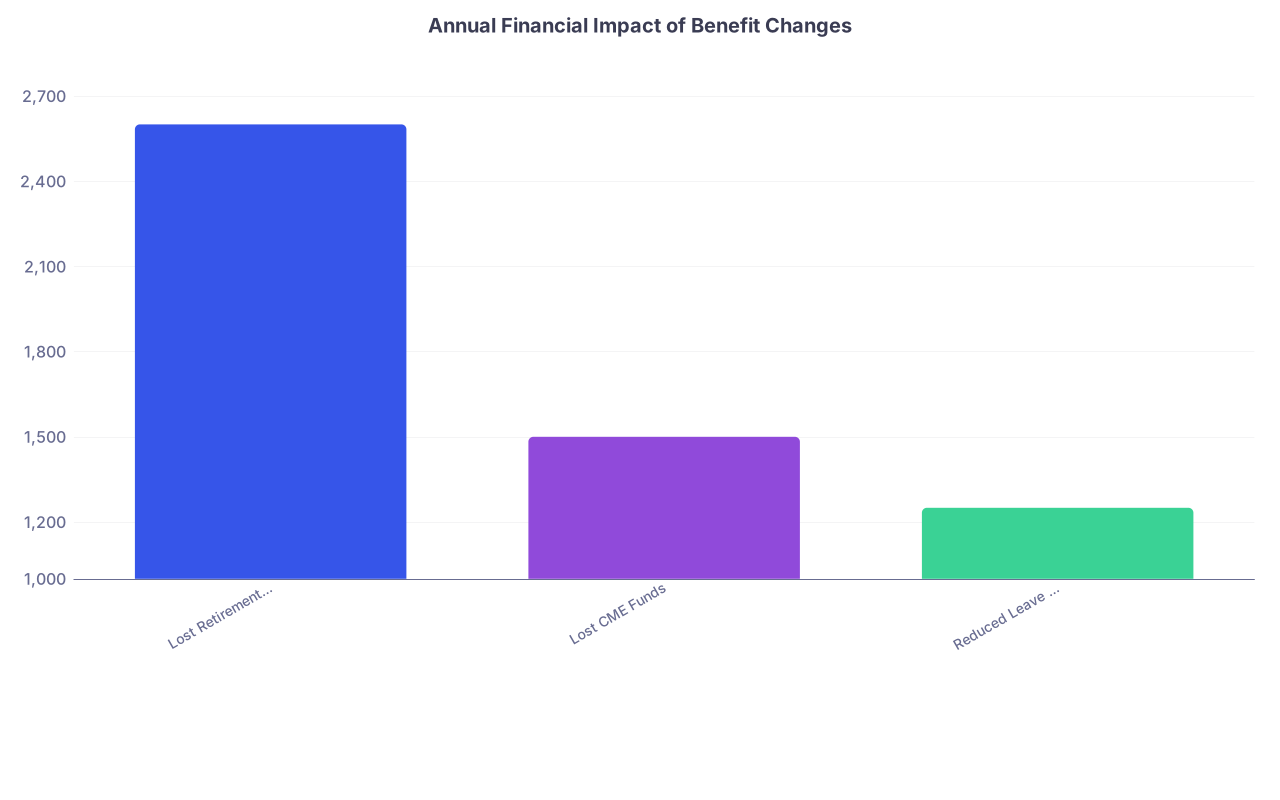
| Category | Value |
|---|---|
| Lost Retirement Match | 2600 |
| Lost CME Funds | 1500 |
| Reduced Leave Value | 1250 |
Now scale it:
“If applied to all 120 residents, the retirement match change alone represents ~$312,000 per year shifted from trainee compensation back to the system.”
Hospitals care about optics of taking six figures from residents.
When you present to GME or HR, show the math. Briefly. One slide or half a page. That’s enough.
Step 7: Decide Your Strategy: Fix, Mitigate, or Document and Leave
You’ve basically got three paths.
Path A: Push for a Fix or Grandfathering
Best‑case scenario: you convince leadership to:
- Grandfather current residents under the old benefits, or
- Offer some offset (e.g., a one‑time lump sum, increased salary, or partial restoration of key benefits).
Leaning arguments that work:
- Recruitment: “If future applicants hear that benefits were cut mid‑contract, this will damage your ability to recruit.”
- Fairness / Reliance: “We made long‑term financial decisions (housing, childcare, loans) based on the prior benefits.”
- Accreditation optics: “Large, unexpected benefit cuts to residents during a merger can look like systemic disregard for trainee welfare.”
You’re not threatening, you’re pointing out reality. Calmly.
Path B: Negotiate Mitigations
If they will not restore everything, push for targeted, high‑impact concessions:
Examples:
- Restore retirement match only for PGY‑3s and fellows finishing in 1–2 years
- Partial CME reinstatement, even $750/year
- One additional week of non‑clinical time for conferences or board prep if CME dollars are gone
- Stipends: “If you can’t match retirement, can you add a $100/month educational stipend?”
This is where you decide where you care most: money now, time off, or long‑term retirement value.
Path C: Document the Hit and Plan Your Exit
Sometimes admin digs in. The merger is done, the system is huge, and they simply do not care enough to fix it.
If that happens:
- Write down exactly what changed, with dates and amounts.
- Keep copies of all communications.
- Remember this when:
- Writing your program reviews
- Warning future applicants politely but clearly
- Negotiating your first attending contract (you now know how real “benefits subject to change” can be)
If you’re early in training and the environment is getting toxic, yes, sometimes it’s rational to plan to transfer or to not stay for fellowship there. You’re not being dramatic.
Step 8: Know When to Get a Lawyer or a Union Involved
This is where people get nervous. Good. It means you’re taking it seriously.
When to talk to an employment lawyer
Consider a brief consult (often $200–$400) if:
- Your contract lists a specific benefit as part of compensation (e.g., “Employer shall provide X”), and
- That benefit has been materially reduced or removed mid‑term, and
- There is no clear language giving them that right unilaterally.
You want to ask:
- “Does this constitute a breach of contract in my state?”
- “Is this large enough to be worth pursuing legally, individually or as a group?”
- “What are the realistic remedies—money, reinstatement, or nothing?”
Do not threaten legal action in emails unless a lawyer tells you to. Just gather information first.
When unions matter
If you’re in a unionized hospital (CIR/SEIU or similar):
- Pull your collective bargaining agreement (CBA).
- Many CBAs lock in benefits during the contract term or require bargaining before change.
- Contact your union rep immediately with your documentation.
If you’re not unionized, this is often the moment residents realize why unions exist. I’ve seen hospitals fast‑track modest “restorations” just to avoid mass talk of organizing.
Step 9: Watch Out for Retaliation (And Don’t Be Paranoid Alone)
Most programs will not overtly retaliate. They’re not stupid. But subtle things happen:
- Suddenly “unprofessionalism” comments appear on evals for the loudest complainers
- Chief selection bypasses residents who organized the response
- Schedule “coincidences” punish squeaky wheels
To protect yourself:
- Keep all your advocacy professional, factual, and group‑oriented (“we,” “our cohort”)
- Avoid venting about specific attendings/admin in writing or group chats that can be screenshotted
- Document any weird performance feedback changes with dates and details
If things start to smell retaliatory, that’s when a lawyer, union, or even your school’s ombuds office (if you’re still technically a med student at an academic institution) can be useful.
Step 10: Adjust Your Personal Financial Plan—Now
Even if you win some concessions, assume the new baseline is less generous. Build around that.
You should immediately:
- Re‑do your monthly budget with the new health premiums, parking fees, or meal changes.
- Decide your new savings priority:
- If retirement match is gone, you may still want to contribute something to Roth IRA or 403(b), but you’re not missing “free money” anymore.
- Re‑evaluate big expenses you were planning:
- Buying a house? Maybe delay.
- Having a child? Factor in increased childcare or health costs.
- Expensive board review course? Check if your program will still cover part of it.
Use the anger or frustration as fuel to get ruthlessly clear about your financial reality.
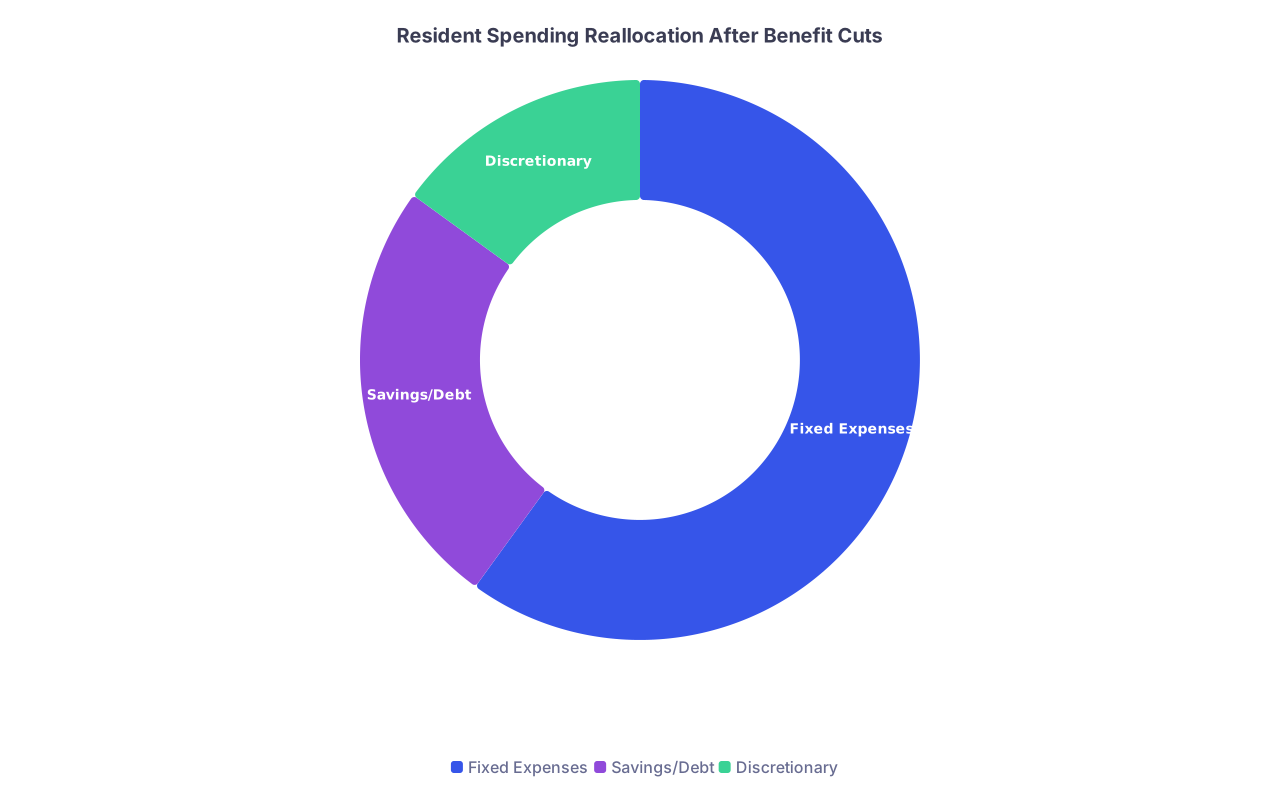
| Category | Value |
|---|---|
| Fixed Expenses | 60 |
| Savings/Debt | 25 |
| Discretionary | 15 |
You may end up shifting more into “fixed expenses” and less into discretionary spending. Not fun. But better than pretending nothing changed.
Step 11: Decide What You’ll Do Differently Next Time
The hidden value of this mess is what it teaches you about future contracts. Your attending contract will be bigger, longer, and even more merger‑prone.
For the future, you now know to:
- Treat any benefit not written in the contract body as “maybe temporary.”
- Ask directly in interviews:
- “Have you had any mid‑contract benefit changes to physicians in the last 5 years?”
- “What protections do you offer if the system merges during my contract term?”
- Push to have key items written in:
- CME dollars and time
- Retirement match
- Call pay structure
- Relocation or signing bonuses
It’s not paranoia. It’s just pattern recognition.

You got burned once. Do not let it happen again quietly.
Quick Reality Check: What Usually Happens
From what I’ve seen across multiple systems:
If residents are passive:
- Benefits quietly get cut.
- Maybe a PR email. Nothing more.
If residents organize professionally and present clear data:
- Some benefits get partially restored, or
- Current trainees get grandfathered or given a small offset.
If residents escalate with union/legal pressure:
- Admin discovers a “transition fund” to soften the blow.
- Or they delay full cuts until after current contracts expire.
You will not get everything back. But you can often turn a 100% loss into a 30–50% loss. Over 3–4 years, that’s big money.
What You Can Do Today
Do not sit and stew.
Today—literally today—do these three things:
- Pull your contract and highlight every line that mentions benefits, compensation, or “subject to change.”
- Email HR/GME for the original and current benefits summaries for your training year.
- Start a shared doc with co‑residents to list exactly what changed and the estimated dollar impact per year.
Once you see the numbers clearly, you’ll know how hard you want to push. And you will not be the resident who just shrugs and hopes it gets better. It rarely does—unless you make it.