
It’s your second-to-last month of residency. You’ve got an offer letter in your inbox, base salary looks decent, there’s a signing bonus, and HR is nudging you to “get the paperwork back so we can start credentialing.”
You skim the benefits section. Health, dental, 401(k)/403(b), malpractice, some vague CME money, “standard PTO.” You tell yourself you’ll go through it in detail “this weekend.”
You won’t. And years from now, you’ll meet the seasoned attending who says, over lukewarm conference room coffee: “Whatever you do, do not do what I did. I didn’t negotiate X, and I’ve been paying for it ever since.”
Let me tell you what X actually is.
Because attendings almost never regret not getting an extra 10–20k on base salary. That stings for maybe a year.
They regret the benefits and non-salary terms they never touched. The stuff that quietly bleeds six figures and wrecks their schedule, their family life, and their future options.
I’m going to walk you through what they really wish they’d negotiated. The stuff that never shows up in glossy recruitment brochures and rarely gets spelled out on paper unless you bring it up.
The Time Trap: FTE, Call, and “Standard” Schedules
The single biggest category of long-term regret is time. Nobody on their deathbed complains they negotiated too much PTO. They complain they signed away their evenings and weekends without understanding what they were doing.
Most residents are so fixated on “full-time” and salary that they never question the default FTE or the call structure. That’s a mistake.
FTE & Schedule Structure
Here’s the game: admin sells you “1.0 FTE” as if it’s binary. Full-time or part-time. Behind the scenes, there’s a lot of flex, and senior people know it.
What attendings often regret not negotiating:
- 4-day work week at 0.8–0.9 FTE with a proportional salary.
I’ve watched this over and over:
– New doc signs at 1.0 FTE, 5 days a week, crushed by volume.
– Two years later, they burn out, ask for 0.8. Admin says, “Well, this will hurt your bonus and benefits…” and suddenly they’re begging instead of negotiating from strength.
Would’ve been way easier to bake in from day one: “My standard schedule is 4 days per week, 0.8–0.9 FTE, with adjusted base and RVU targets.” Veterans know to ask this up front.
- Explicit clinic / OR block structure.
“Full-time” means nothing unless you pin it down.
I’ve seen contracts that say “typical schedule” and then the doc ends up with:
- Early morning add-on clinics
- Late afternoon “urgent” slots forced into their schedule
- “We’re all pitching in” random Saturday clinics
You want clear language: days per week, clinic sessions, admin/protected time, and how schedule changes must be agreed upon. If you do not negotiate this, they will flex you, not the system.
- Protecting admin/academic time.
New hires constantly get burned here, especially in academic or hybrid roles. They’re promised “protected” time and then discover, in practice, it’s just… empty clinic space the scheduler can fill when access metrics look bad.
If you want 0.1–0.2 FTE for research, teaching, leadership, or QI, you want it in writing with:
- Exact half-days or blocks
- Prohibition on scheduling patients in that time without your explicit consent
- Clarity on what happens when clinical demand rises
Attendings quietly complain: “They just slowly took my academic time away.” In every case I’ve seen, it was because the contract never nailed it down.
Call, Nights, and Weekends
This is where the silent resentment really lives.
New hires routinely underestimate:
- How often they’ll be on call
- How brutal the call actually is
- How much this will matter to them after they have kids, a mortgage, and 10 more years of fatigue in their bones
What they later wish they’d negotiated:
- Call frequency caps and definitions.
Not “equitable call.” That phrase means nothing. Equitable to whom? The burned-out guy who’s been taking extra call because he can’t say no?
You want numbers: “No more than X weekday calls and Y weekend calls per month” with “call” defined explicitly (home vs in-house, back-up vs primary, post-call expectations, etc.).
- Post-call protections.
I’ve watched hospitals squeeze this mercilessly.
You think post-call means you go home. Admin thinks post-call means you still do clinic “unless your census is unusually high.” Then “unusually high” is reinterpreted monthly.
I’ve seen attendings deeply regret not insisting on language like: “Post-call day will be free of scheduled patient care activities except in emergencies.”
- Extra pay for extra call.
Huge missed opportunity. A lot of groups have unwritten norms where older attendings dump call onto new hires, especially in private or quasi-private groups.
You can and should negotiate:
- Baseline call (included in salary)
- Additional call (paid at a clearly defined per-shift or per-24h rate)
Plenty of mid-career docs will tell you, quietly, “I subsidized the whole department’s lifestyle for years because I was too naïve to ask for paid extra call.”
The Invisible Money: Retirement, Disability, and Tail Coverage
Residents obsess over base salary. Admin teams obsess over total cost of employing you. The difference is where a lot of regretted non-negotiation lives.
Retirement Contributions and Vesting
You know what experienced attendings look at first on an offer? Often not salary. They flip straight to:
- Employer retirement match/nonelective contribution
- Vesting schedule
Here’s the part HR doesn’t emphasize: these are often negotiable, especially in competitive specialties or underserved markets.
| Employer Type | Employer Contribution | Vesting Schedule |
|---|---|---|
| Academic Hospital | 5% of salary | 3 years |
| Community Hospital | 3% + 2% match | Immediate |
| Private Group | Profit-sharing 10% | 2 years |
| Rural Hospital | 8% of salary | 1 year |
I’ve seen attendings kick themselves because they never asked:
- “Can the employer contribution start sooner?”
- “Is there flexibility on the vesting schedule?”
- “Can we increase the match if we accept a slightly lower base?”
Over ten years, a 3–5% swing in employer retirement contributions is massive. Way bigger than the 10k you fought for in base salary.
Disability Insurance and Own-Occupation Definitions
Here’s one of the less glamorous, truly painful regrets.
A shocking number of attendings:
- Took the default, cheap hospital-provided disability
- Never bought a strong own-occupation policy early
- Found out the hard way how limited their coverage actually was
You can negotiate:
- Employer-paid long-term disability with a true own-occupation definition (or at least supplemental coverage)
- Higher coverage caps
- Employer reimbursing or subsidizing a private own-occupation policy as part of your package
I’ve heard more than one partner say, bluntly, “I’d give up 30k of salary every year if I could go back and buy the right disability policy before I had my diagnosis.”
You do not want future-you saying that.
Malpractice and Tail Coverage
This one’s ugly. And some groups use it deliberately as golden handcuffs.
Two big issues:
- Who pays tail coverage when you leave?
- What is the actual cost of that tail?
Attendings often deeply regret:
- Signing with a claims-made policy where the employer doesn’t cover tail
- Having vague language like “tail cost may be shared”
- Discovering, 5–7 years in, that their tail bill is 60–120k if they want to move jobs
You want it explicit:
- Claims-made vs occurrence
- If claims-made: who pays tail, under what conditions, and whether that obligation changes if you are terminated without cause vs with cause vs you resign
- Whether there’s a vesting concept (e.g., “Employer covers 20% of tail per year of service, fully vested at 5 years”)
I’ve literally watched good physicians stay in toxic jobs because they “couldn’t afford to leave.” Not because of salary. Because of tail.
The Lifestyle Stuff That Matters More Than You Think
In residency, the thought of “vacation days” or “CME allowance” feels like a joke. You just want sleep and maybe a day off where no one pages you.
Fast forward three years. You’ve got kids, aging parents, maybe a partner in another demanding field, and suddenly PTO, CME, and flexibility aren’t fluff — they’re the entire quality of life equation.
PTO: Quantity and Structure
Regret here is almost universal in people who didn’t ask.
The mistakes:
- Accepting “standard” PTO without numbers
- Not understanding how holidays, weekends, and CME days interact
- Failing to negotiate unpaid time options or sabbatical policies
Attendings later say: “I didn’t realize I was effectively getting 2 weeks of real vacation once you accounted for holidays and CME.” That’s pretty common.
You want clarity on:
- Total PTO days per year
- How many are true vacation vs sick vs CME
- Whether you lose clinic/OR productivity/bonus if you actually use them
- How holidays are handled (especially if you’re in shift-based work)
And yes, this can be negotiated:
- Extra PTO in lieu of some salary
- Front-loaded PTO in the first year
- “Protected” weeks where you’re not covering colleagues’ inboxes or results
CME and Professional Development
Most people just glance at the CME line. “$3,000 per year, 5 days.” Sounds fine, right?
Until you’re trying to go to a national meeting in a high-cost city and you realize flights, hotel, fees, and meals blow past that fast.
A lot of attendings wish they’d:
- Negotiated a higher CME budget, especially if their role involves leadership, teaching, or subspecialty skills
- Secured separate time for CME, not taken out of their PTO bucket
- Got commitments for other professional development: coaching, leadership courses, certificate programs
The trick here is understanding that CME is often easier for systems to move than base salary. I’ve watched people get stuck haggling over 5k in base when admin would have happily thrown them another 3–5k of CME funds and extra CME days.
Nonclinical Work and Side Gigs
Here’s a quiet regret: not carving out explicit permission and boundaries for moonlighting or nonclinical work.
Some hospitals and groups:
- Have formal or informal expectations that your “loyalty” is total
- Frown on moonlighting, consulting, expert witness work, or telemedicine on the side
- Write restrictive covenants so broad they effectively lock you out of anything interesting
Many attendings, especially those who later get into medical-legal work, telemedicine, startups, or advisory roles, look back and wish they’d:
- Clarified which activities are allowed
- Limited noncompete and “no-moonlighting” clauses
- Built in explicit carve-outs (e.g., telemedicine outside the hospital’s patient base, out-of-state consulting, nonclinical advising)
Once you’re in the job and they see you as “theirs,” it’s harder to get permission. At the offer stage, when they’re trying to close you? Much more leverage.
The Geographic and Exit Traps: Noncompete, Location, and Transferability
This is where your future self, five years older and much more jaded, will either thank you or curse you.
Noncompete Clauses and Geographic Radius
Let me be blunt. A lot of noncompetes are written absurdly broad. Hospital counsel just throws in the most aggressive version knowing new grads rarely push back.
I’ve seen:
- 50-mile noncompetes in dense metro areas
- 2-year duration
- Language that covers any role in a health system (clinical, administrative, telehealth associated with that entity)
You don’t feel the pain until life changes — spouse job, school needs, toxic admin — and now you can’t work anywhere within commuting distance without paying a fortune or sitting out.
Experienced attendings often say: “I didn’t realize this basically chained me to this hospital system for years.”
Things you can negotiate:
- Radius reduction (10–15 miles in urban areas is very different from 50)
- Duration (1 year vs 2–3)
- Narrowing scope (only applies to direct competing clinical roles, not telemedicine, research, or nonclinical work)
- Exclusion if they terminate you without cause or fail to renew your contract
A lot of systems will bend on this if you ask — especially if they believe in the short run you’re not going anywhere. But they will not volunteer it.
Portability of Benefits
Here’s another subtle regret: choosing a structure where your benefits are deeply tied to the system and not very portable.
Examples:
- 457(b) plans that are subject to employer creditors and not easily rolled over
- Pension-like arrangements that vest slowly and trap you for 5–10 years
- Partnerships where your capital buy-in is large and illiquid
These can be good if you truly want to stay long-term. They’re traps if you later want out.
What laid-back, jaded attendings say ten years on:
“Honestly, I would’ve taken a slightly lower base and simpler, more portable benefits just to keep my options open.”
You can negotiate:
- Accelerated vesting schedules
- Higher employer contributions with shorter vesting in exchange for a modest trade somewhere else
- Clear language around what happens if the group is sold or merges (common now with private equity and system consolidation)
The Stuff Everyone Laughs Off… Until It’s Too Late
There are a handful of other benefits/documents that look minor as a resident but end up driving a disproportionate amount of regret.
Relocation and Signing Bonuses with Strings Attached
People focus on the headline number: 20k relocation, 40k sign-on. Great. Don’t forget the clawbacks.
Typical pattern:
- Clawback if you leave before 2–3 years
- Sometimes accelerated if you’re terminated “for cause” (and that “cause” definition is broad)
I’ve seen attendings regret:
- Not negotiating a shorter payback period
- Not converting some of that into guaranteed salary instead
- Not understanding whether the bonus is taxed as a lump sum (and then owing if they must pay it back after tax)
You can often:
- Shorten the commitment period tied to bonuses
- Make repayment prorated (e.g., 1/36th per month over 3 years)
- Convert some bonus into relocation + CME + moving support, which sometimes has different strings
Student Loan Assistance vs Salary
In some markets, hospitals dangle loan repayment like candy. 50–100k over a few years, sounds great.
The regret: not understanding tax treatment, vesting, or opportunity cost.
Often, loan repayment:
- Is paid annually
- Is taxable
- Comes with harsh clawbacks if you leave early
Some attendings later wish they’d:
- Taken a higher base or better retirement match instead
- Or at least negotiated more favorable vesting on loan payments
If a hospital is offering you 30k per year in loan repayment for 3 years, you can absolutely ask, “What if we shift some of that into retirement contribution or base salary if we simplify the clawback?”
They may say no. They might also say yes. It’s negotiable far more often than residents realize.
How Programs and Hospitals Actually Think About This Stuff
Let me pull back the curtain.
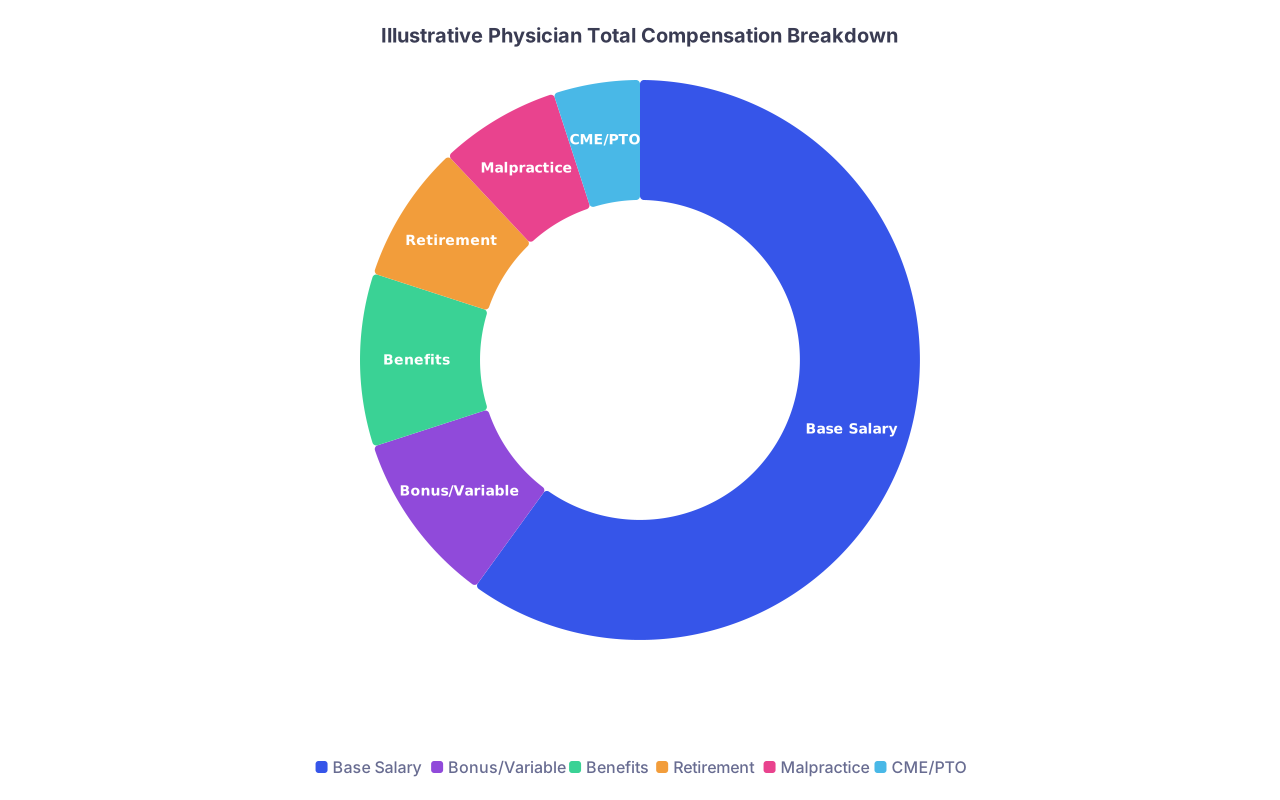
Internally, when leadership and HR talk about recruiting you, they don’t just say, “We’ll pay them 280k.” They see a spreadsheet of total compensation:
- Salary
- Employer taxes
- Malpractice premiums
- Benefits (health, dental, disability)
- Retirement contribution
- CME, PTO, etc.
Some of those line items are rigid. Many are not.
They have a total cost range they’re trying to hit. They got that number approved by some finance committee. The trick isn’t demanding some random thing, it’s understanding that if you flex in one category, they often have room in another.
| Category | Value |
|---|---|
| Base Salary | 60 |
| Bonus/Variable | 10 |
| Benefits | 10 |
| Retirement | 8 |
| Malpractice | 7 |
| CME/PTO | 5 |
I’ve sat in meetings where:
- Candidate A haggles over 10k base salary and “wins”
- Candidate B says, “Base is fine, but I want: 4-day week at 0.9 FTE, extra 5 days PTO, employer covers full tail if I stay 5 years, and 2k more CME”
Guess which one has a better life five years later?
And guess which one admin is quietly happier with? Often B. Why? Because B is easier to keep happy, stays longer, and doesn’t blow up in year two from burnout.
Hospitals care a lot more about stability and predictability than the exact number on your base salary. You can leverage that.
What You Should Actually Prioritize
Let me boil this down so you don’t drown in details.
If you’re going to focus your energy, the things attendings most often regret not negotiating are:
Schedule and call
- FTE and days per week
- Call frequency, post-call rules, payment for extra call
- Protected admin/academic time, clearly defined
Exit-related landmines
- Tail coverage
- Noncompete radius/duration/scope
- Vesting on retirement, loan repayment, and bonuses
Quality-of-life benefits
- PTO quantity and structure
- CME funds and time
- Disability coverage and retirement match
You’ll notice “base salary” is not on that list. It matters, but not nearly as much as residents think. You can fix salary later by changing jobs or ramping up productivity. Fixing a bad noncompete or tail liability? Much harder.

| Step | Description |
|---|---|
| Step 1 | Review Offer |
| Step 2 | Negotiate FTE and Call |
| Step 3 | Check Retirement and Tail |
| Step 4 | Clarify PTO and CME |
| Step 5 | Limit Noncompete |
| Step 6 | Confirm Disability and Malpractice |
| Step 7 | Decide to Accept or Counter |
| Step 8 | Time or Money Priority |
Bottom Line
Three takeaways, and then you can go back to pretending your “standard benefits” are fine:
The worst regrets are about time, flexibility, and exit traps, not the extra 10–20k you didn’t get in base salary.
Tail coverage, noncompete clauses, and retirement/vesting terms quietly control your future options. You either negotiate them now or pay for them later.
Hospitals care about total package cost and stability, not just salary. Use that to push for what actually changes your life: sane schedule, real PTO, strong protection (malpractice, disability), and the freedom to leave if you need to.
Negotiate those, and future-you will not be the attending in the break room telling the new hires, “Yeah… I really screwed that part up.”