
The non‑compete in your contract is not about “protecting education” or “patient continuity.” It’s about leverage. Pure and simple.
Let me tell you what actually happens behind those closed-door admin meetings where your contract gets designed, dissected, and weaponized.
What Non‑Competes Are Really For (Not What They Tell You)
The public story is polished: “We invest so much in onboarding and training; we just need to protect that investment.” I’ve heard that line in more C-suite meetings than I can count.
The private story is uglier.
Non‑competes exist to:
- Make it painful for you to leave.
- Scare your colleagues into not following you if you do.
- Keep competitors from instantly benefiting from your hard work.
- Trap patient revenue streams inside the current system.
Notice what’s missing: anything about your career development, autonomy, or fair competition. Those are collateral damage.
I’ve sat in strategy meetings where they literally pulled up a map, drew a radius around hospitals, and said, “Can we stretch this to 25 miles without scaring off recruits?” Not “Is this ethical?” Not “Is this good for patient access?” Just “Can we get away with it?”
And when a physician pushes back hard on a non‑compete? I’ve seen HR whisper, “Might be a troublemaker” into the notes column.
You’re not being paranoid. That’s actually happening.
How Non‑Competes Are Crafted Behind the Scenes
Non‑competes aren’t written by some benevolent committee of physicians. They’re usually crafted by:
- The system’s in-house counsel
- Outside employment and healthcare lawyers
- VP of Physician Services / CMO / CFO
- Sometimes a physician leader who’s been fully co-opted by administration
The goal isn’t fairness. The goal is “maximum enforceability without scaring away too many recruits.”
So they run this playbook:
- Start with an aggressive radius (20–50 miles).
- Add a broad time period (1–2 years).
- Use language like “any competing practice” rather than specifying direct competitors.
- Hide the teeth in bland wording: “restrictive covenant,” “post‑employment obligations,” “practice limitations.”
Then they “soften” it just enough that your average graduating resident—exhausted, broke, eager—signs without a lawyer.
Here’s the part most residents do not realize: the same system often uses different versions of non‑competes for different specialties and different bargaining positions.
I’ve seen systems where:
- Hospitalists fresh out of residency got 25 miles / 2 years.
- A mid‑career cardiologist they were desperate to recruit negotiated down to 5 miles / 1 year or even no non‑compete at all.
- A high-volume surgeon got no geographic restriction, only a non‑solicitation clause.
They’re not applying one “standard policy.” They’re testing what they can get away with on you.
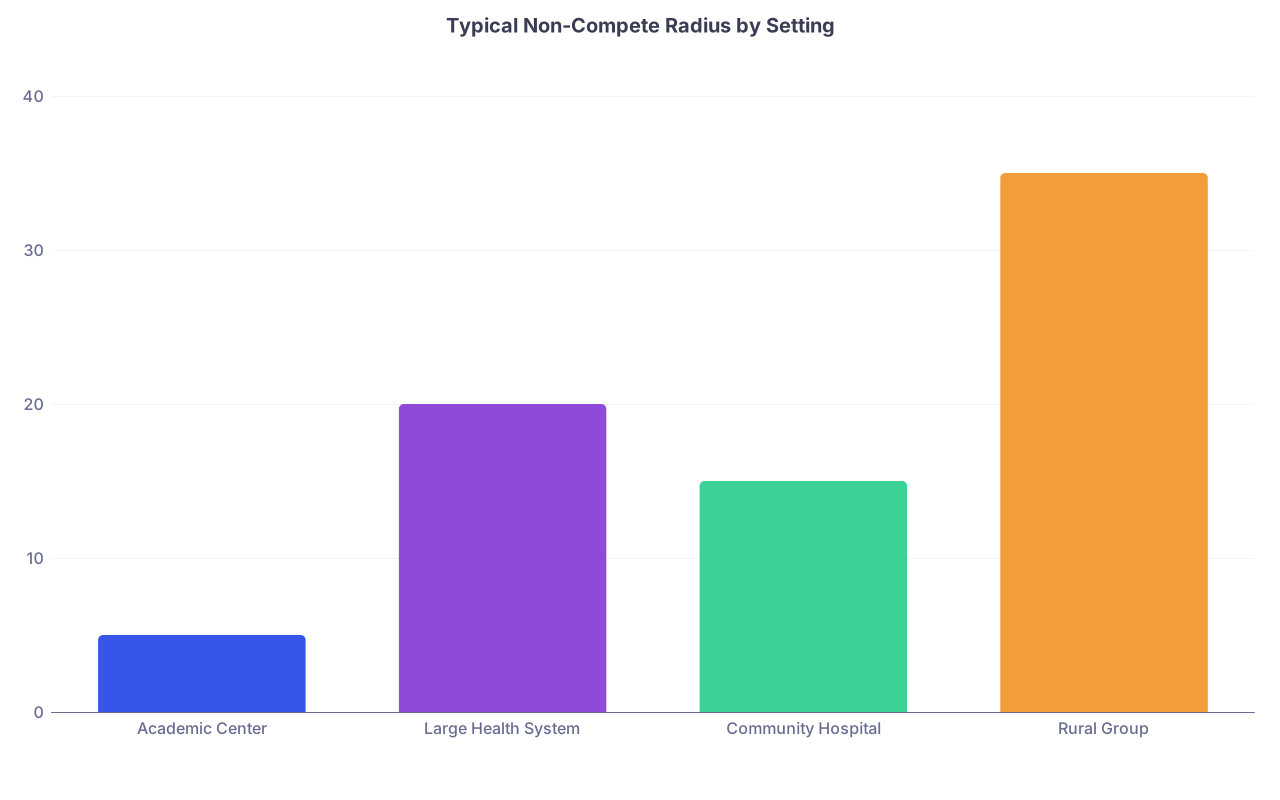
| Category | Value |
|---|---|
| Academic Center | 5 |
| Large Health System | 20 |
| Community Hospital | 15 |
| Rural Group | 35 |
The Real Economic Purpose: You Are a Revenue Anchor
Here’s how administrators talk about you when you’re not in the room.
You’re not “Dr. Patel, dedicated internist.” You’re:
- wRVUs per year
- Downstream imaging and procedural revenue
- Contribution margin
- “Capture rate” of patients to in-system services
Non‑competes are designed to protect that revenue stream.
If a strong outpatient internist leaves and sets up shop 2 miles away:
- A big chunk of their panel follows.
- Those patients get their labs, imaging, procedures, and admissions outside the system.
- Primary care referral patterns shift to new surgeons, cardiologists, GI, etc.
That terrifies administration. So they want your choice to leave to be as painful and complicated as possible.
I sat in a finance meeting once where a practice administrator literally said, “If we don’t tighten our non‑competes, we’ll lose another million in downstream revenue next year from defections.” They weren’t talking about quality metrics. They were talking about your future right to work.
So the non‑compete is structured to do a few things at once:
- Force you to move if you want to leave (new city, new market).
- Make you think twice about joining a nearby competitor or opening your own shop.
- Signal to other physicians: “Leaving won’t be simple for you either.”
Is it always enforceable? No. But remember: they don’t need to win in court. They just need to make you afraid of going to court.
What It Means for Moonlighting and Side Gigs
Here’s where it gets sneakier. The non‑compete doesn’t just affect your “next full‑time job.” It can quietly strangle your moonlighting, side hustles, and future flexibility.
The smart systems now are bundling several tools together:
- Non‑compete
- Non‑solicitation
- Conflict-of-interest and outside-work policies
- IP / invention assignment clauses
- Mandatory “approval” of any outside medical work
So you think you’re just agreeing not to open a competing clinic 10 miles away. In reality, you may be signing away:
- The ability to moonlight at a competing hospital or ED in the same region.
- The option to start a telemedicine side gig that sees local patients.
- Freedom to build a brand (podcast, coaching, niche clinic) that could be seen as “competitive.”
- The right to leave and take your panel to a DPC or concierge practice.
I’ve reviewed contracts where the employer claimed rights over:
- Any clinical service in the same specialty within X miles.
- Any telehealth service serving patients residing in that region.
- Any management or advisory role with “competing entities.”
One resident showed me a hospitalist contract that required written approval for “any professional clinical services outside primary employment.” Translation: we own your nights and weekends too, unless we say otherwise.
So moonlighting in the same market? Often a landmine. Tele-ICU work for another system pulling patients from your area? Very questionable. Starting a local cash-pay clinic on your days off? Probably violating something.

| Step | Description |
|---|---|
| Step 1 | Review Contract |
| Step 2 | Same City |
| Step 3 | Different Region |
| Step 4 | Likely Restricted |
| Step 5 | Needs Written Approval |
| Step 6 | Usually Safer |
| Step 7 | Check Telehealth Catchment |
| Step 8 | Non-compete Radius? |
| Step 9 | Moonlighting Same Market? |
The Clauses That Actually Matter (The Ones Faculty Never Taught You)
You’ve probably heard “watch the non‑compete” from some older attending. That’s not detailed enough. There are specific pieces that really control your future.
You need to zero in on:
1. The Radius and Definition of “Competing”
Not just “25 miles.” From what?
- Your primary clinic?
- Any facility in the system?
- The corporate office?
- “Any site where employer maintains operations”?
I’ve seen language that effectively covers an entire metropolitan area by using “any facility within the employer’s network.” In some regions, that’s four counties.
Then, “competition” is often defined absurdly broadly:
- “Any practice providing similar clinical services”
- “Any entity offering medical care in the same specialty”
- “Any healthcare provider engaging in similar patient care activities”
That can include:
- FQHCs
- Urgent cares
- Telehealth companies
- Direct care clinics
- Concierge practices
If the language is vague, it’s not an accident. Vagueness benefits the party with more lawyers.
2. The Duration and Trigger
Look at how long the restriction lasts and what events trigger it.
Typical: 12–24 months after separation.
But watch for this:
- Does it apply if you’re terminated without cause?
- Does it apply if your contract is not renewed?
- Does it apply after the initial term, even if they low-ball a renewal?
Some of the more ruthless systems make the non‑compete apply no matter who ends the relationship or why. You could be laid off—and still be blocked from working locally.
3. Non‑Solicitation: The Silent Killer
Sometimes even when the non‑compete is softened for physicians who negotiate, the non‑solicitation clause remains vicious.
Non‑solicitation often says you can’t:
- Proactively contact patients to follow you.
- Solicit staff, nurses, MAs, or other physicians to join you.
- Reach out to referral sources.
So you might “win” on the non‑compete but still cripple your ability to reconstitute your practice across the street.
I’ve seen groups threaten physicians for announcing a new address on social media, claiming it was “solicitation.” Crazy? Yes. Did the doc still back down? Also yes, because they didn’t want a lawsuit hanging over their head.
4. The “Blue Pencil” and Enforcement States
Whether the clause is reasonable or legal depends heavily on the state. But here’s the twist: most systems exploit the fact that you don’t know the nuances.
Some states:
- Flat-out ban physician non‑competes (e.g., a few have outlawed them or heavily limited them).
- Strongly restrict them, especially for employed physicians.
- Allow them but expect them to be narrow and reasonable.
- Allow broad non‑competes and have “blue pencil” doctrines where courts can rewrite overbroad language rather than tossing the whole thing.
From the system’s perspective, a “blue pencil” state is gold. They can draft something aggressive, and worst case the judge trims it. Meanwhile, the aggressive language scares you into compliance long before a judge ever sees it.
| State Category | Typical Non-Compete Risk |
|---|---|
| Ban / Strict Limits | Low |
| Reasonableness Focus | Moderate |
| Physician-Friendly? No | High |
| Blue Pencil States | Very High |
(Always check current law; this landscape is shifting quickly.)
How Programs and Faculty Quietly Enable This
Here’s the part that annoys me the most.
Residency programs spend thousands of hours pounding guidelines, pathways, and scoring systems into your head. But basic contract literacy? Understanding non‑competes? You get maybe a one-hour “career talk” with some generic PowerPoint.
I’ve sat in faculty meetings where a PD shrugged and said, “They’ll figure it out when they’re out there.” Translation: not my problem.
Some PDs actively discourage “rocking the boat”:
- “You’re lucky to get an offer in this market.”
- “That’s just how all contracts are.”
- “You can’t negotiate your first job; you’ll scare them off.”
Meanwhile, the same PD might be working with a completely different contract through their own side clinical work or leadership role.
Hospitals love that training programs don’t teach this. A naive graduating resident is the dream recruit: high clinical skill, low business knowledge, maximal fear of unemployment.
So yes, you are behind. By design.

Where This Collides with the Future of Medicine
Here’s the ironic part.
Healthcare is moving toward:
- Telemedicine.
- Micro-practices.
- DPC and concierge models.
- Portfolio careers: part‑time clinical, part‑time telehealth, consulting, teaching.
- Increased physician mobility and locums-heavy staffing.
Yet the employment contracts in big systems are still built like you’re a 1990s full-time lifer.
So you get stuck:
- You want to build a local telehealth brand? Non‑compete and “exclusivity” language may say no.
- You want to open a part-time DPC practice in town? Non‑compete probably blocks you.
- You want to do locums in nearby hospitals on off weeks? Conflict-of-interest and non‑compete might choke that too.
And here’s the kicker: systems know the model is changing. They’re watching physicians leave for DPC, remote jobs, locums, or hybrid roles. They’re reacting by tightening contracts, not loosening them.
I’ve seen new language creep in like:
- Restrictions on practicing within your specialty including virtual medicine within the radius.
- Broad bans on “providing clinical care to any patients residing within the restricted area,” even via telehealth.
- Intellectual property language reaching into apps, educational courses, and digital tools you build on your own time.
The future of medicine does not mix well with an old‑school, land‑locked non‑compete. But until enough physicians push back, systems will keep pretending it does.

| Category | Telemedicine Roles | Locums-Heavy Careers | DPC/Concierge |
|---|---|---|---|
| 2018 | 5 | 15 | 3 |
| 2019 | 10 | 18 | 4 |
| 2020 | 25 | 20 | 6 |
| 2021 | 40 | 24 | 9 |
| 2022 | 55 | 30 | 12 |
| 2023 | 65 | 35 | 16 |
How Non‑Competes Shape Your Actual Day-to-Day Power
This is where all the theory becomes very practical.
A harsh non‑compete changes how you behave at work. That’s the point.
When you know you:
- Can’t easily get another local job.
- Would have to move your family or take a giant commute.
- Could face legal threats if you leave for a nearby group.
You tolerate more.
You tolerate:
- Unsafe staffing.
- Unreasonable productivity expectations.
- Toxic leadership.
- Constant call creep and scope drift.
- “Mandatory” unpaid committee work and hospital projects.
I’ve watched excellent physicians put up with garbage for years because their kids were in school nearby and their spouse couldn’t easily move. The non‑compete turned them from skilled professionals into captive labor.
Administrators know this. They might not say it in public, but you’ll hear it slip out in side conversations:
- “He won’t leave. His whole extended family is here.”
- “She’s on a visa and bound to us by contract.”
- “He’s got a 30-mile non‑compete; he’d have to move states.”
They calculate your pain threshold. Your non‑compete is a major input.

What a Savvier Approach Looks Like (Realistic, Not Fairy Tale)
I’m not going to tell you, “Just refuse all non‑competes.” In many markets, especially as a new grad, that’s fantasy. Some employers won’t budge. Some will walk away.
But you can do far better than blind acceptance. A realistic play looks like this:
- Narrow the radius. From 25 miles to 5 or 10. From “any facility” to your primary practice site.
- Shorten the term. Push from 24 months down to 12, or 18 down to 9.
- Tie it to cause. If they terminate you without cause or choose not to renew, the non‑compete should dissolve.
- Clarify exceptions. Academic work, telehealth in other states, VA, Indian Health Service, locums in non-overlapping markets.
- Limit scope. Define “competitive services” narrowly: your subspecialty, not “any medical care.”
- Clean up non‑solicitation. Allow general announcements. Allow staff to follow you of their own initiative.
Will you win all of this? No. But if you get two or three of those pieces, your future looks very different.
And here’s the insider fact: the first physician in a department to push back is the hardest battle. Once one person gets concessions, that language has a way of sticking around.
I’ve seen hospitalists in one group quietly pass around a red‑lined contract that added:
- No non‑compete outside a 5‑mile radius of their main hospital.
- No restriction if terminated without cause.
- Telehealth excluded from the geographic restriction.
The admin team hated it. But once three or four signed with those terms, it became de facto standard.
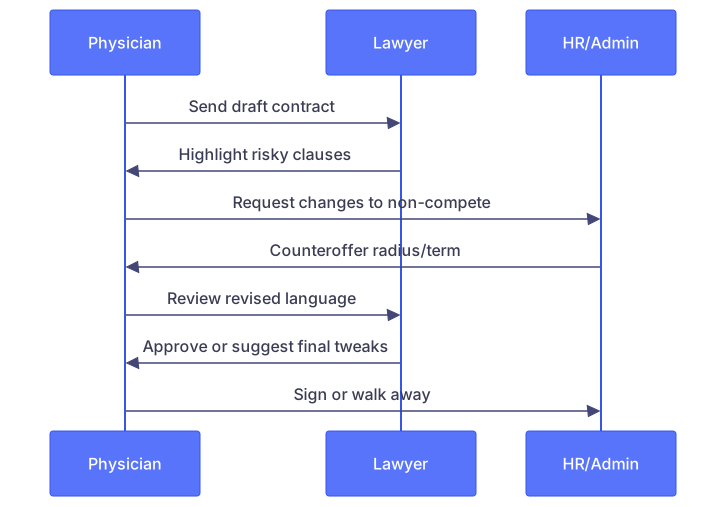
The Bottom Line
Your non‑compete is not just a line in a contract. It’s a structural attempt to control your options, your behavior, and your exit strategy.
Everyone on the employer side knows that. They designed it that way.
Once you see it clearly, you stop looking at that clause like “oh yeah, the thing everyone has,” and start viewing it as what it is: a powerful economic weapon pointed straight at your future.
You do not have to become a contract lawyer. But you cannot afford to be naive:
- Read every word of your restrictive covenants.
- Pay a healthcare-savvy attorney once; it will be the cheapest “CME” you ever buy.
- Decide consciously what level of restriction you’re willing to live with.
- And remember: the job you accept at 29 should not have the power to choke your options at 39.
You’re going to see more hybrid careers, more telehealth, more physician mobility over the next decade. The systems you work for will fight to keep controlling your geography and your choices. That tension is only going to grow.
For now, understand the game. Then choose how you want to play it.
With this foundation, you’re ready to start thinking more strategically about all the “minor” clauses that surround your non‑compete—malpractice tails, moonlighting approvals, IP rights. But that’s a story for another day.