
The way most physicians think about benefits is backwards. They start with the offer, then decide how they “feel” about it. That is how you end up underinsured, overworked, and stuck in a job that looked good on paper.
You fix this by doing one thing first: building a clear, brutally honest must‑have vs nice‑to‑have benefits list. Before you negotiate. Before you sign. Before you moonlight.
This is how to do it properly.
Why You Need a Benefits Must‑Have List Before Anything Else
You are not just choosing a salary. You are choosing:
- Your future call schedule
- Your ability to start a family or take care of one
- Your protection if you get disabled
- How fast you burn out
Most physicians never write this down. They “kinda know” they care about vacation and call and health insurance. Then they see a big number on the offer letter and everything else becomes “I’ll figure it out later.”
Later is when you discover:
- Your “bonus” is unachievable without RVU gymnastics
- Your “health insurance” is a high‑deductible minefield
- Your “protected time” is a rumor, not a policy
- Your moonlighting is technically allowed but practically impossible
So you flip the script. You define what you require, in writing, before anyone shows you an offer. That gives you:
- A decision filter
- Negotiation leverage
- A way to compare full‑time positions and moonlighting side‑gigs on the same grid
Let us build that system.
Step 1: Define Your Non‑Negotiables (Must‑Haves)
Must‑haves are not “things that would be nice” or “it would be cool if.” Must‑haves are:
If this is not present (or is below X threshold), I will walk away.
If you are not willing to walk away, it is not a must‑have. It is a preference.
Start with these core categories. Then we will turn them into an actual list.
1. Income and Compensation Structure
Do not just stare at the total dollar sign. You care about:
- Base salary minimum
- How variable pay works (RVUs, collections, shifts, bonuses)
- How moonlighting pay fits in (separate contract? same rate?)
Decide your must‑haves:
- Minimum base salary (for stability)
- Minimum total target compensation (realistic, not fantasy numbers from recruiters)
- Clear, written formula for how additional pay and moonlighting are calculated
If you cannot explain your own pay in one or two sentences, the structure is bad or opaque. That is a problem.
2. Malpractice Coverage and Tail
This one is non‑negotiable for any physician with a license and a pulse.
Your must‑haves should include:
- Claims‑made vs occurrence coverage
- Who pays for tail if claims‑made (you, group, hospital)
- Adequate policy limits (commonly 1M/3M or better in the US)
If tail coverage is on you and you leave after three years, that bill can be five figures or more. I have seen young attendings frozen in jobs they hated because they could not afford tail. That is not a theoretical risk.
3. Health Insurance and Basic Benefits
You do not need a perfect plan. You do need a floor.
Must‑have items might be:
- Employer‑sponsored health plan with reasonable premiums
- Coverage for dependents at a defined maximum out‑of‑pocket cost
- Access to disability and life insurance options (even if you also buy private)
If the “benefits” are basically “we give you a W2 and best of luck,” you need to be very sure the pay compensates for what you are going to buy on your own.
4. Time Off and Schedule Control
Your schedule is a benefit. It is also the fastest route to burnout if it is bad.
Decide your minimums:
- Paid time off (PTO) days per year
- Maximum number of nights/weekends/holidays you are willing to work
- Maximum call burden (q3? q4? home vs in‑house?)
And then: how changes are decided. A program that can unilaterally double your call without discussion is not a safe environment.
5. Moonlighting Rules and Restrictions
Category is “MOONLIGHTING AND BENEFITS,” so let us be blunt. Moonlighting is where a lot of physicians salvage their financial lives. It also can get you fired if you do it wrong.
Must‑have clarity on:
- Is internal moonlighting available? At what rate and under what conditions?
- Are you allowed to externally moonlight? Any non‑compete or conflict‑of‑interest limits?
- Are moonlighting hours counted toward duty hour caps (for residents, fellows)?
- Who covers malpractice for moonlighting—employer or you?
If the answer to any of these is “we are not sure, we can talk about it later,” that is not acceptable. “Later” usually means “no leverage.”
Step 2: Define Your Nice‑to‑Haves (Preferences, Not Deal‑Breakers)
Nice‑to‑haves differentiate a good job from a great one. But you do not walk away solely because one is missing, if everything else is strong.
Common nice‑to‑have categories:
1. Retirement and Long‑Term Wealth
- 401(k) / 403(b) match level
- Access to 457(b) plans
- Employer contributions to retirement even without your match
- Pension or defined benefit plan (less common, but golden when real)
For many younger attendings, this feels abstract. It should not. The difference between no match and a 5% match over 20 years is six figures.
2. Education, CME, and Professional Development
Nice‑to‑have items:
- Annual CME allowance and paid CME days
- Payment of licenses, DEA, boards, and society dues
- Support for additional training or certificates (e.g., ultrasound, obesity medicine)
These will not save you from a toxic job. But they do matter for your growth and your CV.
3. Lifestyle and Flexibility Benefits
Think about what makes your daily life tolerable:
- Remote work options (for telemedicine, admin, charting)
- Part‑time or 0.8 FTE options after a period
- Sabbatical policies
- Onsite childcare, gym, parking, meals
Good to have. Not worth ignoring red flags for.
4. Career Trajectory and Leadership
If leadership or academic titles matter to you:
- Clear promotion tracks (assistant → associate → full)
- Protected admin or academic time
- Support for research or QI projects
Think of these as “future leverage.” They compound over time.
Step 3: Put It in a Simple, Usable Format
If your “list” is a mental note plus a few starred emails, it will fail when a recruiter waves a $50k signing bonus at you.
You want one simple, one‑page view you can keep pulling up for each job or moonlighting gig.
Here is a clean layout approach:
- Column 1: Benefit category
- Column 2: Your must‑have threshold or condition
- Column 3: Nice‑to‑have details
- Column 4–6: Space to score or check each potential job or moonlighting offer
To illustrate the structure, here is a basic comparison between full‑time and moonlighting priorities:
| Area | Full-Time Job Must-Have | Moonlighting Must-Have | Mostly Nice-to-Have For Both |
|---|---|---|---|
| Base Pay | Stable minimum | Competitive hourly rate | Productivity bonus |
| Malpractice/Tail | Strong, clear coverage | Covered for each shift | Higher policy limits |
| Schedule | Sustainable call/PTO | Predictable shifts | Customizable schedule |
| Moonlighting Rules | Allowed by contract | N/A | Internal shift priority |
| Retirement/CME | Some employer support | Usually N/A | High match / large CME pool |
You are not trying to build a 10‑tab spreadsheet. You are building something you will actually use in a 10‑minute phone screen.
Step 4: Translate Vague Wants into Specific Must‑Have Criteria
Here is where most people fail. They write things like:
- “Good health insurance”
- “Reasonable call”
- “Opportunities to moonlight”
Those are useless. You need numbers and thresholds.
Let me show you how to convert fuzzy wants into hard lines:
Example 1: PTO / Vacation
Bad: “Good PTO”
Useful:
- Must‑have: At least 4 weeks per year of PTO (vacation + holidays + CME clearly defined)
- Nice‑to‑have: 5+ weeks and separate CME days
Example 2: Call
Bad: “Not too much call”
Useful:
- Must‑have: No more than q4 home call or q6 in‑house on average, with written coverage rules
- Nice‑to‑have: Protected post‑call day off, predictable weekend rotation
Example 3: Moonlighting
Bad: “Moonlighting allowed”
Useful:
- Must‑have: Written policy that either
- Allows external moonlighting with no non‑compete conflict,
- Or offers internal moonlighting at ≥ $X per hour, with malpractice covered
- Nice‑to‑have: Priority access to internal shifts, transparent posting of shifts
Example 4: Compensation
Bad: “Competitive salary”
Useful:
- Must‑have: Base salary of at least $X based on MGMA or specialty norms in your region
- Must‑have: Any RVU or collection bonus formula fully defined in writing
- Nice‑to‑have: Sign‑on bonus with no unreasonable clawback terms
Once you start forcing yourself to write numbers, you will immediately see where you have not thought things through.
Step 5: Build the Actual Must‑Have vs Nice‑to‑Have Checklist
Here is a structure you can copy and customize. I will frame it specifically with moonlighting in mind but it works for any physician job.
Section A: Non‑Negotiable Must‑Haves
Write each as a testable statement. Example template:
Malpractice and Tail
- Must have: [Occurrence coverage OR claims‑made with tail fully paid by employer]
- Policy limits: At least [1M/3M]
- Applies to: [Primary role / moonlighting / both]
Base Pay / Rate
- Full‑time base: Minimum $_____ per year
- Moonlighting: Minimum $_____ per hour or per shift
- Pay clarity: Written formula for any RVU/bonus component
Schedule and Call
- Max average hours per week: ______
- Max call frequency and type: ______ (e.g., home q4, in‑house q6)
- Post‑call policy: ______
Time Off (PTO/CME)
- PTO: Minimum ____ weeks per year, clearly defined
- CME: At least $_____ per year or ____ days per year (if you care)
Moonlighting Permissions and Limits
- Internal moonlighting: [required / optional / not important]
- External moonlighting: Contract must explicitly allow external work without conflict, or list clear prohibited locations
- Duty hours: Any required tracking must not make moonlighting practically impossible
Health Insurance and Core Benefits
- Health: Employer plan with employee premium ≤ $_____ per month for single coverage
- Disability access: Must have the option to buy own‑occupation coverage (employer or private)
- Basic life: At least 1x salary (or you plan to buy privately and offset with higher pay)
You can stop here and already be in better shape than 90% of your peers.
Section B: Strong Nice‑to‑Haves
Now the “upgrades” that help you rank offers:
Retirement
- Employer match: ≥ _____% on 401(k)/403(b)
- Access to 457(b) or other tax‑advantaged accounts
CME and Professional Support
- CME money: ≥ $_____ per year
- Paid society dues, licensing, and DEA
Flexibility and Lifestyle
- Remote or hybrid work options for some clinical/admin time
- Option for reduced FTE after X years
- Onsite childcare, parking, meals, gym, etc.
Career Development
- Protected time for academics/administration (if relevant)
- Clear promotion or partnership pathway with written criteria
Extra Financial Perks
- Sign‑on and relocation bonuses with fair clawback terms
- Loan repayment assistance
- Profit‑sharing or equity (for private groups)
You are not demanding all of these. You are using them to compare good vs excellent.
Step 6: Apply the List to Real Offers and Moonlighting Gigs
A list is only useful if you use it. Here is how you do that without turning every conversation into a negotiation knife‑fight.
1. During Early Screening Calls
You do not start by grilling the recruiter. You do this:
- Ask them to walk you through the basics: pay structure, schedule, benefits summary
- While they talk, quietly mark off must‑have boxes: Yes / No / Unknown
- If you hit a clear “No” on a must‑have, you do not invest emotional energy. You get the info you need, then move on.
You might say:
- “For me, malpractice and tail are non‑negotiable. Can you confirm who pays for tail if this is claims‑made?”
- “I have a minimum compensation floor I need to hit for my situation. Can you share the realistic total comp range for someone at expected productivity?”
If they dodge or cannot answer, that is a red flag by itself.
2. When Evaluating Moonlighting Opportunities
Moonlighting offers are notorious for being casual and sloppy. “We pay $X an hour, want some shifts?” is not a complete answer.
Run the same checklist, but laser‑focused on:
- Rate per hour or per shift
- Malpractice and tail for that location
- Who supplies documentation, credentialing, and who is responsible for any legal fallout
- Shift type (nights, weekends, holidays) and flexibility
Then ask yourself bluntly:
- Does this rate fairly compensate for the schedule pain and risk after taxes?
- Does it violate any contract clauses in my main job?
- Can I maintain safe patient care at this workload?
If the answer to the last one is “probably not,” you walk. Easy money does not matter if you are unsafe.
3. Turning the List into Negotiation Leverage
Your list also becomes your script.
You do not say: “I want better benefits.”
You say:
- “Based on comparable positions and my must‑have criteria, I am looking for at least 4 weeks of PTO, with a defined CME package. Right now this offer is at 3 weeks with CME baked into that. Can we separate CME days or increase PTO to hit that minimum?”
Or:
- “I am comfortable with the base salary, but I need clarity and written language about external moonlighting. My financial plan assumes I will pick up X hours per month. Can we add language that explicitly allows this outside a Y‑mile radius and not with direct competitors?”
Clear, specific, unemotional. Much harder to dismiss.
Step 7: Revisit and Update the List as Your Life Changes
Your must‑haves at PGY‑3 are not the same as your must‑haves at age 45 with two kids and aging parents.
Every 1–2 years, sit down and adjust:
- Are you still willing to trade schedule for money the way you did as a new attending?
- Has your need for moonlighting changed because you paid off loans or bought a house?
- Do retirement benefits matter more now than a sign‑on bonus?
That reassessment will keep you from sleepwalking into the same bad deal you signed five years ago when you were a different person.
Quick Visual: Which Benefits Usually Matter Most
To give you a rough sense of what most physicians actually prioritize (versus what recruiters brag about), here is a simple weighting example:
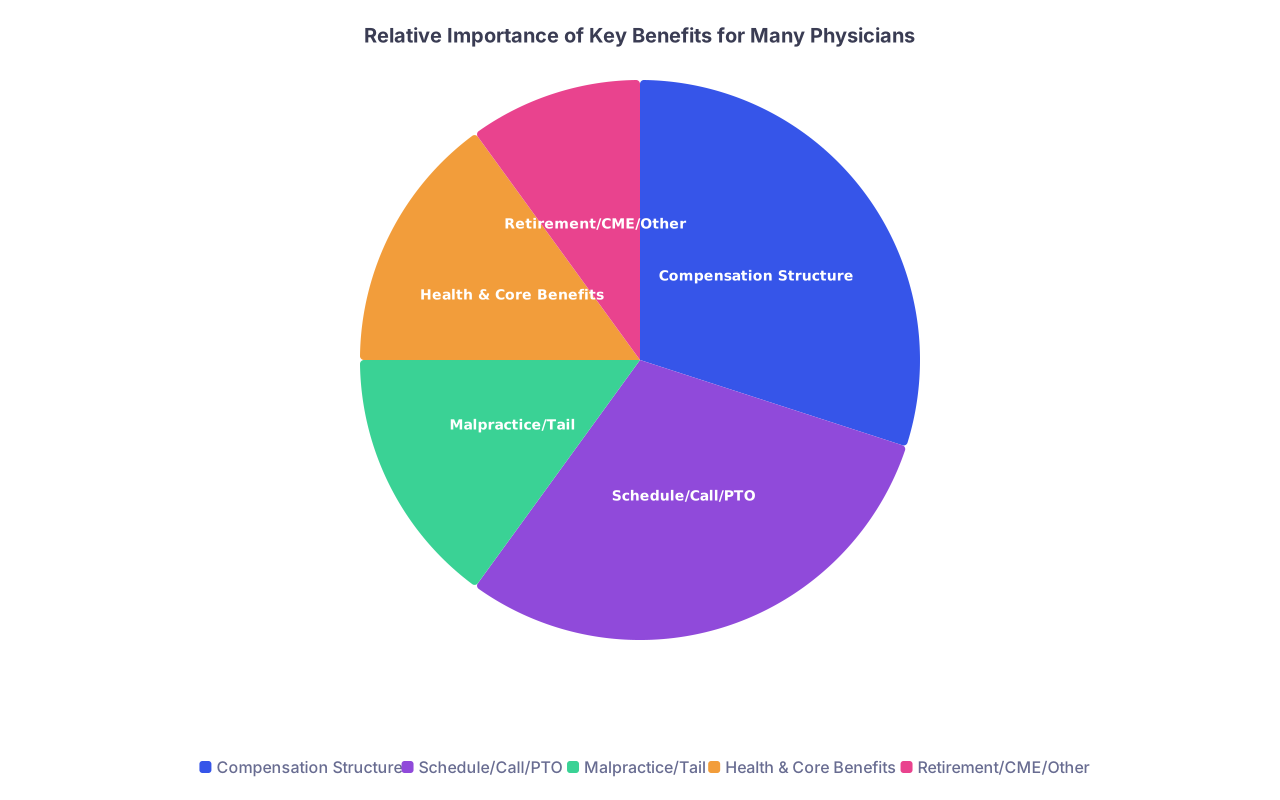
| Category | Value |
|---|---|
| Compensation Structure | 30 |
| Schedule/Call/PTO | 30 |
| Malpractice/Tail | 15 |
| Health & Core Benefits | 15 |
| Retirement/CME/Other | 10 |
If your personal pie chart is wildly different, good. That is the point. Customize ruthlessly.
A Simple Decision Flow for Any Offer
One last thing. When you get an offer—primary job or moonlighting—run this mental flow:

| Step | Description |
|---|---|
| Step 1 | Receive Offer |
| Step 2 | Check Must Have List |
| Step 3 | Clarify or Negotiate |
| Step 4 | Score Nice to Have Items |
| Step 5 | Decline Offer |
| Step 6 | Compare With Other Options |
| Step 7 | Accept Offer |
| Step 8 | Keep Looking |
| Step 9 | Any Must Have Failed? |
| Step 10 | Must Have Fixed? |
| Step 11 | Best Overall Fit? |
Do not skip the “clarify” step. Many offers look bad simply because they are vague. Get things in writing before you decide.
How This Applies to the Future of Medicine
Medicine is shifting:
- More hospital employment, fewer true private practices
- More shift‑based work and telemedicine
- More dependence on productivity and metrics
That means benefits will become less standardized and more “creative.” Translation: more ways to hide bad deals behind shiny numbers.
Having a hard, personal must‑have vs nice‑to‑have framework is your defense against:
- “Unlimited PTO” that nobody actually uses
- “High earning potential” with impossible metrics
- “Flexible scheduling” that collapses under staffing shortages
As moonlighting, gig‑style shifts, and portfolio careers grow, your benefits list will not just be for one employer. It will be the backbone of how you assemble a mix of work that is financially and personally sustainable.
Practical Next Steps (Do These in the Next 24–48 Hours)
Draft your first must‑have list for:
- Malpractice/tail
- Base pay / rate
- health/core benefits
- Schedule/call/PTO
- Moonlighting permissions
Add 5–10 nice‑to‑have items that would separate a great job from an average one.
Save it as a one‑page document (PDF or note on your phone) you can glance at during calls.
Use it on the next recruiter email or moonlighting inquiry you get. Not theoretically. In real time.
Do this, and you stop reacting to offers. You start evaluating them like a professional.