
The way most residents structure moonlighting almost guarantees duty hour violations. Not because they are lazy or reckless, but because the system is set up to trap them if they are not brutally organized.
You want the extra money. You might even need it to survive. But you also want to stay out of trouble with your program, your GME office, and the ACGME. Those three have no sense of humor about violations, even when everyone knows the system is underpaying you.
Here is how to structure moonlighting so it actually works—for your wallet, your sanity, and your duty hours.
1. Get Clear On The Rules (Not The Rumors)
Let’s kill the usual confusion first. Half of the “rules” you hear about moonlighting are just folklore passed down by PGY-4s who did not read the manual.
You are dealing with three overlapping rulebooks:
- ACGME duty hour rules
- Institution / GME and program policy
- Licensing and credentialing rules (state + hospital)
A. The ACGME Framework You Cannot Ignore
Whether your program likes moonlighting or not, the ACGME rules are the hard floor:
- 80-hour weekly limit, averaged over 4 weeks
- 1 day off in 7, free of all clinical responsibilities, averaged over 4 weeks
- 10 hours between duty periods (or 8 in some special scenarios)
- Maximum in-house call every 3 days (averaged over 4 weeks)
Key point that people conveniently “forget”:
All moonlighting hours count toward the 80-hour limit if you are in an ACGME-accredited program. Internal and external.
If someone tells you, “external moonlighting does not count,” they are wrong. Or lying. Or both.
B. Internal vs External Moonlighting
This matters a lot for how you structure things:
Internal moonlighting
Paid work at your home institution or affiliated sites, usually under the same credentialing / EMR / malpractice umbrella.External moonlighting
Paid work at unaffiliated hospitals/clinics, often with separate credentialing, EMR, and contracts.
Both count toward duty hours. But internal is usually easier to monitor, schedule around, and get approved. External can be logistically heavier and harder to “hide” when something goes sideways.
C. Program and GME-Specific Rules
Some typical local rules I see:
- No moonlighting before PGY-2, or sometimes PGY-3.
- Must be on “good standing” (no remediation, no major professionalism issues).
- Must have a full, unrestricted license (not just training license) for external moonlighting.
- Must get written approval from PD and GME.
- Limits on number of moonlighting hours per week or per month.
You solve this confusion in 30 minutes:
- Pull your GME moonlighting policy (usually PDF on the GME website).
- Pull your program handbook.
- Talk to your chief resident who actually moonlights and ask how they do it without getting flagged.
Stop relying on vague hallway memory. You need the exact text and how it’s enforced in real life.
2. Design A Moonlighting Model That Is Actually Sustainable
The biggest mistake residents make is treating moonlighting like Uber: “I’ll just grab shifts when I can.” That is how you drift into 90-hour weeks, horrible fatigue, and a PD email that starts with “Can you stop by my office?”
You need a model—a consistent structure with rules you follow.
Step 1: Decide Your Non-Negotiables
Before you look at any moonlighting opportunity, answer:
What is my maximum total weekly hours I am willing to tolerate?
Hint: If you regularly sit at 79.5 hours, fatigue will wreck you.How many consecutive days of work will I allow?
Example rule: no more than 6 days in a row under any circumstances.What is my absolute minimum sleep window between duty shifts?
Example: minimum 8 hours at home between end of one shift and start of next for any moonlighting.
You write these down. You treat them like contract terms with yourself.
Step 2: Pick A Moonlighting “Type” That Fits Your Life
Most resident moonlighting falls into a few buckets:
- Night cross-cover / nocturnist-style shifts
- ED / urgent care shifts
- Weekend day coverage (rounding, admissions)
- Telemedicine (triage, refills, minor complaints)
You want to pick a type that:
- Predictably fits around your heaviest rotations.
- Does not destroy your post-call recovery.
- Has simple logistics (credentialing, EMR, malpractice).
If you are in a surgical program doing Q3 home call with frequent callbacks, you probably should not be stacking ED moonlighting on top. That is a recipe for mistakes and complaints.
3. Build A Duty-Hour Safe Schedule: The 4-Week Grid
You cannot wing this week to week. You need to work in 4-week blocks, because that is how 80-hour averages and day-off requirements are calculated.
Step 1: Create A 4-Week Master Grid
Do this before committing to any moonlighting:
- Make a simple 4-week calendar (Google Sheet, Notion, even paper).
- Fill in:
- All scheduled residency duties (day shifts, nights, clinic, call).
- Post-call days.
- Guaranteed days off.
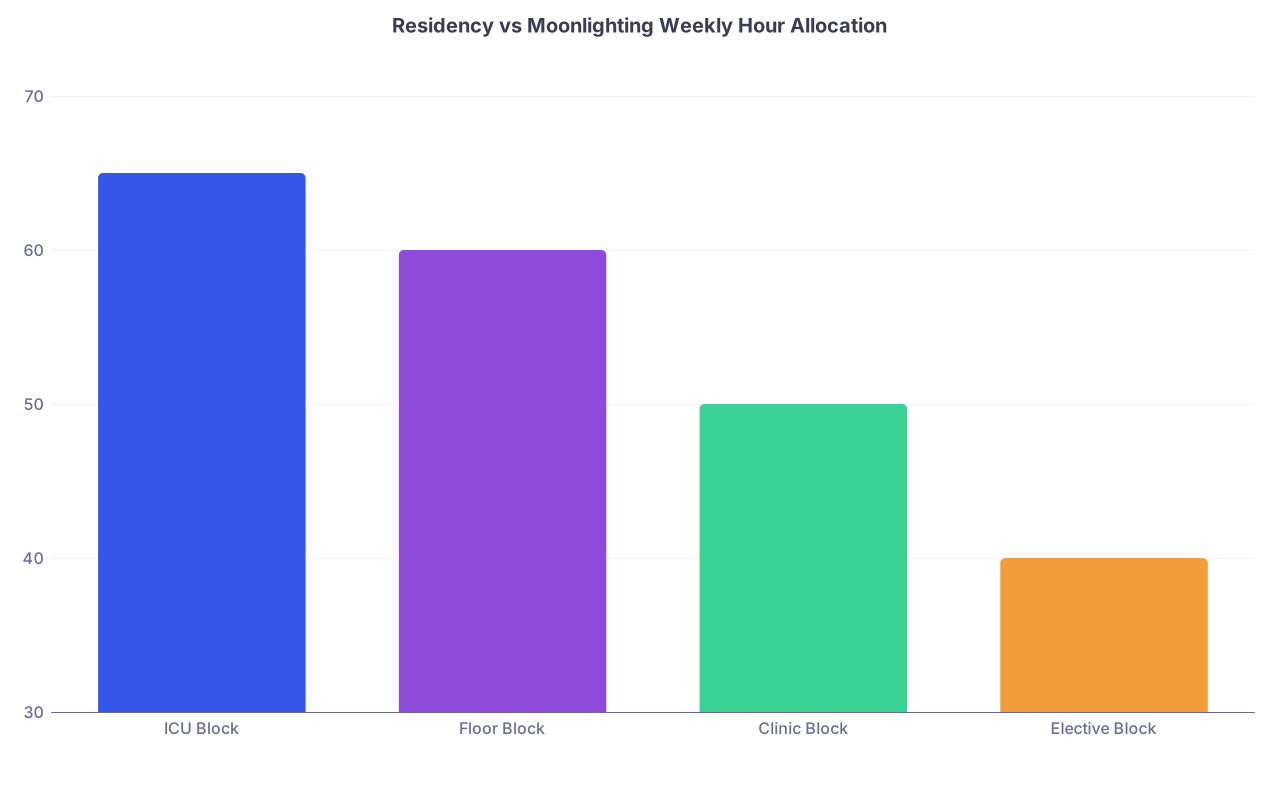
Then, calculate approximate weekly residency hours:
- Heavy ICU month: 60–70 hours.
- Floor month: 55–65 hours.
- Clinic-heavy: 45–55 hours.
- Elective / research: 30–45 hours (sometimes 0 moonlighting is smarter if using that time for career stuff).
Now you can see your “headroom” for moonlighting.
| Category | Value |
|---|---|
| ICU Block | 65 |
| Floor Block | 60 |
| Clinic Block | 50 |
| Elective Block | 40 |
Interpretation: if you are averaging 65 in the ICU, you have 15 hours max per week for moonlighting before hitting the 80-hour wall. On elective, maybe up to 40. That does not mean you should do 40. It means that is the ceiling.
Step 2: Hard-Cap Moonlighting Hours Per Block
Do this before you agree to any shifts.
For each block:
- Take your average expected residency hours.
- Subtract from 80.
- Set your personal moonlighting max to something below that.
Example:
- ICU block: 65 residency → 80 – 65 = 15 → personal cap = 8–10 hr/week.
- Floor block: 60 → cap 10–12 hr/week.
- Clinic: 50 → cap 16–20 hr/week.
- Research: 40 → cap 20–25 hr/week (but only if you are not sacrificing your long-term goals).
Write that cap in your calendar. Treat it as a legal limit.
4. Structuring Shifts To Avoid Specific Duty Violations
There are three ACGME tripwires people hit repeatedly:
- 80-hour violation
- 1 day off in 7 violation
- Inadequate rest between shifts
You need concrete rules that make these mathematically unlikely.
A. Protecting The 1 Day Off In 7
This is the most neglected rule. People say “I am fine, I’ll just sleep.” The ACGME does not care. A “day off” is:
- A full 24 hours
- Free from all clinical duties, including moonlighting
If you string 14 days straight of “just one extra moonlighting shift” you are in violation. Period.
Your fix:
- Pick one guaranteed day off per week, before adding moonlighting.
- Block it off in your calendar as “OFF – NO SHIFTS.”
Non-negotiable rules that work:
- Never moonlight on your post-call day off if that erases your only day off in 7.
- If you are on a rotation with only 4 days off in 4 weeks, you may only be able to moonlight on 1–2 of those “off” days. The others need to stay protected to meet the 1-in-7 average.
B. Maintaining Safe Rest Intervals
Residency duty rules require appropriate rest between resident shifts. But fatigue does not care if the hours were “moonlighting” or “primary residency.”
Your structure:
No back-to-back overnights with early-morning primary work.
- Example rule: If you moonlight 7 p.m.–7 a.m., you do not start a residency shift before 1 p.m. that day. If your program schedule says 7 a.m.–5 p.m. the next day, that overnight is simply off-limits.
No “stacking” night float plus moonlighting nights.
- If you are on night float, do not add additional moonlighting nights. If you absolutely must, cap it severely and get PD approval explicitly.
Hard minimum home time.
- For any combo, require minimum 8 hours from “door in” to “door out” between the end of moonlighting and the start of residency duty.
5. Approval, Documentation, And Not Getting Burned
If you are going to moonlight, own it. The worst approach is “I will just not log the moonlighting hours and hope nobody notices.”
Eventually, somebody does.
Step 1: Formal Approval Pipeline
Standard steps (adapt to your institution):
- Review program and GME moonlighting policy.
- Obtain unrestricted license if required for external moonlighting.
- Secure malpractice coverage confirmation (many external gigs provide their own; internal is often covered by the hospital).
- Fill out the GME moonlighting request form:
- Employer or site
- Type of work
- Expected hours per week / per month
- Supervisor / point of contact
- Get Program Director sign-off.
- Obtain GME office approval.
- Maintain separate contract with the moonlighting entity.
You want this process in writing and complete before working a single paid shift. Retroactive approval is often a mess.
Step 2: Track Your Hours Better Than Your Program Does
Your program’s duty-hour system (MedHub, New Innovations, whatever) is designed for minimum compliance, not for optimizing your schedule.
You need your own independent tracker that includes both:
- Residency duty hours
- Moonlighting hours
I strongly recommend a simple spreadsheet with:
- Date
- Start time
- End time
- Type (Residency / Moonlighting)
- Site
- Notes (call, post-call, etc.)
| Week | Residency Hours | Moonlighting Hours | Total Hours |
|---|---|---|---|
| 1 | 58 | 8 | 66 |
| 2 | 62 | 10 | 72 |
| 3 | 64 | 6 | 70 |
| 4 | 60 | 12 | 72 |
You can glance and see your 4-week average and whether you are drifting up.
Step 3: Be Proactive With Your PD
If you wait until they see a violation flagged in the duty system, that conversation starts adversarial. Instead:
- At the start of a moonlighting plan, show them:
- Your 4-week grid
- Your planned maximum hours
- The type of work and setting
This tells them you actually thought about safety and compliance. They are much more likely to support you. And if something goes sideways (shift runs long, last-minute coverage), you have a pattern of being responsible.
6. Smart Scheduling Patterns That Actually Work
This is where theory becomes practical. Here are tested patterns that tend to avoid violations when used correctly.
Pattern 1: “Elective Month Concentrated Moonlighting”
Best for: IM/FM/Neuro/Psych where you have light elective or research months.
Structure:
- Goal: Make extra income while on lighter rotations, zero moonlighting during heavy blocks.
- Example:
- Heavy ward/ICU months: 0 moonlighting.
- Clinic months: 1 shift per week max.
- Elective month: 2–3 shifts per week, capped well under 80 hrs.
Rules:
- Still keep one full day off per week.
- Keep consecutive work days ≤ 6.
- Do not let the fact that “elective is chill” justify 75–80-hour weeks. Use some of that freed time for sleep and career development.
Pattern 2: “Weekend-Only, Daytime Coverage”
Best for: Programs with relatively predictable weekdays.
Structure:
- One Saturday or Sunday moonlighting shift most weeks.
- You leave the other weekend day fully off as your 1-in-7 protection.
- Aim for 8–12-hour daytime shifts, not overnight.
Why it works:
- Preserves circadian rhythm.
- Easily modeled into your 4-week grid.
- Usually high-yield financially if you get decent daytime rates.
Hard rule: If your residency rotation steals one weekend day (for call, mandatory coverage), you do not fill the other with moonlighting every time. You still need zero-clinical days.
Pattern 3: “Protected Night Coverage With Built-In Recovery”
Best for: Residents comfortable with nights, with programs that allow creative scheduling.
Structure:
- Moonlighting only on post-call “evening” or pre-off days when the next 24 hours are yours.
- Example:
- Friday: Regular residency work.
- Saturday: Day off.
- Saturday overnight: 11 p.m.–7 a.m. moonlighting.
- Sunday: Mostly recovery, no residency.
You still count the hours. But you are not going night → day → night in a destructive way.
7. Red Flags: When Moonlighting Is About To Bite You
You can structure things perfectly on paper. Real life will still fight back. Watch for these warning signs:
- You are regularly adjusting your duty-hour entries to avoid flagging >80. That is not “optimizing.” That is falsifying.
- You find yourself microsleeping during rounds, driving home, or in patient rooms.
- You are snapping at nurses, co-residents, or staff more than usual. Chronic fatigue shows up as irritability long before you notice your cognition slipping.
- PD or chiefs start dropping phrases like “we are concerned about your wellness” or “we noticed some duty-hour patterns.” Translation: you are on their radar.
When you see these, do not double down. Scale back.
8. Financial Reality: Making The Math Worth It
If you are going to push your body and your schedule, the numbers better justify it. A lot of residents moonlight for terrible effective rates.
You want to calculate effective hourly value, adjusting for:
- Commute time
- Pre-shift chart review or onboarding
- Extra fatigue spillover into your main job
Basic formula:
Effective hourly rate = Pay per shift ÷ (paid hours + unpaid overhead hours)
Example:
- 8-hour shift pays $800.
- 30 minutes commute each way = 1 hour.
- 30 minutes setup/closeout = 0.5 hour.
- Total time commitment = 9.5 hours.
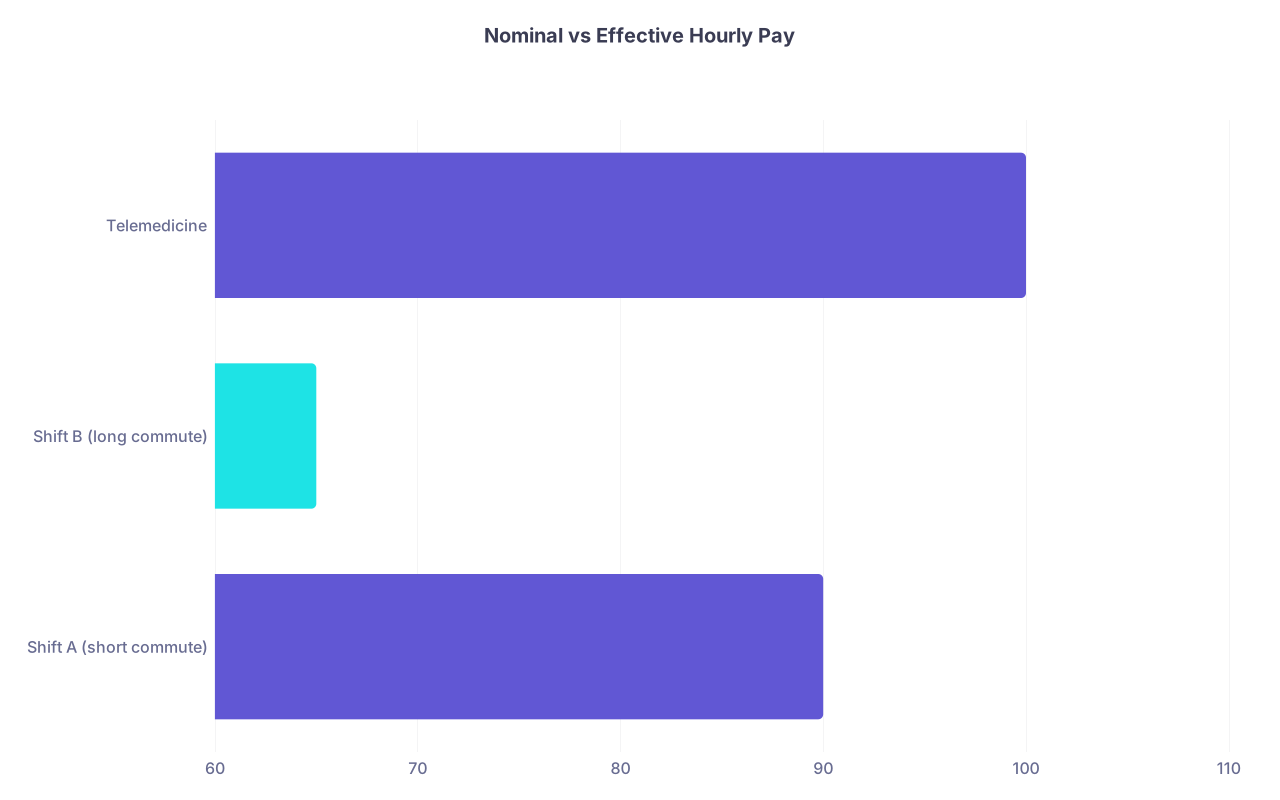
→ Effective rate ≈ $84/hr, not $100/hr.
Now add fatigue cost. If that shift makes your next day miserable and you cut corners on studying or career tasks, that is another “hidden” cost.
| Category | Value |
|---|---|
| Shift A (short commute) | 90 |
| Shift B (long commute) | 65 |
| Telemedicine | 100 |
Telemedicine frequently wins because overhead is minimal and fatigue impact is lower. Many residents underestimate this.
9. Telemedicine And Remote Moonlighting: A Useful Workaround
Telemedicine is not magic, but it solves some structural problems:
- No commute.
- Often flexible scheduling.
- Sometimes lighter cognitive load than ED or inpatient nights.
- Easier to slot between other duties without wrecking your sleep.
But you still must:
- Count every hour toward the 80-hour cap.
- Ensure it is approved by your PD/GME if you are in training.
- Make sure malpractice and licensing are properly handled for all states you cover.
Use telemedicine to replace, not stack on top of, physically brutal shifts. If you are already doing 60–70 hours in-house, 10 hours of telemedicine is better than 10 hours of added ED work.
10. A Simple, Repeatable Moonlighting Protocol
If you want something you can literally follow step-by-step, use this.

| Step | Description |
|---|---|
| Step 1 | Review GME and Program Policies |
| Step 2 | Estimate Rotation Hours |
| Step 3 | Build 4 Week Grid |
| Step 4 | Skip Moonlighting This Block |
| Step 5 | Set Personal Hour Cap |
| Step 6 | Identify Moonlighting Type and Site |
| Step 7 | Obtain PD and GME Approval |
| Step 8 | Schedule Shifts Within Cap |
| Step 9 | Track All Hours Weekly |
| Step 10 | Cancel or Reduce Shifts |
| Step 11 | Continue Current Plan |
| Step 12 | Headroom > 8 hr per week? |
| Step 13 | Approaching 80 hr or 1 in 7 Violation? |
If you follow this loop every block, you dramatically lower the risk of surprise violations.
FAQs
1. Can my program really stop me from external moonlighting if I have a full license?
Yes. Your license lets you practice medicine. Your residency contract controls what you are allowed to do while in their program. If their written policy says “no moonlighting” or “PD approval required,” and you ignore that, you are risking disciplinary action, “unprofessional behavior” documentation, or even non-renewal. A license is not a shield against program rules.
2. What if my moonlighting shift runs long and pushes me over 80 hours?
You still must log the true hours. Then do two things:
- Immediately cut back or cancel upcoming moonlighting to bring your 4-week average back under 80.
- Let your chief or PD know if it is a pattern (e.g., that site always runs late). You want a record that you are trying to comply and that the issue is structural, not you being dishonest.
3. Is it ever okay to not report moonlighting hours in the duty-hour system?
No. If you are in an ACGME-accredited program, all clinical work—including moonlighting—must be counted. Under-reporting is falsification. If you are unlucky, it can be framed as a professionalism or integrity issue, which is much worse than a cleanly explained one-time violation.
4. What is a reasonable maximum for moonlighting hours during residency?
For most people, 8–16 hours per week is the realistic safe range on lighter rotations, and 0–8 hours on heavier ones. If you are consistently doing more than 20 hours per week on top of a full residency schedule, your risk of fatigue-related errors, burnout, and duty-hour problems skyrockets. Very few residents can sustain that without something important breaking.
Key points:
- Treat moonlighting like a structured project, not a side hustle you squeeze in blindly.
- Use a 4-week grid, hard hour caps, and a guaranteed day off each week to stay clear of ACGME violations.
- Get formal approval, track every hour, and be willing to cancel shifts when the numbers or your fatigue start to look ugly.