
The biggest threat to your fellowship dreams is not your Step score or your research output. It might be that “easy” $150/hour moonlighting gig you picked up to pay your loans.
Let me tell you what really happens behind closed doors when fellowship program directors see a resident who is clearly moonlighting a lot. They don’t see “hustle” or “financial responsibility.” They see risk. Fatigue. Divided focus. And in some cases, a future colleague they simply cannot trust.
You’re being sold moonlighting as a resident “benefit.” The money is real. But so is the cost—and the bill comes due right when you need your record to be spotless: during fellowship recruitment.
Let’s walk through the parts nobody explains to you on orientation day.
The Uncomfortable Truth: PDs Talk About Your Moonlighting
I’ve sat in rooms where fellowship rank lists were made. The public story is that they rank “holistically,” weighing clinical performance, research, letters, and interviews.
The private story is sharper: they’re looking for evidence of judgment. Moonlighting is one of the best (and most underappreciated) markers of that.
Here’s the unvarnished version of what happens:
A file goes up on the screen in a cardiology, GI, pulm/crit, or heme/onc fellowship committee meeting. Strong Step scores. Solid research. Good letters. Then someone—often the PD or APD—says:
“This resident is known to moonlight a lot. There have been some near-misses on service.”
You can feel the mood in the room shift. People lean back. Eyebrows go up. The candidate just slid from “probably yes” to “maybe” or even “no” in under 10 seconds.
No one writes this in your ERAS application. It surfaces in three ways:
- Quiet comments in letters of recommendation
- Off-the-record phone calls between PDs
- Reputation—what your name means when whispered in the attending room
And let me be blunt: PDs trust each other more than any piece of paper. If your PD says, “This person is very strong but they get distracted with extra work on the side,” that’s a major red flag when the committee is comparing you to someone who is “all-in” on residency.
How Moonlighting Actually Shows Up on Your Record
You think: “But moonlighting isn’t on my ERAS. How can they even know?”
They know. Or they can smell it.
Here’s how it leaks out.
1. Evaluation patterns that don’t add up
Attendings notice when your baseline changes.
You used to present sharp, thorough, and anticipate issues on rounds. Then suddenly your notes are sloppier, orders are delayed, and you’re missing subtle things. Not catastrophic, just… off.
On evaluations, that translates into wording like:
- “Generally strong, but can appear tired and distracted on busy rotations.”
- “Has improved over time but occasionally seems overextended.”
- “Good potential; would benefit from better attention to detail.”
You read those as minor critiques. Fellowship PDs read them as: “This person is moonlighting and coming in post-call fried.”
2. The timing of your fatigue
Everyone is tired in residency. But the pattern matters.
You’re magically more exhausted:
- On weekends, right after your moonlighting shifts
- On light rotations where you “should” be fresh
- On electives you picked for the supposed “free” time
Attendings talk. “I don’t get it, we had 6 patients on the service and she looked more tired than when we have 16. Isn’t she on that urgent care moonlighting gig?”
Once that idea is planted, it doesn’t leave.
3. The whispers between PDs
This is the part no one tells you in medical school: PDs absolutely call each other.
You apply for a competitive cardiology fellowship. Your PD gets an email: “Hey, what’s the real story on Dr. X?”
If your PD has had to:
- Warn you about hours violations because of moonlighting
- Talk to you about borderline patient care issues after extra shifts
- Field complaints about your availability for teaching or research
…the “real story” is not going to enhance your application. They might still say you’re smart. They might still say you’re capable.
But if they also say, “We had some issues with time management because of outside work,” that’s the kiss of death for top programs. You get quietly nudged down the rank list.
The Hidden Ways Moonlighting Erodes Your Fellowship Profile
The obvious risk is fatigue and mistakes. Honestly, that’s the part you think you can manage. “I can handle a few extra nights. I’ve done 28-hour calls. I’m fine.”
That’s not what kills you. What kills you is everything else that dies when you give those hours away.
Research: the first sacrifice, and fellowship PDs know it
Fellowship programs—especially in cardiology, GI, heme/onc, pulm/crit, and academic IM—care deeply about your “trajectory.” They want to see that you’re building something: projects, publications, QI work, teaching.
Moonlighting steals the exact hours when this happens:
- Post-call afternoons where you would normally work on a manuscript
- “Chill” elective blocks you could have used for data analysis
- Weekend mornings that should be writing time
Instead of showing up with 2–3 decent publications or abstracts, you show up with 1 weak poster and a story about “not having much research at my program.”
Insider truth: PDs can tell the difference between “my institution truly has no research” and “I traded my research time for $150/hour at the community ED.”
They may not confront you about it in the interview. But they absolutely debate it in the ranking meeting.
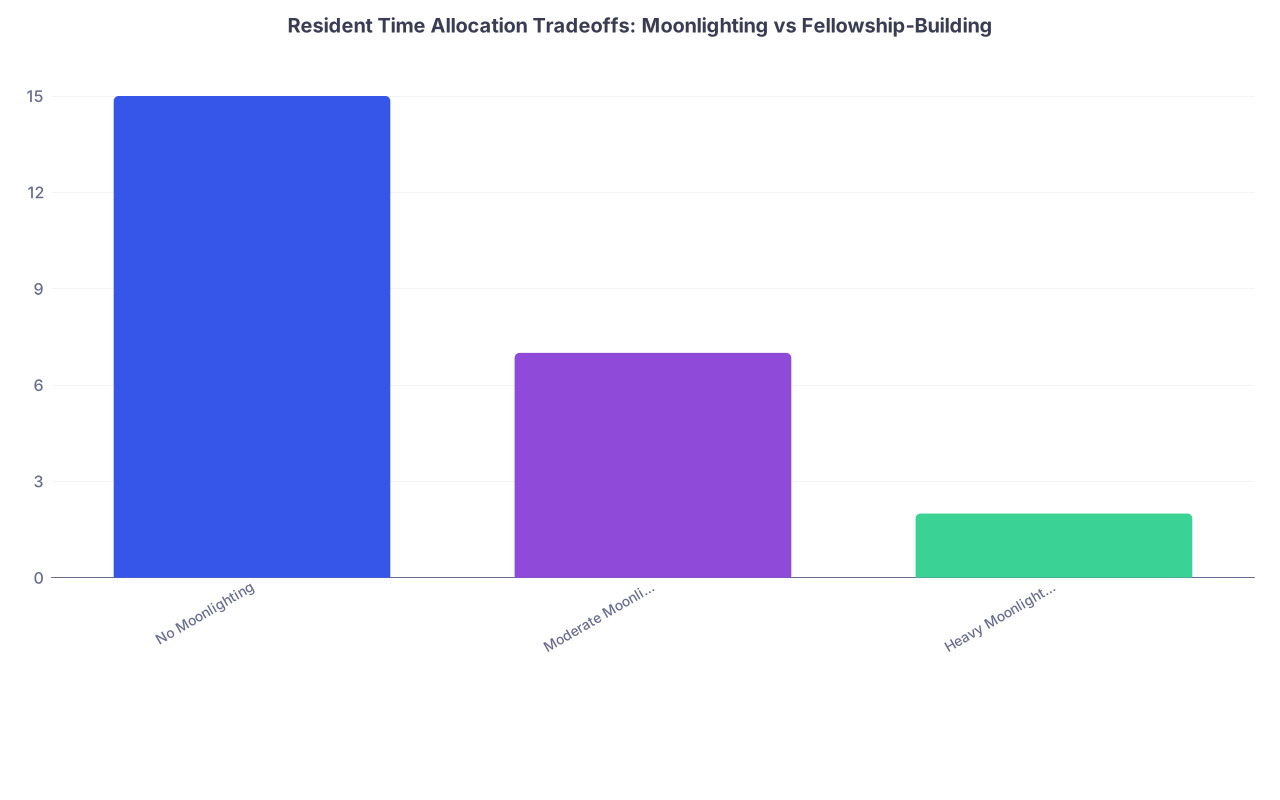
| Category | Value |
|---|---|
| No Moonlighting | 15 |
| Moderate Moonlighting | 7 |
| Heavy Moonlighting | 2 |
That chart? Rough but real. Those numbers mirror what I’ve seen: the more you moonlight, the fewer serious CV-building hours you actually get. That matters far more than you think.
Letters: attendings can tell when you’ve checked out
(See also: How to Vet a Moonlighting Offer for a 15-minute contract checklist.)
Strong fellowship letters have a very particular feel. They say things like:
- “She is the best resident I’ve worked with in the last 5 years.”
- “He consistently goes above and beyond on patient care and academic work.”
- “She actively seeks out feedback, follows through on projects, and is fully engaged with our service.”
Those letters usually come from attendings who have seen you:
- Show up early
- Stay late when needed
- Ask thoughtful questions
- Follow up on interesting cases
- Participate in QI or small projects
Moonlighting residents often develop a different pattern: do the minimum, finish the list, get out. Not maliciously—just self-preservation. You’re tired. You’ve got another shift. You’re thinking about your schedule, not about impressing that attending with initiative.
So the letters become lukewarm:
- “Dependable and generally competent.”
- “Worked well on a busy team, handled tasks appropriately.”
- “Solid resident. I expect he will do fine in fellowship training.”
Those phrases sound positive to you. To fellowship selection committees, they scream: “Middle of the pack, nothing special, probably split focus.”
And if there’s any subtle hint about fatigue, time management, or inconsistent performance? Forget top tier.
Clinical reputation: the quiet ledger you never see
Here’s the part that stings: your reputation is being built when you are not in the room.
Examples I’ve watched play out:
A night float resident who starts missing early signs of decompensation after starting to moonlight in an outside ICU. Not huge misses. Just a step down in vigilance. Nursing starts saying quietly, “He’s slower at night now.” That makes its way back to the chiefs. The chiefs talk to the APD. When you apply for critical care fellowship, your name is already pre-labeled: “Not quite as sharp as we’d hoped.”
A third-year IM resident doing frequent ED moonlighting who suddenly stops volunteering for sick admits and starts subtly ducking procedures to get out on time. The ED faculty see it. The ward attendings see it. In the fellowship ranking meeting, when your name comes up, someone says, “Good resident, but I don’t see him as that next-level intensivist. He seemed ready to clock out.”
An aspiring GI fellow who used elective time for hospitalist moonlighting instead of GI clinic, endoscopy observation, or research. On paper, she claims strong interest in GI. In the internal committee discussion, her own PD says: “We’ve had residents who were clearly all-in on GI. She’s good, but she didn’t fully immerse herself.”
Every time, moonlighting was “just a way to make some extra money.” Nobody thought it would end up poisoning the exact file that would be judged for fellowship.
The Regulatory Landmines That Can Sink You
Beyond the soft stuff—fatigue, research, reputation—there are hard, ugly pitfalls people pretend aren’t real until they explode.
ACGME hour violations: usually not accidental
Programs are under a microscope for duty hour compliance. If you’re moonlighting, especially off-site, you’re playing with fire.
The official line is: “All moonlighting must count toward the 80-hour limit.”
The unofficial reality:
- Residents underreport moonlighting hours.
- Some sites do not report anything back.
- PDs “trust” residents until there’s a problem.
Once there’s a sentinel event, a near-miss, or a random audit? Your logs get examined. If they find obvious discrepancies between your reported hours and reality, your PD is not going to shield you in fellowship season.
I’ve seen PDs say on calls:
“We had some ACGME issues with them around outside work. They’re a good person but I’d be cautious.”
No PD wants to import a resident who almost dragged them into an ACGME mess.
Patient safety events: everything is traceable
This is the darker scenario, but it’s not hypothetical.
You pick up a moonlighting shift, come back tired, miss something major on call. Maybe not malpractice-level disaster, but a clear lapse. It gets reviewed.
On internal review, the sequence often goes:
- Was this resident over hours?
- Were they moonlighting in the prior 24–48 hours?
- Did fatigue play a role?
If the answer is “yes-ish” to any of that, it’s documented somewhere. Officially or in PD memory. That follows you. PDs have long memories about “the resident who almost got us sued.”

| Step | Description |
|---|---|
| Step 1 | Start Moonlighting |
| Step 2 | PD Concern About Compliance |
| Step 3 | Weaker CV For Fellowship |
| Step 4 | Low Risk Overall |
| Step 5 | Subtle Red Flags In Letters |
| Step 6 | PD Hesitant On Calls |
| Step 7 | Lower Rank Or No Offer |
| Step 8 | Hours Truly Under 80? |
| Step 9 | Research Still Productive? |
| Step 10 | Evaluations Still Strong? |
(See also: Moonlighting contract traps)
That’s the flowchart PDs don’t show you. But they’re running it mentally.
The Seduction: Why Moonlighting Looks Better Than It Is
Let me acknowledge the obvious: the money is tempting. brutally tempting.
You’re staring at:
- Six-figure loans
- Pathetic resident salary
- Colleagues posting paystubs from moonlighting gigs
Everyone says, “It’s easy. Just some simple admits. You’re trained for this. Why not?”
Here’s the tradeoff nobody forces you to quantify:
You might be trading an extra $15–40k during residency for a worse fellowship match. Which, over a lifetime, is a laughably bad deal.
If heavy moonlighting costs you:
- Matching at a top academic cardiology vs a mid-tier program
- Getting a heme/onc spot in a research-heavy center vs a purely community place
- Landing a pulm/crit position where you can sub-specialize vs a generic IM job
You are leaving millions on the table over your career. For the psychological relief of making a little more in PGY-2 and PGY-3.
Residents almost never think about it that way, because no one forces them to do the math.
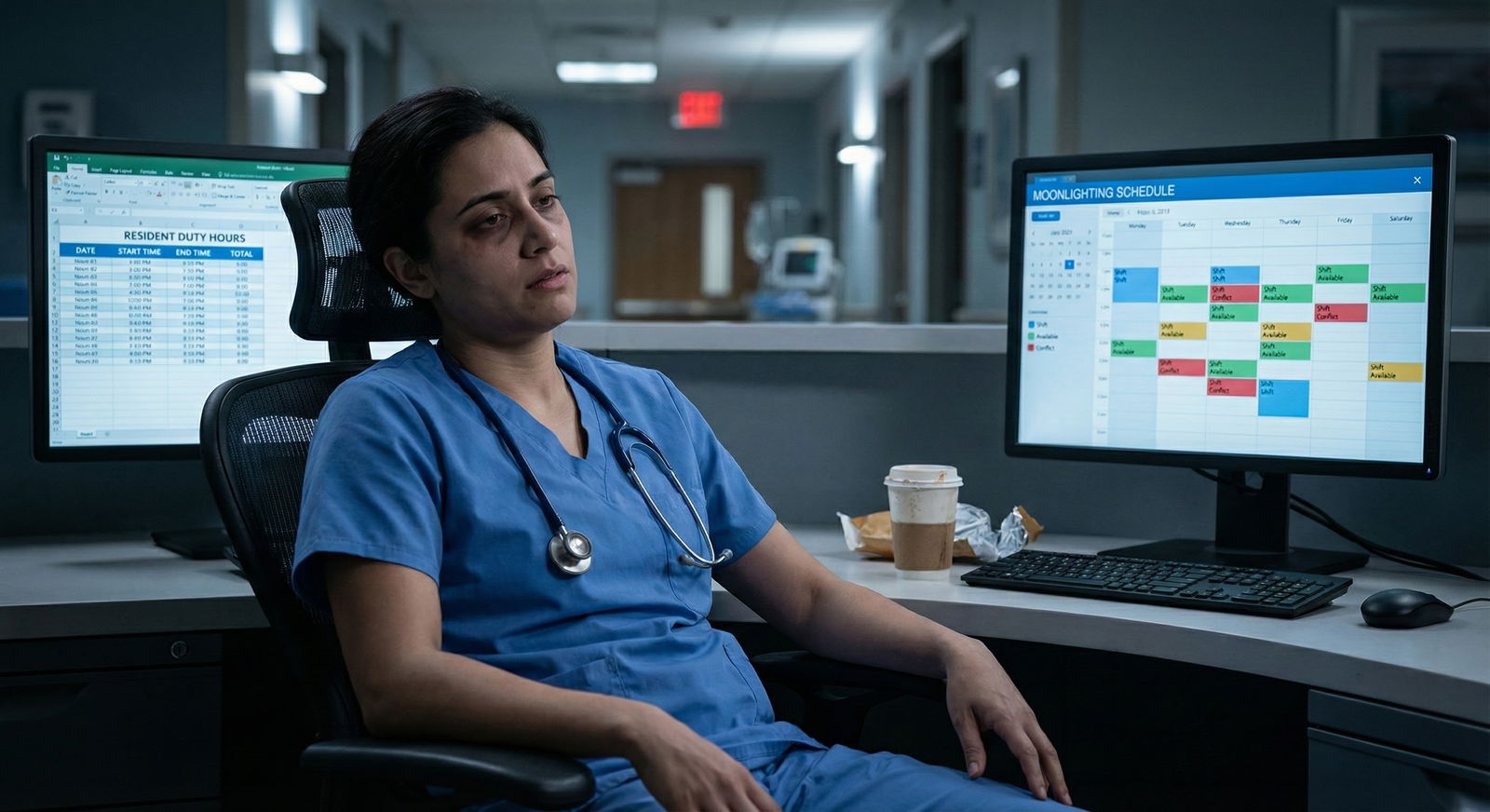
When Moonlighting Doesn’t Kill Your Fellowship Shot
Moonlighting is not automatically evil. Some PDs are fine with it—within reason. I’ve seen residents moonlight and still crush fellowship. The difference is not luck. It’s control.
The ones who get away with it usually follow a pattern:
They start late, not early.
No moonlighting as an intern. Sometimes not until mid-PGY2. They spend the first year establishing a pristine clinical reputation and banking strong letters.They cap their shifts ruthlessly.
1–2 shifts a month, not 6–8. They treat moonlighting as a garnish, not a second job.They protect research and electives like gold.
If they’re serious about fellowship, research time is non-negotiable. No moonlighting on research days. None on late-night call before academic conferences or important meetings.They are brutally honest with themselves about fatigue.
If their performance starts slipping, they cut back immediately. They do not tough-guy their way through obvious deterioration.They keep their PD explicitly in the loop.
Not “I think my PD knows.” Actually sitting down and saying, “This is what I’m doing, this many hours, at this site. I want to make sure I’m not putting my training—or your trust—at risk.”
When PDs see that kind of judgment, they’re far less worried. You look like someone who can handle complexity without losing the plot.
| Profile | Moonlighting Pattern | Fellowship Risk |
|---|---|---|
| The Grinder | 4–8 shifts/month, starts PGY1, hides hours | Very High |
| The Opportunist | 2–4 shifts/month, random weeks, research suffers | High |
| The Planner | 1–2 shifts/month, never on research/elective blocks | Moderate |
| The Late Starter | Starts PGY3, tightly limited, PD-approved | Low |
| The All-In Fellow | No moonlighting, maximizes research and mentorship | Minimal |
If you want fellowship—especially in a competitive field—you want to be the Planner or the Late Starter at worst. The Grinder almost always has a story attached to their name. And that’s not the resident you want to be when applications go out.
How To Decide If Moonlighting Is Worth It For You
Strip the emotion out. Do a cold, unsentimental calculation.
Ask yourself:
Do I absolutely need this money now or is it just nice-to-have?
Needing childcare, supporting family, surviving a high cost-of-living city? Different story from just wanting a nicer car.How competitive is the fellowship I want?
Cardiology, GI, heme/onc, pulm/crit, allergy, rheum, academic hospitalist tracks—these programs care a lot about research and reputation. Less competitive, more community-oriented fellowships might be more forgiving.Where am I starting from?
- Strong scores, early research, top-of-class resident? You have some buffer.
- Middle of the pack, no publications yet, average evals? Moonlighting is gasoline on the wrong fire.
What does my PD actually think?
Not what you want to believe. What they say when asked direct questions. If your PD says, “I’m a little worried it might be too much,” that is a warning shot. They’re already drafting the language they’ll use on the phone with fellowship PDs.If I lost my dream fellowship by a tiny margin, would the extra cash feel worth it?
That’s the knife you need to put to your own throat. Because that’s often exactly how this plays out—close calls, tie-breakers, subtle concerns that push you just off the list.
If you can look yourself in the mirror and say, “Yes, I’d take the money over a slightly better fellowship,” then fine. Own it. But most residents, when pressed, absolutely would not.
FAQs
1. Should I completely avoid moonlighting if I want a competitive fellowship?
Not necessarily. But you should treat it like a controlled substance, not a vitamin. Minimal dose, clear indication, and constant monitoring. If you cannot keep your research, evaluations, and engagement at a high level while moonlighting, then yes—you should avoid it. For cardiology, GI, heme/onc, or top academic fellowships, heavy moonlighting is almost always a bad trade.
2. Will fellowship programs directly ask if I moonlighted?
Rarely. They do not need to. They ask your PD, your chiefs, and your letter writers about your work ethic, reliability, and engagement. If moonlighting caused any problems, it will leak out in that “soft” feedback. The danger isn’t the question, it’s the story behind your name.
3. Can I mention moonlighting as a positive experience in my application or interview?
Only very carefully, and usually only if it’s clearly aligned with your fellowship goals and didn’t compromise anything else. For example, limited ICU moonlighting that directly expanded your critical care skills, after you had already built a strong research and clinical record. Even then, I’d be cautious. You never want an interviewer leaving the room thinking, “So were they doing this instead of research?”
4. What if my co-residents are all moonlighting and still matching well?
You’re seeing the highlight reel, not the denominator. You hear about the one resident who moonlighted like crazy and still matched GI at a good place. You don’t hear about the three who quietly slid down rank lists because of lukewarm letters and “mild concerns.” Also, not all moonlighting is equal. Frequency, timing, and your baseline performance all matter. Comparing yourself to others without knowing those details is a good way to sabotage yourself.
5. How do I talk to my PD about moonlighting without raising red flags?
Be direct and preemptive. Go in before you start or expand moonlighting and say: “I’m considering 1–2 shifts a month at this site. My priority is still fellowship. I want your honest opinion if this will hurt my training or my application, and I’m prepared to stop if you see any impact.” That does two things: it signals maturity, and it gives your PD permission to intervene early rather than building silent resentment. PDs are far more likely to support you if you show that you understand the risk—and that you’re not blind to how this looks from their side of the table.
If you remember nothing else, remember this: fellowship programs are not just selecting brains. They’re selecting judgment. Moonlighting tests your judgment in a very public, very traceable way. Do not let a few extra paychecks become the quiet reason your dream fellowship quietly passes you over.