
Last winter, I sat in a closed-door CCC meeting while a PD pulled up a resident’s call logs. The numbers were ugly: full-time ICU rotation, plus three 12‑hour moonlighting shifts a week. The PD leaned back, looked around the room, and said, “Alright, we either pretend we don’t see this, or we acknowledge he’s basically working two jobs.”
That’s the conversation you never hear about. But it happens in every program that allows moonlighting, especially when someone is clearly chasing every extra dollar they can get.
Let me tell you what program directors really think about residents who moonlight aggressively. Not the party line. The actual calculus they use behind the scenes.
The Official Story vs The Real Story
On paper, the stance is clean and polished.
“We support residents developing independence and supplementing income as long as it does not interfere with education, wellness, or duty hour regulations.”
That’s the line. It’s in your handbook, your moonlighting contract, maybe even your GME orientation slide deck.
The real story? Program directors sort residents who moonlight into mental buckets. They rarely say this out loud, but it’s exactly how they think:
| Bucket | How PDs Describe Them |
|---|---|
| Light | Occasional, responsible |
| Moderate | Watch list, but acceptable |
| Aggressive | Problem or future problem |
| Secretive | Trust issue, red flag |
“Light” moonlighting is a couple shifts a month. Extra urgent care coverage, an occasional cross-cover weekend, maybe a cushy telemedicine night. Nobody cares. Honestly, many PDs like it—they see it as practice readiness.
“Moderate” is when you’re clearly trying to pay real bills, but not destroying yourself to do it.
“Aggressive” is when PDs start screenshots, email trails, and documentation in case this becomes their problem with the DIO or the ACGME.
And “secretive”? That’s when their entire attitude toward you changes, even if your performance is technically fine.
How PDs Actually Find Out You’re Moonlighting Too Much
You think they only know what you log in MedHub or New Innovations. That’s cute.
Here’s how they really discover aggressive moonlighting:
The coresident complaint.
This is the most common. Someone on your team is drowning while you “mysteriously” seem checked out or unavailable post-call. They make an offhand comment to a chief: “Yeah, he was moonlighting again last night.” Chiefs repeat it upwards, either casually or with an edge. And it sticks.The ancillary staff slip.
A nurse at an outside hospital says to one of your attendings: “Oh, I see your resident here all the time on weekends!” I’ve seen this happen. The attending goes back to your PD and says, “Did you know X is covering the community hospital cross-cover basically every Friday and Saturday night?”Call schedule patterns.
PDs and chiefs notice the resident who is chronically wheeling and dealing their calls and weekends away, but never “just to rest.” It’s always to cluster nights. To free up big chunks of time that magically align with known moonlighting gigs in town.The performance crash.
You’re suddenly not the same: notes late, sloppy handoffs, lazy exam, missed labs, snappy with nurses. They go digging. And your moonlighting logs tell the rest of the story.Credentialing trails.
Every time you get credentialed somewhere new, there’s paperwork. HR emails, references. Sometimes it crosses someone’s desk at the main hospital. Or an attending gets a “can you verify this resident is in good standing?” form and realizes you’re stacking more work somewhere else.
You may think you’re subtle. You’re not. The system isn’t built to protect your secret; it’s built to protect the institution.
The First Question PDs Ask: “Is This Hurting My Program?”
Program directors are not primarily thinking about you. They’re thinking about their accreditation, their faculty reputation, their board pass rates, their QI metrics, and how much political capital they have with the DIO and C-suite.
So when they see heavy moonlighting, their mental checklist is ruthless:
- Are duty hours being violated in any way that can be traced back to us?
- Are patients at our main hospital being affected?
- Is this resident’s performance dipping in a way that could become a problem case?
- If something terrible happens during moonlighting, does it splash back on our program?
If the answers look safe, many PDs will quietly shrug and keep an eye on things. If not, you become a project. And you do not want to be a PD’s project.
How Aggressive Moonlighting Changes How PDs See You
Here’s the part people don’t want to admit: two residents can have identical performance on paper, but if one is known to be aggressively moonlighting, they’re not viewed the same way.
The “Priorities” Question
When a PD hears you’re stacking 2–3 extra shifts a week, their first internal conclusion isn’t “Wow, great hustle.” It’s:
“So this person’s primary priority is income, not training.”
That colors everything. Your requests for certain rotations. Your asks for letters. Your complaints about workload. Your “burnout” conversations.
Rightly or wrongly, the thought is: You’re not tired because residency is hard. You’re tired because you turned this into two jobs.
Trust and Judgment
Programs care a lot about residents who self-regulate. Someone who is doing a brutal ICU month and decides to say no to a few moonlighting offers? That’s read as good judgment.
Someone who says yes to absolutely everything?
PD translation: “This person will trade safety for money.”
And if they start seeing hints of that in your clinical work—rushing, cutting corners, slow to respond to calls—they get nervous.
The “Would I Hire This Person?” Test
PDs are always thinking about the long game. Who will get good jobs. Who they’d hire as faculty.
Aggressive, poorly controlled moonlighting sets off a future employer alarm in their head:
- Will this person be the attending who signs up for every extra shift and then burns out in 2 years?
- Will they be the one who double-books telemed, urgent care, and hospital shifts and then shows up half-present on rounds?
- Are they going to be that physician who always has a side gig and is never fully engaged?
They may never say that to your face. But it absolutely influences letters, phone calls, and behind-the-scenes conversations.
What “Aggressive” Actually Looks Like to a PD
Residents always ask: “So what counts as aggressive?”
Let me be blunt. PDs don’t sit with a calculator and a specific number. They look for patterns. But there are thresholds that consistently set off alarms.
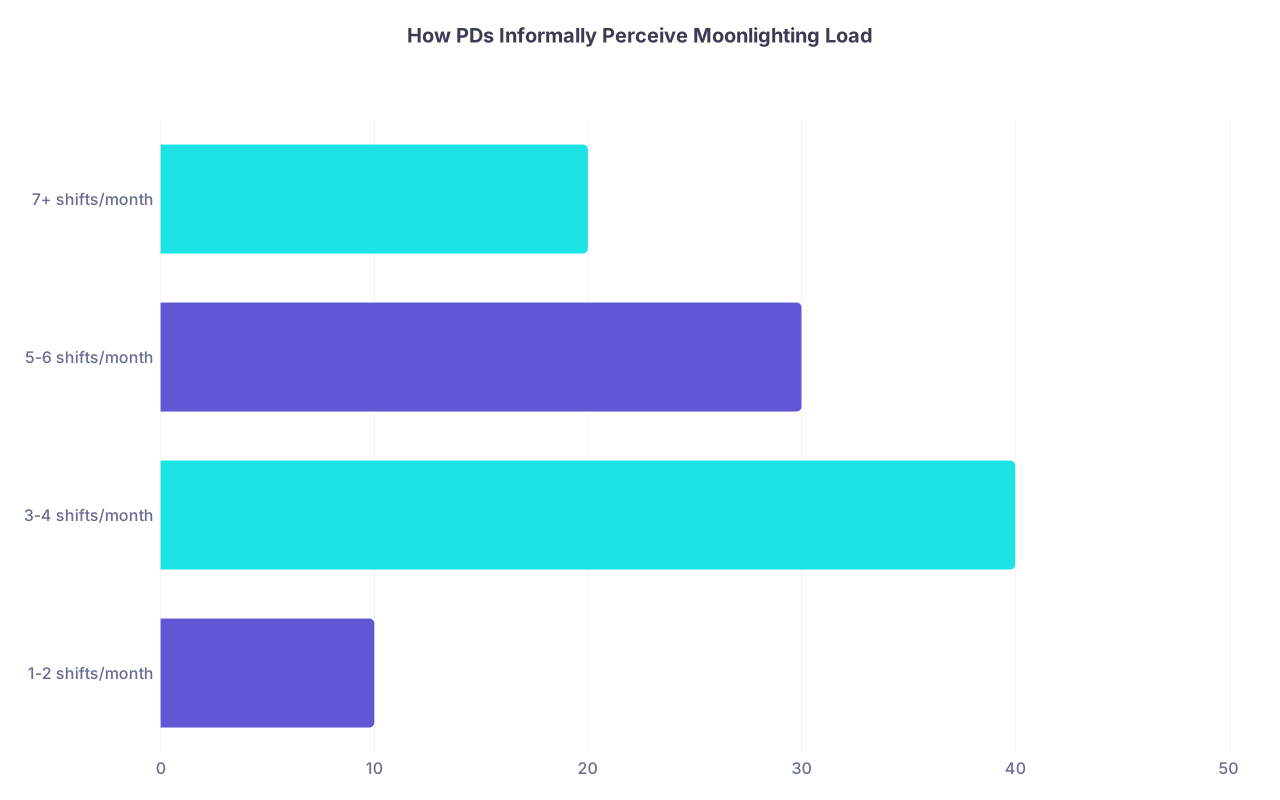
| Category | Value |
|---|---|
| 1-2 shifts/month | 10 |
| 3-4 shifts/month | 40 |
| 5-6 shifts/month | 30 |
| 7+ shifts/month | 20 |
Here’s how they categorize it in their heads, even if they never write it this way:
- 1–2 shifts a month – “No big deal. Healthy, normal, probably helpful.”
- 3–4 shifts a month – “Okay, they’re making real money, but likely manageable if they’re solid clinically.”
- 5–6 shifts a month – “We need to be sure this isn’t bleeding into their performance.”
- 7+ shifts a month – “This is an issue. Or a soon-to-be issue.”
The context matters. If you’re an R3 in EM or anesthesia, lighter clinical months, and you’re moonlighting 5 shifts of low-intensity urgent care? That’s very different from an R2 on a malignant ICU service doing 5 overnight cross-cover hospitalist shifts.
Programs know the difference. But once you cross that 7+ territory routinely, you’re on their radar in a way you can’t fully undo.
The Unspoken Risk Calculus: Liability and Scandal
Every PD has a nightmare scenario playing in the back of their mind:
A resident, post-night-float at the home institution, goes straight to a moonlighting shift. Sleep-deprived. Something catastrophic happens there—delayed recognition of sepsis, missed STEMI, wrong med, bad airway. Family sues. Lawyers start asking questions about hours worked, supervision, credentialing, fatigue.
The question that haunts PDs: “How much did your training program know? And what did you do about it?”
So when they see aggressive moonlighting, they see risk. Not abstract risk. Career-ending, front-page risk.
This is why some PDs clamp down hard the first time they see it. They’re not thinking only about you. They’re thinking about the email from the DIO at 3 a.m. and the institutional review.
And if you think this is theoretical, you’re wrong. I’ve watched a PD yank all moonlighting privileges for an entire program for a year because one resident turned into an urgent-care regular while struggling on inpatient months. It was defensive, maybe heavy-handed. But institutional memory runs long once someone scares leadership.
The Equity Question: “Why Does This One Person Get to Have Two Careers?”
There’s another layer most residents don’t think about: group dynamics.
Aggressive moonlighters reshape team culture. Here’s what PDs hear in closed-door feedback from chiefs and faculty:
- “Team morale drops when one person is clearly exhausted from outside work and others have to pick up slack.”
- “He’s always ‘tired’ on rounds, then talks about picking up three extra shifts over the weekend.”
- “She can’t present cleanly on Monday morning because she was working all night off-site.”
Your coresidents might never snitch directly. But they absolutely change how they talk about you. And PDs read between the lines. They can tell the difference between “everyone’s tired” and “this one person is choosing to be wrecked.”
Once you’re seen as the resident whose second job is compromising the team, goodwill evaporates.
Where PDs Draw the Hard Line
Most PDs will quietly tolerate or selectively ignore moderate moonlighting if:
- You’re clinically strong
- You’re never late with notes or sloppy with patient care
- You don’t bring your fatigue into the main hospital
- Duty hour documentation is clean
But there are clear triggers that flip the switch from “tolerate” to “intervene.”
Here’s what usually does it:
Documented duty hour violations linked to moonlighting.
Not “I stayed late to help with admits,” but “I worked 12 hours moonlighting right after 24+ hours at my home institution.” That’s when a PD has to act, or they’re exposed.Repeated patient care concerns during heavy moonlighting periods.
Even soft stuff—sloppy notes, late orders, missed follow-ups—gets interpreted differently if they know you worked outside shifts the last two nights.Failure in another domain: exams, boards, evaluations.
A resident who fails Step 3 or in-service while also aggressively moonlighting? The narrative writes itself: they prioritized money over preparation.Lying or hiding.
That’s the one that really burns PDs. If you say you’re “just picking up occasional shifts” but they find out you’re essentially on another schedule altogether, they take it personally. Trust is gone.
When that happens, programs pull back hard. Moonlighting privileges revoked. Mandatory wellness or remediation plans. Monitoring of your hours. In extreme cases: “You’re now required to get approval for each moonlighting shift in advance.”
You don’t ever want to be on the receiving end of that conversation.
How to Moonlight Aggressively Without Being Seen as Reckless
I’m not going to pretend residents don’t need the money. Loans, family support, childcare, partner out of work—real life doesn’t pause because you’re PGY-2. Some of you will moonlight hard because you simply have to.
So if you’re going to push it, you need to understand how to keep PDs from mentally putting you in the “problem” bucket.
Focus on three things: transparency, performance, and pattern.
1. Radical Transparency (But Not Naivety)
Telling your PD, “I’d like to moonlight heavily because I’m drowning in private school tuition for my kids” is not going to earn applause. But saying nothing and hoping nobody notices is worse.
The smartest residents I’ve seen do this say something like:
“I’m planning to pick up some extra shifts this year, especially on lighter rotations. I’m committed to not letting it affect my performance or duty hours. If you ever see anything that worries you, I want to hear it directly.”
You’re signaling: I know there are boundaries. I’m inviting feedback. That, at least, prevents you from landing in the “secretive” category.
2. Impeccable Performance at Home
If you’re going to moonlight aggressively, you’d better be rock-solid where it counts.
That means:
- Clean, timely notes.
- Responsive on pages.
- No recurring themes of “checked out” or “slow” in evals.
- Showing up prepared to teaching, conferences, and clinics.
When PDs review a resident who is working a ton off-site and the evals are still glowing, they may still privately think you’re slightly insane, but they don’t intervene. Because they don’t have to.
The moment your work at the home institution dips, they now have an obvious cause. And once they have an obvious cause, they’re obligated to move.
3. Smart Patterns, Not Chaos
PDs hate chaos. They don’t mind intensity if it’s organized and safe.
The residents who get in trouble are the ones whose moonlighting schedule looks like a random, desperate scatterplot—here, there, anytime, any rotation—even during heavy months.
The ones who get away with aggressive moonlighting tend to:
- Cluster most shifts on electives, consults, or ambulatory blocks.
- Avoid picking up extra work on top of the hardest rotations.
- Take breaks—weeks or months where they don’t moonlight at all.
- Say no sometimes and can articulate why.
That last piece matters more than you think. When a PD hears a resident say, “I stopped moonlighting this month because I felt myself getting too tired,” they breathe easier. That’s judgment. They can work with that.
The Quiet Upside: When PDs Respect Moonlighters
Not all PDs are anti-moonlighting. In fact, plenty of them did it themselves as residents. They’re not blind to the realities.
Many quietly see some positives when it’s done well:
- You gain confidence managing patients independently.
- You see how community hospitals, urgent cares, and telemed really function.
- You get better at efficiency because time is now literally money.
- You understand your own thresholds—when you’re too tired, when you’re sharp.
I’ve heard PDs say, in private: “My best seniors are the ones who pick up a reasonable amount of moonlighting. They’re just tougher and more ready for real practice.”
But that respect vanishes fast when “reasonable” becomes “relentless.”
The line is thin. And PDs are less forgiving when you trip over it than residents expect.
The Call You Never Hear but Should Imagine
Picture this.
It’s your final year. You’ve moonlighted a ton, but you’ve managed to stay afloat. You ask your PD for a strong letter for a hospitalist job or fellowship.
They write the letter. It says all the right things on paper.
Then the recruiter or fellowship PD calls and asks the one question that actually matters:
“Would you have any concerns about this person’s judgment or reliability?”
That’s when all of this cashes out.
If your PD has you mentally filed as “solid resident, also hustled a lot on the side but never let it harm patient care,” you’re fine. You may even get framed as motivated, hard-working, “this person will handle volume.”
If they have you filed as “smart but always tired, constantly chasing extra shifts, we had to rein them in more than once”—that tone comes across in the phone call. Even if they never use those exact words.
Residency ends. But the story they tell about you does not.
Years from now, you won’t remember exactly how many extra shifts you picked up. You’ll remember whether people trusted you. Whether your name, when spoken in a closed-door meeting, made people relax or tense up.
Moonlight if you need to. Even moonlight a lot if your life demands it. Just do not kid yourself about the tradeoffs the people in power are silently tracking.
Because the real question isn’t “Can I get away with this month’s schedule?”
It’s “What narrative am I writing in my PD’s head every time I say yes to another shift?”