
The way residency programs talk about moonlighting publicly is sanitized. Behind closed doors, GME committees treat it like a controlled substance.
They do not “support your financial wellness.” They manage risk. Your fatigue risk. Their accreditation risk. Their malpractice risk. In that order.
Let me walk you through how this actually works in real programs, not the PR brochure version.
How GME Really Thinks About Moonlighting
Here’s the quiet truth: to most program directors and DIOs (Designated Institutional Officials), moonlighting is not a “benefit.” It’s a liability they’re forced to tolerate because residents are broke and hospitals need bodies to staff low-margin services.
They ask three questions every time moonlighting comes up:
- Does this put our accreditation at risk?
- Does this expose us to a malpractice or duty-hour scandal?
- Does this make my life harder when something goes wrong?
Most policies, “approvals,” and “restrictions” exist to protect them from those three things, not to maximize your income.
You see the final policy email. I’ve seen the conversations before that email ever goes out.
Inside the GME Committee Room: What They Actually Worry About
Let me take you into a real (de-identified) GME Committee discussion.
A resident got into a minor car accident driving home at 8am after a moonlighting shift. No one died. No lawsuit. Just a reportable “event” and a pissed-off spouse.
The DIO opened the meeting with: “Find out if his total hours exceeded 80. If yes, I want documentation we shut this down immediately.”
No one asked first, “Is he okay? Should we increase resident salaries so they don’t need side shifts?” That came later, in a softer tone, for the minutes.
The real game is:
- Track hours obsessively.
- Document that the hospital “monitors fatigue.”
- Show ACGME they “educate residents about risks.”
- Make a clear paper trail that moonlighting is “voluntary” and “not required clinical work.”
The second someone connects moonlighting to:
- an adverse patient outcome,
- a duty hour violation,
- or a public complaint,
the GME machine tightens the screws. On everyone.
How They Actually Police You: Mechanisms Most Residents Underestimate
They don’t just throw a PDF policy at you and hope. They build a system around it.
1. The Approval Gatekeeping
Approval isn’t about “support.” It’s a control point.
Almost everywhere that “allows” moonlighting, there’s a sequence like:
- You submit a formal application.
- Your program director signs off.
- GME office or DIO signs off.
- Sometimes legal, risk management, and credentialing weigh in.
I’ve sat through PD discussions like:
- “She’s already struggling to close notes on time. I’m not signing off on moonlighting.”
- “He’s great clinically, but his Step 3 barely passed. I’m nervous about him working independently in an outside ED.”
- “Her professionalism issues last year? No way I’ll sign my name on that.”
Officially, the criteria are “in good academic standing,” “no professionalism concerns,” “up to date on evaluations.” Unofficially: if the PD doesn’t trust you, you’re not getting approved.
| Filter | How It’s Used Quietly |
|---|---|
| Late notes / poor admin | Justification to say no |
| Marginal exam scores | “Not ready for independent” |
| Vague professionalism flags | Automatic rejection |
| Recent remediation | Delayed or denied approval |
| PD’s subjective “gut feel” | Final tie-breaker |
No policy document will say, “We only approve the residents we personally trust.” But that’s exactly what happens.
2. Duty Hours as the Primary Weapon
Duty hour tracking is the easiest way to control moonlighting.
Programs use it to:
- Block internal moonlighting if you’re consistently close to 80 hours.
- Retroactively yell at you: “You chose to work extra knowing it would push you over.”
- Create a defensible record: “We monitored and intervened.”
Some programs say, “You must log moonlighting hours into the duty hour system.” Others pretend not to know, until something goes wrong. Then suddenly the expectation was “clearly communicated in the handbook.”
At one large IM program I know, the unofficial rule was: if your reported hours rarely exceed 65, the PD quietly knows you’re either:
- underreporting, or
- moonlighting and not logging.
The solution wasn’t trust. It was a GME email: “All moonlighting hours must be logged. Failure to do so may be considered falsification of duty hours.” That word—falsification—is chosen very intentionally. It’s the nuclear option for discipline.
3. Credentialing and Malpractice Control
GME committees obsess over a few concrete things:
- Whose malpractice covers you?
- What types of patients are you seeing?
- Are you truly functioning independently or as an extension of their residency?
They’ll:
- Demand a written statement from the external site about malpractice coverage.
- Restrict moonlighting to certain settings (e.g., no ICU, no OB, no ED).
- For internal shifts, force you onto a special “moonlighting” appointment, separate from your resident role.
Behind the scenes, legal and risk management absolutely weigh in. I’ve seen risk officers say:
- “If they’re moonlighting in our hospital, they must be credentialed as faculty extenders, not just residents.”
- “If they touch OB, I want extra documentation of training level and supervision.”
That’s why some programs abruptly ban certain types of moonlighting after “a review” — translation: risk found a scenario they didn’t like.
Internal vs External Moonlighting: What GME Really Prefers
Publicly, programs say they “support external opportunities” or “allow both internal and external moonlighting within policy.”
Privately, most prefer one thing: internal moonlighting under their thumb.
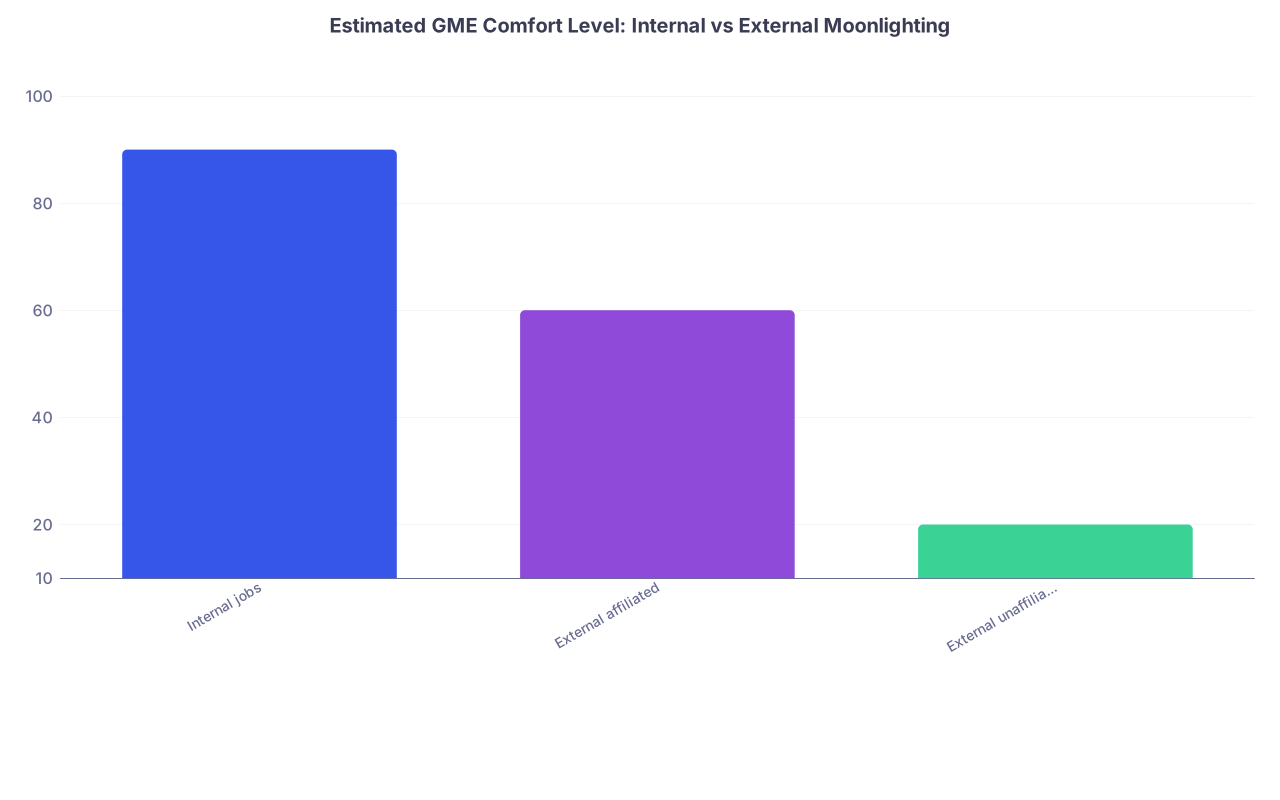
| Category | Value |
|---|---|
| Internal jobs | 90 |
| External affiliated | 60 |
| External unaffiliated | 20 |
Internal Moonlighting
This is their comfort zone. Why?
- Same EMR, so they can see exactly what you did if something goes bad.
- Same credentialing and malpractice umbrella.
- Same admin can shut it down instantly if needed.
- They can control scheduling and hours tightly.
I’ve watched a PD email: “As of next month, all internal hospitalist moonlighting is paused pending review.” No negotiation. Because they own the environment.
They also quietly use internal moonlighting shifts as leverage:
- Reward for senior residents who “play ball.”
- Carrot during recruitment: “Our residents earn an extra $10–20k a year.”
- Thing they can take away if duty hours look messy.
External Moonlighting (Affiliated)
These are gigs at a community site or affiliate system. GME committees get nervous here.
They’ll insist on:
- Copy of your contract.
- Written statement of malpractice coverage.
- Sometimes a direct conversation between PD and external site director.
Many PDs quietly hate this category. I’ve heard:
- “We lose control over their hours and their fatigue.”
- “If they screw up there, our name still ends up in the story.”
So they do what bureaucrats do when they don’t want something but can’t outright ban it: bury it in process. Ten forms. Multiple signatures. Slow-turnaround reviews. A lot of residents simply give up.
External Moonlighting (Unaffiliated)
This is where most GME committees draw a hard line. Some flat out forbid it. Those who “allow” it treat it like a contaminant.
You’ll hear language like:
- “Strongly discouraged.”
- “Requires special review.”
- “Case-by-case basis only.”
Behind closed doors, faculty say:
- “If I don’t control the environment, I’m not signing my name on this.”
- “If something happens there, we will still get dragged into it.”
Where the Line Really Is: “Educational Value” vs “Service”
GME committees survive by convincing ACGME that everything you do is “educational” first and “service” second. Moonlighting exposes the lie.
When you’re working a nocturnist shift in a community hospital as a PGY-3, nobody pretends it’s educational. It’s work. Pure service.
So GME protects itself by drawing invisible lines:
- Anything under their umbrella is “part of the learning environment,” even if it’s glorified scut.
- Anything clearly outside that environment has to be separated legally and optically.
I’ve seen committees quietly shift internal moonlighting rules so they can argue to ACGME: “These residents are in a supervised, structured environment that builds autonomy,” even when it’s functionally independent coverage.
It’s not honesty. It’s survival.
How Moonlighting Affects Your Evaluation Behind the Scenes
This part nobody will tell you straight: your moonlighting choices color how faculty and PDs view you.
Patterns I’ve seen repeatedly:
- Resident always tired on rounds, chronically late on notes, but rumored to be moonlighting aggressively? PD labels them as “poor insight,” “not prioritizing training.”
- Resident hustles a bit on weekends, still on top of service, high performer? PD calls it “hardworking,” “resourceful.”
- Resident asks for moonlighting approval early PGY-2 while still shaky clinically? PD silently flags that as questionable judgment.
They don’t usually write “moonlighting” in your evaluation. They write:
- “Concerns about reliability.”
- “Needs to improve time management.”
- “Occasionally appears fatigued.”
And in CCC (Clinical Competency Committee) meetings, the comments are more direct:
- “He’s chasing money instead of focusing on his development.”
- “She’s doing a lot of outside shifts; I worry about burnout.”
- “He’s solid, but I’m not comfortable sending him out as independent coverage yet.”
That is exactly how moonlighting ends up affecting:
- Letters of recommendation.
- Chief resident selection.
- Fellowship advocacy.
Not because you worked extra. Because of how they perceive your judgment while doing it.
The Future: Why Moonlighting Rules Are About to Get Tighter
You’re living in an inflection point. The old wild-west moonlighting reality is already dying in many systems.
Here’s what’s pushing GME toward more policing, not less.
1. Electronic Trails Everywhere
Every system is now cross-referencing:
- Badge swipes.
- EMR login times.
- Duty hour logs.
- Payroll and timesheets.
You can’t claim “75 hours this week” when your EMR logins across two hospitals show 102 hours of activity. I’ve watched an internal audit where they literally overlaid schedules, EMR activity, and duty hours to build a case for “non-compliance” and “educational risk.”
That kind of data turns vague concerns into enforceable discipline.
2. ACGME Scrutiny on Fatigue and Safety
ACGME isn’t blind. They’ve seen the same thing GME committees see: residents working 70 hours “officially” and then stacking moonlighting on top.
So programs preemptively over-police to avoid citations. You’ll see:
- “Moonlighting is prohibited on weeks containing 24-hour calls.”
- “No moonlighting during ICU or night float months.”
- “Residents may not moonlight if they averaged more than 65 hours over the previous 4 weeks.”
These rules often don’t come from an individual PD’s philosophy. They come from institutional panic about potential citations and front-page cases.

| Step | Description |
|---|---|
| Step 1 | Resident incident |
| Step 2 | Internal review |
| Step 3 | Risk and legal notified |
| Step 4 | Quiet counseling only |
| Step 5 | GME committee meeting |
| Step 6 | Policy rewrite |
| Step 7 | Stricter moonlighting rules |
| Step 8 | Duty hours exceeded? |
Every bad story creates a new rule. That’s the pipeline.
3. Financial Pressures on Hospitals
Hospitals are under pressure to:
- Staff nights and weekends cheaply.
- Expand coverage for low-reimbursing services.
- Avoid paying full attending rates.
So internal moonlighting becomes a structural crutch. As that happens, GME feels compelled to formalize and restrict it more tightly—because the more the hospital depends on resident moonlighting, the higher the institutional risk.
I’ve watched systems move from:
- “Just pick up a shift and we’ll pay you”
to - “Only pre-approved senior residents, credentialed as moonlighters, with strict caps, and mandatory fatigue training modules.”
Same underlying business model. Much more policing.
How to Work With the System Instead of Getting Crushed by It
You’re not going to change how GME thinks. But you can operate intelligently inside their framework.
A few hard truths:
- They care more about optics and documentation than your bank account. Accept it.
- They judge your judgment more than your desire for extra income.
- Once you’re labeled “that resident who’s always moonlighting,” your leash gets shorter fast.
So if you’re going to moonlight:
- Be frighteningly on top of your primary job. Notes, evals, patient care. Zero excuses.
- Protect your PD. Do not put them in a position where they get blindsided by your external gig or an incident.
- Track your actual hours and sleep like an adult, not a martyr. The “I can handle it” persona collapses quickly when something goes wrong and you were on hour 96 that week.
Remember: GME committees do not care how badly you need to pay your loans when they’re reviewing a fatigue-related incident. They care about documented policy compliance and whether they can convince ACGME and risk that they “did their part.”
You don’t have to like that. But you ignore it at your own risk.
FAQ: Behind-the-Scenes Answers You Won’t Get at Orientation
1. Can my program punish me for moonlighting that’s technically within written policy?
Yes, and it happens. They won’t write “punished for moonlighting.” They’ll cite professionalism, fatigue, failure to comply with duty hour logging, or “concerns about clinical judgment.” They have enormous discretion. If your moonlighting creates work or risk for them, they will find a lever.
2. Do programs actually check my external moonlighting hours or just trust what I report?
Many cross-check when they suspect something: comparing your moonlighting contract dates, your call schedule, and even EMR login timestamps if you’re in the same system. If you trigger an incident, expect a retroactive archaeological dig through your hours. Some places are starting to require external sites to send formal monthly hour reports. Quietly.
3. Is internal moonlighting really safer for my career than external?
Usually, yes. They control the environment, the malpractice, and the documentation. So they’re calmer about it. The flip side: because they can see everything, they’ll also intervene faster if you look overextended. External gigs can feel “freer,” but once there’s a problem, GME’s attitude shifts from “neutral” to “why were you doing that at all?”
4. If my PD refuses to sign off on moonlighting, do I have any recourse?
Formally, you can escalate to the DIO or GME office. Practically? That’s almost always a losing move. You’re broadcasting “I prioritize money over my PD’s judgment.” GME will almost always back the PD on “educational concerns” because that’s their shield with ACGME. If you reach that level of conflict, your letters and evaluations are already in danger.
5. Will fellowship programs look down on my moonlighting?
They don’t care that you made extra money. They do care about how your own program describes you. If your PD writes, “Highly reliable, took on extra moonlighting without any impact on performance,” no one bats an eye. If the letter subtly hints at fatigue, spotty availability, or questionable priorities, then yes—your moonlighting just cost you. The moonlighting itself is neutral. The story your home program tells about it is not.
Key Takeaways:
GME committees don’t “support” moonlighting; they contain it. They use approval gates, duty hour tracking, and malpractice control to manage their risk, not your finances. If you choose to moonlight, do it with ruthless honesty about fatigue, aggressive professionalism in your primary role, and full awareness that when something goes wrong, the system will protect itself first.