
Most physicians who think they are “winning” with an RVU bonus are quietly setting themselves up for burnout.
Let me be blunt: RVU compensation is where otherwise smart doctors get played. Not because they are naïve. Because they are rushed, tired, and sold a story about “uncapped earning potential” that rarely matches reality.
If you misunderstand how RVUs and bonuses actually work, you will work more, feel worse, and earn less than you think. And by the time you realize it, you will be exhausted, bitter, and locked into a system you helped build by overperforming.
You are in the “miscellaneous and future of medicine” phase here, which means you are probably trying to plan your career, moonlighting, or considering new offers. This is exactly when people make permanent mistakes for temporary paychecks.
Let’s walk through the most common RVU bonus misunderstandings that quietly drive burnout. And how to avoid them.
1. Confusing “High RVU Rate” With “High Take‑Home Pay”
The first trap is simple. And deadly.
You see a contract that pays, say, $60–$75 per RVU and you think, “That is fantastic. I will crush it.”
Maybe. Or maybe you will work yourself into the ground for less than your peers with “worse” rates.
The mistake: treating the RVU rate as if it exists in a vacuum.
You have to look at:
- Base salary
- RVU threshold before bonus kicks in
- Total expected RVUs per year
- How RVUs are counted (or not counted) for your specific work
| Scenario | Base Salary | RVU Threshold | Bonus Rate | Expected RVUs | Realistic Outcome |
|---|---|---|---|---|---|
| A | $260k | 4,500 | $60/RVU | 6,000 | Exhausting but decent bonus |
| B | $310k | 7,000 | $60/RVU | 6,500 | No bonus, high volume, high burnout |
| C | $230k | 3,500 | $75/RVU | 5,000 | Big hours, admin under pressure |
In Scenario B, the doc never reaches the threshold. They are “busy” all the time but never see bonus money. That is not bad luck. That is how the contract was built.
The burnout setup looks like this:
- You underestimate how high the threshold is.
- You overestimate how much volume is actually possible (or supportable) in your clinic.
- Year 1, you miss the bonus by a little. Admin says, “You’re so close, maybe up your access.”
- Year 2, you cram more into your schedule, stay late finishing notes, just to creep past threshold.
- Your effective hourly rate drops, but your fatigue rockets up.
Do not make the mistake of evaluating the rate without the structure.
Ask these questions before you ever get impressed with a dollar-per-RVU number:
- What was the median RVU production for the last 3 people in this role?
- How many actually hit the bonus? What did they earn?
- How much support staff was available when they did it?
- What happens to the base salary over time? Does it reset based on prior year’s RVUs?
If they cannot answer clearly, or they dodge, that is a huge red flag.
2. Ignoring the RVU Threshold Games (This Is Where Burnout Breeds)
Thresholds are not neutral. They are levers.
Admin loves to talk about “market competitive” RVU thresholds. Physicians love to assume someone did thoughtful math. Sometimes that is true. Often it is not.
Here is the misunderstanding: thinking the threshold is a benign benchmark rather than an engineered productivity target that may be misaligned with reality.
Common threshold traps I keep seeing:
- Threshold set at the 90th percentile of MGMA but presented as “average”
- Thresholds ratcheted up after the first contract cycle once you prove you can work like a machine
- “On track” schedules created using fantasy assumptions: no‑shows minimal, perfect staffing, zero admin interruptions
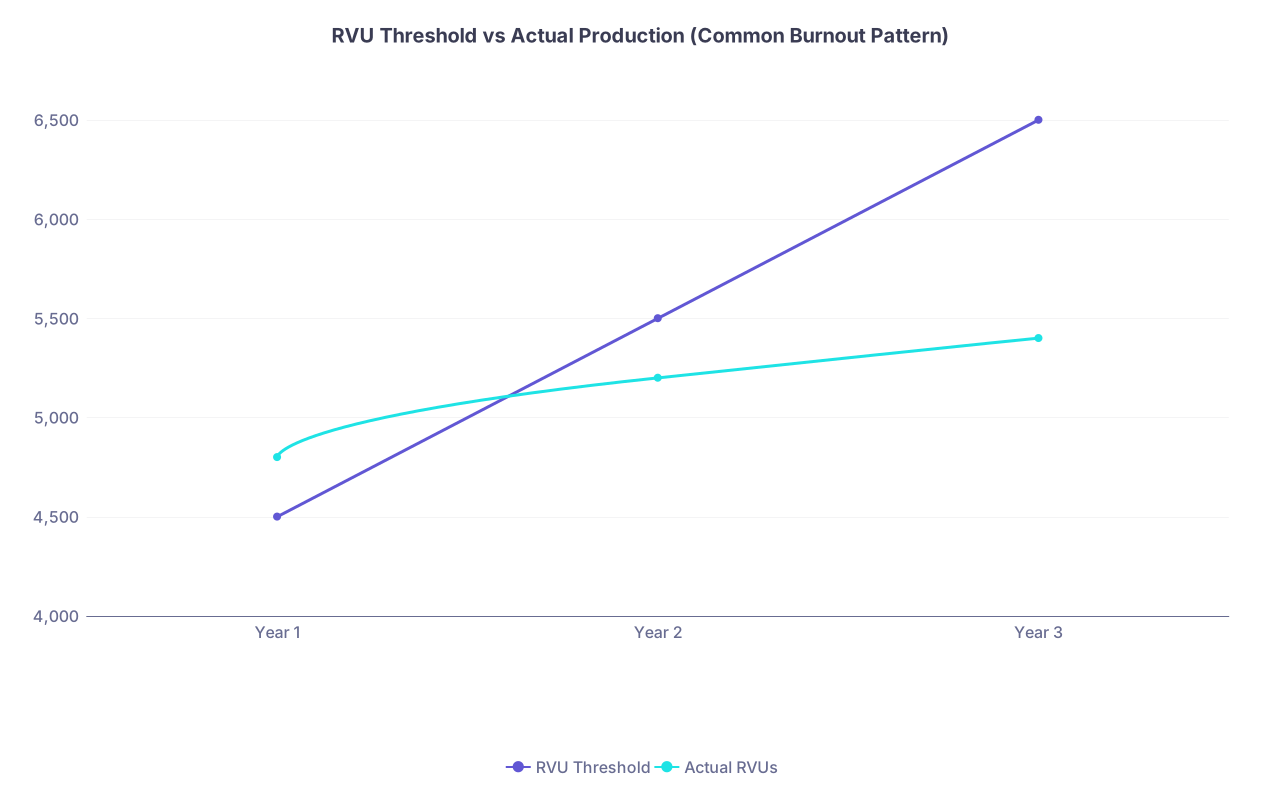
| Category | RVU Threshold | Actual RVUs |
|---|---|---|
| Year 1 | 4500 | 4800 |
| Year 2 | 5500 | 5200 |
| Year 3 | 6500 | 5400 |
Look at that pattern. In Year 1, you clear threshold. You feel good. They “reward” you by raising the bar. By Year 3, you are still working hard, but now you miss the bonus. Morale tanks.
Your mistake if you allow this:
You accept a contract that:
- Does not specify how thresholds are set
- Allows unilateral adjustment “based on market data”
- Has no floor or protection against radical jumps
- Ties your base renewal to past RVU performance (this one is especially nasty)
That last point is brutal. I have seen contracts where your base salary in renewal is recalculated based on your prior year RVUs, effectively baking in your overwork as the new normal. If you drop volume later to save your sanity, your pay collapses.
You should insist on:
- Clear language about how thresholds are set (with numbers, not vague references)
- Limits on annual increases (for example, no more than 5–10% without mutual agreement)
- Written confirmation that your base salary will not automatically plummet if your RVUs drop modestly
If they will not put it in writing, assume they will increase thresholds aggressively once you perform.
3. Believing “All Your Work Generates RVUs” (It Does Not)
This one causes stealth burnout more than anything else.
You think: “I am here all day, missing family dinners, constantly messaging patients. At least I am getting RVUs for this.”
You are not. A depressing amount of your effort is non-RVU work:
- Inbox messages
- Prior authorizations
- Phone calls
- Care coordination
- Teaching
- Committee work
- Unbillable follow-ups (“quick check-ins”)
- Charting and documentation clean-up

The misunderstanding is assuming “high work” automatically equals “high RVUs.” It does not. RVUs only apply to billable services, and even then, only if billed and coded correctly.
Here is the burnout recipe:
- Clinic is double-booked. You see 24–28 patients. But staffing is short.
- You then spend 1–2 hours after clinic finishing notes, in-basket, refills, prior auths.
- None of that extra “invisible” work generates RVUs.
- Your hourly rate plummets when you divide total hours by total pay.
I have watched physicians brag about hitting 7,000+ RVUs while their effective pay per hour was worse than a locums doc seeing fewer patients, in a lower stress environment.
You must separate:
- Paid work (billable RVU-generating, plus any stipend for non-RVU tasks)
- Unpaid labor (everything else)
Then be very clear how much of your time is quietly migrating into the unpaid category as expectations creep.
Ask explicitly:
- Are inbox messages compensated? How?
- Are telephone visits billed as E/M or not?
- Is there RVU credit or a stipend for teaching, meetings, and committees?
- Does after-hours documentation count for anything?
If the answer is “That’s just part of being a good team player,” hear it for what it is: unpaid labor. Perform it only with eyes open, and not on the naive assumption that your bonus will magically make it “worth it.”
4. Misreading RVU Bonuses as “Free Upside” Instead of Voluntary Overtime
You are told: “The base is solid, and the RVU bonus is uncapped. Amazing upside.”
Translation: “We are not going to pay you fairly for the base workload, but you are welcome to work a second job inside your first job if you want to make a real income.”
RVU bonus, psychologically, feels like “extra.” Like you are just capitalizing on your hard work. But functionally, it is overtime. Especially when hitting that bonus requires:
- Shorter visit times
- Less time for thinking, explaining, counseling
- More “easy” patients crammed into the schedule
- Working through lunch and after hours
You cannot treat RVU bonuses as free upside if:
- Your panel is complex and slow
- Your support staff is inadequate
- Your schedule is already overbooked
- You are regularly taking work home
Here is the subtle burnout misunderstanding: you think you are just “pushing a bit harder” this quarter to hit the bonus. But you are training everyone—admin, staff, even yourself—that this insane pace is your baseline.
The hospital will not say, “Wow, that pace looked unsustainable, let’s add staff.” They typically say, “Great, we can open up more access and grow the service line.”
You should:
- Decide in advance what maximum RVU pace is acceptable to you long term
- Treat anything above that as explicitly temporary, with a clear end date
- Watch carefully whether “temporary” becomes the expectation
If you need overtime-level RVU work just to feel financially safe, the base is wrong. That is not a “bonus system.” That is exploitation wearing a productivity badge.
5. Underestimating Documentation, Coding, and Denials (The Hidden RVU Sinkhole)
Another painful misunderstanding: assuming all RVUs you “generate” by working will land in your bank account.
They will not.
A significant chunk evaporates in:
- Incomplete documentation (not supporting the level of service)
- Under-coding out of fear or habit
- Denied or down-coded claims
- Bizarre payer rules and pre-auth failures
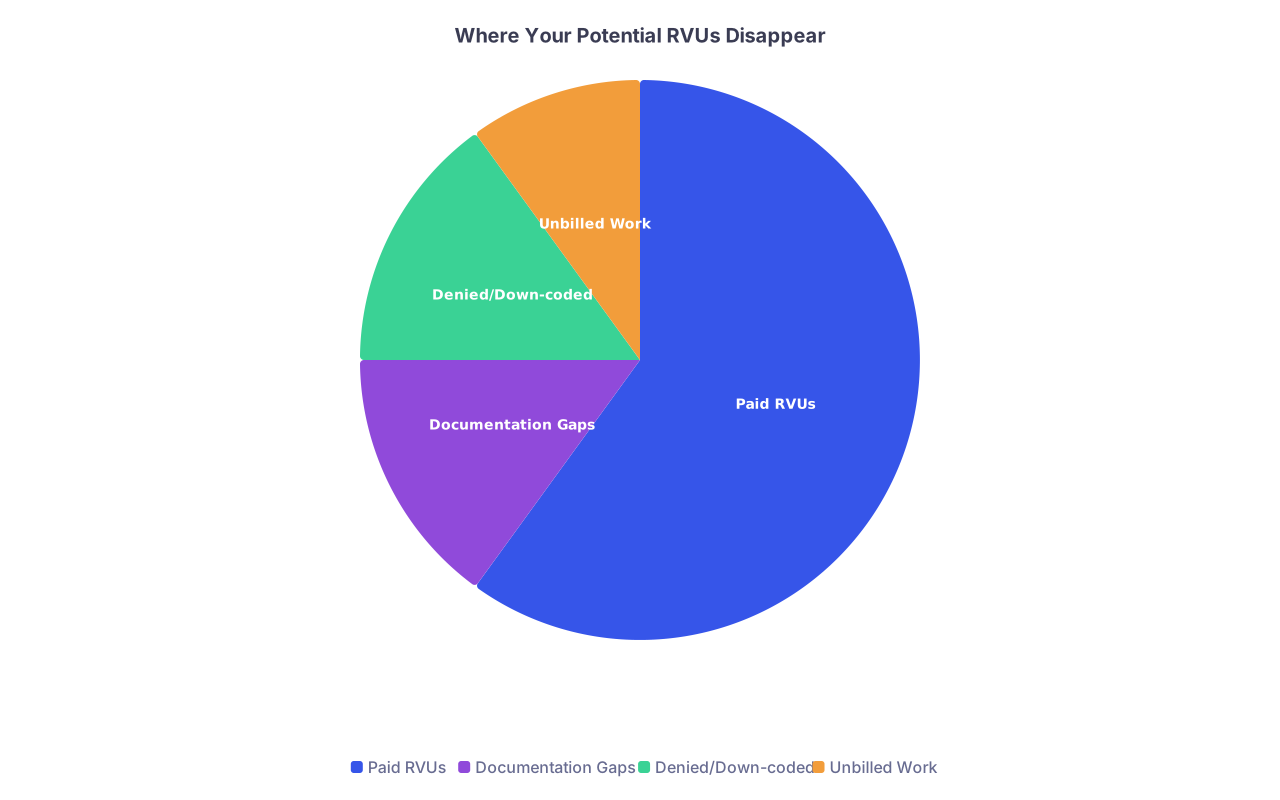
| Category | Value |
|---|---|
| Paid RVUs | 60 |
| Documentation Gaps | 15 |
| Denied/Down-coded | 15 |
| Unbilled Work | 10 |
If your mental model is “I saw 25 patients, therefore I earned a strong RVU bonus,” you are lying to yourself.
You only get paid on:
- Services actually billed
- Coded correctly at appropriate levels
- Accepted and paid by insurers
- Tracked correctly in your employer’s RVU accounting system
I have seen physicians furious after discovering that entire categories of their work—like certain procedures, consults, or telehealth visits—were not being counted correctly for RVU credit due to bad build in the EHR, miscoding, or plain negligence.
You prevent this burnout trap by doing what most doctors hate doing: reviewing the numbers.
Ask for:
- Monthly or quarterly RVU reports
- Side-by-side visit counts, charge capture, and paid RVUs
- A walk-through of how each common CPT code maps to RVUs in your system
Then, spot check. Pull 10–20 encounters, compare what you did vs what was coded, and match against your RVU report. If those numbers do not line up, your bonus assumptions are fantasy.
Do not rely on “the billers handle that.” If your income depends on RVUs, then so does your risk of burnout. You cannot abdicate that to someone you have never met.
6. Moonlighting with RVU Bonuses: Double-Counting Your Energy
Let’s talk moonlighting and RVUs, because this is where people torch themselves “for just a year or two.”
Common pattern:
- Full-time job with RVU-based bonus
- Extra moonlighting shifts “to make up for loans / daycare / housing”
- Both environments built on RVU models
- You tell yourself it is temporary; your nervous system does not care

Here is the misunderstanding: acting like your energy is infinite and only your calendar is limited. It is not. Your cognitive and emotional reserves are finite, and RVU-heavy work torches them faster.
Watch out for these moonlighting‑RVU mistakes:
- Taking moonlighting shifts that do not compensate adequately for intensity (eg, high-acuity ED shift with RVU model that underestimates complexity)
- Assuming that because you are “used to” high volume in your main job, adding more will be manageable
- Failing to consider the lagging impact (three months later you hate everything, and you do not connect it back to that quarter of brutal moonlighting)
When moonlighting under an RVU system, you need to be more ruthless, not less:
- Hard minimum effective hourly rate after expenses and recovery time
- Strong clarity on whether you are being “paid per shift” vs “paid per endlessly added RVU”
- Absolute cap on number of high-intensity shifts per month
Treat moonlighting as a stress amplifier when combined with RVU‑based primary jobs. If both are RVU-driven, you are stacking volatile workloads, not diversifying.
7. Assuming RVU Models Are Static (They Are Shifting Under Your Feet)
You are in the “future of medicine” era. That means something uncomfortable: RVU models are not stable.
More telehealth, value-based care, team-based visits, AI documentation assistance… all of this is slowly undermining the old “face‑to‑face, fee‑for‑service RVU” world.
The misunderstanding here is believing that the RVU model in your contract today will behave the same way over the next 3–5 years.
Possible (and already real) changes:
- Payers reducing RVUs or payment for certain commonly used codes
- Pressure to move toward quality metrics, panel-based or shared savings models
- Team-based care where NPs/PAs see more patients, diluting your RVU pool
- Greater scrutiny and audits, increasing denials and documentation burden

| Step | Description |
|---|---|
| Step 1 | Start New RVU Job |
| Step 2 | High Motivation |
| Step 3 | Increase Volume to Hit Bonus |
| Step 4 | Admin Raises Threshold |
| Step 5 | Staffing Struggles Grow |
| Step 6 | More Non RVU Work |
| Step 7 | Lower Effective Pay per Hour |
| Step 8 | Exhaustion and Cynicism |
| Step 9 | Consider Leaving or Moonlighting More |
Notice there is no natural path in that diagram that resolves into “balanced, sustainable work.” You have to actively intervene.
Before you tether your income to RVUs for the long term, ask:
- What is the organization’s 5‑year plan regarding value-based care vs pure RVU?
- Are there hybrid models where a larger guaranteed base plus a smaller RVU component smooths the risk?
- Are they already experimenting with panel-based stipends, quality bonuses, or other non-RVU elements?
If leadership shrugs and says, “We have always done RVUs,” that is not reassuring. That is code for “We are not thinking ahead, and you will absorb the chaos.”
FAQs
1. How many RVUs are “too many” before burnout becomes likely?
There is no universal magic number, but there are patterns. When physicians start consistently pushing above the 75th–90th percentile for their specialty’s RVUs without corresponding support, burnout risk spikes. If you are regularly adding 10–20% more RVUs than your peers just to feel financially safe, you are probably trading mental health for income. The real question is not “How many RVUs?” but “What does my life look like outside work, and what does my effective hourly rate look like after all the unpaid tasks?”
2. Is it ever smart to chase a big RVU bonus for a few years?
It can be strategic in short, clearly defined sprints—paying down high-interest debt, building an emergency fund, saving for a down payment. But those sprints must be:
- Time-limited (6–24 months, not “until I feel caught up”)
- Protected by strong boundaries (no endless admin creep, clear off days)
- Paired with a plan to ratchet back to a sustainable pace
The mistake is treating sprint-level effort as baseline. That is what turns a smart move into chronic burnout.
3. What is the biggest RVU mistake new attendings make?
They accept the first “standard” RVU contract handed to them without demanding data. They do not ask for prior physicians’ actual RVUs, collection data, or the percentage who actually hit bonuses. They trust phrases like “most of our docs do very well.” Then they discover “very well” means grinding at levels that are unsustainable long term. New attendings often underestimate their negotiation leverage and overestimate how much the system will protect them.
4. How can I quickly assess whether an RVU offer is dangerous?
Run this quick check:
- Are thresholds clearly defined and reasonable compared to MGMA median, not 90th percentile?
- Does the base salary alone provide a life you can accept without burning out?
- Is there documented support—staff, scribes, MA ratios—that makes the expected volume realistic?
- Are non-RVU tasks (inbox, teaching, admin) compensated somehow?
If the answer to two or more of those is “no” or “we do not really track that,” you are looking at a burnout trap, not a generous incentive plan.
Takeaway: Do not let RVU bonuses seduce you into building a life that only works if you are exhausted.
Understand the thresholds. Separate paid from unpaid work. Treat your energy like the scarce and valuable resource it is.
If a compensation model requires you to run at full speed, all the time, just to feel okay, the problem is not your work ethic. The problem is the model.