
What exactly did you just sign when you agreed to that “easy” $150/hour moonlighting shift?
Let me be blunt: most residents do not read their moonlighting contracts carefully. They skim for rate, location, and start date, then sign. Six months later they’re sitting in a GME office, program director furious, HR involved, maybe even risk management—because of a clause they never saw but absolutely agreed to.
You’re smarter than that. Or you will be by the end of this.
The Big Picture: Why Moonlighting Contracts Are Not “Side Gig” Paperwork
Moonlighting looks simple:
- Extra money
- Same skills
- Same hospital systems (often)
So people treat it like doing extra call. It is not. It’s a separate legal and financial arrangement with its own landmines.
The common pattern I’ve seen:
- Resident hears about good-paying moonlighting from co-resident.
- Word-of-mouth summary: “It’s chill, $180/hr, they just need coverage.”
- Contract arrives. Resident skims page 1, scrolls to signature page.
- Signs. Sends. Shows up for first shift.
- Months later: Problem.
The traps are almost always in the same places:
- Hidden in “standard” boilerplate
- Buried in “Professional Obligations” or “Miscellaneous” sections
- Stuff you assume must be fine “because everyone signs it”
That assumption is how you get burned.
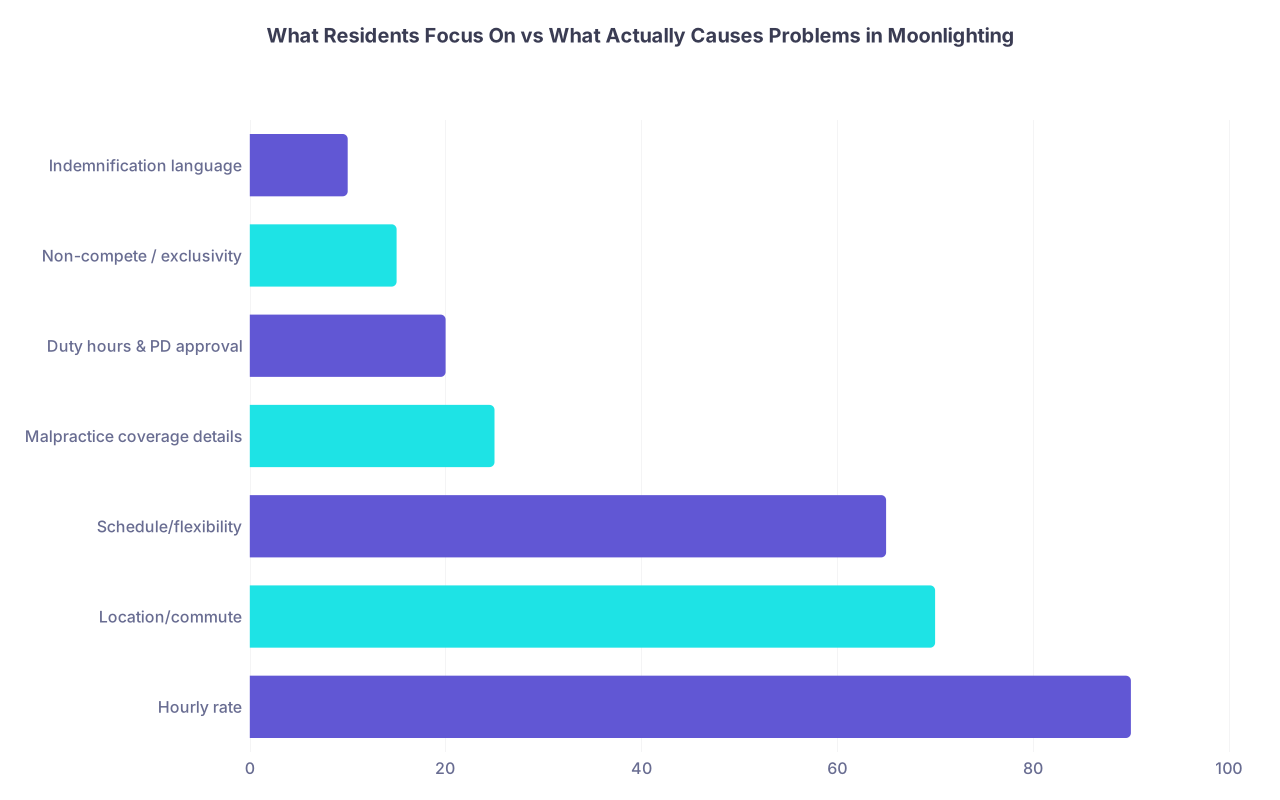
Before we go clause-by-clause, you need to see the leverage picture.
| Category | Value |
|---|---|
| Hourly rate | 90 |
| Location/commute | 70 |
| Schedule/flexibility | 65 |
| Malpractice coverage details | 25 |
| Duty hours & PD approval | 20 |
| Non-compete / exclusivity | 15 |
| Indemnification language | 10 |
Residents obsess over:
- Hourly rate
- Number of shifts
- Can they study/sleep when it’s slow
The disasters come from:
- Malpractice gaps
- Violating ACGME duty hours
- Breaching your main employment contract
- Non-competes that follow you after residency
- Indemnification language that puts all the risk on you
Let’s walk through the 9 specific clauses residents routinely ignore—and regret.
1. Malpractice Coverage: The “Claims-Made vs Occurrence” Time Bomb
The single biggest mistake: assuming “malpractice is covered” means you’re protected forever. It doesn’t.
You must find and understand four things in writing:
- Type of coverage
- Who pays for it
- Whether tail coverage is included
- Whether coverage limits are shared
Watch for language like:
- “Claims-made professional liability policy with limits of…”
- “Moonlighter is responsible for obtaining and maintaining malpractice insurance…”
- “No tail coverage will be provided upon contract termination…”
If you see claims-made with no tail, here’s the trap:
- You work for 2 years
- You leave
- Three years later, a lawsuit is filed for a patient you saw during your moonlighting shift
- The policy you were on has ended, and no tail was purchased
- Result: you’re personally exposed
You also need to know if limits are individual or shared. If you’re sharing a $1M/$3M limit with 10 other docs in a high-risk ED, that’s not the same thing as your own $1M/$3M.
Do not sign until you know:
- Is it occurrence or claims-made?
- If claims-made, who pays for tail?
- Are the limits per provider or shared pool?
- When exactly does coverage start and end for you?
If the contract says you must supply your own malpractice, you need to price that out before you ever think the rate is “good.”
2. “Independent Contractor” Language That Pretends You’re a Business
Residents see “Independent Contractor Agreement” and think: great, more autonomy. Wrong. That phrase means:
- They do not see you as an employee
- You’re responsible for your own taxes
- No benefits, no employment protections
- Often more risk pushed onto you
Red flags in the language:
- “Physician shall be engaged as an independent contractor and not as an employee.”
- “Physician shall be solely responsible for payment of all federal, state, and local taxes.”
- “No workers’ compensation or unemployment benefits shall be provided.”
If you’re an independent contractor:
- You need to plan for self-employment tax (roughly 15.3% on top of income tax)
- You may want an LLC or S-corp for some legal and tax reasons
- You have fewer protections if they decide to cut you loose suddenly
- Some programs frown upon (or prohibit) residents signing separate IC contracts without review
Also, watch for:
- Requirements to carry your own disability insurance
- Language that shifts liability away from them and onto you (often linked with indemnification, which I’ll get to)
Independent contractor status is not automatically bad. It can be totally fine. But it changes the math. A “great” $170/hr might be effectively $110/hr after taxes, policy, tail risk, and unpaid commute time.
3. Duty Hours & PD Approval: The “Off-the-Books” Disaster
A very common screw-up: signing a contract and starting shifts without written program director approval or without disclosing it on your duty hours.
You think: “Everyone moonlights. I’m fine.” Until:
- ACGME site visit
- Patient safety concern
- Adverse event after a 24+ hour stretch including moonlighting
Then someone audits the duty hours. They compare your logged hours to:
- Moonlighting schedule
- EMR access times
- Badge swipe reports
If it doesn’t match, you’re not just in trouble. You’ve:
- Potentially violated ACGME standards
- Lied on official documentation (duty hour reporting)
- Put your PD and program at risk
Watch for clauses like:
- “Physician represents that these services will not violate any duty hour restrictions.”
- “Physician warrants that all required GME or PD approvals have been obtained.”
If your program requires prior approval (most do), your moonlighting contract is useless if it conflicts with that. You can’t sign away duty hour rules. Your moonlighting agreement won’t save you from GME.
Concrete rule:
Do not start a single shift until you have:
- Written PD approval
- Confirmation of institution policy on internal vs external moonlighting
- A way to accurately log those hours (yes, you must log them)

| Step | Description |
|---|---|
| Step 1 | Hear about moonlighting |
| Step 2 | Get contract draft |
| Step 3 | Read key clauses |
| Step 4 | Check residency contract and GME policy |
| Step 5 | Discuss with PD or GME |
| Step 6 | Request written PD approval |
| Step 7 | Adjust or decline moonlighting |
| Step 8 | Sign contract only after approval |
| Step 9 | Start tracking moonlighting hours accurately |
| Step 10 | Conflict with duty hours or policy |
Skip that, and you’re gambling your training status for a few hundred bucks.
4. Non-Compete and Non-Solicitation: Handcuffs After Residency
You don’t think about this until PGY-3 when you’re trying to sign a job 10 miles from where you trained and suddenly you’re in conflict with a clause you barely noticed.
Look for:
- “Physician shall not engage in the practice of medicine within X miles of Facility for Y months after termination.”
- “Physician shall not contract with any Facility clients, affiliates, or entities introduced through this Agreement for two (2) years following termination.”
The traps:
- You moonlight at a community ED 30 minutes away
- Later, you want a full-time offer there—they love you
- Your moonlighting contract says you cannot work directly for that hospital or any of their affiliates for 1–2 years
- Or worse: it says you can’t practice anywhere within 10–25 miles of that hospital
Some states restrict physician non-competes, but don’t count on being protected. Enforcement varies. And even unenforceable clauses can cause enough hassle that employers walk away from hiring you.
Minimum steps:
- Find any “restrictive covenant,” “non-compete,” “non-solicitation” sections
- Confirm the radius and duration
- Make sure the scope is narrow: ideally limited to that specific facility and only moonlighting-type shifts
If they insist on broad restrictions that impact your future job options, walk. You’re a resident, not a captive workforce.
5. Indemnification: The Clause That Sends You the Bill
This one makes my blood pressure rise. Because I’ve seen residents sign horrifying indemnity language without a second thought.
You need to scan for the word: indemnify.
Typical nasty version:
“Physician agrees to indemnify, defend, and hold harmless Facility, its owners, and affiliates from any and all claims, damages, liabilities, costs, and expenses (including attorneys’ fees) arising out of or related to Physician’s services under this Agreement.”
Translation:
If something goes wrong, they can come after you for:
- Legal fees
- Settlement costs
- Damages
Even if they’re also partly at fault.
You absolutely do not want broad, unilateral indemnification. At most, indemnification should be:
- Narrowly tailored
- Mutual (they also indemnify you under some conditions)
- Tied to your gross negligence or willful misconduct, not routine work
If the contract says you must both:
- Carry malpractice
- And indemnify them for almost everything
…you’re functionally an unpaid risk pool.
At minimum:
- Flag any indemnification clause
- Ask them to remove or soften it
- If they refuse, you need to seriously reconsider whether the rate justifies that risk
6. “Scope of Duties” and Unsafe Staffing Assumptions
Residents often skip the job description section because it looks “obvious.” It isn’t.
Watch for phrases like:
- “As reasonably assigned by Facility”
- “Including but not limited to” followed by a short list
- “Physician shall provide unsupervised care in…” with a very broad scope
Risks:
- You think you’re doing urgent care-type low acuity
- They actually expect you to run a full ED alone overnight
- Or manage ICU-level patients without backup
- Or cover multiple sites at once via telehealth without safe staffing ratios
The other trick: responsibilities creep.
They start with:
- “Just admit and cross-cover”
Then someone leaves and suddenly you’re:
- Running codes
- Managing ventilators
- Dealing with pediatrics you aren’t comfortable with
If the contract lets them unilaterally expand your duties “as needed,” you have almost no control.
You want:
- Clear description of clinical setting
- Reasonable patient age range, acuity, and procedures
- Clarity on backup: who is on call / in-house / reachable
- Ability to say no to unsafe assignments without being in breach
Never forget: your name is on the chart, not the contract manager’s. If the setting is unsafe, you are the one at risk.
7. Termination and Scheduling: How They Trap Your Calendar
Most residents only check one thing: “How soon can I start?” They forget to ask: “How can I stop?”
Look for:
- Notice periods: “Either party may terminate this Agreement upon 90 days prior written notice.”
- Shift cancellation rules: “Physician who cancels a scheduled shift within 30 days shall be responsible for covering the shift or paying a penalty.”
- Automatic renewal: rolling 1-year terms that continue unless you give written notice far in advance
Problem scenarios:
- You match into fellowship across the country, start date moves earlier, and suddenly you’re legally bound to shifts that conflict
- You have board exams or an urgent family issue and the contract punishes you for needing to pull off a shift
- They can cut your shifts to zero overnight, but you need to give them 60–90 days notice
Before signing, know:
- How much notice you must give to stop moonlighting entirely
- How much notice is required to drop a single shift
- Whether there are any no-show or late-cancellation penalties
- Whether they can change your rate or duties during the term with little notice
You must be able to exit without wrecking your life or violating the agreement.
8. Billing, Coding, and “Productivity” Clauses You Don’t Control
This one sneaks up on people. Residents assume: “I just see patients; billing is their problem.” The contract often says otherwise.
Watch for:
- “Compensation shall be based on collections received.”
- “Physician agrees to document in a manner that supports maximum allowable billing…”
- “Any overpayments or recoupments by payors attributable to Physician services may be recovered from Physician.”
Problems:
If the compensation is collections-based, your pay depends on:
- Their billing staff accuracy
- Payer mix
- Contracted rates
If there’s language about recoupments, payors can claw money back months or years later, and the group may legally take that from you.
You also don’t want to be on the hook for:
- Coding errors you didn’t commit
- Compliance issues in their EMR templates
- Documentation standards you were never properly trained on
Best scenario as a resident moonlighter:
- Flat hourly rate
- No RVU / collections dependence
- No clawback language tied to payor recoupment
If you must accept a productivity or collections model, you need:
- Clear explanation of how it’s calculated
- Time lag between work and payment
- Whether any negative balance carries forward or is forgiven at termination
Otherwise you can end up doing work now and fighting for every dollar later.

9. Conflict with Your Primary Residency Contract and Institutional Policies
This is the silent killer. Your moonlighting contract might be completely fine in isolation, but incompatible with:
- Your GME contract
- Institutional policies
- State law on resident work hours
Common conflicts:
- Moonlighting at a competing hospital in the same system without permission
- Using your resident license in ways not permitted
- Accepting pay directly from a site your institution already has an affiliation with
- Carrying your residency malpractice policy to external sites without their consent (most don’t allow this)
You must read your residency/GME documents for:
- Moonlighting sections (often buried)
- Internal vs external moonlighting rules
- Licensing and supervision requirements
- Any prohibition on independent contracting during training
Then compare to the moonlighting contract side by side.
| Document | Top Issues to Check |
|---|---|
| Residency/GME Contract | Duty hours, moonlighting rules |
| Program Handbook | PD approval process, reporting |
| Institutional GME Policy | Internal vs external limits |
| State Licensing Board Rules | License type, supervision needs |
| Moonlighting Contract (Draft) | All 9 clauses in this article |
If there’s any mismatch, you fix it before signing. Not after someone complains.
How to Actually Review a Moonlighting Contract Without Losing Your Mind
You don’t need to become a lawyer. But you do need a method.
Print it or open it on a big screen.
Highlight and label:
- Malpractice and tail
- Status (employee vs independent contractor)
- Non-compete / non-solicit
- Indemnification
- Scope of duties
- Termination / notice
- Compensation / billing
- Duty hour and approval language
- Conflict with your residency terms
For anything you don’t like, ask. Directly.
Example email language:
“I have a few concerns about specific clauses before I can sign:
• Indemnification (Section 9): This appears to expose me to broad liability beyond my malpractice coverage. Can this be limited to gross negligence or removed?
• Non-compete (Section 11): As a resident, I can’t accept restrictions that affect my future employment after training. Can this section be removed or narrowed to this specific facility only?”If something feels off, run it by:
- Someone who’s already moonlighting there
- A physician you trust
- A contract review service or lawyer if stakes are high
Spend 60–90 minutes up front. It’s cheaper than dealing with a lawsuit or GME problem later.

When to Say No Even if the Money Looks Great
A few hard lines I’d recommend:
Walk away if:
- There’s no malpractice or tail coverage solution that makes sense
- They insist on a broad non-compete that affects your first job choices
- Indemnification is completely one-sided and tied to routine care
- They won’t clarify scope of duties or staffing support
- You can’t get PD approval or align it with duty hours
Be extremely cautious if:
- Pay is collections-only with no transparent reporting
- They want 60–90 days notice to stop, but can drop your shifts at will
- They can move you between multiple facilities with no input
Remember: you are not trapped. There are always other moonlighting options, including waiting a year and doing something safer and cleaner.
| Category | Value |
|---|---|
| Malpractice gaps | 95 |
| Indemnification | 90 |
| Duty hour violations | 85 |
| Non-compete | 75 |
| Scheduling penalties | 60 |
| Productivity pay confusion | 55 |
Final Takeaways
Keep it simple:
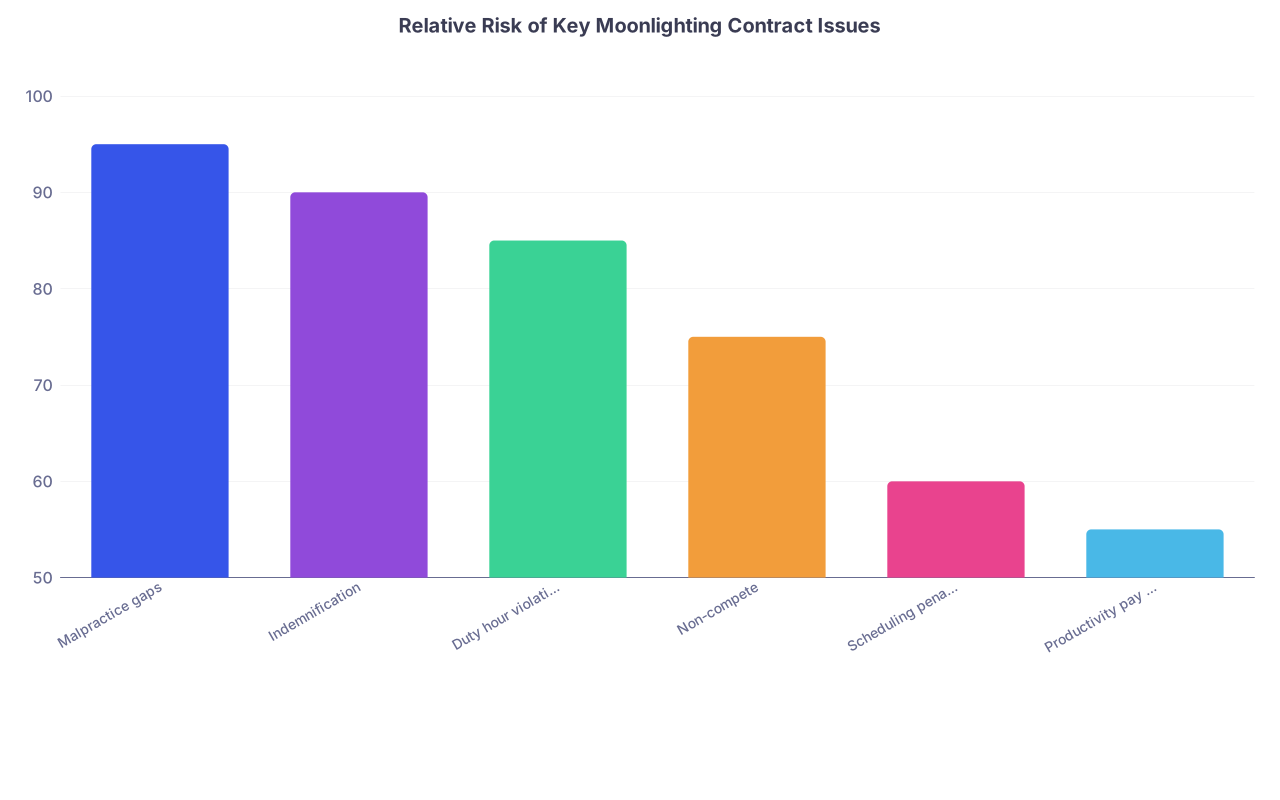
- Don’t just look at the rate. Malpractice, indemnification, and non-compete clauses can cost far more than you’ll ever earn.
- Your residency contract and GME rules still control the situation. If your moonlighting deal conflicts with them, you’re the one on the hook.
- Any contract you don’t fully understand is a bad contract—for you. If they won’t explain or adjust the worst clauses, you walk.