
The worst malpractice risk you face from moonlighting is not the patient you worry about. It is the contract you never read.
You can be clinically excellent and still destroy your career with one sloppy assumption about coverage. I have watched smart residents, new attendings, and seasoned physicians step straight into these traps because “everyone said it was fine.”
It often is “fine.” Until it is not. And then it is catastrophic.
This is about the malpractice coverage mistakes that quietly stalk your side gigs—urgent care shifts, telemedicine, med spa injectables, expert witness work, chart review, aesthetics, concierge sideline jobs, you name it. If you are earning money with an MD/DO after your name outside your primary job, you are a malpractice target. Pretending you are too small to matter is how you get burned.
Let me walk through the mistakes that cause the real damage. The ones you will not be forgiven for by a plaintiff’s attorney, your board, or your hospital.
Mistake #1: Assuming Your Main Job’s Coverage Follows You
This is the classic, expensive, career-threatening mistake.
“I am covered by my hospital’s policy.”
“I am a W‑2 employee; they handle that stuff.”
“My chair said it is fine to moonlight.”
None of those sentences mean one thing about your side gig coverage.
Most employer policies:
- Cover only clinical work performed for that employer, at their sites, under their credentialing.
- Explicitly exclude any outside work, even if it feels “related.”
- Treat moonlighting as unauthorized practice, which can void coverage—and get you disciplined or fired.
You must avoid these assumptions:
“All clinical work I do is covered under my employer’s policy.”
Wrong almost every time. Employer policies are not general-purpose shields. They are contracts with boundaries.“If I am on call for my main job, my side gig is also covered.”
No. Different employer, different setting, different corporation, different risk profile. Different policy.“I am working at an affiliated urgent care, so it is all under the same system.”
Maybe. Often not. Many systems use separate legal entities and separate insurance structures for clinics, employed groups, and urgent care chains.
Here is what you should be doing instead:
- Get it in writing from your main employer:
- Are you allowed to moonlight?
- Are you covered for any outside work?
- Are there restrictions on type, location, or hours?
- Ask for the actual malpractice policy summary (or declaration page) and read:
- Named insured
- Covered locations
- Scope of practice
- Exclusions related to independent practice or outside work
If anyone tells you “Yes, yes, you’re covered, do not worry about it”—your next words must be:
“Perfect. Please send me that in writing with the relevant policy language.”
If they refuse, that is your answer. You are not covered.
Mistake #2: Not Understanding Claims-Made vs Occurrence
You do not have to become an insurance expert. But if you cannot explain the core difference between claims-made and occurrence, you are playing malpractice roulette with your side gigs.
Quick and brutal summary
Occurrence coverage:
If the event happened during the policy period, you are covered—no matter when the claim is filed later.Claims-made coverage: You are covered only if:
- The event happened during the policy period and
- The claim is filed while the policy is still active (or while tail coverage is in place).
Side gigs often use cheap claims-made policies. That is where the trap lives.
| Feature | Claims-Made Side Gig Policy | Occurrence Side Gig Policy |
|---|---|---|
| Premium (short term) | Lower | Higher |
| Needs tail if you stop | Yes | No |
| Late-filed claims risk | High without tail | Low |
| Common in telemed | Very common | Less common |
If you do occasional shifts, bounce between moonlighting jobs, or stop and restart side gigs, claims-made without a plan for tail coverage is a time bomb.
The mistakes I see repeatedly:
- Physicians have no idea what type of policy covers their side gig.
- They switch jobs or stop the side gig and do not purchase tail.
- A claim arises 2–3 years later. The policy is long gone. No tail. No coverage.
The plaintiff’s attorney is not confused. You practiced. You are personally on the hook.
Avoid this by:
- Asking explicitly:
“Is this malpractice coverage claims-made or occurrence?” - If it is claims-made:
- Who buys tail if I leave—me or the employer?
- Is tail guaranteed in my contract?
- What happens if the company is sold or goes bankrupt?
Do not accept “We always take care of our docs” as an answer. That is not a contract. That is a story.
Mistake #3: Letting the Side Gig Employer Own Your Tail Risk
Here is where side gig companies quietly shift massive risk onto you.
Common pattern:
- A telemedicine platform hires you as a 1099.
- They proudly say, “We provide malpractice coverage.”
- You do a bunch of consults. Maybe for a year or two.
- You leave. No discussion about tail coverage.
- Two years later, a claim surfaces.
Who owns the tail?
Often, buried in the independent contractor agreement is language like:
- “Provider shall be responsible for any extended reporting endorsement (tail) upon termination of this agreement.”
- “Company may cease maintaining coverage at its sole discretion.”
Translation: They carry cheap claims-made coverage while you are useful. Once you are gone, they can drop it and you are supposed to buy tail for old patients—if you even realize this is an issue.
Do not make this mistake:
- Signing with any side gig that does not specify in writing who pays for tail.
- Trusting verbal reassurance about coverage beyond your tenure.
You want crystal-clear, written answers to:
- What type of policy is provided?
- Who is the named insured—you, the company, or both?
- Who pays for tail if:
- You leave voluntarily
- You are terminated
- The company stops operations
- For how long must tail last? (Ideally at least as long as the statute of limitations in that jurisdiction, often longer because of minors, discovery rules, etc.)
If they cannot or will not clarify, you are being invited to subsidize their liability with your future.
Mistake #4: Practicing Outside the Scope Your Policy Actually Covers
Side gigs are where scope creep happens. Quietly, then all at once.
You start:
- Minor urgent care work → suddenly you are managing higher acuity because “the ED is backed up.”
- Telemed cough and colds → suddenly weight loss meds, ADHD, or psych meds across multiple states.
- Spa injectables → suddenly you are doing threads, advanced fillers, or laser treatments without formal training.
Malpractice coverage usually has:
- Stated specialties (e.g., internal medicine, pediatrics, emergency medicine).
- Exclusions (e.g., cosmetic procedures, obstetrics, surgery).
- Location limits (states, facilities, telehealth rules).
If you perform procedures or give advice outside that scope, the carrier can deny coverage.
Common unforced errors:
- Hospitalist doing procedural sedation at a med spa under a policy that excludes cosmetic work.
- Family med physician doing “tele-psych” in a state they are not licensed in, under a policy that only covers in-state work.
- EM doc covering a pediatric urgent care where policy excludes patients under a certain age without pediatric specialization.
You cannot rely on “everyone else does it” as your risk standard. “Standard of care” in a lawsuit will not be “what other underinsured side gig docs did at 10 pm.”
Protect yourself with three simple guardrails:
Match your side gig work to your documented specialty and training.
If your CV, board certification, and main job say adult internal medicine, there better be an excellent reason you are doing high-risk pediatrics or advanced procedures in your side gig.Check exclusions explicitly.
Ask the carrier or employer:- Are cosmetic or aesthetic procedures covered?
- Are controlled substance prescriptions covered?
- Are telemedicine visits across state lines covered?
Do not expand services midstream without verifying coverage.
If a side gig wants to “add a few procedures” or new services, you treat that like a new job from a malpractice perspective.
Mistake #5: Ignoring State Lines and Telemedicine Rules
Telemedicine side gigs are a malpractice minefield disguised as easy money.
The sales pitch:
“Work from home. See low-acuity patients. We handle licensing and malpractice.”
The reality:
- You can still be sued in the patient’s state.
- Your licensing board cares if you practice without proper licensure or in violation of telehealth rules.
- Many carriers limit coverage to certain jurisdictions.
Common screwups:
- Believing that being “covered by the platform” automatically means every state they send you patients from is within your coverage.
- Having your personal malpractice policy limited to your home state, while embedded in multi-state telemed work.
- Not realizing some states treat telemedicine as in-person practice for licensure and venue purposes.
At minimum, you should know:
- In which states you are:
- Licensed
- Actively seeing patients via telemed
- Whether your malpractice coverage:
- Names those states
- Covers telemedicine specifically
- Has any telehealth-related exclusions
If a platform routes you a patient in a state where:
- You are not licensed, or
- Your malpractice carrier does not cover practice
…you should not be seeing that patient. Period.
You are the one whose license will get disciplined.
You are the one whose name will appear on the complaint.
Mistake #6: Believing “They Cover You” Without Seeing the Paper
“I do not need my own policy; the group covers me.”
“I am just moonlighting at this urgent care; they handle coverage.”
Sometimes that is completely fine. But you do not know that until you see the documents.
Red flags I have seen in “we cover you” setups:
- The policy only covers W‑2 employees, and you are a 1099.
- The entity insured is a management company, not the actual clinical entity.
- The limits are shockingly low for the risk involved.
- The coverage is shared “per claim” across dozens of clinicians.
If your name is on the lawsuit, you need your name on a policy or clearly listed as a covered provider under a group policy with adequate limits.
Ask for:
- A certificate of insurance showing:
- Your name or role covered
- Policy limits (per claim and aggregate)
- Effective dates
- The type of policy (claims-made vs occurrence)
- Confirmation of tail responsibility in writing
If anyone resists giving you basic insurance documentation, you should assume you are not properly covered until proven otherwise.
Mistake #7: Underestimating Policy Limits for High-Risk Side Gigs
Not all side gigs are equal.
- Chart review and utilization management: lower direct clinical risk.
- Urgent care procedures, ED moonlighting, med spa work: much higher.
Yet I see physicians accept identical or even lower limits for higher-risk side gigs because “it is just part-time” or “only a few shifts a month.”
The plaintiff does not care how many hours you worked when they decide whether to file a $2 million claim.
Watch out for:
- Low per-claim limits that look fine on paper but are out of sync with your patient population and procedures.
- Shared limits across a large group:
If the policy is $1M / $3M but 30 clinicians share that, your “real” practical limit can be far less.
Some carriers or side gig employers will happily sell you or include minimal coverage because it is cheaper. That is not a favor.
Your checklist:
- Know your primary job’s malpractice limits.
- For any side gig with procedural work, urgent presentations, or cosmetic interventions, seriously question limits that are lower than your primary job’s.
- Ensure you are comfortable with worst-case exposure:
“If this went as badly as possible for the worst possible plaintiff, would these limits be defensible?”
Mistake #8: Failing to Separate Entities and Personal Assets
The ugliest scenario looks like this:
- You moonlight for a loosely structured side gig.
- The entity has weak or no protection.
- Malpractice claim names:
- You personally
- The side gig entity
- Sometimes your LLC, if you formed one improperly
And then:
- Plaintiff attorneys discover your personal assets.
- They see real estate, investments, savings.
- They start asking about whether you had adequate insurance and appropriate corporate structure.
No, an LLC is not a magic shield. But operating totally as a sole proprietor, without:
- Clear contracts
- Proper malpractice coverage
- Any thought to asset protection
…is asking to be made an example of.
You are practicing as a professional. You must behave like one when it comes to:
- Contracts and legal structure
- Matching coverage to work
- Documenting agreements
Process Check: How to Vet Any Side Gig for Malpractice Risk
You need a simple, repeatable process, not ad hoc panic each time you sign a new contract.
Use this sequence:

| Step | Description |
|---|---|
| Step 1 | Side gig opportunity |
| Step 2 | Request contract and insurance details |
| Step 3 | Identify policy type and limits |
| Step 4 | Clarify tail responsibility in writing |
| Step 5 | Confirm no tail needed |
| Step 6 | Check scope, states, exclusions |
| Step 7 | Renegotiate or decline |
| Step 8 | Sign and keep documentation |
| Step 9 | Claims-made or occurrence |
| Step 10 | Coverage aligns with your work? |
Print that, mentally if not physically.
If a side gig cannot survive this filter, it is not a harmless little extra-income play. It is a liability dump.
Visual: Where Moonlighting Risk Comes From
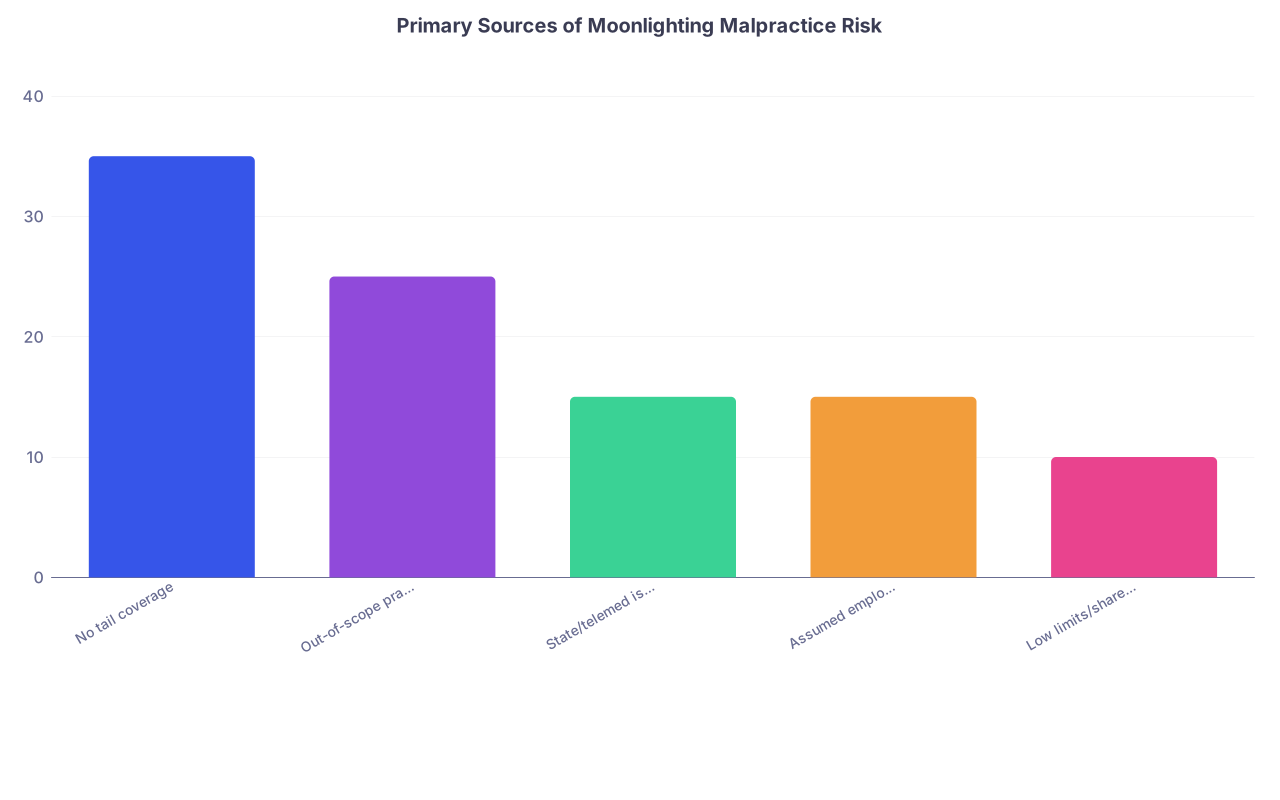
| Category | Value |
|---|---|
| No tail coverage | 35 |
| Out-of-scope practice | 25 |
| State/telemed issues | 15 |
| Assumed employer coverage | 15 |
| Low limits/shared policy | 10 |
These numbers are illustrative, but the pattern is real: no tail, scope creep, and blind trust in employer coverage drive most of the disasters I see.
FAQs
1. Do I really need my own malpractice policy for every side gig?
Not always. But you do need clear, documented coverage for every side gig. If the employer provides solid occurrence coverage that explicitly lists you, with appropriate limits and a clear tail plan (or none needed), you may not need your own separate policy. You should still consider a personal policy if:
- You have multiple side gigs in different settings.
- You are doing higher-risk procedures or telemedicine across states.
- The employer coverage is thin, shared, or unstable.
2. What is an acceptable tail coverage period for a side gig?
You want tail that covers the full statute of limitations for malpractice in that jurisdiction, plus enough buffer to account for delayed discovery and minors. That often means at least 5 years, sometimes longer. Many carriers offer “unlimited” or extended tail. Short, 1–2 year tail for clinical work is usually inadequate. Especially for pediatrics, OB, or anything with long-latency harms.
3. Is it safer to refuse all side gigs until I fully understand malpractice?
Refusing income is not a risk management strategy; it is just avoidance. The smarter move is to pick one simple, low-complexity side gig and use it as a test case:
- Read the contract carefully.
- Talk to the malpractice carrier.
- Clarify tail, limits, and scope.
- Document everything.
Once you have gone through that cycle once, the second and third side gigs are far easier to evaluate. The mistake is not doing side gigs; the mistake is doing them blindly.
Key points:
- Never assume coverage follows you from your main job. Confirm every side gig’s malpractice details in writing—policy type, limits, scope, states, and tail.
- Claims-made without a clear tail plan is the single most common moonlighting malpractice disaster. Do not let employers quietly dump tail responsibility on you.
- If the work, location, or procedures of your side gig are not explicitly covered by a solid policy you have seen, you are gambling with your license, your assets, and your future for a few extra dollars per hour.