
What if that benefits section you just signed means you accidentally agreed to something awful… and you have no idea?
Because that’s the fear, right? You rushed through onboarding, clicked a bunch of boxes, e‑signed some packet about health insurance, disability, moonlighting, malpractice, PTO, “fringe benefits”… and now you’re lying awake wondering:
“Did I just sign away my rights? Did I agree I can’t moonlight? Did I decline something I’m going to desperately need later?”
Let’s walk through this like someone who is also mildly freaking out. Because I’ve seen people get burned by stuff they didn’t understand. But I’ve also seen a lot of panic over things that… didn’t actually matter.
First: How Bad Could This Actually Be?
Let me be blunt: benefits sections are confusing by design. Half legal, half HR-speak, written like no one ever plans to explain it to you.
You’re probably terrified of three things:
- You agreed to something that locks you in or limits your future.
- You lost out on money or coverage you can’t get back.
- You signed something that affects your moonlighting options and you didn’t realize it.
Here’s the reality:
- Most benefits documents are not iron-clad, life-ruining contracts. They’re plan descriptions and acknowledgments.
- If you misunderstood something, there’s usually at least some room to fix or mitigate it—especially if you act sooner rather than later.
- The actual “dangerous” stuff tends to be in your employment contract (non-compete, moonlighting restrictions, termination clauses), not the health insurance brochure.
So no, you probably didn’t sell your soul. But could you have signed yourself into a worse financial or scheduling situation than necessary? Absolutely.
The good news: there’s a way to systematically figure out what you did, what it means, and what you can still change.
Step 1: Figure Out What You Actually Signed (Not What You Think You Signed)
Right now your brain is likely filling in the gaps with worst-case scenarios.
“Maybe that disability section means I get nothing if I’m injured.”
“Maybe that malpractice part means I’m not covered when moonlighting.”
“Maybe that retirement section just stole half my paycheck.”
Stop guessing. You need receipts. Literally.
Do this:
Get the exact document(s)
- Log into your onboarding portal (GME, hospital HR system, or whatever shady web portal they made you create an account for).
- Download everything you signed:
- Employment agreement
- Benefits elections (medical/dental/vision, life, disability)
- Moonlighting policy or “outside work” policy
- Malpractice coverage summary
- Any “acknowledgment” forms
Confirm: was it a plan summary or a legally binding election?
- A “Summary of Benefits” is usually informational.
- An “Election Form,” “Enrollment Form,” or “Waiver of Coverage” is you actually choosing (or declining) something.
- If you clicked “I understand” or “I acknowledge,” you probably didn’t change coverage — you just said “yes, I read this” (even if you didn’t really).
Check timestamps and deadlines
- Look for words like “must be elected within 30 days of hire” or “changes permitted during open enrollment only.”
- That tells you if there’s still a window to fix a bad decision.
Is this tedious? Yes. But it beats lying in bed imagining you just declined health insurance and will bankrupt yourself on day 2 of residency.
Step 2: Identify the Areas That Actually Matter (And Can Hurt You)
Not all benefits sections are created equal. Some misunderstandings are annoying. Some are career-altering.
Here’s where misunderstanding can actually bite you:
| Area | Risk Level | Why It Matters |
|---|---|---|
| Health insurance | High | Huge out-of-pocket costs, coverage |
| Disability insurance | High | Income protection if injured/ill |
| Malpractice & tail | High | Liability for future lawsuits |
| Moonlighting policy | High | Income, contract violations |
| Retirement plan | Medium | Long-term money, but fixable later |
You can skim past vision coverage options and not destroy your life. But if you don’t understand moonlighting restrictions or malpractice coverage, that’s a different level of risk.
Let’s hit the big ones.
Moonlighting & Benefits: The Part Everyone Pretends You Read
You’re in the “Moonlighting and Benefits” world, so I’m going to assume at least part of your panic is:
“Did I just sign something that says I can’t moonlight? Or that I’m not covered if I do?”
Very common. Very fixable if you actually find the relevant sections.
Search your documents (Ctrl+F / Cmd+F) for words like:
- “moonlighting”
- “outside employment”
- “secondary employment”
- “extra-clinical work”
- “professional services outside the program”
Typical patterns:
- Some programs: “Moonlighting is prohibited” = hard stop, no means no.
- Others: “Moonlighting requires prior written approval from Program Director.”
- Others: “Moonlighting is permitted but hours must be counted toward 80-hour limits.”
- Malpractice: “Coverage applies only to duties assigned by the program” = your internal shifts are covered, your random urgent care gig isn’t.
So if you just signed something saying “I understand that moonlighting is only allowed with prior written approval” and you didn’t realize it — you didn’t ruin anything yet. It just means if you moonlight without that approval, you’re possibly violating policy and uncovered legally.
Which is… bad. But avoidable. Because now you know to:
- Ask your PD or GME office: “What’s the process to get approved to moonlight?”
- Get written confirmation whether your malpractice through the hospital covers moonlighting, or if the external site must provide separate coverage.
What If I Already Signed and I Don’t Understand a Single Line?
This is the part where your brain says, “Too late. You signed. You’re screwed.”
No. You’re not automatically screwed just because you signed something you didn’t fully understand. Happens all the time in medicine. We live in a world of “click here to agree” forms.
Here’s what you do next:
Contact HR or GME — in writing
Literally send an email like:Hi [Name],
I recently completed my onboarding and signed the benefits documents. After reviewing them again, I realize I don’t fully understand some parts — specifically about [health insurance/disability/moonlighting/malpractice].Could I either get a plain-language explanation or schedule a brief meeting to review these sections so I’m clear on what I elected and what my options are?
Thank you,
[Your Name]You’re not confessing to a crime. You’re asking for clarity, which any reasonable HR/GME person should support.
Ask very specific questions
Don’t just say “I don’t get this.” Say things like:- “If I become disabled during training, what percentage of my income is replaced and when does that start?”
- “Does my malpractice coverage extend to moonlighting? If not, what do I need?”
- “Can I change my health plan outside open enrollment if I misunderstood my original election?”
Use benefits reps to your advantage
Many hospitals contract with benefit vendors (Fidelity, TIAA, insurance brokers). Those reps actually want you to ask questions — they’re paid for this exact thing. They usually explain things more clearly than the hospital.
The Stuff People Regret Not Understanding Until It’s Too Late
This is where the real horror stories live. The “oh my god no one told me” category.
Disability Insurance
You’re young, healthy, and broke. Disability sounds like something for 60-year-olds.
Until someone in your program gets in a car wreck. Or gets diagnosed with something life-altering.
Key things you need to know from that section:
- Is it short-term, long-term, or both?
- What percentage of your salary does it cover? 60%? Less?
- When does it kick in? (90-day elimination period is common.)
- Is it employer-paid only, or can you buy additional coverage?
If you signed “I waive optional long-term disability coverage” without realizing it, that’s not ideal. But sometimes you can add coverage later (during open enrollment or with evidence of insurability). This is one of those areas where a 30-minute call with someone who sells physician DI policies is actually worth it.
Malpractice & Tail Coverage
So many residents don’t understand this and it makes me nervous for them.
- “Claims-made” vs “occurrence” coverage.
- Tail coverage = protects you from lawsuits that get filed after you leave a job.
- For residency, most programs cover you while you’re there and often handle tail. But for moonlighting or future attending jobs? That’s where people get hit.
If that benefits section said something like “Coverage is provided on a claims-made basis with no tail coverage provided for activities outside assigned duties,” that’s your red flag that moonlighting might be uncovered.
If you don’t get this, ask: “If I leave this program and a patient later sues for something that happened while I was here, am I covered?”
And specifically: “Is moonlighting covered under the same policy?”
What If I Picked the “Wrong” Health Plan?
Another big spiraling thought:
“I chose the cheapest health plan because I was broke and now I’m terrified I’ll get sick and be ruined.”
Deep breath. Three reality checks:
You’re probably not stuck forever.
- Most programs allow changes during annual open enrollment.
- If you have a “qualifying life event” (marriage, baby, loss of other coverage), you can change mid-year.
The “wrong” plan is usually not catastrophic — just more expensive if you actually use it heavily.
- High deductible = bad if you’re sick, but not a permanent death sentence.
- Worst case: you pay more out-of-pocket this year, then fix it next cycle.
You can still minimize damage:
- Use in-network everything.
- Use your HSA/FSA correctly if you have one.
- Call the insurance and ask “What’s the cheapest way to get X done under my plan?”
So yes, it’s annoying if you misunderstood health plans. But it’s usually not irreversible.
How To Stop This from Blowing Up Your Future Moonlighting Plans
Since you’re in a moonlighting/benefits context, let’s be very practical.
If you’re thinking of moonlighting — or already doing it — and you signed benefits stuff you didn’t understand:
Do these four things before you pick up extra shifts:
- Confirm in writing whether your program allows moonlighting at all.
- Confirm if you need written PD or GME approval.
- Confirm who provides malpractice for moonlighting — the external site or your main hospital (spoiler: usually the site).
- Confirm if moonlighting hours must be counted toward the 80-hour work week and duty hours reporting.
That’s your legal/ACGME safety net. Miss one of those and you’re playing with fire.
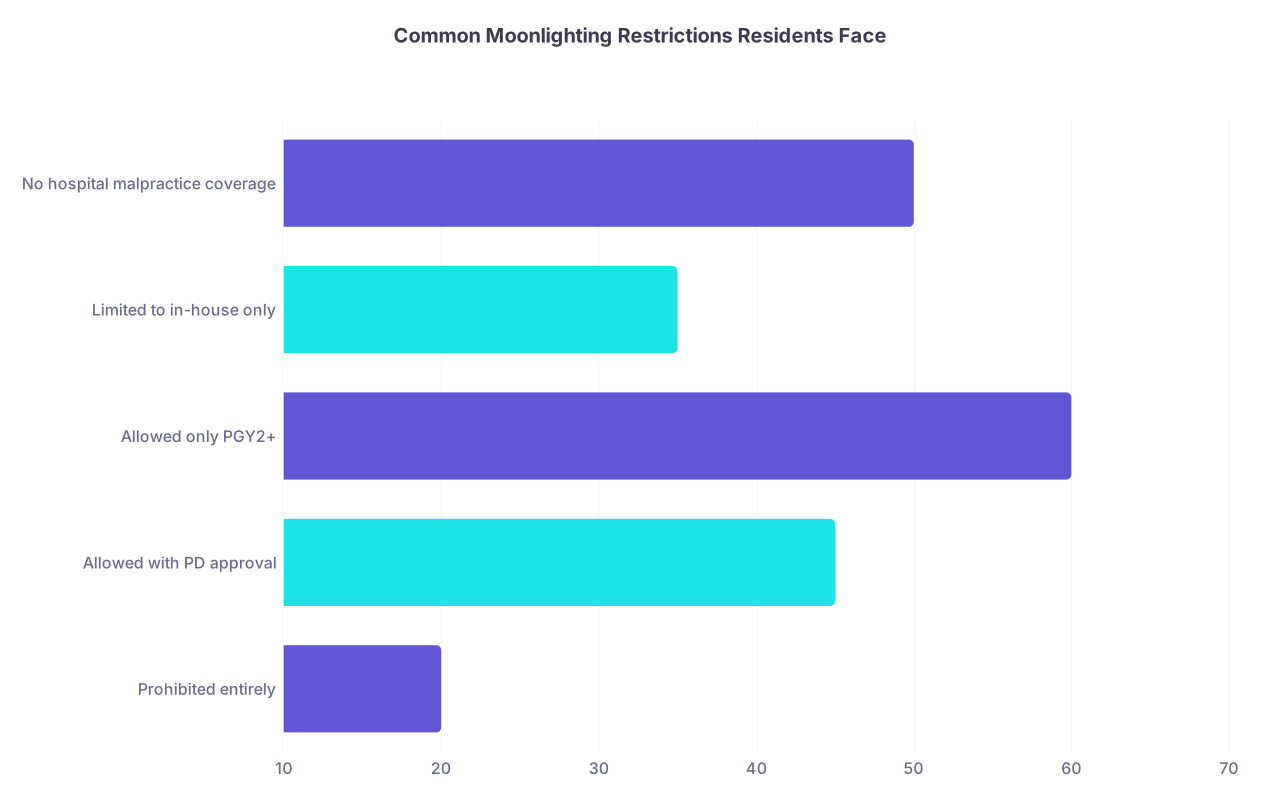
| Category | Value |
|---|---|
| Prohibited entirely | 20 |
| Allowed with PD approval | 45 |
| Allowed only PGY2+ | 60 |
| Limited to in-house only | 35 |
| No hospital malpractice coverage | 50 |
Numbers above are illustrative, but the pattern is real: most programs allow something, but with strings attached you only find out about if you actually read or ask.
When You Should Consider Talking to a Lawyer
Most of the time, HR + GME + a benefits rep is enough.
But there are situations where I’d stop playing nice and get an actual lawyer involved:
- You’re being told you violated the contract based on a benefits/moonlighting section you genuinely didn’t understand.
- You’re being billed or held liable for something that conflicts with your understanding of your coverage (e.g., malpractice, tail, major uncovered events).
- You suspect the written policy and what you were told verbally don’t match — and it’s hurting you financially or professionally.
Residents and fellows massively underestimate how powerful a short consult with someone who understands physician contracts can be. It’s not paranoid; it’s protective.
A Simple “Sanity Checklist” You Can Use Right Now
If you’re still spiraling, use this as a quick reality check. Grab your documents and ask yourself:
- Do I know:
- What health plan I’m actually on?
- If I have long-term disability and how much it covers?
- Whether moonlighting is allowed and under what conditions?
- Who covers my malpractice for my main job and for moonlighting?
- Whether I accidentally waived something important (and if I can still change it)?
If you can’t answer those right now, that doesn’t mean you messed up beyond repair. It just means you’re flying blind. And you don’t have to.
Start with HR/GME. Escalate if needed.

| Step | Description |
|---|---|
| Step 1 | Signed confusing benefits forms |
| Step 2 | Download all signed documents |
| Step 3 | Identify health, disability, malpractice, moonlighting |
| Step 4 | Email HR or GME with specific questions |
| Step 5 | Consult benefits rep or lawyer |
| Step 6 | Document answers and adjust plans |
| Step 7 | Plan for corrections at open enrollment |
| Step 8 | Understand key areas? |
| Step 9 | Still unclear or high risk? |
FAQ (Exactly 5 Questions)
1. Did I screw myself over legally by signing something I didn’t fully understand?
Probably not in the catastrophic way your brain is imagining. Most benefits acknowledgments are about confirming you received information or made elections, not about secretly agreeing to hidden penalties. Where you can get into trouble is ignoring policies afterward — like moonlighting without required approval or working outside covered malpractice. That’s why getting clarity now actually prevents legal problems later.
2. Can I change my benefits after I’ve already signed and started working?
Sometimes, yes. Health, dental, vision, and some disability options can usually be changed during open enrollment or after a qualifying life event. Retirement contributions can often be adjusted throughout the year. Moonlighting and malpractice policies are less “changeable” and more “obey or don’t” — you don’t usually elect those, you comply with them. So act fast if you realize you misunderstood something time-sensitive like plan elections.
3. What if HR or GME makes me feel stupid for asking about this?
Then they’re bad at their jobs. Benefits are complicated on purpose, and almost nobody fully understands them the first time. If someone is dismissive, escalate: ask to speak to a benefits coordinator, GME office, or the third-party benefits representative. You’re not stupid for wanting to know what happens if you get sick, injured, sued, or want to moonlight. You’re the one being responsible here.
4. How do I know if my moonlighting is actually covered by malpractice?
You don’t know until you see it in writing. Verbal reassurance like “yeah, you’re probably fine” is useless if something goes wrong. Get an email or policy statement that clearly says who covers what. If your hospital’s policy says coverage applies only to “assigned duties,” assume moonlighting is not covered unless explicitly stated otherwise. External sites usually need to provide their own malpractice for your shifts there.
5. If I’m totally overwhelmed, what’s the single most important thing to clarify first?
If you plan to moonlight or might in the future: clarify moonlighting and malpractice first. If you don’t plan to moonlight: clarify health and disability insurance first. Those are the areas where a misunderstanding can cost you the most — either in actual money or in career risk. Everything else (retirement, dental, etc.) is important, but less likely to destroy your life if you got it slightly wrong for a year.
Key points, if your brain is fried:
- You’re not doomed just because you signed something you didn’t fully understand.
- The dangerous blind spots are usually health, disability, malpractice, and moonlighting — focus your questions there.
- Ask early, ask in writing, and don’t be afraid to escalate if the answers you get don’t make sense.