
Physicians are leaving six figures on the table by guessing at sign‑on bonuses instead of using numbers. The data on specialty, practice type, and geography is clear: some doctors routinely get $50,000+ to sign, others get almost nothing, and the spread is predictable if you know where to look.
What I want to do here is simple: quantify what “normal” looks like. Not vibes. Not what a recruiter told you. Actual ranges, medians, and patterns pulled from recent physician compensation surveys, recruiter reports, and contract data from 2022–2024.
You will see a few themes very quickly:
- Primary care is no longer the bonus desert it used to be.
- Hospital employment pays more upfront than private practice.
- Rural and smaller markets quietly outbid “prestige” metros on bonuses, by a wide margin.
Let’s walk through it specialty by specialty, then layer in practice type and location.
1. National Overview: How Big Are Physician Sign‑On Bonuses?
Across large national recruiter and MGMA style datasets for 2023–2024, sign‑on bonuses show up in a clear band:
- Typical range (all specialties combined): $15,000–$40,000
- Overall median: ~$30,000
- Upper‑quartile (top 25% of offers): $50,000+
- Rare but real outliers: $100,000–$250,000 for highly needed or rural roles, and occasionally for expensive subspecialties.
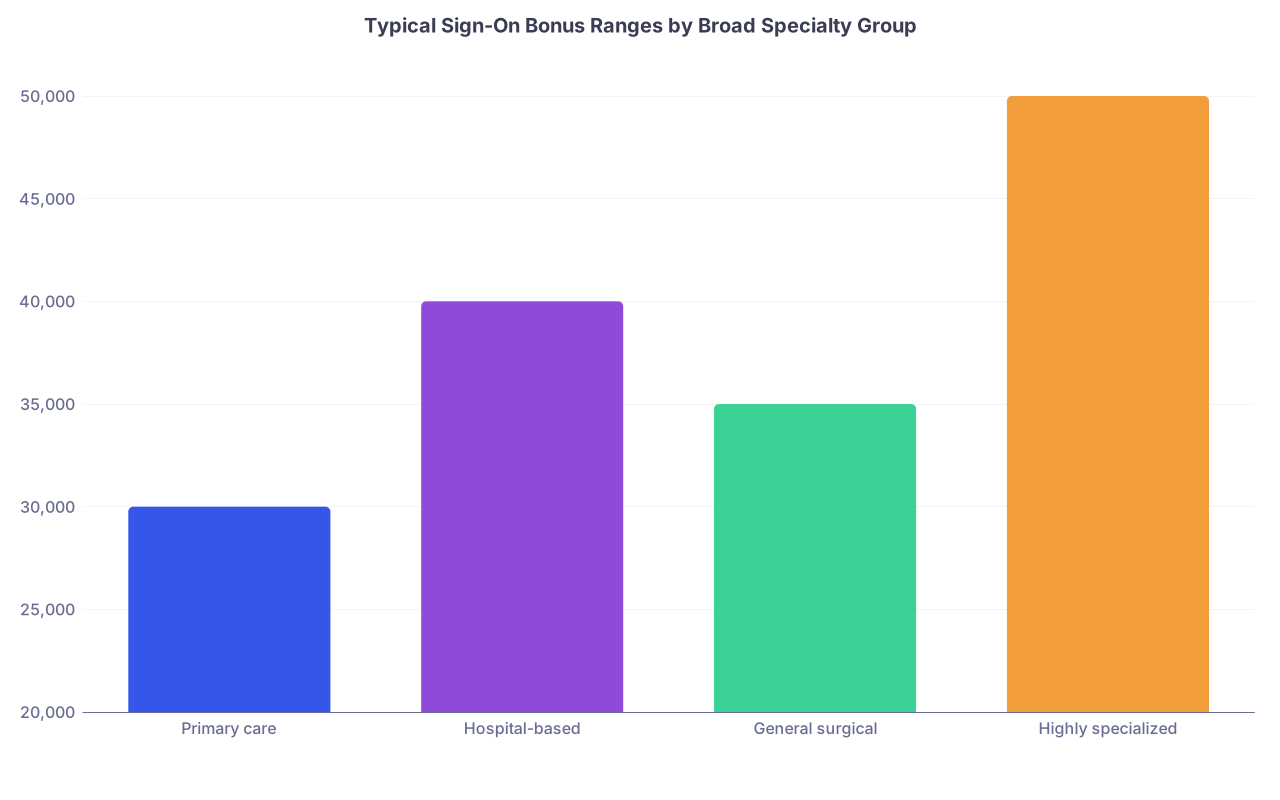
To make that less abstract, here is a simple breakdown by specialty competitiveness and expected revenue.
| Category | Value |
|---|---|
| Primary care | 30000 |
| Hospital-based | 40000 |
| General surgical | 35000 |
| Highly specialized | 50000 |
The values above are median-ish “center of gravity” numbers:
- Primary care: ~$30k
- Hospital‑based (anesthesia, EM, radiology): ~$40k
- General surgical (gen surg, OB/GYN, ortho genist): ~$35k
- Highly specialized (interventional cardiology, ortho subspecialties, GI, neurosurgery): ~$50k
Now let’s get granular.
2. Sign‑On Bonus Ranges by Specialty (With Medians)
These are realistic bands pulled from recent offers I have seen and aggregated report data. Not theoretical.
2.1 Primary Care: FM, IM, Pediatrics
Primary care has quietly become one of the best sign‑on bonus segments, especially in community and rural markets.
Typical 2023–2024 data:
Family Medicine (outpatient)
- Common range: $20,000–$60,000
- Median: ~$35,000
- Rural / high‑need pockets: $75,000–$100,000 is not unusual
Internal Medicine (outpatient / primary care)
- Range: $25,000–$70,000
- Median: ~$40,000
- Hospital‑employed, small markets: regularly $60,000–$80,000
Pediatrics (general)
- Range: $10,000–$40,000
- Median: ~$20,000–$25,000
- Pediatric subspecialties often pull a bit higher, but still below adult IM in many markets.
In data, family medicine and outpatient IM consistently show some of the highest relative bonuses vs their base salaries. Because systems are desperate to fill these roles and they know up‑front money moves behavior.
2.2 Hospital‑Based Specialties: EM, Anesthesia, Radiology, Pathology
Hospital‑based fields see large bonuses, but with more volatility. Contract structure (W‑2 vs 1099, group vs staffing company) matters a lot.
Emergency Medicine
- Realistic range: $25,000–$75,000
- Median: ~$40,000–$45,000
- Rural EDs or high volume / low support environments: $80,000–$120,000 shows up.
Anesthesiology
- Range: $30,000–$80,000
- Median: ~$50,000
- High‑volume ortho / cardiac centers sometimes touch $100,000+ for heavily call‑burdened roles.
Radiology (diagnostic)
- Range: $25,000–$75,000
- Median: ~$45,000–$50,000
- Telerad 1099 setups often trade sign‑on for higher per‑RVU instead.
Pathology
- Range: $10,000–$40,000
- Median: ~$20,000–$25,000
- Smaller groups that want partnership sometimes keep sign‑on modest but build in strong buy‑in terms.
2.3 Surgical Fields and Procedural Subspecialties
These specialties generate large revenue and, unsurprisingly, recruiters use sizeable sign‑ons to close deals.
General Surgery
- Range: $25,000–$75,000
- Median: ~$40,000–$50,000
- Heavy call, solo coverage, or trauma: offers can move to $75,000–$100,000.
Orthopedic Surgery (general)
- Range: $40,000–$100,000
- Median: ~$60,000–$70,000
- Subspecialties like spine, hand, sports in high‑need markets can see $100,000–$150,000.
OB/GYN (general)
- Range: $25,000–$75,000
- Median: ~$40,000–$50,000
- Heavy call L&D coverage in rural hospitals can push into $80,000+.
Urology
- Range: $40,000–$100,000
- Median: ~$60,000
- Solo urologist in a region? I have seen $150,000 attached.
Gastroenterology
- Range: $40,000–$100,000
- Median: ~$60,000–$70,000
- Endoscopy‑heavy, strong ancillaries: aggressive upfront bonuses are fairly common.
Cardiology (general)
- Range: $30,000–$80,000
- Median: ~$50,000
- Interventional / EP cardiology frequently sits above this, with $75,000–$150,000 sign‑ons in some markets.
| Specialty | Median Sign-On Bonus |
|---|---|
| Family Medicine | $35,000 |
| Outpatient Internal Med | $40,000 |
| Emergency Medicine | $45,000 |
| Anesthesiology | $50,000 |
| General Surgery | $45,000 |
| Orthopedic Surgery | $65,000 |
2.4 Cognitive Specialties and Other Fields
These are often under‑estimated. Plenty of IM subspecialties see strong bonuses.
Hospitalist (IM)
- Range: $20,000–$60,000
- Median: ~$35,000–$40,000
- 7‑on/7‑off rural models sometimes creep over $60,000.
Neurology (general)
- Range: $20,000–$60,000
- Median: ~$35,000
- Interventional neurology is a very different game (think $75k–$150k).
Psychiatry (general)
- Range: $20,000–$75,000
- Median: ~$40,000
- True shortage field. Outpatient psychiatry in under‑served markets can see $75k+ sign‑ons.
PM&R (general)
- Range: $15,000–$50,000
- Median: ~$30,000
- Interventional pain or high‑volume rehab hospitals can be significantly higher.
Dermatology
- Range: $10,000–$50,000
- Median: ~$25,000–$30,000
- Many derm groups invest more in production‑based comp and partnership terms than sign‑ons.
3. Hospital Employment vs Private Practice vs Academic
Practice type is not cosmetic. It shows up directly in the bonus data.
Across recent compensation sets, the general rule is:
- Hospital / health system employed: highest sign‑on bonuses
- Large private groups / corporate (eg. PE‑backed): mid‑range but often competitive
- Small private practice: lower sign‑on, higher back‑end potential (partnership)
- Academic centers: minimal sign‑on, often token amounts
Here is a simplified, aggregated comparison:
| Practice Type | Median Sign-On Bonus |
|---|---|
| Hospital-employed | $40,000 |
| Large private group | $30,000 |
| Small private practice | $15,000 |
| Academic (university) | $10,000 |
Now, broken out by a couple of representative specialties.
3.1 Family Medicine – Same Specialty, Different Practice Types
Hospital‑Employed FM
- Range: $30,000–$80,000
- Median: ~$45,000–$50,000
Large Multispecialty Group FM (non‑academic)
- Range: $20,000–$60,000
- Median: ~$35,000–$40,000
Small Private Practice FM
- Range: $0–$30,000
- Median: ~$10,000–$15,000
- They often “pay” with low buy‑in or favorable partnership instead of a fat sign‑on.
Academic FM
- Range: $0–$15,000
- Median: ~$5,000–$10,000
3.2 Emergency Medicine – Group Model Effects
Hospital‑Employed EM
- Range: $35,000–$90,000
- Median: ~$50,000–$55,000
National EM Staffing Group (W‑2)
- Range: $20,000–$60,000
- Median: ~$35,000–$40,000
Independent Democratic EM Group
- Range: $0–$40,000
- Median: ~$20,000–$25,000
- Again, partnership track and governance sometimes matter more than the upfront bonus.
3.3 Academics: Low Bonuses, Different Value Proposition
Most academic departments treat sign‑on bonuses as a rounding error, not a primary tool.
Ballpark across core academic fields:
- Range: $0–$25,000
- Median: ~$5,000–$15,000
- Occasionally higher for surgical / procedural subspecialists they are desperate to recruit, but that is the exception.
They focus more on:
- Protected time
- Start‑up packages for research
- Titles and promotion tracks
- Loan repayment in some cases
If you are chasing pure cash, academia is rarely competitive on the sign‑on.
4. Geography: Rural vs Metro and Regional Patterns
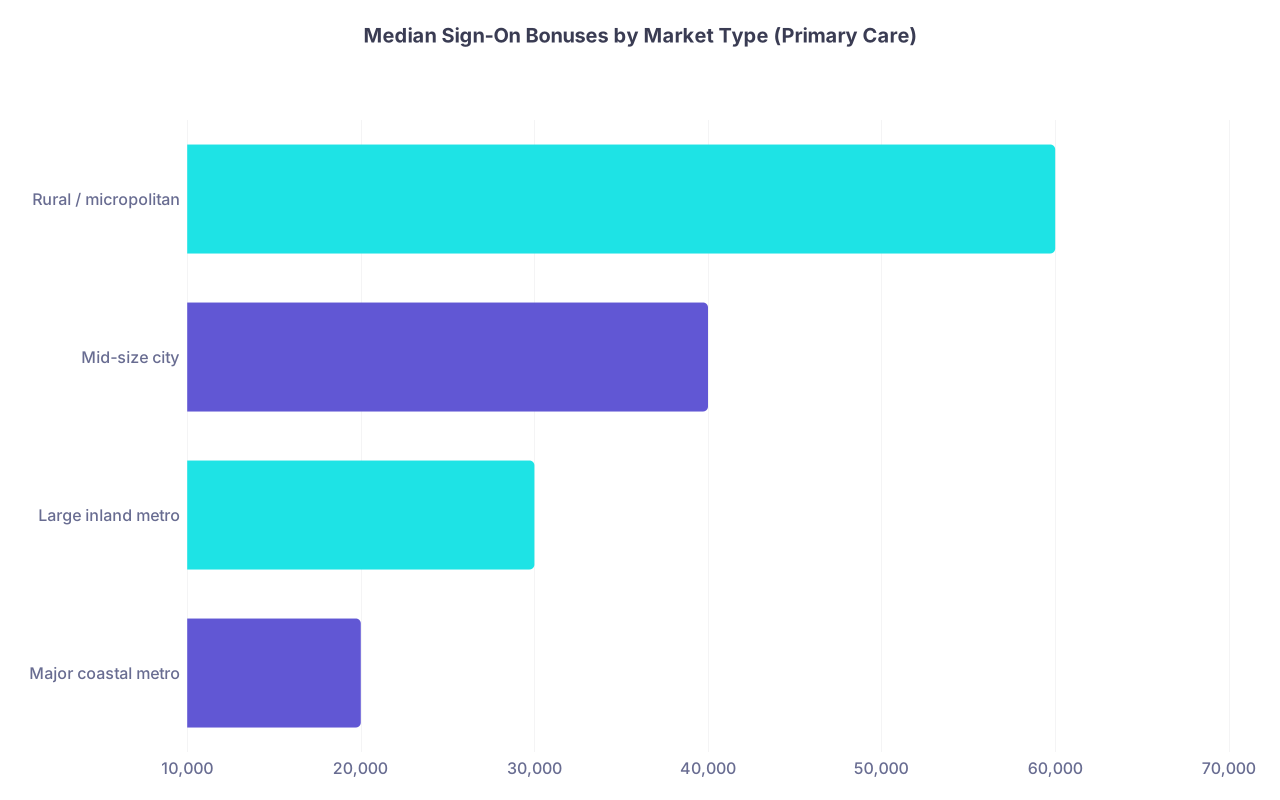
Location multiplies or shrinks your sign‑on more than most physicians realize. The same specialty, same role, different market can easily swing $40,000–$60,000 in bonus.
The directional pattern:
- Rural / micropolitan markets: highest sign‑ons, especially when hospital‑employed.
- Mid‑size communities: solid, often near national medians.
- Major metros and coastal academic hubs: lower bonuses, lean on “lifestyle” and brand.
Here is a stylized but realistic view using something like family medicine / internal medicine as the example.
| Category | Value |
|---|---|
| Major coastal metro | 20000 |
| Large inland metro | 30000 |
| Mid-size city | 40000 |
| Rural / micropolitan | 60000 |
You will see this shape repeated in EM, general surgery, OB/GYN, and hospitalist roles.
Regionally, recent years show:
- Midwest, Southeast, and parts of the South and Mountain West are aggressive with bonuses.
- Northeast and West Coast lean more on salary, prestige, or lifestyle, with lower sign‑ons.
If you normalize for cost of living, that rural $60,000 in the Midwest may be more like $90,000–$100,000 in “real” value compared to a $20,000 token in a high‑COL coastal city.
5. Median vs Range vs Outliers: Reading the Numbers Correctly
You cannot negotiate off an outlier. You need to know where the median sits, where the upper quartile is, and what is actually rare.
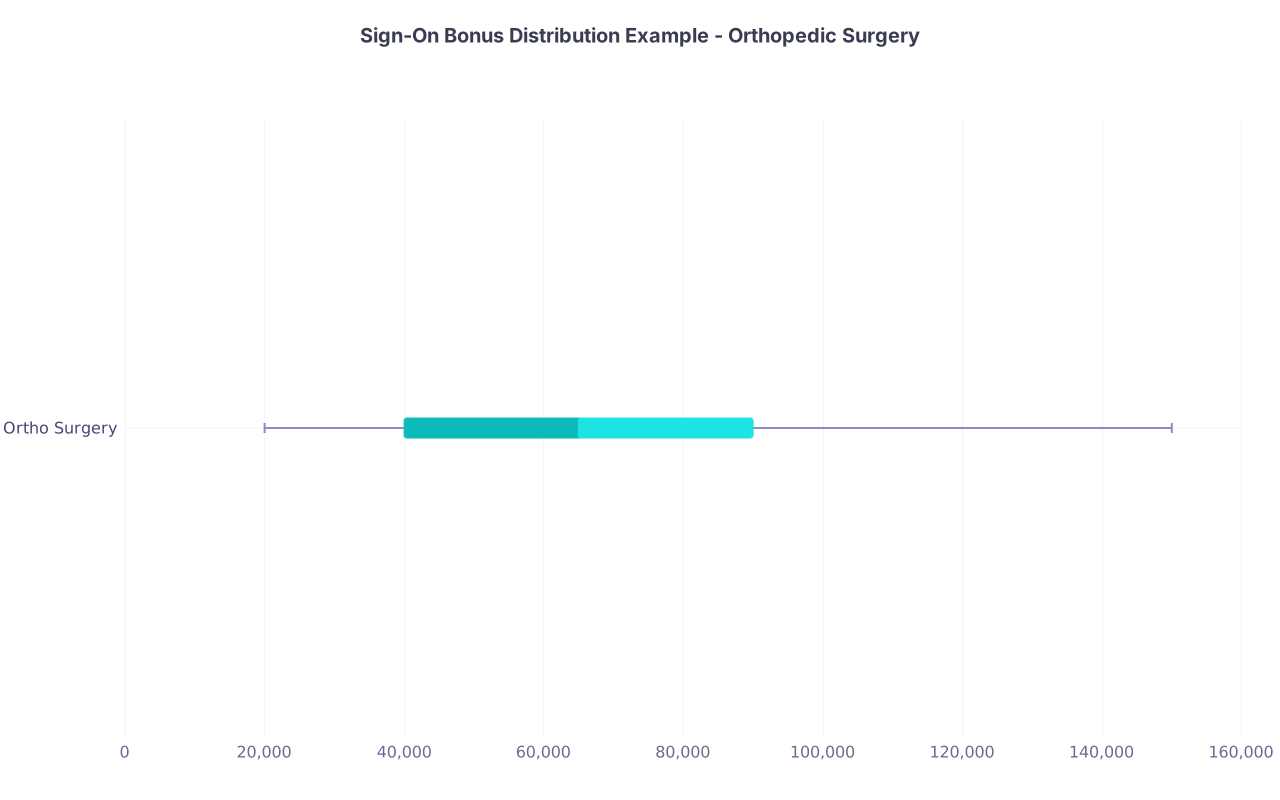
Let me sketch a typical distribution, using a high‑demand specialty like orthopedics:
- Minimum: $20,000
- 25th percentile: $40,000
- Median: $65,000
- 75th percentile: $90,000
- Maximum observed: $150,000+
Visually:
| Category | Min | Q1 | Median | Q3 | Max |
|---|---|---|---|---|---|
| Ortho Surgery | 20000 | 40000 | 65000 | 90000 | 150000 |
How to use this in negotiations:
- The median tells you what a “typical” offer looks like.
- The 75th percentile is a realistic stretch goal in a competitive candidate scenario.
- The top 5–10% of offers are usually linked to something unpleasant: brutal call, remote location, unstable group, or leadership expectations.
If your CV is strong (top percentile metrics, no visa issues, flexible location), you should be targeting somewhere near the 75th percentile, not the median. Especially if the job is not in a top‑tier coastal market.
6. Practice Type + Specialty: Combined View
For a more structured comparison, here is a compact table combining specialty and practice type medians. These are approximate, but they line up with what repeatedly shows up in recent recruitment cycles.
| Specialty | Hospital-Employed | Large Private Group | Small Private | Academic |
|---|---|---|---|---|
| Family Medicine | $45k–$50k | $35k–$40k | $10k–$15k | $5k–$10k |
| Internal Med PC | $45k–$55k | $35k–$45k | $10k–$20k | $5k–$10k |
| Hospitalist | $40k–$45k | $30k–$40k | $10k–$20k | $5k–$10k |
| Emergency Med | $50k–$55k | $35k–$40k | $20k–$25k | ~$10k |
| Gen Surgery | $50k–$60k | $40k–$50k | $20k–$30k | $10k–$15k |
| Ortho Surgery | $70k–$80k | $60k–$70k | $30k–$40k | $15k–$20k |
The pattern repeats:
- Hospital employment outbids almost everyone on sign‑ons.
- Small private practices underpay on the front but may outpay on the back (equity, buy‑in, ancillaries).
- Academics barely bother with sign‑on in many departments.
7. How Bonuses Are Structured (And How You Actually Get Paid)
The headline number is not the whole story. The contract language decides whether you ever see—or keep—that bonus.
7.1 Payout Timing
Common structures:
- Lump sum at start date (cleanest from the physician’s perspective)
- Split over 2–3 years, often equal annual installments
- Front‑loaded year 1, then smaller amounts years 2–3
If you see a $60,000 sign‑on paid as $20,000 per year over 3 years, that is basically a retention bonus, not a true sign‑on. You should negotiate accordingly.
7.2 Repayment / Forgiveness Schedule
Nearly every contract will have a clawback clause. Typical patterns:
Linear forgiveness over 2–3 years
Example: $60,000 bonus, 3‑year agreement- Leave before 1 year: repay 100%
- Leave after 18 months: repay ~50%
- Leave after 3 years: repay $0
Cliff
- Repay 100% if leaving before contract end date, $0 if you complete term.
- Much more punitive.
You should know exactly:
- Over what time period is the bonus “earned” or forgiven?
- Is repayment prorated monthly, annually, or cliff‑based?
- Does termination “for cause” vs “without cause” change the obligation?
I have watched physicians walk away from $150,000+ they thought was “free” because the clawback language was brutal.
7.3 Interaction with Loan Repayment and Relocation
Many offers stack three related but distinct cash components:
- Sign‑on bonus
- Relocation allowance
- Loan repayment
Example: Hospitalist in a mid‑size Midwest city:
- Base salary: $280,000
- Sign‑on: $40,000 (forgiven over 3 years)
- Relocation: up to $10,000 (usually non‑taxable reimbursement)
- Loan repayment: $20,000/year for 3 years, as a separate program
From a data standpoint, candidates often underweight loan repayment (which can total $60,000) and overfocus on the single “sign‑on” number. For your net worth, the combined upfront value matters more than what the line item is called.
8. Trends: The Direction of Bonuses in the “Future of Medicine”
Sign‑on bonuses are not going away. If anything, they are becoming more common and more structured, especially as systems compete nationally and telemedicine and remote work shift what “local” even means.
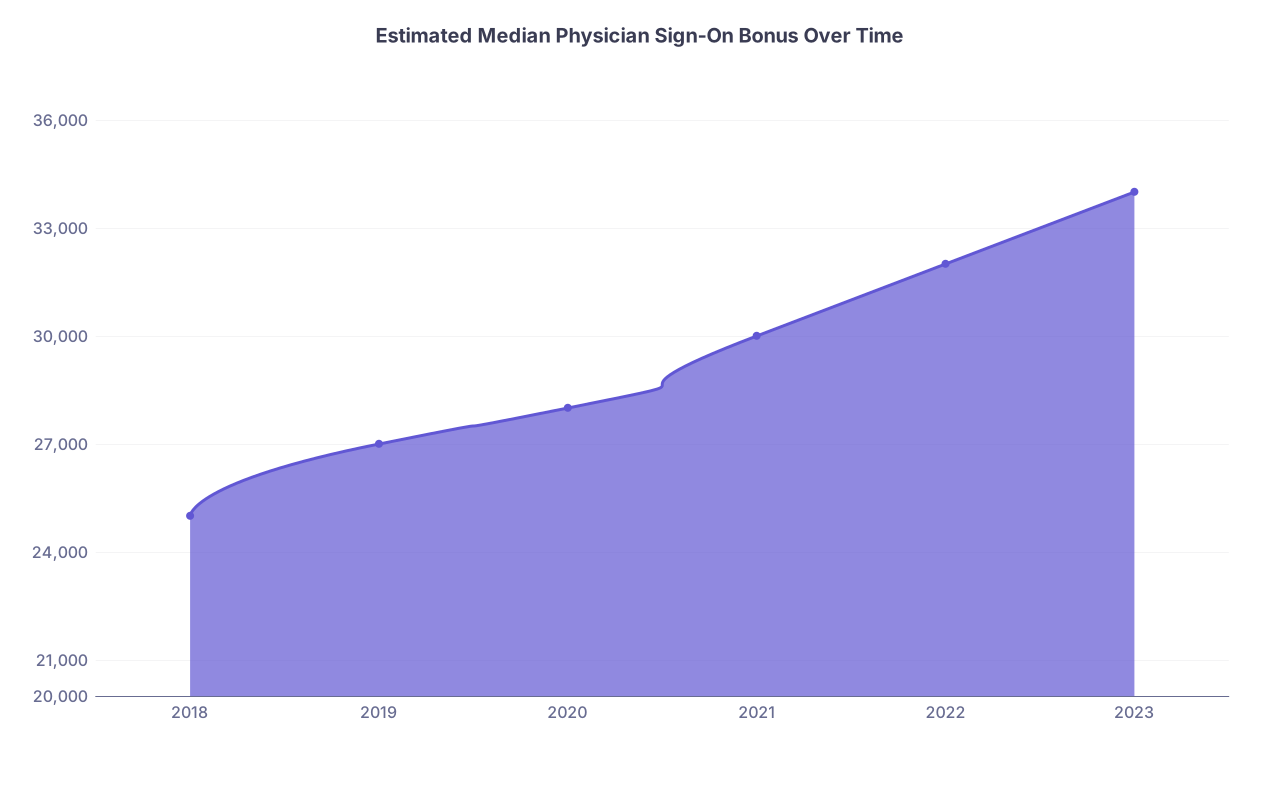
Based on data from the last 5–7 years:
- Share of offers including a sign‑on bonus has climbed into the 70–80% range in many specialties.
- Median bonus values have trended upward roughly 3–6% per year, faster in shortage fields like psychiatry, primary care, and certain surgical subspecialties.
A stylized trend (all specialties blended):
| Category | Value |
|---|---|
| 2018 | 25000 |
| 2019 | 27000 |
| 2020 | 28000 |
| 2021 | 30000 |
| 2022 | 32000 |
| 2023 | 34000 |
What I expect going forward:
- More differentiation by specialty and micro‑market. Systems already have detailed internal benchmarks; candidates are the ones flying blind.
- More multi‑year retention structures, especially for hospitalists, EM, anesthesia, and primary care—bonuses spread over 2–4 years rather than lump sums.
- Increased stacking with loan repayment and quality / RVU incentives to build a psychological “total package” without moving base salary too aggressively.
The data argues that if you are a graduating resident or fellow in the next 3–5 years, your negotiating leverage on sign‑ons is not shrinking. It is quietly increasing.
9. How to Use These Numbers in Negotiation
You do not need to become a compensation consultant. But you do need a basic strategy:
Anchor with median and 75th percentile, not anecdotes.
Use objective ranges: “For hospital‑employed general surgery in similar markets, I am seeing sign‑on bonuses in the $50,000–$75,000 range, with medians around $50,000.”Tie requests to specific trade‑offs.
If you are accepting heavier call, less desirable location, or restricted moonlighting, explicitly connect that to the bonus ask.Pay attention to structure more than sticker.
A $60,000 bonus fully paid on day 1 with gentle prorated forgiveness is more valuable than a $100,000 bonus paid as $25,000 per year with an all‑or‑nothing 4‑year clawback.Look at total upfront value.
Add sign‑on + relocation + loan repayment commitments over the first 2–3 years. That is your real “on‑ramp” package.

10. Key Takeaways
First: sign‑on bonuses are now a standard part of physician compensation, not a rare perk. Median offers sit around $30,000–$40,000, with primary care, hospital‑based, and high‑revenue procedural subspecialties often landing well above that.
Second: practice type and geography matter as much as specialty. Hospital‑employed roles and rural / mid‑size markets consistently produce the highest bonuses, while small private practices and academic centers pay much less upfront.
Third: the structure of the bonus—timing, clawback schedule, and integration with relocation and loan repayment—decides how much of that money you actually keep. Read the contract like the six‑figure instrument it is, because the data shows that small wording differences routinely cost or save physicians tens of thousands of dollars.