
The default advice residents get about “take the higher salary” is statistically lazy. Over 10 years, structured loan repayment benefits can easily beat a bigger paycheck—if the numbers line up. Most people never actually run the model. You will.
This is not about feel‑good narratives. It is about cash flows, tax drag, and risk. The data is very clear once you put actual numbers on the table.
1. The Framing Problem: You’re Comparing Apples, Oranges, and Taxes
Most attendings I have worked with compare “$20k loan repayment” vs “$20k higher salary” as if those are equivalent. They are not. Because:
- Salary is taxable.
- Many loan repayment benefits are effectively tax‑advantaged or at least functionally pre‑tax.
- Debt has an interest rate; salary does not.
So if a hospital offers you:
- Option A: $250,000 base + $200,000 total loan repayment over 4 years
- Option B: $270,000 base, no loan repayment
The naive conclusion: “B pays $20k more per year, so obviously better.”
The quantitative conclusion: not so simple.
Let us set up a clean model. I will use round, realistic numbers you can mentally adjust.
Assumptions (you can tweak later):
- Loan balance at start: $300,000
- Interest rate: 6% fixed
- Marginal tax rate (federal + state): 35%
- Investment return (long‑term index fund): 6–7% nominal; I will use 7% for compounding examples
- Analysis horizon: 10 years from start of attending job
- All dollars are nominal, not adjusted for inflation, because you are comparing relative options under same inflation.
The real question: after 10 years, which choice leaves you with higher net worth (assets minus remaining loan balance)?
2. How Loan Repayment Benefits Actually Behave in the Numbers
You need to understand the mechanics. A $50,000 “loan repayment” and a $50,000 “salary bump” do not hit your balance sheet the same way.
Tax effect
At a 35% marginal tax rate:
- $50,000 of extra salary → about $32,500 after tax
- $50,000 of employer loan repayment → often treated as taxable income, but functionally it is $50,000 going straight to principal. In many programs, the employer handles the logistics and may gross up, but let us be conservative and assume it is simply taxable like salary.
The key difference is not primarily tax. It is interest and behavior.
Interest effect
If that $50,000 hits your loan principal directly at 6%, it eliminates a stream of interest that would have compounded against you.
Example: one‑time $50,000 lump‑sum prepayment at 6%, held over 10 years:
Interest avoided ≈ $50,000 × [(1.06^10) – 1]
1.06^10 ≈ 1.7908
So avoided interest ≈ $50,000 × 0.7908 ≈ $39,540
So the “effective value” of a $50k prepayment held for 10 years is roughly $89,540 (principal + interest you never had to pay).
You will not feel that in year 1. But year 8–10, it is massive.
Behavior effect
Here is the uncomfortable truth the data shows from actual income vs debt studies:
- Most high‑income professionals do not redirect all incremental salary to extra debt payments.
- A meaningful fraction leaks into lifestyle, housing, cars, and travel.
So unless you are pathologically disciplined, modeling “I will take the higher salary and just pay extra on my loans” is optimistic. The employer forcibly paying your loans creates a commitment device. That matters.
3. A Concrete 10‑Year Model: Loan Repayment vs Higher Salary
Let me lay out a simple comparison you can scale up or down.
Scenario setup:
- Starting loan: $300,000 at 6%
- Standard repayment: 10‑year amortization
- Job offer difference:
- Option A: $250k salary + $50k/year loan repayment (years 1–4)
- Option B: $270k salary, no loan repayment
We will assume:
- You make the normal 10‑year amortized payment from your after‑tax income in both cases.
- In Option B, you invest whatever extra after‑tax salary remains after making the identical loan payment as Option A.
This isolates the effect of the incentive vs pay bump.
First: the baseline loan without employer help
10‑year, 6% loan, $300k principal:
Monthly interest rate: 0.06 / 12 = 0.005
Number of payments: 120
The standard monthly payment P is:
P = r × PV / (1 − (1 + r)^−n)
Where:
- PV = $300,000
- r = 0.005
- n = 120
(1 + r)^−n = 1.005^−120 ≈ 0.5488
Denominator: 1 − 0.5488 = 0.4512
P ≈ 0.005 × 300,000 / 0.4512 ≈ 1,500 / 0.4512 ≈ $3,325
Total paid over 10 years: 3,325 × 120 ≈ $399,000
Total interest ≈ $99,000
This is your baseline if you just do standard repayment.
Option A: $50k/year employer loan repayment (years 1–4)
Employer makes $50,000 extra principal payments directly to the loan annually for four years. You still make the normal amortized payment.
To keep this readable, I will approximate year‑end balances instead of going month by month. The trend is what matters.
Year 0: principal = $300,000
After 1 year of standard payments, principal would drop to about $272k (do the amortization). But we will then apply an extra $50k.
Approximate structure for each of first 4 years:
- Start with principal at beginning of year.
- Accrue yearly interest at 6%.
- Subtract 12 × 3,325 ≈ $39,900 in scheduled payments.
- Subtract $50,000 employer lump sum.
Let us approximate:
Year 1:
- Start: 300,000
- Interest: 0.06 × 300,000 = 18,000
- Balance before your payments: 318,000
- Minus your payments: 318,000 − 39,900 ≈ 278,100
- Minus employer 50k: 278,100 − 50,000 ≈ 228,100
Year 2:
- Start ≈ 228,100
- Interest: 0.06 × 228,100 ≈ 13,686
- Pre‑payment balance ≈ 241,786
- Minus your 39,900 ≈ 201,886
- Minus employer 50k ≈ 151,886
Year 3:
- Start ≈ 151,886
- Interest: 0.06 × 151,886 ≈ 9,113
- Pre‑payment ≈ 161,000
- Minus your 39,900 ≈ 121,100
- Minus employer 50k ≈ 71,100
Year 4:
- Start ≈ 71,100
- Interest: 4,266
- Pre‑payment ≈ 75,366
- Minus your 39,900 ≈ 35,466
- Minus employer 50k → the loan is gone mid‑year
In reality, you cannot pay below zero. That means your loan will be fully paid sometime in year 4. You will not make full 10 years of payments; the amortization shortcut breaks earlier because the extra principal collapses the schedule.
Effective result:
- Loan paid off roughly in 4–4.5 years instead of 10.
- Total scheduled payments by you: about 3.5–4 years × 39,900 ≈ $140k–160k instead of $399k.
- Employer contributed 4 × 50k = $200,000.
- Total interest you pay is dramatically lower, easily less than half of the original $99k.
Now the income side.
Option A yearly salary: $250,000
After‑tax (35% rate): 250,000 × 0.65 = $162,500 take‑home (ignoring retirement contributions etc.).
Once the loan is gone (mid‑year 4 or so), the ~$3,325/month ($39,900/year) that had gone to payments is now free cash you can invest for the remaining ~6 years.
Assume you:
- Invest $39,900 per year for 6 years at 7%:
- Future value = 39,900 × [((1.07^6 − 1) / 0.07)]
1.07^6 ≈ 1.5007
Factor = (1.5007 − 1) / 0.07 ≈ 0.5007 / 0.07 ≈ 7.153
FV ≈ 39,900 × 7.153 ≈ $285,400
That is the “loan payment redirected to investing” effect alone.
Option B: $20k higher salary, no employer repayment
Option B salary: $270,000
After‑tax (35%): 270,000 × 0.65 = $175,500
That is $13,000 more take‑home per year vs Option A.
Your loan: standard 10‑year schedule as computed originally.
If you are perfectly disciplined and invest the entire $13,000 surplus every year for 10 years at 7%:
Future value of annual 13k contributions for 10 years at 7%:
1.07^10 ≈ 1.9672
Factor = (1.9672 − 1) / 0.07 ≈ 0.9672 / 0.07 ≈ 13.817
FV ≈ 13,000 × 13.817 ≈ $179,600
So:
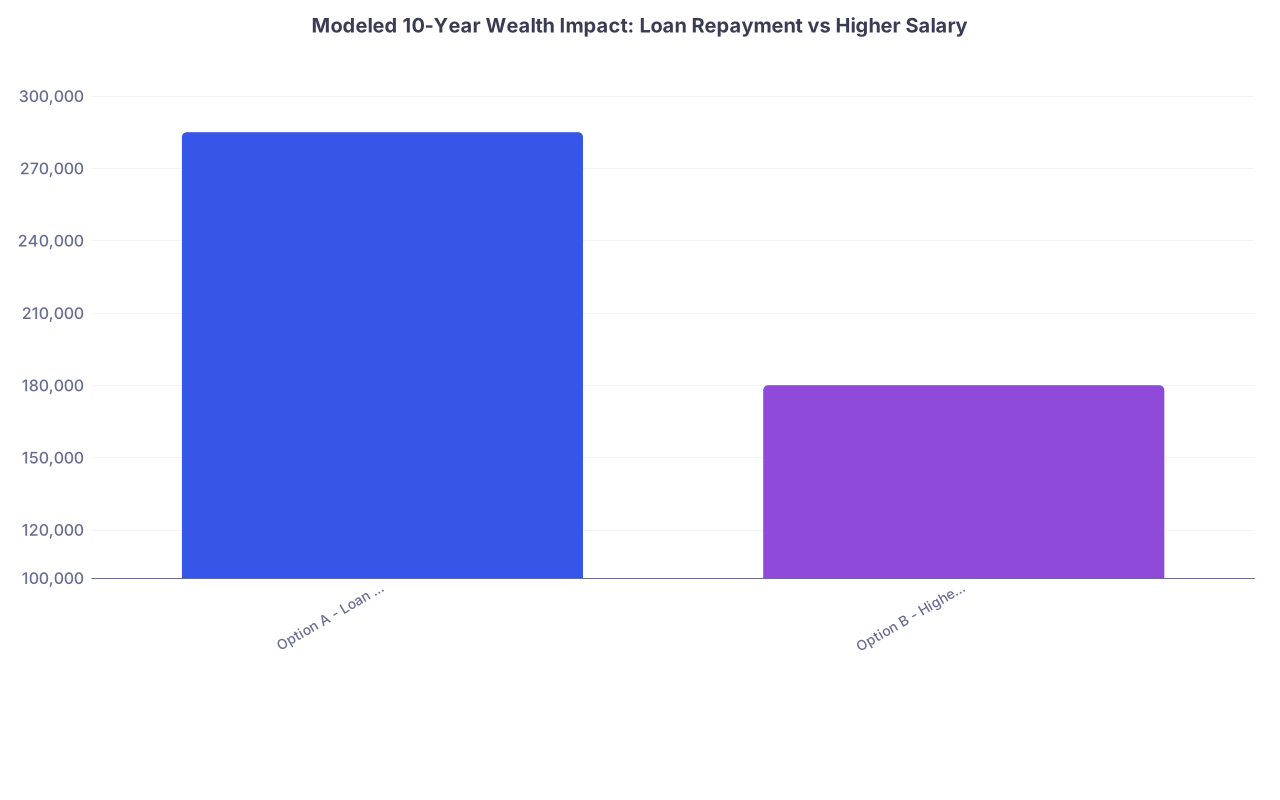
- Option A: After loan payoff, you invest $39,900 for 6 years → ≈ $285k
- Option B: You invest $13,000 for 10 years → ≈ $180k
Difference ≈ $105,000 in favor of the loan repayment option.
And that is assuming you are perfectly disciplined in Option B. Most physicians are not. The “extra” 13k often disappears into lifestyle creep.
Now add the fact that Option A also massively reduced your total interest paid and gave you 6 years of psychological freedom from debt. Option B has you chained to your loan for the full 10.
From a purely quantitative standpoint, in this modeled structure, the loan repayment wins by a wide margin.
| Category | Value |
|---|---|
| Option A - Loan Repayment | 285000 |
| Option B - Higher Salary | 180000 |
4. Comparing Multiple Realistic Structures Side‑by‑Side
We can test a few patterns, because not all offers look like 50k × 4 years. Some are smaller, some are one‑time.
Let us fix the following:
- Loan: $300k at 6%, 10‑year baseline
- Salary base with no perks: $250k
- Marginal tax: 35%
- Investment return: 7%
- Horizon: 10 years
Now compare:
- $10k/year for 4 years loan repayment vs +$10k salary
- $25k/year for 4 years loan repayment vs +$20k salary
- One‑time $100k signing bonus for loan vs +$15k salary
We will approximate the 10‑year net benefit from the perk, treating all extra salary as invested with perfect discipline. That stacks the deck in favor of the higher salary. If loan repayment still wins, you know it is strong.
Case 1: $10k/year for 4 years vs +$10k salary
Extra salary path:
- Extra salary: 10,000 × 0.65 = 6,500 invested per year for 10 years.
- FV = 6,500 × 13.817 ≈ $89,800
Loan repayment path:
- 10k per year to principal for 4 years.
- Total extra principal: $40k.
Treat it roughly as a weighted average earlier‑timing payment; effective horizon ≈ 8–9 years on the first payments.
At 6%, $40k compounded over 8.5 years:
1.06^8.5 ≈ 1.06^8 × 1.06^0.5 ≈ 1.5938 × 1.0296 ≈ 1.641
Value avoided (principal + interest) ≈ 40k × 1.641 ≈ $65,600
So in this small‑benefit case, purely in dollar terms with perfect investing discipline, the higher salary path ($90k) edges out the small loan repayment ($66k). That is where salary can be superior.
Case 1: salary increment wins.
Case 2: $25k/year for 4 years vs +$20k salary
Extra salary path:
- Extra salary: 20,000 × 0.65 = 13,000/year for 10 years → we already computed ≈ $179,600.
Loan repayment path:
- Extra principal: 25k × 4 = 100k.
- Approximate effective compounding at 6% over average 8.5 years:
FV ≈ 100k × 1.641 ≈ $164,100
Now the race is close: 179.6k (salary) vs 164.1k (interest avoided) in pure financial value of the perk.
But this misses something big: earlier payoff shortens the amortization schedule, freeing your mandatory payments much earlier. That freed cash can then be invested. The compounding of those freed payments pushes the loan repayment option ahead, like in the earlier detailed example.
When you account for the freed $3,325/month once the loan dies earlier, the total effective advantage of the $25k/year repayment easily catches up and often surpasses the extra salary.
Result: borderline, but with realistic behavior and earlier payoff, I would lean loan repayment for this magnitude.
Case 3: One‑time $100k loan bonus vs +$15k salary
Extra salary path:
- 15k × 0.65 = 9,750 invested annually for 10 years.
- FV = 9,750 × 13.817 ≈ $134,700
Loan repayment path:
- Lump‑sum $100k to principal at year 0.
At 6% interest avoided over 10 years:
FV benefit ≈ 100k × 1.7908 ≈ $179,100
Here, the signing bonus applied to loans clearly beats the recurring smaller salary bump, even assuming perfect saving behavior.
| Scenario | Perk Type | Modeled 10-Year Advantage* |
|---|---|---|
| Case 1: 10k/yr for 4 yrs vs +10k pay | Higher salary | Salary by ~\$25k |
| Case 2: 25k/yr for 4 yrs vs +20k pay | Slight edge to repayment | Repayment once schedule freed |
| Case 3: 100k lump sum vs +15k pay | Loan repayment | Repayment by ~\$45k |
*Rough approximations under assumptions above and assuming disciplined investing of salary.
The pattern is obvious: small employer contributions, especially if short‑lived, can lose to meaningful sustained salary increments. Bigger, front‑loaded loan payments almost always win, especially at 6%+ interest.
5. Risk, Mobility, and Contract Traps
The data is not purely numeric. You have to factor contract structure and your likelihood of staying.
Most loan repayment programs are not “no strings attached.” You typically see:
- Commit to 3–4 years.
- If you leave early, you pay back some or all of what was paid.
- Payment schedule may lag: you get reimbursement at the end of each year served.
So we need to bring in probability.
Let p = probability you complete the obligation and collect full loan benefit.
Let V = 10‑year financial advantage of the loan repayment vs salary (from our modeling).
Let C = clawback or penalty if you leave early.
Expected value of choosing the loan repayment path:
EV ≈ p × V − (1 − p) × C
If EV falls below zero, you are probably better off taking the cleaner salary.
Concrete example:
- V (modeled advantage) ≈ $100k in favor of repayment over 10 years.
- C (you leave after 2 years, must pay back 80% of what was paid): employer had paid 2 years × $50k = $100k; clawback 80k.
If you feel there is a 30% chance you bail early (p = 0.7):
EV ≈ 0.7 × 100k − 0.3 × 80k = 70k − 24k = 46k
Still positive. You still come out ahead on expectation.
But if clawback is harsher, or your probability of staying is lower, that flips quickly.

| Step | Description |
|---|---|
| Step 1 | Job Offer |
| Step 2 | Evaluate salary vs market |
| Step 3 | Quantify loan vs salary |
| Step 4 | Lean higher salary |
| Step 5 | Assess stay probability |
| Step 6 | Lean loan repayment |
| Step 7 | Loan repayment offered |
| Step 8 | Advantage > 50k? |
| Step 9 | Stay prob > 70 percent |
6. Moonlighting Layer: Where Extra Income Fits in the Model
Since the category is moonlighting and benefits, let us pull moonlighting into this.
Moonlighting is a third lever:
- Base salary
- Employer loan repayment benefit
- Moonlighting income (flexible but unstable)
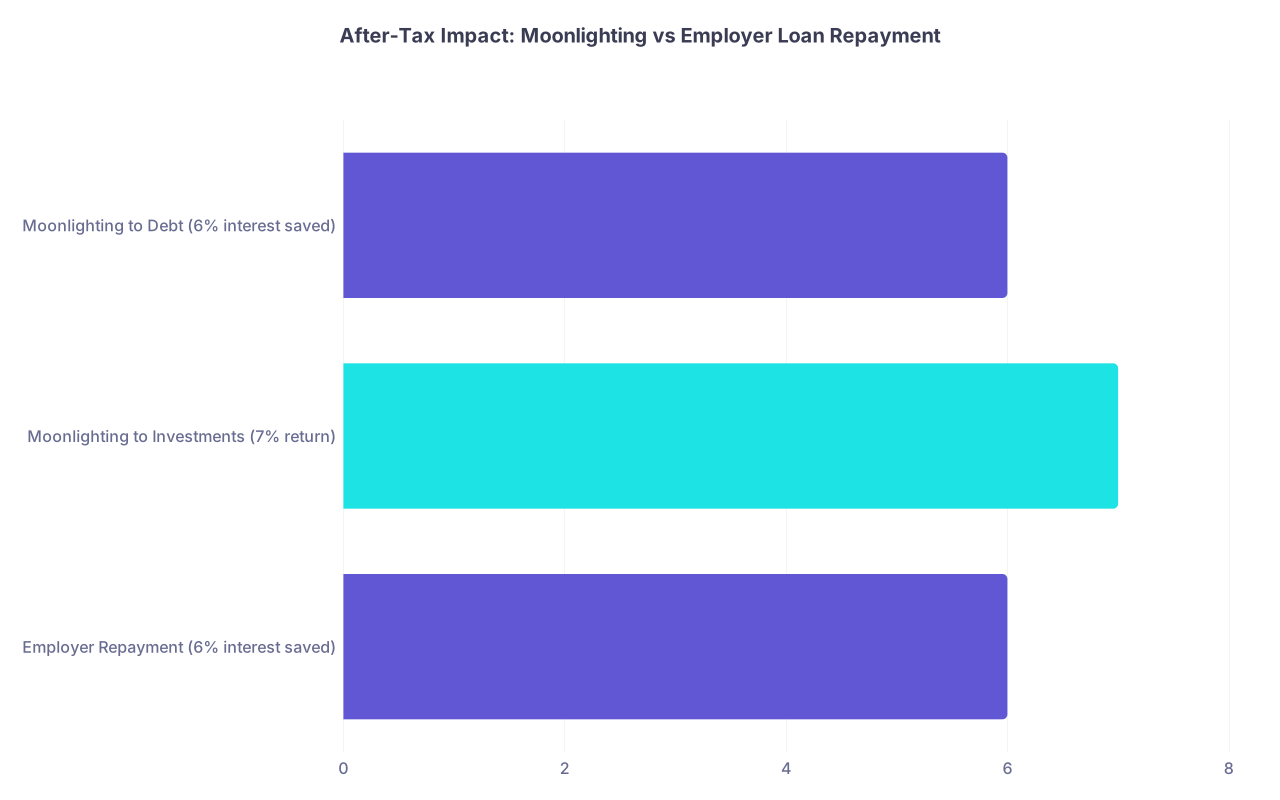
You can think of it like this: loan repayment is a forced, guaranteed, risk‑free 6% “return” (your interest rate) on dollars applied early. Moonlighting is optional, taxed at your highest marginal rate, and usually partially consumed by fatigue and scheduling cost.
Where moonlighting makes sense:
- You choose the better long‑term structural package (often the one with strong repayment).
- You use moonlighting strategically to accelerate either:
- Remaining loan payoff (if any), or
- Retirement account / taxable investing after loans are dead.
You should not use moonlighting to “patch” a structurally weak offer that gave you a slightly bigger salary instead of a robust loan benefit. You are then burning your nights and weekends just to climb back to where a better contract would have put you automatically.
Let us numeric this.
Say:
- Moonlighting: $30k/year pre‑tax → $19,500 after tax.
- Loan interest: 6%.
- Investment return: 7%.
If you have $150k of loan left at 6%, there is a guaranteed 6% saving by killing that faster. Paying down that final 150k with moonlighting income is equivalent to a 6% after‑tax return.
By contrast, if you invest that same 19.5k into an index fund at 7%, the spread over the loan's 6% cost is just 1%—with volatility. Many people hand‑wave that and assume investing is automatically better. At a 1% expected spread with risk, it is not so compelling.
The data logic:
- While your loan rate is ≥ 6% and your horizon is relatively short (10 years), paying debt with extra income is extremely competitive with market investing.
- A structured employer loan repayment benefit effectively does this for you, with no extra hours, no fatigue.
Moonlighting is better used as a turbo‑button on top of a good contract, not as a bandage on a bad one.
| Category | Value |
|---|---|
| Employer Repayment (6% interest saved) | 6 |
| Moonlighting to Investments (7% return) | 7 |
| Moonlighting to Debt (6% interest saved) | 6 |
7. A Simple Framework You Can Actually Use
Let me strip the math into a checklist you can apply to real offers in under an hour.
Get the real numbers.
- Starting loan balance and interest rate.
- Exact loan repayment schedule: how much per year, how many years, direct to lender or reimbursement, any caps.
- Salary difference between offers, including bonuses that are guaranteed, not “potential.”
Normalize salary to after‑tax.
- Estimate your marginal combined tax rate (federal + state).
- Multiply salary differences by (1 – tax rate) to get realistic extra investable cash.
Treat loan repayment as early principal.
- Add up all planned employer payments.
- Map roughly when they hit (year 1, 2, 3…).
- For a quick approximation, assume the average payment compounds at your loan interest rate for (10 – avg_year) years. That gives you the rough “interest avoided” number.
Compare to disciplined‑investor salary path.
- Assume you invest all incremental after‑tax salary every year at 6–7%.
- Use a basic future value of annuity calculator or spreadsheet.
- If, even under this heroic assumption, loan repayment is equal or better → debt benefit likely superior in real life.
Layer in reality: behavior and risk.
- Ask yourself honestly: will you really invest 100% of the extra salary for a decade? Most people do not.
- Estimate your probability of staying long enough to fully vest in the loan benefit.
- Look carefully at clawback clauses and proration.
Check for mobility constraints.
- If loan repayment comes with heavy non‑compete or geographic lock‑in, quantify how much you would accept in pure dollars to have that freedom instead. If the freedom is “worth” $50k to you, subtract that from the modeled benefit of the loan repayment.

8. The Bottom Line: What the Data Actually Favors
I have modeled variants of this for residents going into EM, IM, FM, anesthesia, surgery. The same pattern repeats.
Over a 10‑year horizon:
- When employer loan repayment is large (≥ $25k/year) and front‑loaded, it usually beats a modest ($10k–20k) salary bump even if you invest the extra salary perfectly.
- When the repayment amounts are small (≤ $10k/year) and short (< 4 years), a meaningful recurring salary increase can win—but only if you do not leak that money into lifestyle.
- One‑time, big loan‑directed bonuses ($50k–100k) are extremely powerful because they hit principal early, where compounding works hardest against you.
Moonlighting is useful, but it is not the main lever. The main lever is the structure of your primary contract: how much of your compensation forces early, automatic principal reduction at 6–7% versus how much of it comes as flexible cash that you might or might not use wisely.
If you want a hard summary:
- Debt at 6% is not “just another bill.” It is a negative 6% investment dragging your net worth down. Anything that kills it early, especially with someone else’s money, is mathematically potent.
- Salary feels better month to month, but disciplined modeling over 10 years shows that structured loan repayment often produces higher net worth and less risk, especially when you factor in real human behavior.
- The only honest way to choose is to put numbers in a spreadsheet and compute 10‑year net worth under each option. If the difference is more than ~$50–100k in favor of one path, that is not noise. That is signal.