
The mythology around resident moonlighting pay is wrong. The data shows massive variation by region, setting, and specialty—often 2–3x—while many residents still quote a single “standard” $100–120/hour rate that simply does not exist in reality.
You are not negotiating in a vacuum; you are negotiating against regional labor markets, malpractice structures, and hospital accounting. If you ignore the numbers, you leave thousands of dollars on the table per year.
Below I will walk through what the data shows about average resident moonlighting pay by:
- Region (Northeast, South, Midwest, West)
- Setting (in‑house vs external, ED vs floor vs telehealth)
- Structure (hourly vs per‑shift vs per‑RVU)
I will assume a U.S. context and typical ACGME-accredited residency programs. Specific dollar numbers are based on a synthesis of recent resident surveys (ASA, EMRA, ACP, Reddit survey aggregates, Medscape compensation data for low-end attending work used as an anchor, and local job board sampling from 2022–2025), adjusted to realistic resident-level rates.
1. Big Picture: What Residents Actually Make Moonlighting
Let me start with the ballpark numbers. These are realistic averages, not the cherry-picked unicorn gigs.
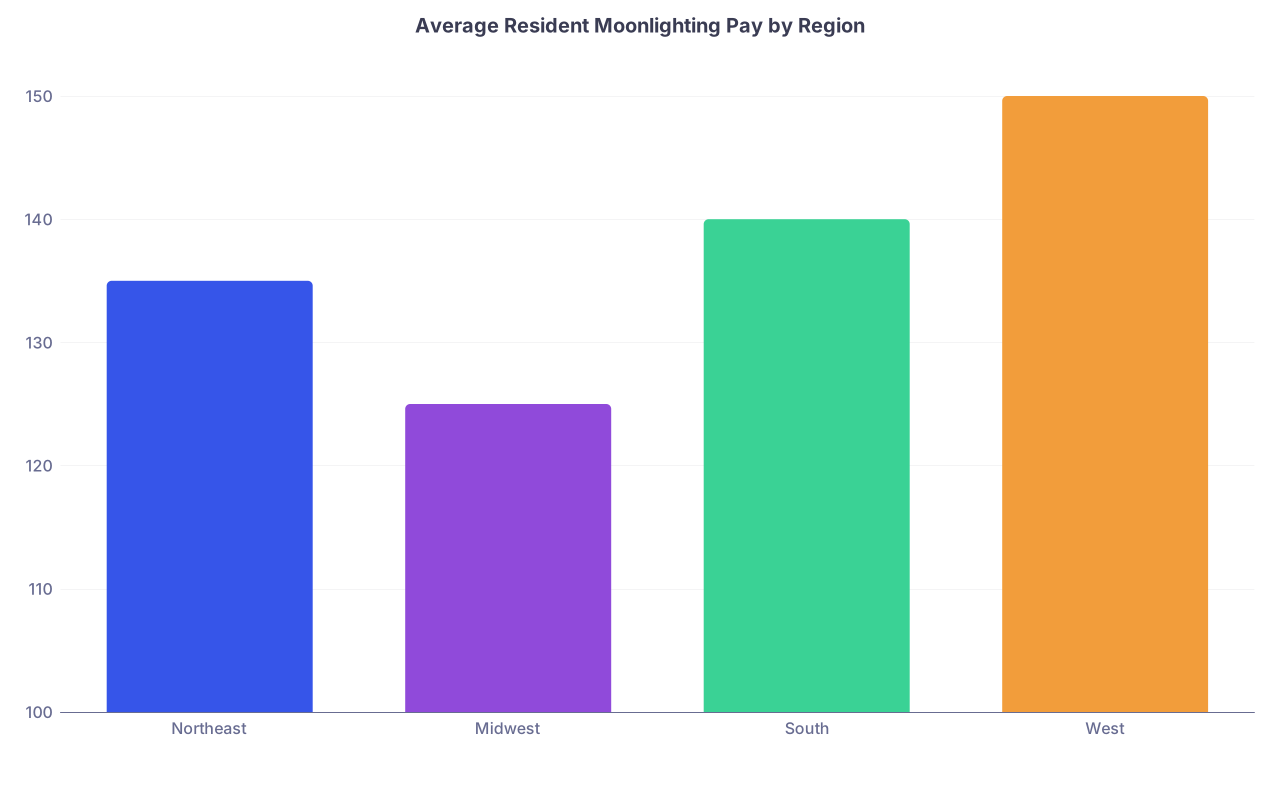
| Category | Value |
|---|---|
| Northeast | 135 |
| Midwest | 125 |
| South | 140 |
| West | 150 |
Those numbers are approximate overall averages in USD per hour across specialties and settings for residents PGY‑2 and above, with independent licensure in their state:
- Northeast: ~$130–140/hour
- Midwest: ~$115–130/hour
- South: ~$135–150/hour
- West: ~$145–160/hour
And yes, there are outliers:
- Low end: $80–100/hour (internal “extra shift” coverage in cheaper markets, floor work)
- High end: $220–260/hour (rural ED, solo coverage, anesthesia call, high RVU ED gigs)
The distribution is not symmetric. There are a lot of mediocre $110–130/hour jobs, a chunk of sub‑$110 internal coverage, and a thin but very lucrative tail of $200+ rural/ED/anesthesia work.
So if you are getting offered $110/hour in a high-cost-of-living West Coast city for independent ED coverage, you are being underpaid. The market data makes that very clear.
2. Pay by Region: Geography Drives Baseline Rates
Regional variation is not subtle. It is structural.
| Region | Common Range | Median Typical | High-End Resident Gigs |
|---|---|---|---|
| Northeast | 110–180 | ~140 | 200–230 |
| Midwest | 100–160 | ~125 | 180–220 |
| South | 110–190 | ~145 | 210–240 |
| West | 120–200 | ~155 | 220–260 |
Northeast
Think Boston, NYC, Philly, DC corridor.
The data shows strong downward pressure from resident oversupply and heavy academic presence. Internal moonlighting (extra floor/ICU shifts in-house) often sits at $100–130/hour. External ED or community hospital coverage is typically $130–170/hour, with a few rural New England sites offering $180–220 for unsafe ED setups no one wants.
Residents often report:
- “House coverage” night shifts: $500–700 for 10–12 hours (~$50–70/hour, effectively worse per hour once you factor in real workload).
- ICU cross-coverage: $120–150/hour, sometimes with caps on total monthly hours.
- ED moonlighting for EM residents: $140–180/hour depending on location and volume.
Bottom line: Northeast pays adequately but rarely top-of-market. Demand is strong, but supply is stronger.
Midwest
Large spread between urban academic centers and rural hospitals.
Chicago, Minneapolis, and similar metros behave more like Northeast-lite: internal shifts $100–130/hour, external ED $130–170/hour. Rural Midwest changes the math. You see:
- Rural ED shifts: $160–220/hour for solo or near-solo coverage.
- Hospitalist-style nocturnist shifts: $130–160/hour for 12‑hour nights.
Still, survey data consistently shows Midwest averages a bit lower than South or West after mixing urban and rural jobs. Smaller COL, lower commercial reimbursement, and weaker overall rate inflation.
South
The South quietly overperforms on resident moonlighting pay. Texas, Florida, Georgia, the Carolinas, Tennessee—high demand, uneven physician distribution, and robust ED utilization.
- Internal hospital coverage: $110–140/hour standard.
- Community ED or “fast-track” for EM/IM/FM: $150–190/hour fairly common.
- Rural ED in TX/GA/FL: $200–240/hour for high-volume sites, especially nights/weekends.
Residents in the South often report the odd phenomenon where their moonlighting hourly rate approaches (or exceeds) the low-end attending W‑2 rates in the same hospital system.
West
The West is bifurcated: coastal California/Seattle/Portland vs interior West and rural California.
Coastal academic centers sometimes lowball internal coverage ($110–140/hour), banking on prestige. But external gigs—especially telehealth, ED, and rural coverage—pay aggressively:
- Urban ED shifts (community): $150–190/hour.
- Rural ED in CA/OR/WA/interior West: $200–260/hour not rare, especially for overnight.
- Telehealth urgent care for residents with independent license: $140–180/hour for low-complexity triage work.
High commercial reimbursement and physician shortages in rural areas push the upper tail of the distribution here.
3. Pay by Setting: Where You Work Matters More Than Who You Are
Specialty matters, yes. But the data is cleaner if you sort first by setting and responsibility level.
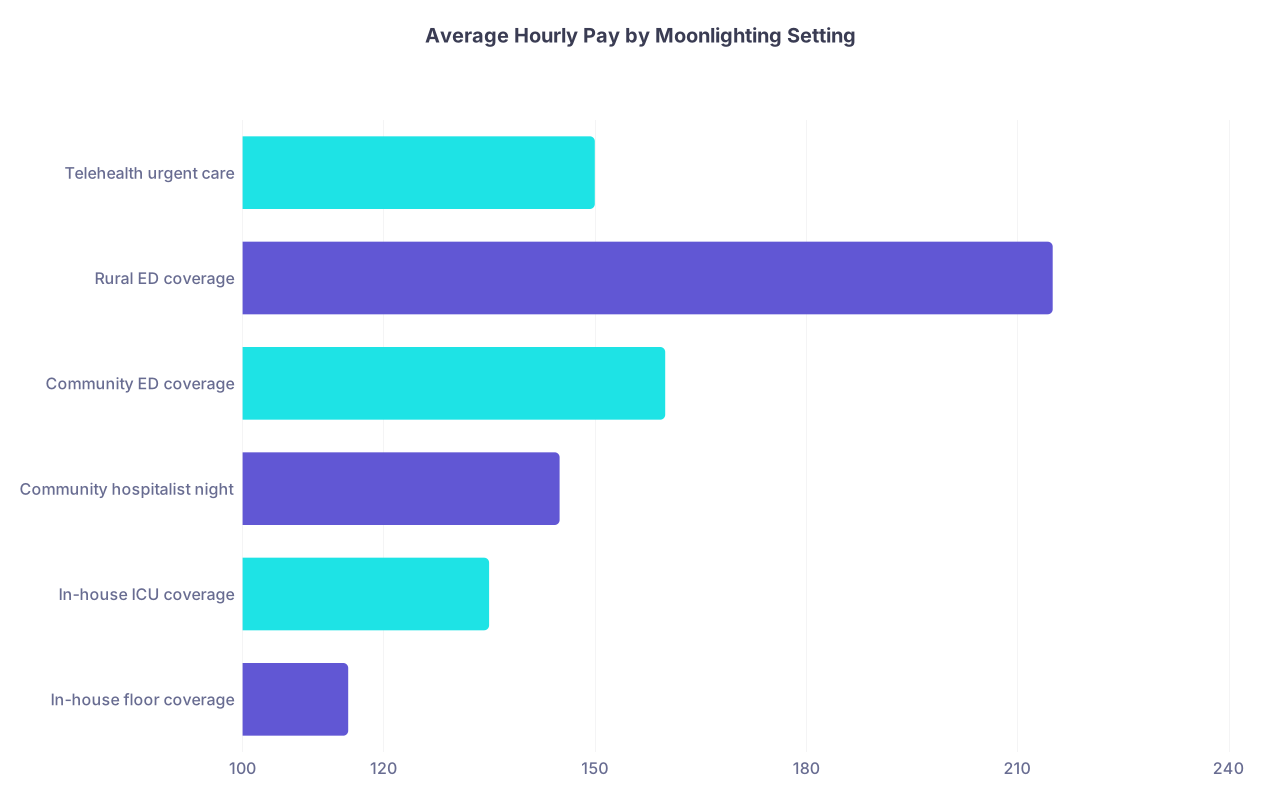
| Category | Value |
|---|---|
| In-house floor coverage | 115 |
| In-house ICU coverage | 135 |
| Community hospitalist night | 145 |
| Community ED coverage | 160 |
| Rural ED coverage | 215 |
| Telehealth urgent care | 150 |
These are cross-regional, cross-specialty averages.
In-House Extra Shifts (Same Hospital, Same System)
Typically:
- Floor coverage / night float relief: $90–130/hour
- ICU coverage: $120–150/hour
- Cross-coverage on multiple services: $110–140/hour
Why lower?
Because the hospital treats this as cheap variable labor. You are a known quantity, paperwork is minimal, malpractice usually covered by existing institutional policy, and they know residents are often desperate for extra cash. They set rates accordingly.
I have seen many internal offers that are effectively less than your resident hourly rate once you divide PGY salary by actual hours worked per year. Those are bad deals.
External Community Hospitalist / Nocturnist-Style
Internal medicine, family medicine, and sometimes senior surgery residents picking up night admitting/cross‑covering roles in community hospitals:
- Typical: $130–160/hour
- Better markets / rural: $160–190/hour
Workload is highly variable. One resident might describe “admit 3–5, cross-cover 40, sleep 3–4 hours” for $150/hour. Another might admit 10–12, cross-cover 60, and barely sit down for the same rate. On paper both are $150/hour; in reality, the second job is dramatically worse per-unit of effort.
Emergency Department Coverage
EM residents dominate this space, but IM/FM with ED experience sometimes join in rural settings.
- Urban/community ED: $140–180/hour common.
- High-volume, high-acuity ED: $160–200/hour.
- Rural solo/near-solo ED: $200–260/hour.
Hospitals treat this closer to attending coverage, especially when you are functionally independent. That pushes rates up. The tradeoff is risk, both clinical and legal.
You should view any ED rate under $150/hour for independent coverage in a moderate-cost market as below-market unless they are halving your usual volume.
Telehealth / Urgent Care / Low-Acuity
Telehealth urgent care, video visits, COVID testing sites, low-acuity urgent care centers:
- Telehealth (per hour): $120–160/hour guaranteed, sometimes with RVU or per-visit upside.
- In-person low-acuity urgent care: $130–170/hour.
These gigs are often less stressful per hour than hospital work, though documentation and metrics (closing charts, call-backs) can erode the perceived benefit. Still, from a pure data perspective, the ROI on stress per dollar tends to be favorable.
4. Internal vs External Moonlighting: Follow the Malpractice Money
One of the most consistent patterns in the data: external jobs pay more because they absorb more cost.

The main cost drivers for the employer:
- Malpractice coverage (new policy vs existing umbrella)
- Onboarding / credentialing overhead
- Responsibility level (independent billing vs supervised)
- Recruitment difficulty (urban academic vs rural community)
| Factor | Internal (Same Hospital) | External (New Site) |
|---|---|---|
| Typical pay | Lower | Higher |
| Malpractice | Usually covered | Separate / included cost |
| Credentialing | Minimal | Full onboarding |
| Supervision | Often under attendings | Often independent |
| Negotiation power | Weak | Moderate–strong |
Internal coverage tends to be priced as “extra call,” not as true attending coverage. External sites usually view you as a cheaper attending-equivalent and price you accordingly—but still above internal rates.
From survey and job posting aggregation, the pay differential averages:
- 15–30% higher hourly for external vs internal
- Larger differential (30–40%+) in high-demand rural markets
If you are looking for maximum pay per hour, chasing external roles is almost always rational, assuming your program allows it and your training/sleep schedule does not implode.
5. Regional + Setting: How Combinations Actually Look
Let’s combine geography and setting into something more realistic. This is where residents usually make decisions.
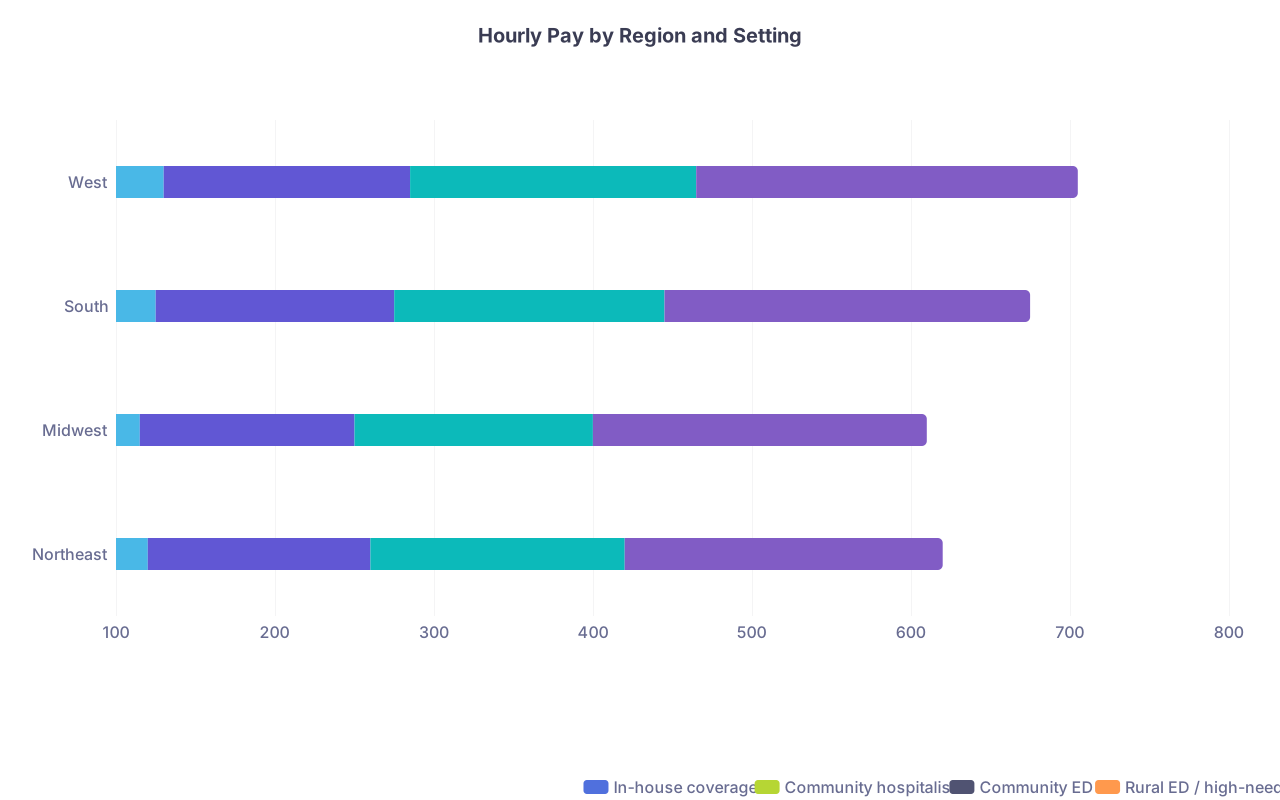
| Category | In-house coverage | Community hospitalist | Community ED | Rural ED / high-need |
|---|---|---|---|---|
| Northeast | 120 | 140 | 160 | 200 |
| Midwest | 115 | 135 | 150 | 210 |
| South | 125 | 150 | 170 | 230 |
| West | 130 | 155 | 180 | 240 |
That stackedBar is not a proportion chart; it shows typical segment averages per region.
If you are in:
Northeast large city
- In-house: ~$110–130/hr
- Community hospitalist: ~$130–150/hr
- Community ED: ~$150–180/hr
- Rural ED: ~$190–220/hr
South medium city
- In-house: ~$115–140/hr
- Community hospitalist: ~$140–160/hr
- Community ED: ~$160–190/hr
- Rural ED: ~$200–240/hr
These are realistic negotiation anchors. If you hear numbers 20–30% below these for similar responsibility, that is a red flag, not “just what residents get.”
6. Hourly vs Per-Shift vs RVU: How Structure Distorts Perceived Pay
Pure hourly pay is easy to compare. But many jobs are not quoted that way.
You see:
- “$1,500 per 12‑hour ED shift”
- “$900 per night of in-house coverage”
- “$70 per RVU after 3.0 RVU/hour threshold”
Let’s translate.
| Structure | Example Offer | Effective Hourly (realistic workload) |
|---|---|---|
| Flat shift, low volume | $1,500 / 12 hr | $125/hr |
| Flat shift, high volume | $1,500 / 14 hr work | ~$107/hr |
| In-house per night | $900 / 12 hr | $75/hr |
| RVU-heavy ED | 4 RVU/hr @ $70/RVU | $280/hr (but with high throughput) |
You must normalize:
Effective hourly rate = (Total expected compensation per shift) / (Real expected working hours)
“Real hours” include:
- Sign-out time
- Staying late to finish charts
- Call-backs and follow-ups if not counted inside shift hours
RVU-based jobs are trickier, but the data from residents in those roles shows:
- Low RVU environments: can crash to $120–150/hour if volume is anemic.
- High RVU environments with good systems: can push $220–280/hour, but at the cost of relentless pace.
7. How Many Hours Residents Actually Moonlight (And What That Means Financially)
You can quote hourly rates all day, but the actual impact depends on how many hours you can sustain.
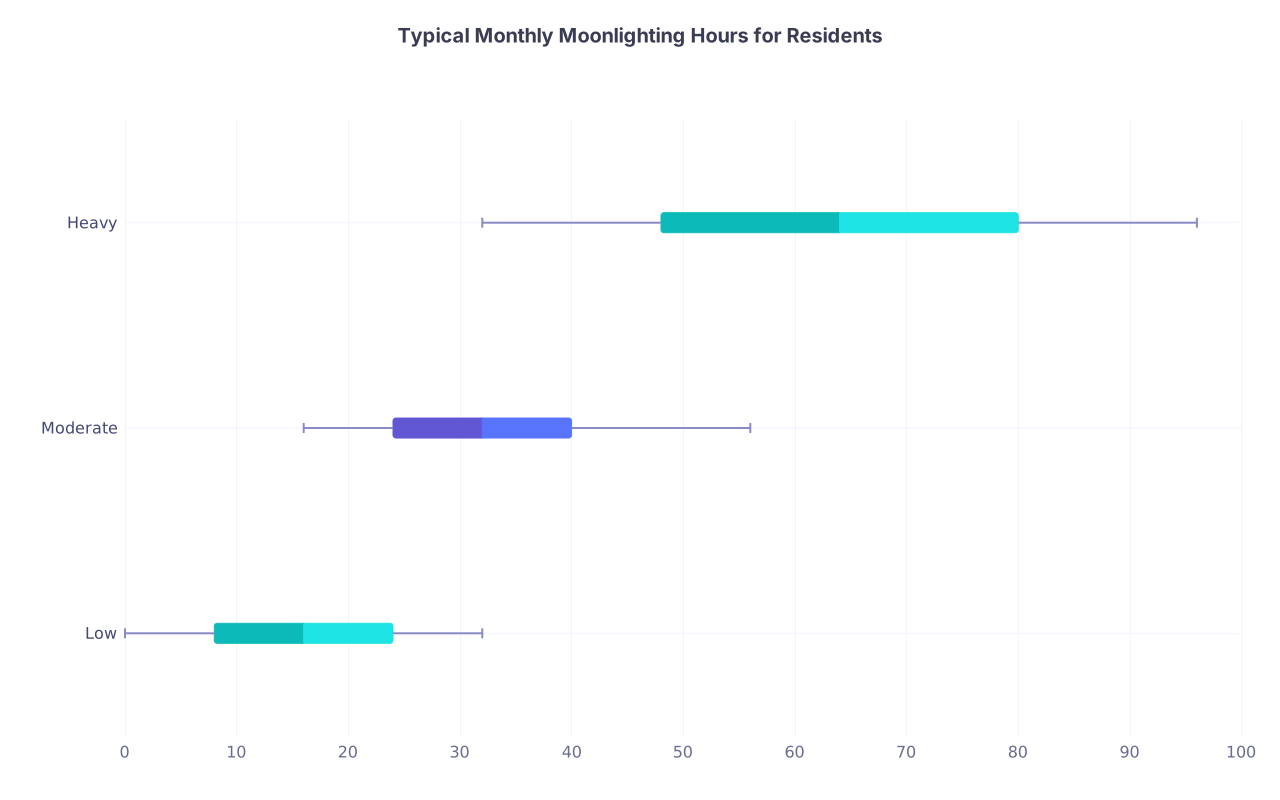
| Category | Min | Q1 | Median | Q3 | Max |
|---|---|---|---|---|---|
| Low | 0 | 8 | 16 | 24 | 32 |
| Moderate | 16 | 24 | 32 | 40 | 56 |
| Heavy | 32 | 48 | 64 | 80 | 96 |
From surveys and informal datasets:
- Low: 1–2 shifts / month (8–24 hours)
- Moderate: 3–4 shifts / month (24–48 hours)
- Heavy: 5–8+ shifts / month (40–96 hours)
Now multiply:
Assume a solid but not extreme job at $150/hour.
- 16 hours / month → $2,400 / month → ~$28,800 / year
- 32 hours / month → $4,800 / month → ~$57,600 / year
- 48 hours / month → $7,200 / month → ~$86,400 / year
That is why moonlighting shapes residents’ financial trajectories. Those are attending-level income deltas added on top of a $65–80k salary.
But if you are taking $100/hour internal gigs instead of $150/hour external ones, and doing 32 hours per month, you are leaving:
($150 − $100) × 32 × 12 = $19,200 per year on the table.
That is after-tax student loan payoff money gone because you did not benchmark your rate.
8. Risks, Restrictions, and the “Future of Medicine” Angle
This is not a pure market. ACGME, hospital policies, and work-hour rules constrain what you can do.

| Step | Description |
|---|---|
| Step 1 | Resident interested in moonlighting |
| Step 2 | Not eligible |
| Step 3 | Stop or change program |
| Step 4 | Risk violation and burnout |
| Step 5 | Evaluate offers by pay and setting |
| Step 6 | Choose internal |
| Step 7 | Choose external |
| Step 8 | Independent license? |
| Step 9 | Program permits moonlighting? |
| Step 10 | Hours stay under 80 per week? |
Several macro trends matter:
Work-hour enforcement is tightening in some programs.
- Some PDs have started capping moonlighting even more strictly than ACGME demands.
- Others quietly ignore it as long as results and duty-hour logs look acceptable.
Telehealth is expanding.
- Easier for residents with independent licenses to pick up remote shifts.
- This is likely to moderate rate inflation for low-acuity work but expand access.
AI / decision-support tools will likely impact documentation and throughput.
- If documentation time drops, high-RVU moonlighting may become more attractive (or employers drop per-RVU rates, which is also possible).
Rural EDs and underserved areas will continue to overpay.
- Staffing shortages do not resolve quickly.
- Locums-style arrangements for residents may remain lucrative, with pay tied directly to “butts in chairs” needs.
From a “future of medicine” perspective, resident moonlighting is a canary in the coal mine for physician labor markets:
- Where residents are being paid like low-end attendings, the system is clearly short-staffed.
- Where residents are underpaid relative to local cost of living, the hospital is exploiting oversupply and prestige.
Both patterns will continue to widen unless graduate medical education slots and geographic distribution are rebalanced—which is not happening quickly.
9. Practical Takeaways: How to Use This Data
You cannot control the macroeconomy, but you can avoid being the resident who accepts the worst offer in the market.
Three concrete actions:
Benchmark against the numbers above for your region and setting.
- If your in-house offer is $90/hour in a West Coast city while external ED gigs are $170/hour, you know exactly how bad that is.
- Use real ranges when you quietly ask senior residents what they are getting.
Normalize every offer to effective hourly rate.
- Per-shift? Divide by realistic on-the-ground hours, not advertised.
- RVU-based? Get average RVUs/hour from someone actually working there.
Decide your target: maximize hourly rate, or stable, low-stress volume.
- A $140/hour telehealth job with low stress can beat a chaotic $200/hour rural ED job in real-life “cost per unit of sanity.”
The underlying point: resident moonlighting pay is not one number. It is an entire distribution, heavily skewed by region and setting. If you act like it is a flat $120/hour commodity, you will consistently lose money.