
Most new attendings are signing RVU contracts they do not actually understand. And the data shows that misunderstanding costs six figures over a few years.
Let me be blunt: RVUs are not “just an admin thing.” They are the currency of your career. If you are a new attending and you do not know what a realistic RVU target looks like for your specialty, you are walking into a negotiation blind while the other side has a decade of benchmark data open on their screen.
This piece is about correcting that information asymmetry.
I will walk through what national benchmarks actually show for RVU targets, how those targets translate into time, visits, and income, and how moonlighting and “extra shifts” really look once you run the numbers. I am going to reference MGMA, AAMC, and other large data sets conceptually—not to bore you with citations, but to anchor this in the ranges that hospital systems actually use.
1. RVU 101 For New Attendings (The Fast, Honest Version)
You already know the formal definition. You probably do not know how aggressively systems game it.
RVUs (technically wRVUs when we talk about personal productivity) do three things for you as a new attending:
- Set the bar for your “expected” work (annual RVU target).
- Define when you start earning a true productivity bonus (threshold).
- Determine how underpaid you are if the conversion factor is low.
Most contracts bundle these into some Frankenstein hybrid:
- Base salary guaranteed for 1–3 years.
- “Productivity target” in wRVUs tied to that base.
- A stated conversion factor for wRVUs above the target, often $40–$80 per wRVU depending on specialty and market.
The trap: the target is often set around the 60th–75th percentile of national benchmarks, while the base salary is pegged lower (around 40th–50th percentile). That forces you to overperform just to make “market” money.
Let us ground this with ranges.
| Specialty Group | Conservative Target (P40–P50-ish) | Aggressive Target (P70–P75+) |
|---|---|---|
| Primary Care (IM/FM) | 4,500–5,500 | 6,000–7,000+ |
| Hospitalist | 4,000–4,800 | 5,200–6,000+ |
| Outpatient Neurology | 4,000–5,000 | 5,500–6,500+ |
| Outpatient Cardiology | 6,000–7,500 | 8,000–9,500+ |
| General Surgery | 7,000–8,500 | 9,000–11,000+ |
| Orthopedics | 9,000–11,000 | 12,000–15,000+ |
If your first contract is setting you above the aggressive column as a brand-new attending, you are not being “incentivized.” You are being set up to float the department.
2. What National Benchmarks Actually Show (And How Systems Use Them)
Most large employers lean on:
- MGMA (Medical Group Management Association) productivity data.
- AAMC (for academic salaries more than RVUs, but RVUs show up there too).
- Sometimes Vizient, AMGA, or internal multi-year system data.
You rarely see the raw reports. They do.
The typical pattern in the data
The distributions are not symmetric. A few very high producers drag the averages up, while the median sits lower. When a recruiter quotes “average” RVUs or income they are usually anchoring to the mean, not the median.
Take primary care as a simple example. Ballpark MGMA-type numbers:
- 25th percentile: ~4,000 wRVUs
- 50th percentile: ~5,000 wRVUs
- 75th percentile: ~6,500 wRVUs
Most systems do this:
- Guaranteed base at ~50th percentile salary.
- Productivity targets around 60th–70th percentile RVUs.
- Conversion factor set at a level that looks generous but often just brings your pay to 60th–70th percentile total compensation when you hit that 70th percentile RVU volume.
In other words, you are required to produce like a high-performer to be paid like a slightly-above-average physician.
Here is a simplified comparison to visualize misalignment.
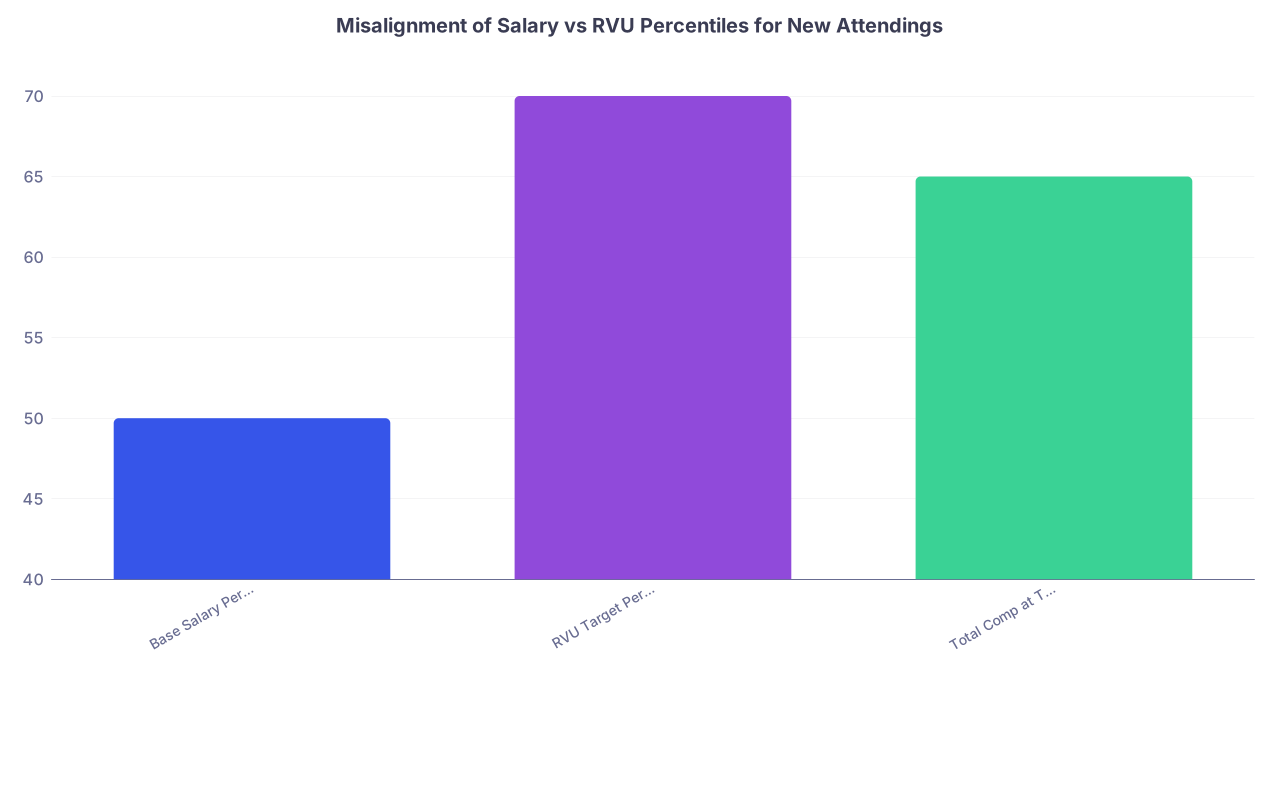
| Category | Value |
|---|---|
| Base Salary Percentile | 50 |
| RVU Target Percentile | 70 |
| Total Comp at Target | 65 |
This is the core structural disadvantage new attendings face: targets are often set higher than the percentile that your base salary reflects.
3. RVU Targets By Specialty: What Is Realistic?
Now the real question: what is a realistic RVU target for a new attending in year 1–3, using national benchmarks as the reference?
I will group specialties and translate RVUs into an approximate daily workload, because that is what you feel.
3.1 Primary Care (Internal Medicine / Family Medicine)
Reasonable first-year target: 4,500–5,500 wRVUs
Aggressive 1–3 year target: 6,000–7,000 wRVUs
Assume:
- 1.5–2.0 wRVUs per established visit.
- 2.0–3.0 wRVUs per new patient or Medicare wellness.
- 44 working weeks per year after vacation/CME/holidays.
Let us take 5,500 wRVUs:
- 5,500 ÷ 44 weeks ≈ 125 wRVUs/week.
- At 1.8 wRVUs per visit (mixed new/established):
125 ÷ 1.8 ≈ 69 visits/week.
At 4 clinic days per week, that is ~17–18 patients per day. Manageable.
But push that to 7,000 wRVUs:
- 7,000 ÷ 44 ≈ 159 wRVUs/week.
- 159 ÷ 1.8 ≈ 88 visits/week → 22 patients/day (4-day clinic).
Twenty-two is doable on paper. In reality, with inbox load and complexity? That is where burnout usually begins.
3.2 Hospitalists
Reasonable target for 7-on/7-off model: 4,000–4,800 wRVUs
Aggressive: 5,200–6,000+ wRVUs
Assume:
- 1.0–1.2 wRVUs per subsequent day.
- 2.0–2.5 wRVUs per admission.
- 182 shifts/year in 7-on/7-off.
For a 4,800 wRVU target:
- 4,800 ÷ 182 ≈ 26.4 wRVUs/shift.
- Assume mix: 8 admits (2.3 RVU each) + 10 follow-ups (1.1 RVU each)
8×2.3 + 10×1.1 = 18.4 + 11 = 29.4 wRVUs → slightly above target.
So 4,800 wRVUs is aligned with a solid but not insane shift.
At 6,000 wRVUs:
- 6,000 ÷ 182 ≈ 33 wRVUs/shift.
You are looking at shifts with 10+ admits or a heavy census, consistently, not occasionally.
3.3 Outpatient Medical Subspecialties (Cards, GI, Neuro, Endo)
Reasonable new attending targets (solo clinic-heavy roles):
- Neurology, Endocrinology: 4,000–5,000 wRVUs
- Cardiology, GI, Pulm: 6,000–8,000 wRVUs (more procedures, higher RVUs)
For a cardiologist at 7,500 wRVUs:
- 7,500 ÷ 44 weeks ≈ 170 wRVUs/week.
- Mix: clinic visits (~2 wRVU) plus stress tests, echos, caths (3–15 wRVUs each).
You can easily overshoot clinic-only equivalents if you have procedures. That is why using raw wRVU benchmarks without understanding procedure mix is sloppy. Systems know their mix; you often do not see it.
3.4 Surgical Specialties
Reasonable early-career target: 7,000–9,000 wRVUs
Aggressive: 10,000–12,000+ wRVUs
Here it is mostly about block time and case mix.
A general surgeon doing:
- 2 mid-sized elective cases per day at 20 wRVUs each → 40 wRVUs/day.
- 3 days in OR/week → 120 wRVUs/week.
- 44 weeks → 5,280 wRVUs from elective cases alone. Add call/EM cases and clinic, you are quickly 7,000+.
In many systems, the surgeon hitting 10,000–12,000 wRVUs is not working “a little harder.” They have optimized block, a high-RVU case mix, and often minimal academic/admin burden. New attendings with teaching and QI obligations should not be benchmarked to them in year 1–2.
3.5 Orthopedics and Procedural Outliers
Ortho, neurosurgery, interventional fields can hit absurdly high numbers.
Non-academic ortho benchmarks:
- Median: ~10,000–11,000 wRVUs
- 75th+: 14,000–16,000+ wRVUs
This is usually driven by a few high-RVU procedure types stacked efficiently. If your contract references “expected” 12,000+ wRVUs as a new ortho attending without defining block time and case mix, that is not a benchmark; that is wishful thinking on their side.
4. RVU Conversion Factors: Where The Money Really Moves
RVU targets do not live in a vacuum. You have to pair:
- Target (annual wRVUs you “owe”).
- Conversion factor (dollars per wRVU above the target).
- Base salary.
Let’s use real arithmetic.
Assume:
- Specialty: Outpatient Internal Medicine.
- Base: $240,000.
- RVU target: 5,500.
- Conversion factor: $50 per wRVU above target.
Scenario A: You produce 6,500 wRVUs (1,000 above target)
- Bonus: 1,000 × $50 = $50,000.
- Total = $290,000.
Scenario B: Same production, but contract set at $40 per wRVU
- Bonus: 1,000 × $40 = $40,000.
- Total = $280,000.
That $10,000 difference repeats every year. Over a 3-year contract: $30,000.
Now compare that to a more aggressive structure:
- Base: $220,000.
- RVU target: 5,000.
- Conversion factor: $60.
You produce 6,500 wRVUs again (1,500 above target):
- Bonus: 1,500 × $60 = $90,000.
- Total = $310,000.
Same workload. Three very different incomes. The data shows that many new attendings fixate on base salary and ignore conversion factor and target pairing, which is where systems quietly extract a lot of value.
5. Moonlighting And RVUs: The Hidden Effective Rate
This is the “Moonlighting and Benefits” category, so let us talk numbers, not vibes.
Moonlighting is usually sold as “extra money for extra work.” That is only true if the effective per-hour pay is attractive after RVU expectations and uncompensated tasks.
You can treat moonlighting in two main structures:
- Pure hourly rate (no RVU tracking, just shifts).
- RVU-based or hybrid (lower hourly + RVU bonus, or RVU-only).
5.1 Pure hourly moonlighting
Example:
- ED moonlighting rate: $170/hour.
- 12-hour shift → $2,040.
- Six shifts per month → ~$12,240 extra/month before tax.
Clean and easy. Now compare that to what your main job is paying you per hour of true work.
If your attending job is functionally 55–60 hours/week including admin and call, and you clear $280,000:
- 60 hours/week × 48 weeks ≈ 2,880 hours/year.
- $280,000 ÷ 2,880 ≈ $97/hour.
Suddenly that $170/hour moonlighting looks very good. Unless the “12-hour shift” is functionally 14 hours.
5.2 RVU-based moonlighting
Example: Hospitalist moonlighting
- Rate: $12 per wRVU.
- Typical shift: 20–25 wRVUs.
- Effective pay: 20 × $12 = $240 to 25 × $12 = $300 per shift.
If that shift is 10–12 hours, you just worked for $20–$30/hour. That is resident pay. You would be financially better off increasing your RVU production at your main job, assuming a normal attending conversion factor.
The math is not subtle:
- If your main contract pays $45–$70 per wRVU for overage.
- And your moonlighting pays $10–$20 per wRVU.
- You are trading down massively unless your moonlighting does not count against your primary RVU target or offers better conditions (low acuity, easy documentation).
The data pattern I see repeatedly: PGY-3s are thrilled at $90–$110/hour. New attendings should be insulted by anything that nets under $150–$175/hour except in very specific circumstances (e.g., protected learning, super low stress).
6. Using Benchmarks To Negotiate: A Data-Driven Playbook
You will not win this game by complaining that something “feels high.” You win it by turning the same numbers they use back on them.
Step 1: Get your hands on benchmark ranges
You want at least:
- 25th, 50th, 75th percentile wRVUs for your specialty.
- Matching total compensation percentiles.
If you cannot access MGMA directly, talk to:
- Your program director.
- Graduated co-residents already in practice.
- Specialty societies (many publish summary ranges).
Step 2: Align your target to your career phase
For a new attending (first 2–3 years), a defensible ask is:
- RVU target between 40th–55th percentile, unless you have protected admin/academic time built into FTE.
- If they insist on 65th–75th percentile productivity targets, compensation should be anchored at or above that percentile as well.
Step 3: Translate RVUs into daily work
Do the math in front of them.
Example, primary care offer:
- Target: 7,000 wRVUs.
- 44 weeks clinic → 159 wRVUs/week.
- Assume 1.8 RVUs/visit → 88 patients/week.
- Over 4 clinic days → 22 patients/day.
State it plainly: “You are asking for 22 patients per day at full panel plus inbox and call. That aligns more with 75th+ percentile productivity. I am new faculty; I am asking to align year-1 target closer to the 50th percentile, around 5,000–5,500 wRVUs.”
Step 4: Evaluate conversion factor and moonlighting together
Look at your options side by side. Here is a simple comparison of effective pay at different conversion factors.
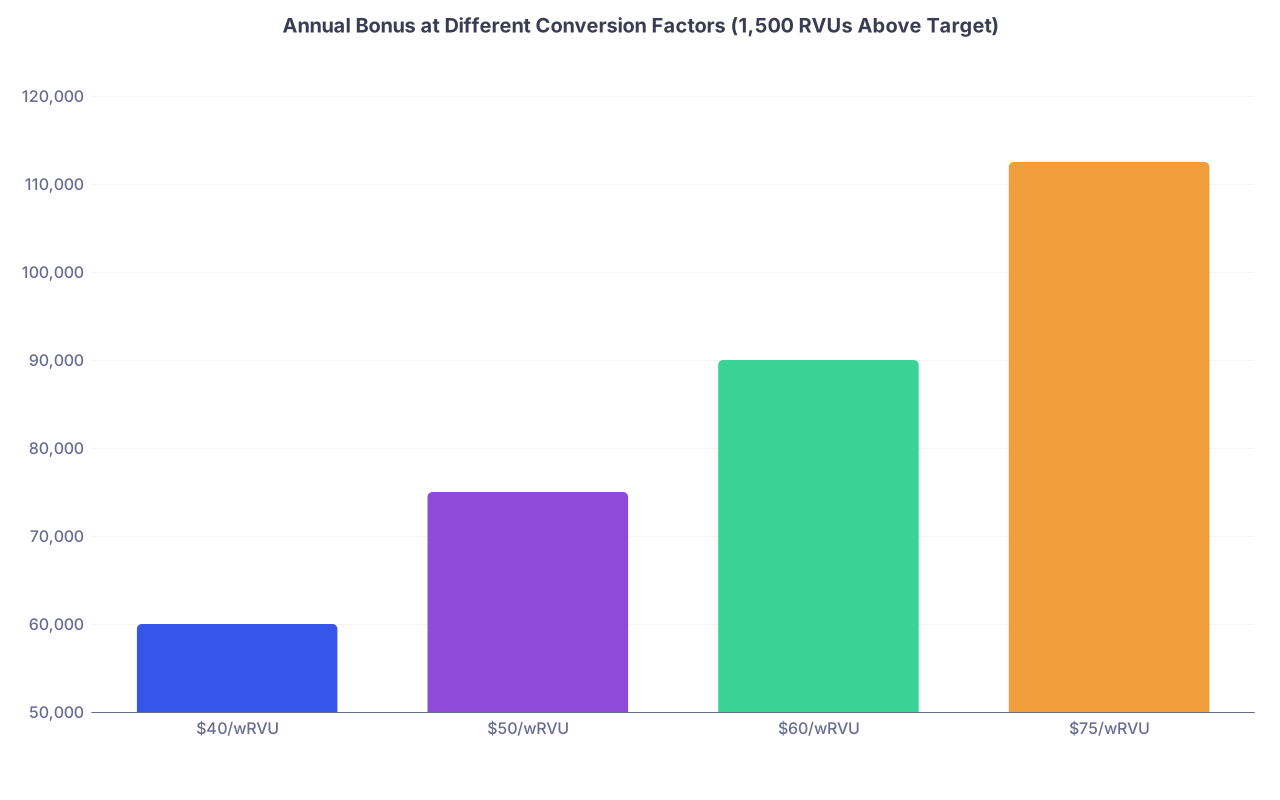
| Category | Value |
|---|---|
| $40/wRVU | 60000 |
| $50/wRVU | 75000 |
| $60/wRVU | 90000 |
| $75/wRVU | 112500 |
If the employer will not move on target, press on conversion factor. If they will not move on conversion factor, push for a more realistic target for the first 1–2 years and a taper up.
7. The Future: RVUs, APPs, and Value-Based Metrics
You cannot talk “future of medicine” and RVUs without acknowledging where the trend line is going.
Two clear data trends are emerging:
APP integration is diluting per-physician RVUs
As nurse practitioners and PAs take on more independent or incident-to billing, physicians may see fewer direct wRVUs but are still judged on team-level productivity. Systems are already experimenting with panel-based or team-based metrics layered on top of RVUs.Value-based care is creeping into bonus structures
Payers and health systems are shifting portions of compensation to quality, patient satisfaction, and cost metrics. The pure “more RVUs = more money” model is slowly eroding, especially in primary care and hospital medicine.
The data right now:
- Many contracts still have 80–90% of variable pay tied to RVUs.
- 10–20% tied to quality, readmissions, patient experience, etc.
- Over the next decade, that may invert in some environments.
That does not mean RVUs will disappear. They are too deeply embedded. But the smartest new attendings I know are tracking two dashboards:
- RVU productivity (short-term leverage).
- Quality and outcome metrics (long-term leverage as the system shifts).
If you can demonstrate that you are above median on both, you have bargaining power in any model they pivot to next.
8. Practical Benchmarks To Anchor Your Own Targets
Let me condense this to something you can sanity check quickly against your offer.
Use this as a rough rule-of-thumb grid for year 1–3 new attendings in full-time clinical roles (0.9–1.0 FTE, minimal admin time):
| Specialty Group | Reasonable Target Range | Red Flag Range for New Attendings |
|---|---|---|
| Primary Care (IM/FM) | 4,500–5,500 | >6,500 |
| Hospitalist | 4,000–4,800 | >5,500 |
| Outpt Neuro/Endo | 4,000–5,000 | >6,000 |
| Outpt Cards/Pulm/GI | 6,000–8,000 | >9,000 |
| General Surgery | 7,000–9,000 | >10,500 |
| Orthopedics | 9,000–11,000 | >13,000 |
If your contract target sits in the red-flag zone and your salary is not clearly at 75th+ percentile total comp, you should be questioning that structure very hard.

| Step | Description |
|---|---|
| Step 1 | Offer Received |
| Step 2 | Identify RVU Target |
| Step 3 | Compare to Benchmarks |
| Step 4 | Review Conversion Factor |
| Step 5 | Check Salary Percentile |
| Step 6 | Negotiate Target or Factor |
| Step 7 | Estimate Daily Workload |
| Step 8 | Consider Accepting |
| Step 9 | Counteroffer or Walk Away |
| Step 10 | Sign with Clear Expectations |
This is the mental flowchart you should run every time.
FAQ (5 Questions)
1. How many wRVUs should a new attending realistically expect to produce in year one?
For most core specialties, a reasonable year-one range is around the 40th–50th percentile of national benchmarks. That typically means:
- Primary care: 4,000–5,000 wRVUs.
- Hospitalist: 3,800–4,500 wRVUs.
- Outpatient subspecialties (neuro/endo): 3,500–4,500 wRVUs.
- Procedural/surgical: 6,000–8,000 wRVUs, depending on block time and case mix.
You can ramp up in year two and three. Contracts that expect 70th+ percentile productivity from day one are using you to plug a preexisting volume hole.
2. Is a high wRVU target always bad if the pay looks good?
No. A high target can be perfectly acceptable if:
- The base salary and realistic bonus bring you to 70th+ percentile total compensation.
- The daily schedule and support (APPs, scribes, nursing) actually allow you to hit those numbers without chronic overwork.
- You have control over key drivers like schedule density and block time.
The red flag is a high target tied to only median-ish pay and limited operational support. High targets must come with either high pay or unusually favorable working conditions—or both.
3. What is a good wRVU conversion factor for a new attending?
For most non-surgical specialties:
- Sub-$40 per wRVU is low.
- $45–$55 per wRVU is common and generally fair.
- $60–$75 per wRVU is strong, especially if the base is not heavily discounted.
Surgical and high-RVU procedural specialties can see higher nominal conversion factors, but context matters because case mix already inflates raw RVUs. Always pair factor with target and base salary when judging the offer.
4. How should I compare moonlighting pay to my main RVU contract?
Convert both to an effective hourly rate:
- For your main job, estimate true hours/week (including charting and call) and divide your expected total comp by annual hours.
- For moonlighting, include real shift length and any unpaid pre/post work.
Then check if the moonlighting rate compensates you meaningfully above your “day job” rate. For a fully trained attending, anything under ~$150/hour for additional night/weekend work is usually a poor trade unless the work is unusually easy or builds strategic skills.
5. What if my contract does not list an RVU target but says “productivity expectations per department norms”?
That is a data-free trap. Ask, in writing:
- What was the median wRVU production for physicians in this role last year?
- What percentile of MGMA (or similar) does that correspond to?
- At what wRVU level does productivity compensation begin, and what is the rate?
If they cannot or will not give concrete numbers, assume you are being hired into a moving target environment. At that point, either secure clear written ranges or treat the offer as significantly higher risk when you compare it to others.
Key points, stripped down:
- RVU targets for new attendings should sit near midline benchmarks, not at the 70th+ percentile, unless pay and support are exceptional.
- The combination of target, conversion factor, and real workload determines your actual income—do the math before you sign.
- Moonlighting only makes sense when the effective hourly rate beats your main job and does not quietly subsidize a bad RVU contract.