
The mythology around call pay and weekend differentials is wildly disconnected from the data.
Most residents and young attendings quote numbers they heard from “a friend of a friend” or a random Reddit thread. Meanwhile, hospital finance teams are running precise spreadsheets on call costs per RVU, coverage gaps, and market benchmarks. You are negotiating off vibes. They are negotiating off pivot tables.
Let us fix that.
This is a data-heavy look at what is actually typical for call pay and weekend differentials in U.S. practice, based on survey data, compensation reports, and patterns I see repeatedly in contracts.
1. The Core Reality: Base Salary ≠ Total Compensation
The first mistake I see: physicians obsess over base salary and underweight call structure and differentials. The data shows why that is a bad idea.
Across multiple national surveys (MGMA, SullivanCotter, AMGA), call pay and differentials can represent:
- 5–15% of total compensation for many hospital-employed physicians
- 20–30%+ for certain procedural or small-hospital roles
- Near 0% for some outpatient-heavy or lifestyle specialties
If you ignore call and weekend structure, you can easily leave $40k–$100k+ on the table each year, or worse, accept a “high salary” job that functionally underpays you relative to work intensity.
The structure matters more than the sticker.
2. How Call Pay Is Actually Structured
Call pay has three dominant models in real contracts. Everything else is a variation.

Model 1: Stipend-Only Call
Flat fee for being on call, no matter what happens.
Example patterns I keep seeing:
- Weeknight call: $150–$400 per night
- Weekend 24-hr call: $400–$1,200 per day
- Holiday 24-hr call: 1.5x–2x the standard weekend rate
Who uses this:
- Many hospital-employed IM, FM, neurology, OB/GYN, general surgery, anesthesia in community settings
- Subspecialists covering specific service lines (e.g., GI, cardiology) where call is “light but mandatory”
Pros: Predictable income. No arguing over RVUs or cases.
Cons: You are punished for busy nights and rewarded for quiet ones. High-burden services lose.
Model 2: Stipend + Production
This is where things start to align closer to work performed.
Common structure:
- Stipend for being on call (say $250/night)
- Plus:
- Professional fees for all work you do while on call, OR
- RVUs at standard or premium rate for call-based encounters, OR
- A higher after-hours rate (e.g., 125–150% of usual wRVU value)
This hybrid model is increasingly common in specialty groups and higher-volume procedural services where call is not just “phone coverage” but actual work.
Model 3: No Stipend, Production Only
This is more brutal than it sounds and surprisingly common in private groups and some academic centers:
- No separate call stipend
- You bill and collect (or earn RVUs) for all work you do while on call
- “Call” is treated as just the mechanism by which you gain access to emergent work
This can be acceptable in genuinely high-acuity, high-paying specialties with strong collections (e.g., ortho trauma, certain cardiology or GI groups). It is borderline exploitative when applied to lower-paying or cognitive specialties.
The critical question here is not the label, but the effective hourly rate.
3. What’s “Typical” by Specialty? Actual Ranges
You want numbers. Here are the patterns that keep repeating across compensation datasets and contracts I have seen. These are on-call stipends, not total pay.
| Specialty | Typical Weekday 24-hr Call | Typical Weekend 24-hr Call |
|---|---|---|
| Hospitalist (in-house) | $0–$400 (often rolled into base) | $300–$800 |
| General Surgery | $500–$1,200 | $800–$1,800 |
| OB/GYN | $400–$1,000 | $700–$1,500 |
| Cardiology (non-interv) | $300–$900 | $600–$1,500 |
| Orthopedics | $500–$1,500 | $900–$2,500 |
Yes, you will see outliers—$3,000+ per 24 hours in rural locums gigs or for very scarce subspecialty coverage. But the table above is where the median lives.
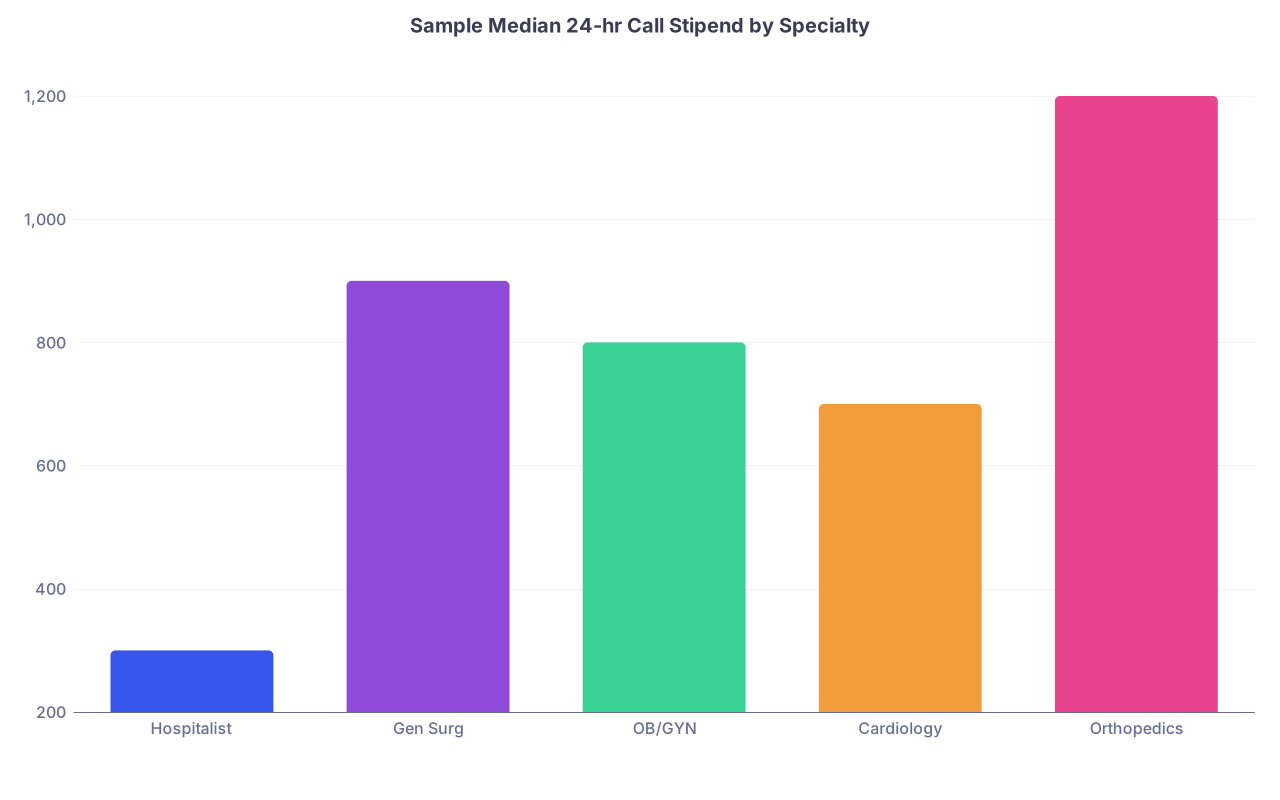
To visualize typical call pay differences between weekday and weekend:
| Category | Value |
|---|---|
| Hospitalist | 300 |
| Gen Surg | 900 |
| OB/GYN | 800 |
| Cardiology | 700 |
| Orthopedics | 1200 |
These values approximate weekend 24-hr call medians in many community settings.
Notice something:
- Orthopedics and general surgery consistently land toward the higher end
- Hospitalists are frequently undercompensated on a pure call-stipend basis because “nights” are bundled into a 7-on/7-off model
- IM subspecialties (e.g., nephrology, ID, rheum) often land below OB/GYN and surgery despite high burnout on call
If you are in a small hospital with limited competition, call rates can swing substantially. I have seen:
- Critical access rural hospital: general surgery weekend call at $2,000–$3,000/24h
- Large metro academic center: $0 stipend, “protected time” and faculty title as the supposed offset
Guess which one feels better at 3:00 a.m. during your third bowel obstruction.
4. Weekend Differentials: How Much More is “Normal”?
Weekend work is not the same as weekday work, and compensation data reflects that pretty consistently.
There are three common ways weekends are priced:
- Higher call stipends for weekend days
- Hourly or shift-based differentials
- RVU or production multipliers for weekend work
4.1. Weekend Call Stipend Multipliers
Most systems I see use a simple multiplier:
- Weekend 24-hr call: 1.25x–1.75x the weekday rate
- Major holidays: 1.5x–2.0x weekend rate
If your contract pays the same flat rate for weekday and weekend 24-hr calls, you are being underpaid relative to market norms in many regions.
4.2. Weekend Shift Differentials (In-House Roles)
This is especially common for:
- Hospitalists
- ED physicians
- Intensivists
- Anesthesia, OB in-house models
Typical weekend differentials:
- +$10–$30/hour on top of base shift rate
- Or +10–25% of base hourly rate
- Or a flat bonus per weekend shift ($150–$400 per 12-hour shift)
Let us take an example.
Baseline hospitalist rate: $130/hour for a 12-hour shift.
Weekend differential: +$20/hour on weekends.
- Weekday 12h shift: 12 × $130 = $1,560
- Weekend 12h shift: 12 × ($130 + $20) = $1,800
That is a 15% increase.
Now imagine 3 weekend shifts per month:
- Extra annual pay: 3 shifts × 12 months × 12 hours × $20 = $8,640
Nothing flashy individually. But real money over a year.
Here is what weekend differentials look like in many actual contracts:
| Role | Common Form | Typical Magnitude |
|---|---|---|
| Hospitalist | Hourly premium | +$10–$25/hr |
| ED Physician | Higher RVU rate or hourly | +10–25% |
| ICU/Intensivist | Shift differential | +$200–$500 per shift |
| Anesthesia | Higher call/day rate | +25–75% vs weekday |
5. In-House vs Home Call: The Real Divide
The single biggest error I see physicians make in evaluating call compensation: treating in-house call and home call as if they should be priced similarly.
They should not.
In-House Call
You are physically in the hospital. You cannot see clinic. You cannot leave. Sleep is questionable. You are effectively working a night shift.
What the data and contracts show:
- In-house call is typically compensated either as:
- Full rate night shift (per hour or per shift), or
- A robust 24-hr call stipend + clear post-call protections
- Many hospitalist and intensivist models do not call this “call” at all. It is just part of the scheduled workweek.
Home Call
You are nominally at home, maybe sleeping. You can be interrupted. You must be able to reach the facility (or telemedicine setup) within a defined timeframe (often 20–30 minutes).
Compensation patterns:
- Lower flat stipends
- Sometimes supplemented by extra pay for coming in (e.g., minimum 2–4 hours at a defined rate per visit)
- Occasionally paid only through professional fees / RVUs
The market logic is simple:
- In-house call ≈ full work shift.
- Home call ≈ constrained freedom with intermittent work.
If your home call involves you being in-house half the night, the data says you should be negotiating from an in-house call reference point, not a token home-call stipend.
6. How Call Burden Actually Adds Up: A Quantitative Example
Let me show you how call and weekend structure translate into annual dollars, using numbers that are realistic.
Imagine an OB/GYN in a community hospital:
- Base salary: $340,000
- Call: 1:4
- Each month:
- 4 weekday 24-hr calls
- 2 weekend 24-hr calls
Case 1: Lowball call pay
- Weekday call: $250/24h
- Weekend call: $400/24h
Monthly call income:
- Weekdays: 4 × $250 = $1,000
- Weekends: 2 × $400 = $800
- Total: $1,800/month = $21,600/year
Case 2: Mid-market call pay
- Weekday call: $500/24h
- Weekend: $900/24h
Monthly:
- Weekdays: 4 × $500 = $2,000
- Weekends: 2 × $900 = $1,800
- Total: $3,800/month = $45,600/year
Difference: ~$24,000/year for the exact same call burden.
Case 3: Aggressive but realistic in some regions
- Weekday: $700
- Weekend: $1,300
Monthly:
- Weekdays: 4 × $700 = $2,800
- Weekends: 2 × $1,300 = $2,600
- Total: $5,400/month = $64,800/year
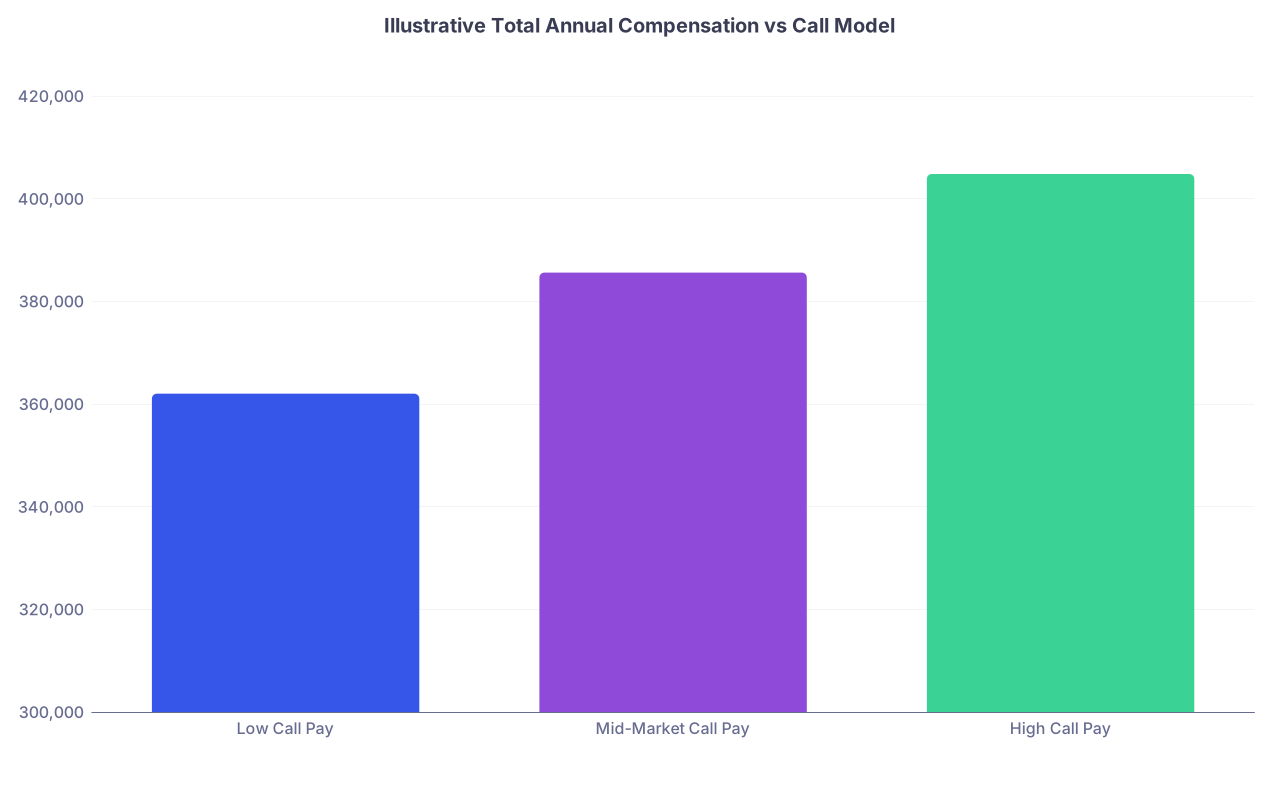
Base salary remained fixed at $340k. But total comp just shifted from ~$362k to ~$405k depending entirely on call pricing.
This is why you cannot just glance at base salary and decide.
To give a sense of how total compensation can be influenced by call and weekend structure, here is a simplified illustrative distribution:
| Category | Value |
|---|---|
| Low Call Pay | 362000 |
| Mid-Market Call Pay | 385600 |
| High Call Pay | 404800 |
Again, these are example numbers, but they match the pattern I see constantly.
7. The Weekend Trade: Money vs Lifestyle
Weekend differentials and call pay are not just about “more money.” They are the price tag on your weekends for the next decade.

Young physicians often underestimate how punishing chronic weekends can be. The data shows:
- Burnout and intent-to-leave are significantly higher in specialties with:
- High overnight call frequency
- Unpredictable weekend work
- Poor recovery time after call
If you accept low weekend differentials and aggressive call expectations early, you set the baseline for your future. Administrators remember “we’ve always paid X for weekends.” You will need leverage to change that later.
From a pure financial optimization standpoint, the equation is:
Effective hourly rate on weekends vs what you would accept to give up those hours in any other context.
Most systems do not want to calculate this explicitly. You should.
8. The Soft Spot: Non-Clinical and “Future of Medicine” Call
The category you flagged—MISCELLANEOUS AND FUTURE OF MEDICINE—is where the compensation models are the most in flux:
- Telemedicine call
- Remote ICU / eICU coverage
- AI-assisted triage and monitoring
- Hybrid clinical–administrative roles
What I am seeing in the data and contracts:
Telemedicine Call
- Often underpriced early on (“you are at home, so…”)
- Frequently structured as:
- Low stipends + per-consult fee
- Or hourly rates substantially below in-person clinical rates
- The real lever: how many patients per hour and how liability is handled
Remote ICU / eICU
- More serious compensation than basic telehealth
- Can approach in-house rates if intensity is high
- Often shift-based with modest night/weekend differentials (10–20%)
Hybrid Clinical–Admin Call
- For roles that blend medical directorship with clinical call
- Admin stipends ($20k–$80k/year) often obscure how much call is actually attached
- You need to unbundle: what is admin vs what is call
Future-facing medicine is not magically immune to old mistakes. In emerging models, the default is: underpay now, “adjust to market” later. If you are early in, you are anchoring the market.
9. How to Benchmark Your Own Offer
Let me make this practical. If you have a contract or are considering a job, here is the minimum dataset you should extract before you judge it.

You want answers to:
Call structure:
- In-house vs home?
- 24-hr periods or nights only?
- Is post-call a scheduled day off?
Frequency:
- Weekday call: how many nights per month?
- Weekend call: how many 24-hr blocks per month?
- Holiday call: how many major holidays expected per year?
Compensation:
- Weekday call stipend (per night or 24 hours)
- Weekend call stipend
- Holiday multiplier
- Additional pay for coming in (minimum hours? defined rate?)
- RVU or collection structure for call work
Weekend differential (if shift-based):
- Base hourly / shift rate
- Weekend hourly / shift rate
- Any extra for nights vs days on weekends
Once you have those, you can compute:
- Monthly call income at expected frequency
- Annual call and weekend income
- Effective hourly compensation on-call (at least approximate)
- Share of total compensation that is “call-dependent”
If your weekend differential is <10% over weekday for similar-intensity work, you are below what I would call “typical” market behavior in many regions.
If your call pay is $0 and you are in a specialty where others are seeing $500–$1,000+ per 24-hr weekend, that is a structural red flag.
10. Where the Data Is Moving
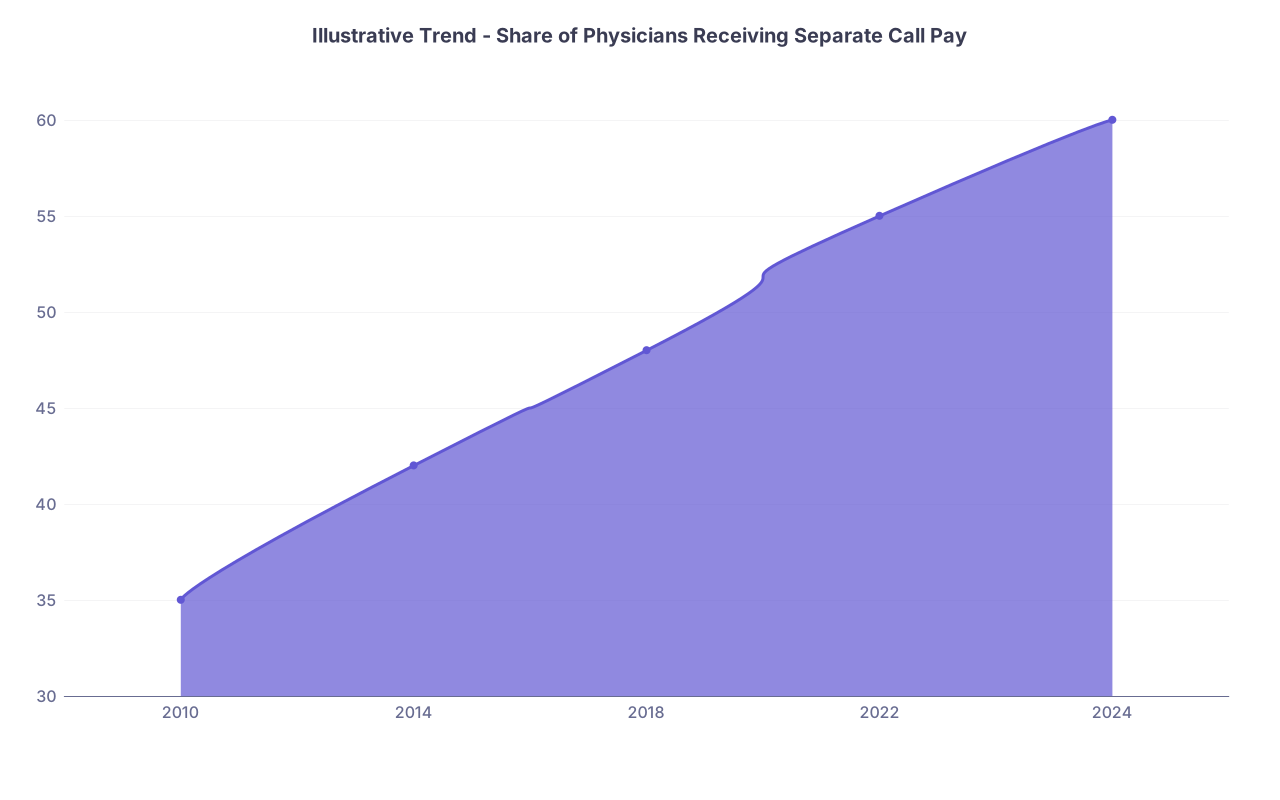
Let me be blunt: long-term, uncompensated heavy call is dying. Slowly. But the trend is clear.
| Category | Value |
|---|---|
| 2010 | 35 |
| 2014 | 42 |
| 2018 | 48 |
| 2022 | 55 |
| 2024 | 60 |
Again, these are illustrative, but they reflect the direction reported by multiple compensation surveys: more physicians receiving explicit, separate call compensation than a decade ago.
Drivers:
- Recruitment pressure in high-demand specialties
- Burnout and retention concerns
- Increased transparency as physicians share more data online
- Hospitals forced to formalize what used to be “expected professional duty”
What will not change quickly:
- Academic centers lagging on call pay, especially for residents and junior faculty
- Primary care and cognitive specialties continuing to fight for fair call valuation
- Uneven rural vs urban pricing based on local supply
If your contract acts like it is 2005, but the market around you is acting like it is 2024, that is leverage.
FAQ (Exactly 4 Questions)
1. Is it normal for new attendings to get lower call pay than senior partners?
Yes, in many private groups. Senior partners sometimes structure deals where new partners or employees receive lower call stipends or more frequent call in exchange for “buying in” over time. The question is whether you can see a clear, time-bound path where your call pay and frequency reach parity. If the answer is vague, assume you are subsidizing them indefinitely.
2. How many weekends per month is “typical” for call?
The most common pattern across many specialties is 1–2 full weekends per month. One in four (1:4) coverage is a typical benchmark. More than 1:3 weekends for high-intensity call, without strong compensation, is not competitive in many markets. If they expect 3 weekends per month with minimal differential, the pay should reflect that aggressively.
3. Should residents and fellows negotiate call pay in moonlighting gigs?
Absolutely. Moonlighting is where you actually have leverage, because you can walk away. For in-house moonlighting, you should compare hourly rates and weekend differentials to standard hospitalist/ED rates in your region. For home-call moonlighting, push for clear minimums per call-back and realistic stipend levels. Do not accept “great experience” as currency.
4. Where can I find hard benchmark numbers for my specialty?
The most reliable data comes from specialty-specific surveys (e.g., ASA for anesthesia, ACR for radiology) and large national reports (MGMA, AMGA, SullivanCotter). Many require institutional access. Short of that, talking with 3–5 physicians in your specialty and region, and asking directly for their call rates and weekend structures, will give you a live benchmark that often beats outdated published numbers.
Three points to walk away with:
- Call pay and weekend differentials routinely swing total compensation by $20k–$60k+ per year. Ignoring them is costly.
- “Typical” patterns: weekend 24-hr call at 1.25–1.75x weekday, and explicit separate call compensation in most high-intensity specialties.
- The trend is toward more formal, better-defined call pay. If your offer looks vague or outdated, the data is on your side when you push back.