
Moonlighting Always Helps Your Career? That’s Often False
Moonlighting is sold like a cheat code: free money, more autonomy, and a gold star on your CV. The reality is harsher. For a lot of residents and young attendings, moonlighting is a career booby trap with a paycheck taped on top.
The myth goes like this: “If you moonlight, you’ll make more money, get more experience, and programs will love you for the hustle.” I hear that in resident lounges every year. And I’ve also watched those same residents drag themselves through morning rounds after a 12‑hour night shift off-site, then get quietly sidelined for fellowships because their evaluations tanked.
Let’s dismantle the fantasy and walk through what the data and real-world outcomes actually show.
The Money Myth: “Extra Cash Is Always Good Career Strategy”
Yes, the paycheck is real. I’m not pretending $120–$200/hr isn’t tempting when you’re sitting on six figures of student loans and making $60k as a PGY‑2.
But framing moonlighting as a “career move” just because it generates cash is sloppy thinking.
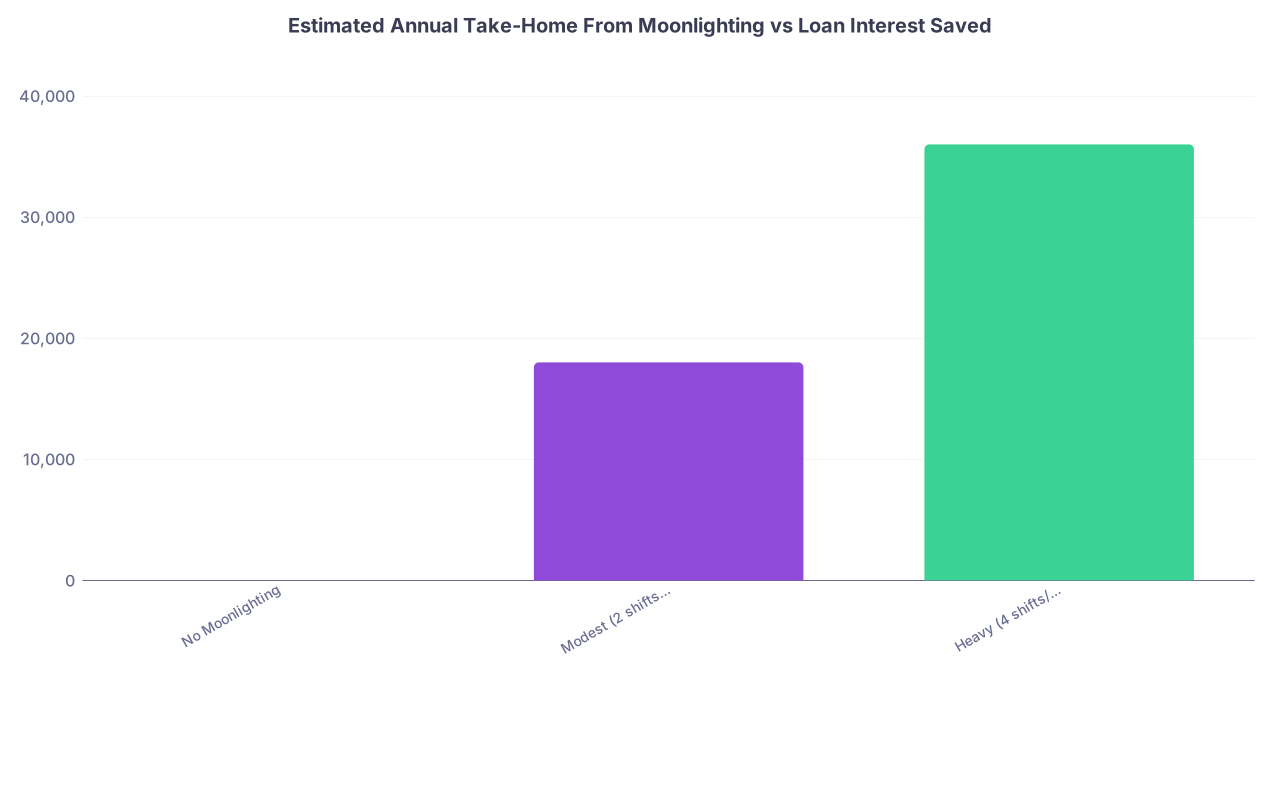
| Category | Value |
|---|---|
| No Moonlighting | 0 |
| Modest (2 shifts/mo) | 18000 |
| Heavy (4 shifts/mo) | 36000 |
Here’s the problem:
You’re trading your scarcest asset—cognitive bandwidth and recovery time—for short-term money. That isn’t always a bad trade, but pretending it’s automatically “good for your career” is wrong.
What actually happens in real programs:
- The resident who moonlights “a little” and still shows up sharp can use the extra cash to blunt financial anxiety. That might indirectly help performance.
- The resident who chases every available shift starts missing conferences, yawning in sign-out, and half-assing notes. Faculty notice. They always notice.
I’ve seen chiefs quietly tell PDs: “She’s great clinically, but honestly, she’s stretched too thin. Always tired. I’d hesitate to put her in a high-intensity fellowship.” That is not a good trade for $25k in extra income.
Also, a lot of people don’t actually use the money strategically. Instead of paying down high-interest loans or building a real emergency fund, it goes to lifestyle creep—upgraded apartments, frequent DoorDash, nicer vacations. That might make you happier in the moment, but it’s not a “career boost.” It’s just more spending.
Financially, moonlighting can make sense. But financially smart is not the same as career smart.
Clinical “Experience” Is Overrated — And Often Misaligned
The other big sales pitch: “You’ll get more reps, more independence, better skills. Future employers will love that.” Sometimes true. Often not.
Here’s where it breaks.
Most moonlighting gigs are not polished teaching environments. They’re coverage gaps. A solo night doc at a community hospital. A low-acuity urgent care. Overburdened psych call. You’re not getting curated learning; you’re getting whatever walks in the door and nobody else wanted to cover.
Ask yourself two questions:
- Does this moonlighting work build the specific skills I need for my intended career?
- Is this experience better, equal, or worse than what I’d get by focusing more fully on my primary training?
For many residents, the answers are uncomfortable.
- Future academic cardiologist moonlighting in a low-acuity rural ED seeing URI after URI? Marginal benefit.
- Future outpatient psychiatrist covering night ED psych consults with minimal supervision and poor documentation systems? Questionable benefit, high risk.
- Future hospitalist doing extra hospitalist shifts at your own institution once you meet supervision requirements? That actually might align well.
What program directors and fellowship directors really care about:
They care far more about how well you mastered your core residency curriculum, the quality of your letters, your reputation as a reliable teammate, your board scores, and any meaningful scholarly work. Moonlighting is a very distant secondary factor, if it matters at all.
I’ve heard fellowship committee meetings where someone says, “He did a lot of moonlighting.” Reactions are mixed:
- One person: “Shows he’s independent.”
- Another: “Yeah, but I wonder if that’s why his in-service exam scores slipped.”
Nobody is saying, “We should bump him to the top of the list because he moonlighted at that community site.”
The Burnout and Performance Problem
This is where the “moonlighting helps your career” story really falls apart.
The literature on resident fatigue, duty hours, and performance is pretty straightforward: more hours, less sleep, worse outcomes. Not complicated.
Residents who moonlight heavily are often doing the following:
- Full residency week (50–80 hrs depending on specialty and rotation)
- Add 1–2 overnight or weekend moonlighting shifts
- Still expected to show up 100% for their home program
There’s good evidence linking sleep deprivation to diagnostic errors, poor procedural performance, and unprofessional behavior. I’ve seen residents on the brink of nodding off in M&M, proudly saying, “I just did three nights of moonlighting in a row,” like it was a flex. It wasn’t. It was a red flag.
Some specific career hits I’ve watched unfold:
- A strong PGY‑3 whose written evaluations turned sharply negative in one block: “appears disengaged,” “less attentive,” “sloppy notes.” Attending quietly: “She’s moonlighting a ton lately.” That block happened to be with a big-name subspecialist. Fellowship chances didn’t recover fully.
- A resident who had a near-miss med error after a string of nights moonlighting. No patient harm, but the chief resident called them in and basically said, “Pick: your training, or the extra income.” That resident dropped half their shifts. Their performance improved.
You know what is career damaging? Mediocre evaluations. A reputation for being always tired. Being the one who forgets to follow up that lab, not because you’re careless, but because your brain is fried.
Your future career depends more on your signal performance in key rotations and relationships than on a line in your CV that says “moonlighted at XYZ hospital.”
Risk, Liability, and the “One Bad Night” Scenario
People hand-wave the medicolegal risk of moonlighting like it’s theoretical. It’s not.
Moonlighting can be one of the riskiest things you do as a trainee:
- You may be functioning with less supervision than in your residency.
- You’re often in unfamiliar systems: different EMR, different protocols, different nursing culture.
- Staffing and backup can be thin, especially nights and weekends.
Now mix that with fatigue, plus the fact that many residents see moonlighting as “easy money” and don’t read all the policies carefully.
The legal risk isn’t just a lawsuit. It’s:
- Getting reported to your program or hospital.
- Having an incident on your record that must be disclosed on credentialing forms for the rest of your career.
- Burning a reference site that might otherwise have hired you later.
I’ve seen a case where a resident, moonlighting as the only overnight provider in a small ED, managed a borderline-unstable patient, delayed transfer, charting was thin, and the case blew up later. No big payout, but there were quality reviews, angry emails, and the resident’s PD got involved. That resident was told explicitly: no more external moonlighting. Ever.
One messy case can erase years of “extra experience” in the eyes of a risk-averse hiring committee.
The CV and Hiring Reality: Who Actually Cares?
Let me be blunt: outside of primary care, hospitalist medicine, and maybe EM, most hiring committees aren’t moved by your moonlighting history.
Here’s how I’ve seen it play out when reviewing candidates:
- Academic fellowships: They care about letters, research, conference presentations, and how faculty talk about you in the hallway. Moonlighting is noise.
- Competitive subspecialty private groups: They care about reputation, training pedigree, references, and whether you’re going to be a reliable partner. Moonlighting might reassure them you’ve seen some real-world volume, but it’s not a primary filter.
- Hospitalist and ED jobs: Here moonlighting can help a bit, because it shows comfort with independent decision-making, billing, and real-world workflows. But again—only if your main training record is strong.
If your in-training exam scores dipped, or your letters sound lukewarm—“hardworking but sometimes scattered,” “occasionally appears fatigued”—moonlighting is not going to rescue that.
And if you’re still in the “I’m not sure what I want to do” phase, leaning hard into moonlighting can steal time from activities that actually drive long-term career options: research, structured mentorship, elective time in subspecialties, board prep.
Future you might be angrier at yourself about the fellowship you did not get than grateful for the $18k you made covering a rural weekend gig.
Where Moonlighting Does Help Your Career
It’s not all downside. There are scenarios where moonlighting absolutely can be a career asset—if it’s deliberate and contained.
Some situations where I’ve seen it work well:
- A PGY‑3 IM resident planning a hospitalist career who moonlights on the same hospitalist service they’ll likely join. They learn the billing, workflows, and team culture. It becomes an extended job interview. That’s smart.
- An EM resident moonlighting in a lower-acuity ED that uses the same EMR and has good backup. They polish efficiency, see volume, and practice bread-and-butter EM. If they stay within safe hours, that can be a net win.
- A psych resident doing structured, well-supervised tele-psych consult shifts with clear protocols and consistent supervision available. Gains comfort with telemedicine, which employers actually care about now.
In these cases, moonlighting is:
- Aligned with career direction
- Structured, not chaotic
- Not so frequent that it sabotages the core residency
But even here, notice the pattern: moonlighting is a tool to accelerate an already-clear path, not a universal booster rocket.
The Hidden Cost: Lost Time for High-Yield Career Work
Every hour you spend moonlighting is an hour you’re not:
- Deepening relationships with mentors who will write meaningful letters
- Working on a project that could turn into a publication or talk
- Actually studying so your board scores are solid
- Resting enough to be excellent during your main job
The residents who win long-term usually aren’t the ones who squeezed the most dollars out of residency. They’re the ones who got the best letters, built solid reputations, matched into strong fellowships or landed good first jobs, and then made real money as attendings with leverage.
I’ve met PGY‑3s who were so booked with moonlighting that when a big-name attending said, “If you’re interested, we could probably get you on this project,” they replied, “I don’t think I’ll have time this year.” That’s tragic. That’s career-costly.
Nobody is offering you that same door later when you finally decide you care about your CV. The window closes.
How to Decide If Moonlighting Is Actually Worth It
If you want a simple rule: moonlighting helps your career only when three things are true at the same time:
- Your evaluations, exam scores, and performance in your main program are already strong and stable.
- The moonlighting work clearly aligns with the skills and environment you plan to practice in.
- The schedule is controlled enough that you’re not regularly fatigued at your primary job.
If any of those three are false, moonlighting is at best neutral for your career, often harmful.
Before you sign up for that extra shift “just because it pays well,” ask yourself:
- Would I trade a slightly worse letter from my PD for $5,000? Because that’s the kind of exchange people accidentally make.
- Would I accept a small but real increase in medicolegal risk for this income?
- If I used this same time for studying, research, mentorship, or rest, would my overall trajectory look better two years from now?
If you’re honest, the answer is often: the shift isn’t worth it.
The Bottom Line
Three things to remember:
- Moonlighting is a financial tool, not an automatic career booster. Sometimes it helps; just as often it quietly undermines your performance where it matters most.
- What determines your future options isn’t how many side shifts you worked—it’s your core training record: evaluations, letters, reputation, and exam performance.
- Use moonlighting surgically, not reflexively: aligned with your field, within sane hours, and only after your main house (residency performance) is firmly in order.
The myth is that “moonlighting always helps your career.” The reality is simpler and harsher: undisciplined moonlighting usually helps your bank account and hurts everything else that actually moves your career forward. Use it wisely—or skip it.