
It’s 11:45 p.m. You just signed out from a brutal night float shift. Your co-resident is pulling up their Lyft app. You’re pulling up something else: the email from a community ER director offering $150/hour for moonlighting, “flexible dates, must be licensed and have privileges.”
You could cover two nights a month and erase your credit card debt in a year. But in the back of your mind: the PD’s vague “we generally discourage moonlighting” speech at orientation. The GME handbook that talks about “80-hour limits” and “duty hour integrity” but never once spells out what really happens when you start chasing extra shifts.
Let me tell you what really happens.
There are written rules. Then there are the rules that decide whether you quietly moonlight for three years and graduate rich… or you get called into the PD’s office, your privilege forms pulled up on a screen, and the vibe goes cold.
This is the second set of rules. The ones nobody will ever email you.
What Programs Say vs What They Actually Care About
Most programs have some version of the same official policy: moonlighting is allowed with written approval, must not interfere with your training, must be logged in duty hours, and must not push you over 80 hours per week averaged over 4 weeks.
On paper, it looks simple. In practice, the real calculus is different.
Here’s what PDs, chiefs, and attendings actually care about but will never codify:
- Are you performing above average in the program?
- Does anyone have to cover for you because you’re exhausted or absent?
- Are you creating liability for the institution?
- Are you making the program look bad to the sponsoring hospital?
Your moonlighting survival rule #1: if you are even slightly in the “problem resident” bucket—borderline exams, professionalism issues, chronic lateness—your PD will treat your moonlighting like contraband. Any slip, and they’ll tie it directly to “outside work.”
If you are solid or stellar? They will look the other way for things they’d crucify a weaker resident for.
I’ve watched the same PD sign off on one PGY-3 doing 6–8 external shifts a month… and then deny another resident a single internal extra call, with the excuse “we’re concerned about burnout.” The difference was not policy. It was trust and reputation.
The Real Gatekeepers: Not Your PD
You think moonlighting is just “get a license, get a shift, get paid.” That’s not how the power structure works.
The unspoken hierarchy is this:
- GME office writes the boilerplate “policy”
- PD controls approval
- Section chiefs control culture and gossip
- Chiefs and senior residents decide whether your name is associated with “reliable” or “walking disaster”
- Risk management and legal freak out quietly in the background
Your PD is not reading every moonlighting contract. Half the time they barely scan them. What they’re doing is this mental math: “If this person screws up at 2 a.m. in that outside ER, will it become my problem?”
The gatekeeper you underestimate most: the chief resident.
They know exactly who is picking up what, where, and how often. They know which anesthesia PGY-4 is doing 24-hour OB calls at a community site every Saturday, and which IM resident is sneaking in urgent care shifts during elective. They’re the ones PDs ask, “How is she doing on service? Is she ever tired? Any complaints?”
If the chiefs like working with you and trust you, your moonlighting gets described upwards as “oh yeah, he does some extra stuff but you’d never know—always solid.” If they don’t? Suddenly it becomes, “I’m worried she’s burning the candle at both ends; she’s been late a few times.”
Same extra shift. Totally different interpretation.
The Silent Line Between “Ambitious” and “Irresponsible”
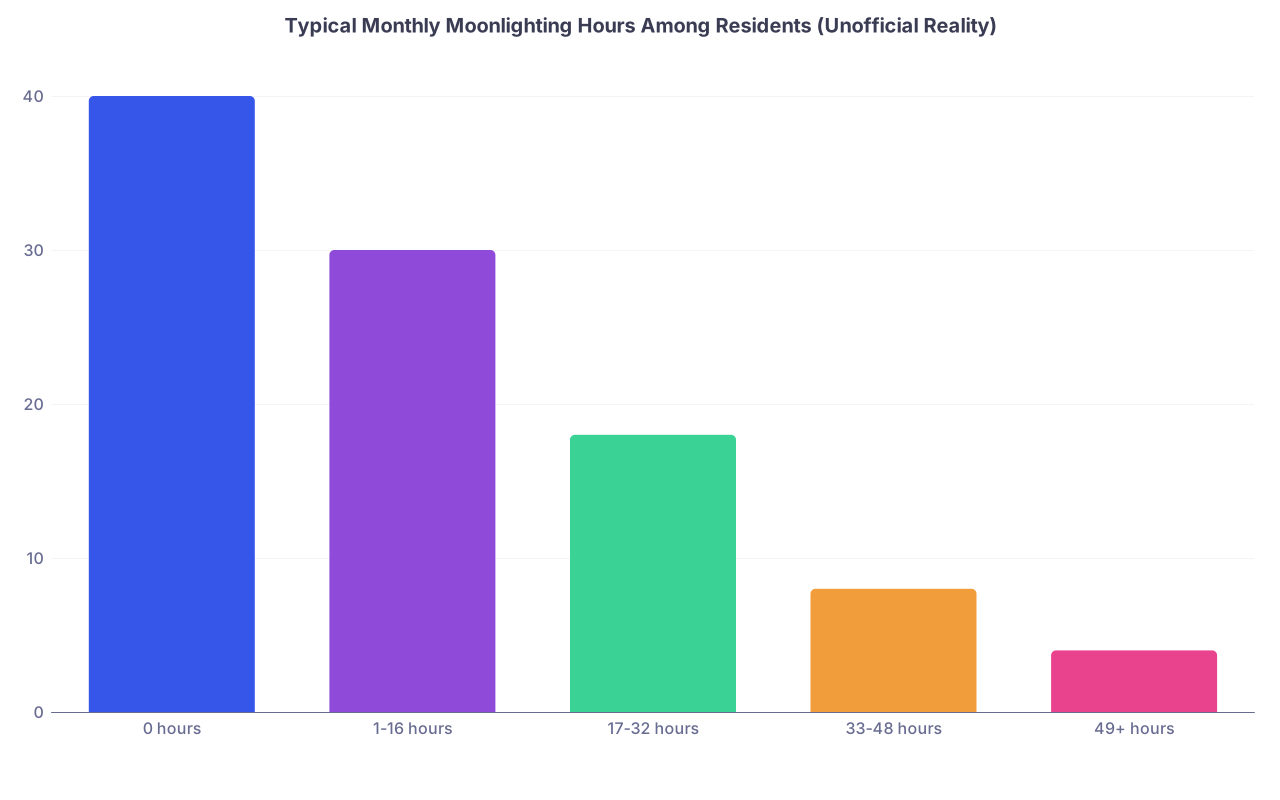
Nobody will give you a number, so here it is: most PDs I’ve talked to or worked with start getting uneasy when a resident regularly clears more than 24–32 moonlighting hours a month. Over 40 and they’ll pretend not to know… until someone complains or something goes wrong. Then it becomes Exhibit A.
They won’t say this out loud because if they pick a number, they own it. So they keep it vague: “Use your judgment.” Which means: “We’ll crucify you after the fact if we decide you used bad judgment.”
To visualize what residents actually do, this is roughly what I’ve seen across programs that allow moonlighting and look the other way as long as you’re performing:
| Category | Value |
|---|---|
| 0 hours | 40 |
| 1-16 hours | 30 |
| 17-32 hours | 18 |
| 33-48 hours | 8 |
| 49+ hours | 4 |
Most live in that 1–32 hour zone and are invisible. The tiny fraction in the 49+ bucket? Everyone knows who they are. Some are legends. Some burn out and become cautionary tales PDs mention, never by name, at orientation.
Your real line is not just hours. It’s pattern.
One 24-hour shift on an elective month? Nobody cares. Three 12-hour ER shifts the same week you’re on wards? Now chiefs start side-eyeing you, even if you swear you “feel fine.”
Duty Hours: The Fiction Everyone Participates In
Let’s be honest. The ACGME duty hour rules were written to protect residents and patients. They also created one of the biggest shared fictions in modern medicine: the duty hour log that nobody believes.
Here’s how it plays out with moonlighting:
Official rule: all moonlighting hours must be reported and count toward your 80-hour limit.
Unspoken reality at many programs: if you report every external hour honestly, you either “magically” never get approved, or your PD “recommends strongly” that you scale back. Meanwhile, attendings who used to moonlight themselves are quietly telling you, “Just be smart about what you log.”
I’ve sat in GME meetings where PDs admit, with a straight face, that they “suspect some under-reporting,” then shrug and move on. Why? Because if they enforce every hour, they lose the political capital they get from saying “we allow moonlighting” to recruit.
Residents respond by doing what everyone knows they’ll do: fudge the numbers so EPIC gets signed and nobody gets audited.
The rule nobody says out loud: if you’re going to play games with duty hours to protect your moonlighting, you’d better be rock solid clinically. If there is ever an adverse event and they pull your hours and see lies, it’s open season on your judgment.
The Politics of “Internal” vs “External” Moonlighting
Another thing nobody prints: programs strongly prefer you do internal moonlighting, even if they “allow” external.
Why? Control and liability.
Internal moonlighting—extra hospitalist shifts at your main hospital, extra call, holding pager for an attending who wants a weekend off—keeps billing, supervision, and risk inside the same system. The hospital gets the RVUs, the department gets cheap coverage, and if anything goes wrong, the lawyers already know which umbrella covers it.
External moonlighting—community ER, SNF rounds, urgent care—lives outside their EMR, their billing system, their policies. If your name shows up on the local news after a bad outcome at that moonlighting site, the first phone call that community hospital makes is to your academic PD. Not to help. To share the liability.
So you’ll see this pattern:
- “Internal” opportunities are magically approved faster, sometimes with a wink.
- “External” places may get stuck in credentialing hell, or your PD “just has concerns about duty hours and supervision.”
I’ve seen PDs drag their feet for months on signing off one resident’s outside ER privileges, while another resident starts internal telemedicine moonlighting in two weeks. The difference isn’t their love of telemedicine. It’s control.
The Quiet Expectations Around Performance
Every PD has a mental list. The “they can do whatever they want and I’ll sign it” list, and the “I’m just waiting for them to screw up” list.
You want to be on the first one before you even whisper “moonlighting.”
Here’s the stuff they won’t tell you they’re watching, but absolutely are:
- Do nurses complain about you?
- Do attendings phrase feedback as “strong but occasionally disorganized” or “concerning pattern of missed details”?
- Are your notes done? Not perfect, just done.
- Do you show up to mandatory didactics? Or are you mysteriously “post-call” every other week?
You can be average and still moonlight. But if you’re borderline and asking for extra shifts on top? They see that as poor judgment. And judgment is the lever they’ll pull when they want to say no without sounding arbitrary.
One PD I know actually kept a running spreadsheet of which residents had late evals, late notes, and professionalism flags. He wouldn’t show it to anyone. But if your name was yellow or red on that sheet and you dropped a moonlighting form on his desk, it sat there. For weeks. And if you pressed? Suddenly he’d “remember” to look into your past issues.
The Three Red Lines You Don’t Cross
Programs will tolerate a lot. They will not tolerate certain things, even if they’ve looked the other way until now.
These are the unspoken red lines around moonlighting:
Anything that looks like abandonment of your core duties.
Leaving early from your residency shift to make it to a moonlighting shift. Calling out “sick” suspiciously often on golden weekends when you also have outside work. If a co-resident says, “He left sign-out a little early; he said he had to ‘get somewhere’,” you’re on thin ice.Anything that generates complaints connected to fatigue.
If a nurse complains, “She seemed exhausted and short with families,” and the attending knows you just did a 12-hour shift at County General last night? That’s all they need to tie your behavior to moonlighting and clamp down.Anything that smells like dishonesty.
Falsified duty hours. Lying when directly asked, “Are you working anywhere else?” Hiding an unapproved external gig. Once they tag you as dishonest, the moonlighting discussion is over. And sometimes so is your career at that institution.
Cross one of these lines and all the “we support resident financial wellness” language vanishes. You become The Example in whispered conversations with interns for years.
What Attendings Really Think (Not What They Say in Meetings)
This part you won’t hear in any town hall.
Older attendings, especially in EM, IM, anesthesia, and hospitalist medicine, almost all moonlighted as residents. Many of them did it harder and dirtier than you will. They remember driving between hospitals on no sleep, stacking call and outside shifts, charting on paper at 3 a.m. while a beeper screamed.
So privately? They get it. They’re not scandalized by the idea you want to take home $3–4k extra a month.
But they’re divided:
Some see it as a rite of passage and a financial lifeline. They’ll help you find the good gigs, tell you which community site is staffed by tired locums versus supportive docs, and how to avoid getting stuck in 18-hour “12-hour” shifts.
Others, especially those beaten up by QI and malpractice meetings, see it as pure risk. They remember the morbidity and mortality where everyone stared at the sleep-deprived resident who’d just done 3 nights in a row plus outside work. That sticks.
What almost none of them will do is go publicly on record saying, “You should moonlight as much as you can.” So you get this weird dynamic where the same attending will:
Morning: in conference, nod along to “limit moonlighting, protect your wellness” slides.
Afternoon: tell you in the workroom, “If you’re going to moonlight, at least choose a place where they don’t dump all the train wrecks on you. And always have malpractice in writing.”
The Future: Telemedicine, Nocturnist Tracks, and the Next Set of Unwritten Rules
Moonlighting’s changing fast. The stuff that was rare five years ago is becoming common, and programs are scrambling to react in real time, usually without updating the formal policy.
Three big shifts I’m seeing:
Telemedicine moonlighting.
Residents doing video visits from home for urgent care chains, prescription refills, or “virtual primary care.” Low acuity on paper. Huge gray zone in practice.“Internalized” moonlighting disguised as new roles.
Hospitalist “moonlighting pools,” resident-run obs units at night, “resident nocturnist” tracks for PGY-3s/4s. It’s moonlighting, just with HR-friendly names.Post-residency style employment while still in training.
Senior residents getting near-attending level shifts at community hospitals that are desperate for coverage and see them as cheap labor.
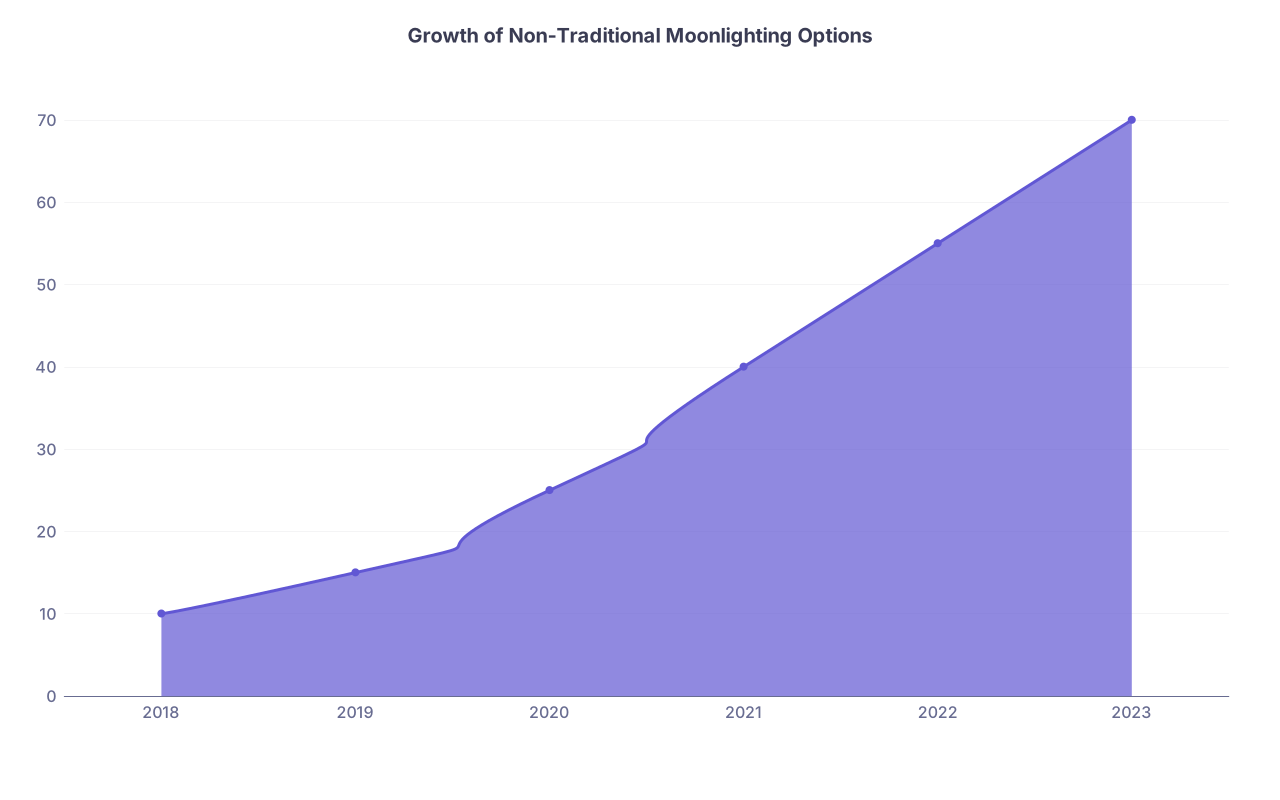
| Category | Value |
|---|---|
| 2018 | 10 |
| 2019 | 15 |
| 2020 | 25 |
| 2021 | 40 |
| 2022 | 55 |
| 2023 | 70 |
(Values here reflecting the relative growth of jobs like telemedicine and “resident nocturnist” roles across institutions I’ve worked with and heard about.)
The unwritten rules are catching up:
Programs hate the idea of you moonlighting from your couch between pages on a home call night. But they also love telling applicants they’re “innovative” and “embrace telemedicine.” So they’ll tolerate it… until something happens.
“Resident nocturnist” tracks are pitched as advanced training. In reality, they’re how hospitals plug night coverage holes with residents they underpay relative to attendings. If you sign up, know the deal: you’ll be treated like a workhorse, not a scholar.
Telemedicine companies are starting to understand they’re dealing with trainees. Some are tightening requirements (no residents, or only PGY-3+ with PD letter). Others quietly don’t ask, don’t tell. Programs hate the latter.
The Stuff You Only Learn By Watching Who Gets Burned
Let me walk you through a few composite scenarios I’ve seen versions of, at more than one institution.
Case 1: The Golden Child Who Could Do No Wrong
PGY-3 in IM. Top of the class, chief-elect, universally liked. Strong board scores, never a negative eval. He starts moonlighting at a community hospital 90 minutes away. Four 12s a month, all on elective and clinic blocks. Never logs the hours fully, obviously over 80 some weeks.
Everybody knows. Nobody cares. Attending says in a division meeting, “He’s one of the best residents we’ve had in a decade.” PD grumbles privately about duty hours but signs every form.
He graduates. Takes a hospitalist job. The program still uses his name in recruitment slides.
Lesson: if they see you as an asset, your moonlighting is “initiative and work ethic.”
Case 2: The Borderline Resident Who Got Sacrificed
PGY-2 in EM. Struggled intern year. A few QI cases where her name shows up in the notes. Not catastrophic, but messy. Nursing complains she’s “sometimes unavailable.” Her notes are chronically late.
She picks up telemedicine shifts from home on her “off” nights. Does not clearly tell the PD; assumes because it’s remote and part-time, it’s fine.
Then one night she misses a critical page for an admitted patient. Turns out she had her personal laptop open, doing video visits between calls. The family complains, “She seemed distracted.”
It explodes. Suddenly, her telemed work is the focal point, not the system failures that led to the missed page.
She gets put on a remediation plan. Moonlighting banned. The PD tells the whole group at conference: “We support outside work, but only when it doesn’t interfere with patient care.” Everyone knows exactly who he meant.
Lesson: if there’s already smoke around your performance, your moonlighting will be blamed for any fire.
Case 3: The Quiet Grinder Who Played It Just Right
PGY-3 in anesthesia. Two kids, spouse in grad school. Money’s tight. She applies for internal OB anesthesia moonlighting—24-hour shifts, decent pay, same EMR, same malpractice umbrella.
She has a reputation for being calm, prepared, and uncomplaining. She never cancels a shift. She never brags about income. Chiefs know she does it but also know she shows up on days “fresh enough” that nobody can pin anything on her.
When she asks for a letter to credential externally at a nearby community hospital for her final year, the PD hesitates… then signs. Why? Because three years of reliability bought her credibility.
Lesson: quiet, predictable competence is the best moonlighting insurance you’ll ever have.
The Few Smart, Unwritten Rules You Should Actually Follow
Programs have their secret rules. You should have yours.
Here’s a short set that will keep you out of 95% of trouble:
Never let moonlighting be the first thing your PD thinks of when they hear your name. You want them to think “solid,” “hard-working,” “teachable”—not “does a ton of outside stuff.”
Don’t spike your volume suddenly. Ramp up. One shift a month. Then two. Let people see that nothing changes about your performance. Only then consider doing more.
Treat duty hour reporting as a risk tool, not a game. If you’re playing with the numbers, do it once you’ve proven yourself, not while you’re still under a microscope.
Don’t be the resident who evangelizes moonlighting to interns in front of attendings. Talk money and side gigs in private, not in the workroom at 8 a.m. sign-out.
Pick gigs that make you better at your core job, or at least don’t make you worse. A sleepy community ER where you see bread-and-butter chest pain and belly pain? Fine. A sketchy urgent care that wants you to push opioids and see 5 patients every 15 minutes? That’s where careers go to die.
| Type | Lower-Risk Profile | Higher-Risk Profile |
|---|---|---|
| Site | Internal hospital, same EMR | Remote urgent care, new system |
| Hours | 1–24/month | 40+/month, clustered |
| Timing | Elective/clinic months | Wards/ICU nights |
| Reputation | Strong resident | Borderline resident |
| Transparency | PD informed, approved | Hidden or vague |

How This All Fits Into the Future of Being a Doctor
Moonlighting isn’t going away. If anything, with the way physician compensation is trending, it’s becoming the norm, not the exception. The line between “primary job” and “side jobs” is going to blur for your entire career.
Right now, in residency, you’re seeing the early version of that. You’re bumping up against rules written for a different era. Program leadership is trying to enforce 2003 duty standards in a 2026 gig economy.
You’re not crazy for wanting more money. You’re not wrong for thinking you can safely work more than you’re “allowed.” Many of us did—back when nobody was counting.
But here’s the uncomfortable truth: as a resident, you’re not fully in control. You’re in a system that holds the keys to your graduation, your board eligibility, your letters. That system uses unofficial rules and vibes as much as written policy.
If you learn to read those vibes now—to understand when to push, when to lay low, who to tell, and who to avoid oversharing with—you’ll do fine. You’ll pay down some loans. Maybe help your family. Maybe buy back a tiny bit of the financial dignity medicine tries to strip from you for a decade.
Just do not confuse “they haven’t stopped me yet” with “they’re okay with this.”
They’re okay with you. For now.

| Step | Description |
|---|---|
| Step 1 | Resident wants to moonlight |
| Step 2 | Fix performance first |
| Step 3 | Build trust quietly |
| Step 4 | Start low risk internal shifts |
| Step 5 | Scale back immediately |
| Step 6 | Consider gradual increase |
| Step 7 | Performance solid? |
| Step 8 | PD and chiefs trust you? |
| Step 9 | Any complaints or issues? |

The Real Takeaways
You made it this far, so I’ll keep the ending short.
First: your reputation inside the program is the currency that buys you moonlighting freedom. Guard it ruthlessly.
Second: the written rules are only half the story. The other half lives in how your PD, chiefs, and attendings talk about you when you’re not in the room.
Third: moonlighting can change your finances; it can also blow up your training if you ignore the quiet red lines. Learn where those lines actually are at your program, not just in the handbook. Then work just below them, not right on the edge.