
Most residents buying tail coverage for moonlighting are paying for a risk they do not actually have.
That is a strong claim in a medicolegal world built on fear, “better safe than sorry,” and malpractice insurers who are more than happy to sell you one more rider you barely understand. But if you strip away the horror stories and look at how moonlighting and liability really work in the United States, the picture is very different from what’s pushed on resident forums and in EM orientation talks.
Let’s walk through what actually matters.
What “Tail Coverage” Really Is – and What It Is Not
Start with definitions, because this is where the confusion (and sales tactics) begin.
Malpractice coverage comes in two main flavors:
Claims-made
- Covers you for claims made while the policy is active, for incidents that happened after the policy’s retroactive date.
- When the policy ends, you’re only covered for future claims if you either:
- Buy tail coverage (AKA “extended reporting coverage”) from the old carrier, or
- Have the new carrier provide prior acts coverage back to your retro date.
Occurrence
- Covers you for incidents that occur during the policy period, no matter when the claim is filed.
- When you leave, you don’t need tail. The coverage is baked in.
Tail coverage is not magical extra protection. It does not give you more limits. It does not cover new incidents. It only extends the time window to report claims from past work done under that claims-made policy.
So the real question for residents is not “Do I need tail?”
The real questions are:
- Do I actually have my own claims-made policy for moonlighting?
- If yes, who is contractually responsible for tail when it ends—me or the employer?
- If no, am I already covered by someone else (hospital, GME, staffing group)?
Most residents never get that far. They just hear “tail = protection” and assume more is better.
The Standard Reality: Most Resident Moonlighting Is Already Covered
Here’s the unsexy reality from reviewing actual resident contracts and moonlighting agreements across multiple states:
In the overwhelming majority of resident moonlighting setups, you already have malpractice coverage through one or more of the following:
- Your GME-sponsored policy (for “approved” internal moonlighting)
- The hospital or health system’s policy (if you’re working as a hospital-based moonlighter)
- A third-party group’s policy (e.g., EM or hospitalist group contracting you as 1099 or W-2)
And in almost every one of those scenarios, the entity providing the coverage also controls the tail obligation.
If the moonlighting is:
Internal (within your training institution)
– Covered nearly always by the same institutional policy as your residency work. Tail is an institutional problem, not yours.External but hospital-employee W‑2
– You’re usually on the hospital’s malpractice policy. Tail again is their headache.Through a physician group
– The group almost always carries a group malpractice policy, and your work is covered as a scheduled provider. Tail is generally negotiated between group and insurer, not pinned on an individual resident for a few shifts.
So where does “residents need tail for moonlighting” even come from?
Mostly from:
- Generic advice aimed at attendings, blindly copy-pasted into resident spaces
- Agents who are used to selling to attendings and apply the same fear framing
- Faculty and risk management staff who use “better safe than sorry” because it’s faster than explaining how claims-made vs occurrence works
In other words: people conflate attending-level independent practice with limited, hospital-controlled moonlighting and assume the liability structure is the same. It usually isn’t.
When Tail Coverage Actually Might Matter for Residents
Now to be fair: there are real situations where a resident could get burned if they ignore tail. They’re just narrower than the folklore suggests.
You should care a lot more about tail if:
You personally buy your own stand-alone claims-made policy for moonlighting.
Example: You’re doing external moonlighting at an urgent care or free-standing ED and they say, “We don’t provide malpractice—you must carry your own.”
If that policy is claims-made and:- You’re the named insured, and
- The contract clearly says you are responsible for tail when you stop working,
then when you finish residency or stop that gig, there’s a real question: - Will you buy tail?
- Or will your next job’s insurer give you prior acts coverage?
You are functioning almost like a junior attending, independently, in a high-risk setting under your own NPI and policy.
Think lone provider nocturnist in a small ED or hospitalist at a critical access hospital, not some extra admitting shifts on your home ward. If something catastrophic happens and the plaintiff attorney sees you had your own policy, they will absolutely drag that policy into the case.The contract explicitly shifts tail to you.
This is the only part that really matters in writing. If your moonlighting agreement says things like:- “Provider shall be responsible, at Provider’s sole cost, for any required tail coverage upon termination of this Agreement,”
you’re being handed a future bill.
- “Provider shall be responsible, at Provider’s sole cost, for any required tail coverage upon termination of this Agreement,”
That’s when “Do I need tail?” becomes a real financial decision, not a vague anxiety.
What the Claims Data Actually Shows About Resident Moonlighters
Let’s cut through the ghost stories and look at risk.
Most malpractice datasets don’t clearly break out “moonlighting residents” as a separate category, but we can triangulate from:
- Medical Professional Liability Association (MPLA) and malpractice carriers’ reports on resident claims
- Internal data from large insurers that track “house staff” as a separate category
- The basic reality of who gets sued and for how much
Pattern is consistent:
- Residents are named in lawsuits, yes.
- But they are usually not the primary target.
- Payouts are almost always coming from the deep pockets: hospital entity, attending of record, group, or system.
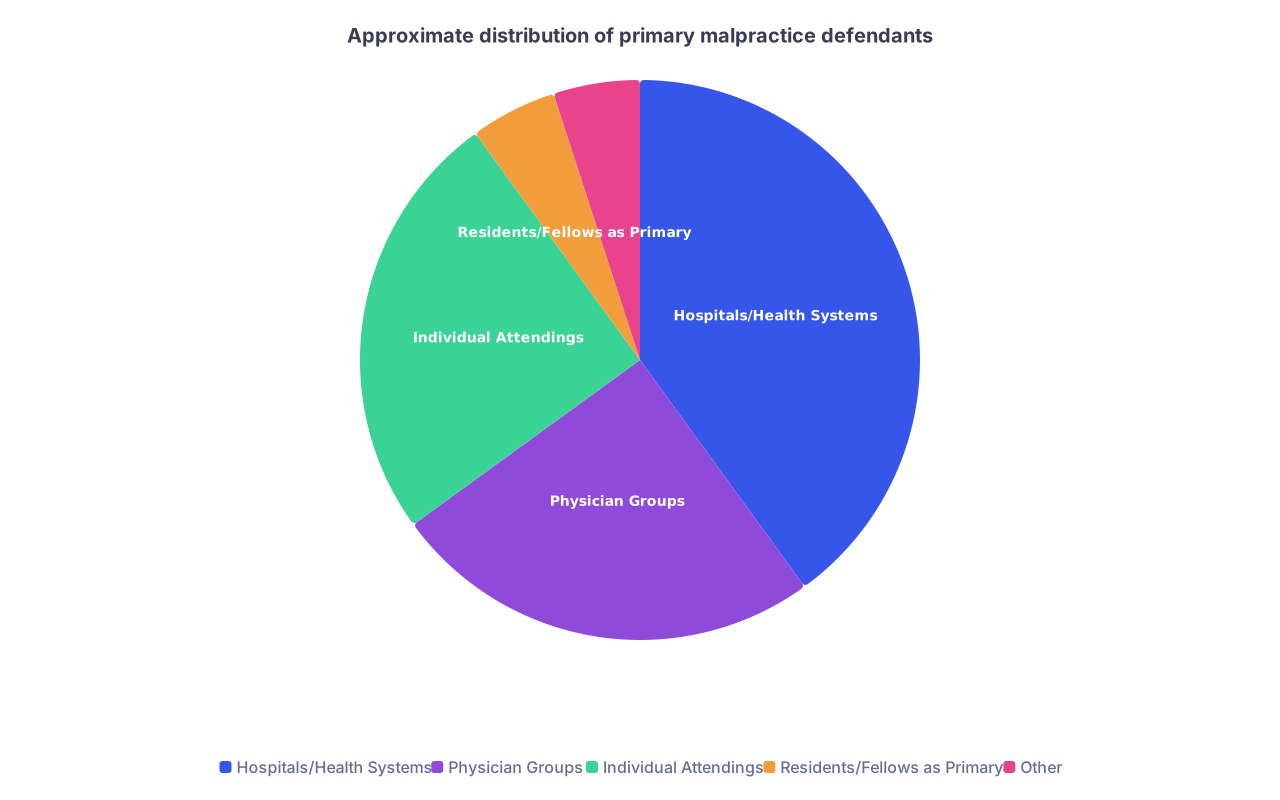
| Category | Value |
|---|---|
| Hospitals/Health Systems | 40 |
| Physician Groups | 25 |
| Individual Attendings | 25 |
| Residents/Fellows as Primary | 5 |
| Other | 5 |
That ~5% “residents/fellows as primary” slice is generous in many datasets. And even then, the employer’s policy is usually still the one paying.
Are there moonlighting cases where a resident’s personal policy was on the hook? Yes. But:
- They’re rare.
- They’re heavily skewed to residents acting essentially as independent providers with their own coverage.
- The resident was almost always told in writing that they were buying their own malpractice.
The idea that every resident picking up a few internal ICU shifts is one tail policy away from financial ruin just does not match real-world claims data.
Internal vs External Moonlighting: The Liability Split
The single most important distinction is this:
Internal moonlighting (within your training institution or its affiliated sites)
vs.
External moonlighting (independent gig outside your program’s institutional umbrella)
They are not the same world.
Internal Moonlighting
Most GME policies and institutional risk structures treat you as:
- Covered under the hospital’s occurrence or claims-made with institutional tail policy
- Working within defined privileges and supervision structures
- A known quantity inside their risk management system
Typical situation: No separate moonlighting policy in your name. No personal tail obligation. If a claim occurs 3 years later, it’s the hospital’s institutional policy that responds.
If anyone is telling you to buy personal tail for that work, ask them a very blunt question:
“Show me where I have my own separate claims-made policy for this work.”
In 9 out of 10 cases, they can’t—because it doesn’t exist.
External Moonlighting
Different animal.
Common scenarios:
- Locums-like work at a small ED or hospital
- Urgent care chain that wants you as a contractor
- Telemedicine / virtual urgent care as a 1099 resident
Here you might see:
- Employer-provided coverage (claims-made or occurrence), with tail assigned to the employer or you
- Requirement to provide your own policy and proof of coverage
| Scenario | Who Usually Owns Tail? | Tail Typically Needed By Resident? |
|---|---|---|
| Internal hospital moonlighting | Hospital / health system | No |
| GME-approved affiliate site | Sponsoring institution | No |
| External W-2 hospital moonlighting | Hospital employer | Rarely |
| External 1099, group provides policy | Group / employer | Sometimes (watch contract) |
| External 1099, resident buys policy | Resident | Yes, unless next job covers prior acts |
You do not treat all moonlighting the same. You read the fine print and see who is named on the policy and who is named in the tail clause.
The Worst Advice Residents Get About Tail
There are a few persistent myths that keep residents overpaying or over-panicking.
Myth 1: “Any time you stop working somewhere, you must buy tail.”
False.
You only need tail when:
- You had a claims-made policy, and
- That policy is ending without replacement prior acts coverage, and
- You are contractually responsible for the tail.
If your employer owns the policy and the contract says they pay for tail, you don’t go buy your own for fun. That’s lighting money on fire.
Myth 2: “Occurrence coverage means you’re fully safe, forever, no matter what.”
Mostly true—for the work done under that policy. But be precise:
- Occurrence coverage attaches to the incident date.
- If your moonlighting was under a clean occurrence policy and you confirm you were listed as an insured, you don’t need tail on that chunk of work.
But that doesn’t magically protect you for some other gig where you had a separate claims-made policy. People blend policies and think “I have occurrence somewhere, so I’m good everywhere.” That’s wrong.
Myth 3: “It’s only a couple thousand dollars. Just buy tail and sleep better.”
That’s how people end up paying for risk that was already covered by an employer’s institutional policy.
Also: resident-tail quotes can be wildly overpriced for the microscopic claim exposure you represent if the insurer knows you’re scared and unsophisticated. I’ve seen residents quoted $4,000–$8,000 tail for a short-run solo policy on an urgent care shift pattern. For a resident. It’s absurd.
You don’t buy peace of mind by default. You buy it when the numbers and contract actually justify it.
The Right Way for Residents to Think About Tail
Here’s the simple, non-hysterical decision process.

| Step | Description |
|---|---|
| Step 1 | Moonlighting Job |
| Step 2 | Covered by GME or hospital policy |
| Step 3 | Confirm no separate policy in your name |
| Step 4 | No personal tail needed |
| Step 5 | Read contract tail clause |
| Step 6 | Consider risk vs cost |
| Step 7 | Claims made or occurrence? |
| Step 8 | Need tail or prior acts later |
| Step 9 | Internal or External? |
| Step 10 | Who provides malpractice? |
Then add three sanity checks:
Ask for the certificate of insurance (COI).
- Whose name is on it? You as an individual? Or the group/hospital with you listed as a covered provider?
Read the tail clause in the contract.
- Does it say “provider shall be responsible”?
- Or does it say the employer will maintain coverage for claims arising from your services?
Ask directly: “Who will be responsible for tail coverage when I leave?”
Say it out loud. Watch how confidently—or vaguely—they answer.
This is not about being paranoid. It’s about avoiding being the only adult in the room who didn’t read page 7.
The Future: Will Tail Even Matter for Residents 10 Years From Now?
Here’s the trajectory that’s already visible:
More hospital-employed models, fewer true independent contractors.
Residents are increasingly funneled into employed roles with system-wide malpractice policies. Moonlighting work tends to be internal or through large, risk-averse entities that bundle you into their coverage.More occurrence policies or occurrence-like products for short-term and telemedicine work.
Many newer telemed platforms use occurrence-based coverage or per-encounter structures simply because it’s easier to onboard and offboard large numbers of short-term clinicians.More standardized GME policies limiting external moonlighting.
Programs are tightening rules. Many either:- Restrict you to internal moonlighting, or
- Require proof of employer-provided coverage if external.
Both trends reduce the odds you’ll be out there solo-shopping for a claims-made policy.
In other words: the slice of residents who truly need to buy their own tail for moonlighting is probably shrinking, not growing.
What will always remain:
- Contracts that quietly shove tail costs onto whoever doesn’t read them.
- Insurers and brokers happy to sell unnecessary tail to scared young doctors.
Do not be that doctor.
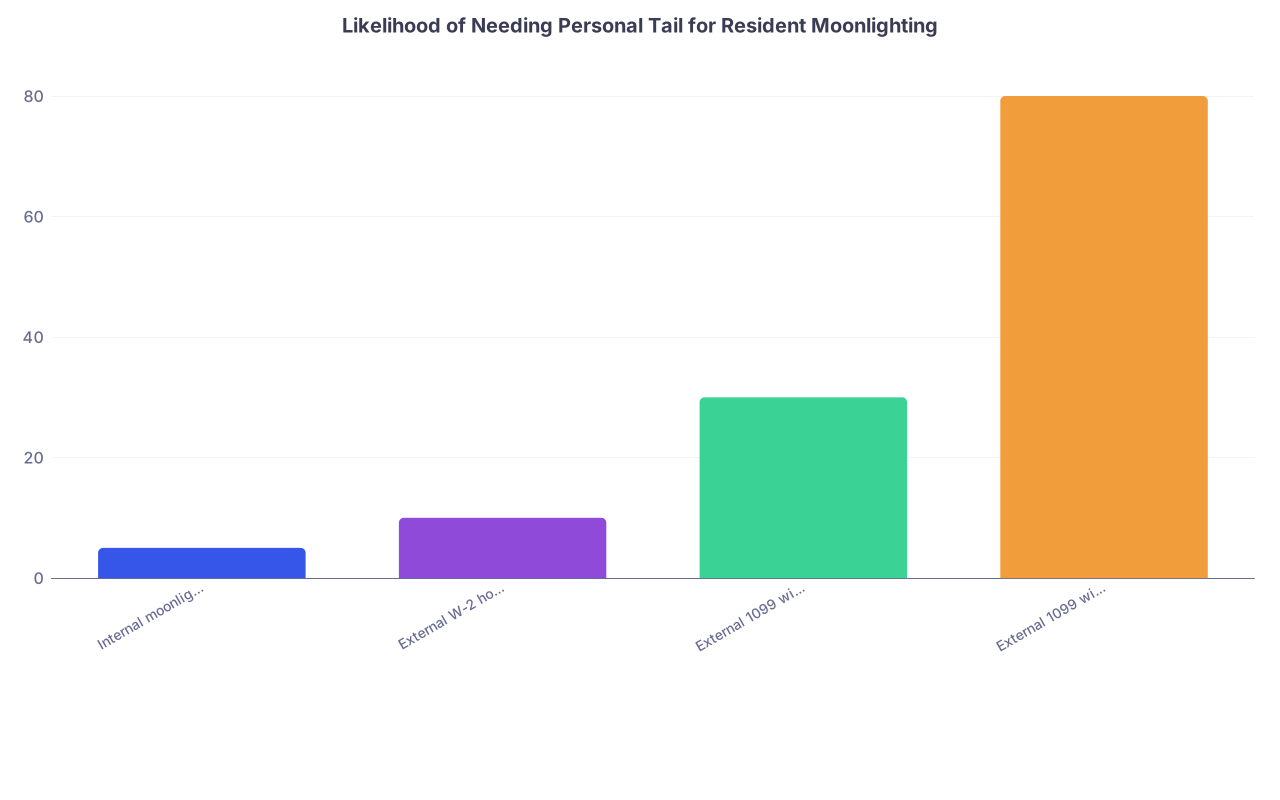
| Category | Value |
|---|---|
| Internal moonlighting | 5 |
| External W-2 hospital | 10 |
| External 1099 with employer policy | 30 |
| External 1099 with own policy | 80 |

So… Do Residents Really Need Tail Coverage for Moonlighting?
Most of the time: no, not personally.
Here are the three take-home points stripped of fear and fluff:
If your moonlighting is internal or hospital-employed, you almost never need your own tail.
You’re covered under institutional policies. Tail is their contractual obligation, not an upsell you should buy separately.Tail matters when you personally own a claims-made policy or your external contract says you pay for tail.
In that narrow situation, you either need tail when you stop, or a future employer willing to pick up prior acts.Stop buying malpractice like a superstition.
Ask who owns the policy, who owns the tail, and what the contract says. Pay for real risk, not vague anxiety.
Everything else is noise.