
The biggest lie in residency contracts is that “competitive salary” line—especially when your program bans moonlighting and your checking account is circling the drain.
If your residency blocks moonlighting but you need extra income, you are not stuck. You are boxed in. Different thing. Boxes have edges. Edges can be worked.
Let’s walk through how you do this without getting fired, getting reported, or burning yourself into an avoidable meltdown.
Step 1: Get Clear On What’s Actually Prohibited
Do not rely on gossip in the workroom. Half of what residents “heard from a senior” is wrong.
Pull out your actual documents:
- Your residency contract
- GME handbook
- Moonlighting policy (sometimes buried in a PDF on the GME website)
- Your specialty board rules (ABIM, ABS, ABEM, etc.)
You’re looking for four things:
- Is all outside work banned, or just clinical moonlighting?
- Is “employment” banned, or “patient care for compensation,” or “any work that could impact duty hours”?
- What do they require to approve moonlighting? (Licensure, malpractice, PD approval, etc.)
- Duty hour language – does outside work count as duty hours?
Typical reality in many programs:
- “Residents are prohibited from all internal and external moonlighting.”
- “All compensated patient care activities must be reported and count toward ACGME duty hours.”
- “Residents must not exceed 80 hours per week averaged over 4 weeks from all clinical activities.”
Translation: they care about:
- liability
- duty hour violations
- your availability and performance on service
They do not usually care if you’re making $800/month teaching MCAT on Zoom.
But you need to know if they used broad language like “any paid employment” versus “moonlighting/clinical duties.” That difference matters.
If the contract says “no external employment of any kind” and you sign a W-2 at Starbucks, you’re technically violating your contract. Most programs don’t go hunting for this—but “most” doesn’t help you if you’re the example they make.
So: read the documents. Then we decide what’s actually possible.
Step 2: Classify Side Work Into Three Buckets
I divide options into three categories:
- Clinical moonlighting (direct patient care)
- Med-adjacent non-clinical work
- Completely non-medical remote or flexible work
Most programs only truly care about #1. That’s where risk is highest.

1. Clinical Moonlighting (Mostly Off the Table)
If your program explicitly bans all moonlighting, do not try to “sneak in” clinical work under the radar. This includes:
- ED shifts at a community hospital
- Urgent care
- Telemedicine visits as a physician (once licensed)
- Hospitalist or cross-cover shifts
Risks:
- Duty hour violations
- Patient safety concerns if you show up post-overnight
- Lying on GME attestations
- Licensing / malpractice coverage questions
- Getting fired. Yes, really. I’ve seen a program terminate a PGY-2 when outside ED shifts came to light.
If the contract says clinical moonlighting is banned, accept that as a hard stop.
2. Medical Non-Clinical Work (Usually The Sweet Spot)
This is where you want to live. Work that uses your knowledge but is:
- Not direct patient care
- Usually independent contractor (1099)
- Often remote and asynchronous
Examples:
- Question writing (USMLE, COMLEX, specialty boards, Qbanks)
- Test prep teaching (MCAT, USMLE, shelf exams)
- Medical editing / content writing
- Clinical research coordination (remote data work, not additional clinical duties)
- Consulting for health-tech or startups (non-clinical advisory roles)
- Chart review for legal cases (once you’re more senior, often as a consultant to attorneys, not as an expert witness yet)
From a program’s perspective, these generally do not trigger:
- Duty hour rules (often not counted)
- Malpractice concerns
- Direct competition with your hospital
Still: you may be legally obligated to disclose any outside income. Some contracts require PD or DIO approval for all external work.
3. Non-Medical Work (Safest Contractually, Not Always Best Use of Time)
These are jobs like:
- Online tutoring (non-med topics)
- Freelance writing in another field
- Coding / tech work if you have that skillset
- Social media management, content creation, design
- Rideshare, delivery, etc. (not recommended given fatigue + safety)
Programs rarely police this if there’s no conflict of interest and it doesn’t show up on hospital property. But your time is limited. Swapping post-call hours for $18/hour DoorDash when you could be earning $50–100/hour doing med-adjacent work is bad math.
Step 3: Identify How Much You Actually Need (Not “Want”)
You’ll waste energy until you do this part with brutal honesty.
Open your accounts. Not in your head. On an actual spreadsheet.
- List all fixed monthly expenses: rent, utilities, minimum loan payments, car, insurance, childcare.
- List variable but necessary: food, gas, phone, internet.
- List truly optional: streaming, subscriptions, eating out, gym, travel.
Then calculate:
- Baseline “keep the lights on” monthly number
- “Comfortable but lean” monthly number
Now compare to your take-home pay.
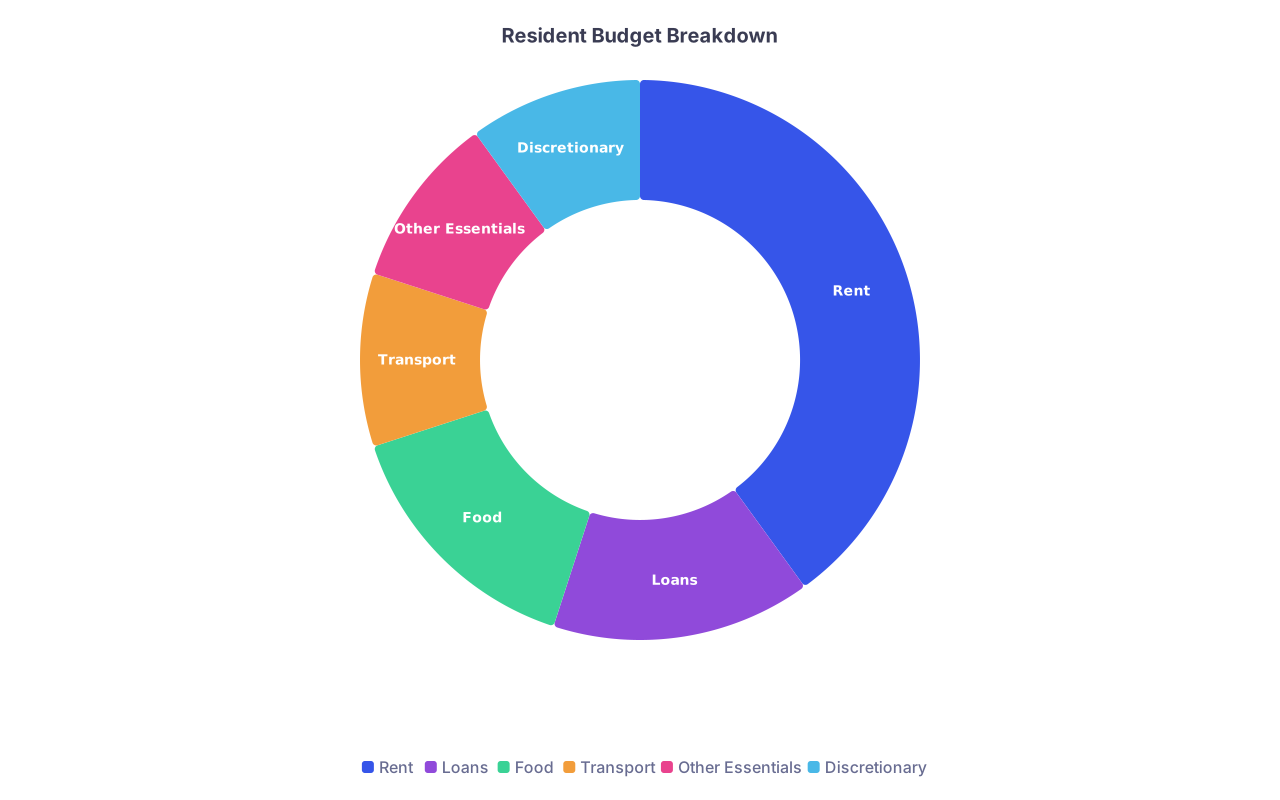
| Category | Value |
|---|---|
| Rent | 40 |
| Loans | 15 |
| Food | 15 |
| Transport | 10 |
| Other Essentials | 10 |
| Discretionary | 10 |
Example:
- Take-home: $4,000/month
- Baseline survival: $3,600
- Comfortable lean: $4,500
You need $600/month to not be constantly behind. You want $500/month more to breathe.
That means you’re looking for $600–1,100/month in extra income. That’s a very different problem than “I hate being broke” which feels infinite and hopeless.
Once you know the number, you can reverse-engineer:
- $800/month at $80/hour → 10 hours/month
- $800/month at $40/hour → 20 hours/month
You’re not hunting for a second job. You’re hunting for ~10–20 high-yield hours per month.
Step 4: Choose Side Work That Matches Your Reality, Not Your Fantasy
You do not have consistent evenings. You do not control your weekends. Anything that requires you to always be free at 6–9 pm on Tuesdays is a trap.
Pick work with these characteristics:
- Asynchronous or highly flexible scheduling
- Short chunks possible (1–2 hours)
- No strict shifts that can’t be moved
- No fallout if you occasionally disappear on a week of nights
A few high-yield, realistic options for residents:
Option A: Question Writing and Content Creation
Programs: UWorld, AMBOSS, TrueLearn, BoardVitals, OnlineMedEd, etc.
What you actually do:
- Write multiple-choice questions, explanations, or review material
- Edit existing questions for clarity and accuracy
Pay:
- Often $25–$150 per item, depending on complexity and company
- Many residents realistically make $500–1,500/month if they’re consistent
Pros:
- 100% asynchronous
- Directly reinforces your own board prep
- Fits in odd hours
Cons:
- Requires good writing and attention to detail
- You need a sample and usually some academic cred (honors, Step scores, etc.)
Option B: Test Prep Tutoring / Teaching
Companies: Kaplan, Blueprint, MedSchoolTutors, private tutoring through Wyzant, etc.
What you do:
- Tutor for MCAT, USMLE Step 1/2, shelf exams, sometimes high-yield premed coursework
Pay:
- Company-based: ~$25–$60/hour
- Private: $50–$150/hour depending on market and reputation
Pros:
- Very high hourly rate once established
- You already know the material
- Clear path to scaling if you want
Cons:
- Scheduling. You have to show up at specific times.
- More feasible if your program has some predictable lighter blocks (e.g., electives)
Option C: Medical Writing and Editing
You can pitch yourself as:
- Medical content reviewer (checking for accuracy)
- Article writer for health sites, newsletters, or patient education content
- Editor for continuing education material
Pay:
- $50–$150 per article or more for longer pieces
- Sometimes hourly $30–$80/hour
Pros:
- Mostly asynchronous
- Builds a portfolio you can leverage later
- No duty hour implications
Cons:
- Getting the first gig is the hardest
- Deadlines matter; you need to be honest about your schedule
Step 5: Decide How “Above Board” You Want This To Be
Now the uncomfortable part: whether and how to involve your program.
No, this isn’t about lying. It’s about recognizing how your specific program behaves.
You have three basic paths:
Full disclosure, full compliance
- You send a simple email: “I’d like to do non-clinical question-writing work. No patient care, remote, 4–6 hours/month.”
- You attach contract section showing this is not prohibited or ask for written approval.
- This is the lowest-risk long term, especially for visas, licensing, and future credentialing.
Quiet but honest if asked
- You do low-risk, non-clinical, remote work that doesn’t touch duty hours or hospital property.
- You don’t proactively broadcast it to your PD.
- If directly asked on an official attestation form, you answer truthfully and explain.
- Many residents choose this lane, especially in rigid or punitive cultures. Risk is not zero, but it’s moderate if you’re careful.
Explicitly against policy
- You do clinical moonlighting or prohibited work and hide it.
- You sign duty hour attestations that are technically false.
- I strongly recommend you avoid this. One complaint, one bad outcome, and you’re the scapegoat.
Tell yourself the truth about your risk tolerance. But understand: losing your spot in residency will destroy your finances far more than being short $800/month.
Step 6: Clamp Down the Holes Before You Add More Buckets
Yes, you need more income. You also probably have a few slow leaks you can fix in a weekend.
| Action | Typical Monthly Impact |
|---|---|
| Refinance high-interest credit card to 0% promo | $50–150 saved |
| Switch to cheaper phone/internet plans | $30–80 saved |
| Renegotiate car insurance | $20–60 saved |
| Cut 3–5 unused subscriptions | $20–50 saved |
| Move to cheaper shared housing at next lease | $100–400 saved |
Do these in this order:
Debt triage
- If you carry high-interest credit card debt, your real problem is interest.
- Consider 0% balance transfer offers (if your credit allows), credit union personal loans, or even calling the card company to request lower rates or temporary hardship plans.
Housing
- Your biggest lever. If you’re overpaying for a solo one-bedroom near the hospital when several co-residents are sharing bigger places for less, you’re taxing yourself unnecessarily.
- Yes, moving is a pain. But moving once can be equivalent to adding a small side job without working a single extra hour.
Transportation and subscriptions
- Ditch unused or low-value subscriptions.
- Shop around for car insurance.
- If you’re paying for parking you barely use, reevaluate.
This is not about “stop buying coffee.” That’s amateur-hour advice from people who have never lived on a resident salary. You go for the large rocks first.
Step 7: Set Hard Limits So You Don’t Torch Yourself
You’re not a full-time person plus a part-time worker. You’re an exhausted full-time person trying to survive a training system that already pushes you.
So you need guardrails:
- Cap side-work at 8–16 hours per month to start.
- Never schedule side-work within 12 hours of starting a long call or 24-hour shift.
- Build in “zero work” days after particularly brutal calls or ICU weeks.

| Step | Description |
|---|---|
| Step 1 | Need extra income |
| Step 2 | Review contract |
| Step 3 | Consider low risk shifts |
| Step 4 | Focus on non clinical work |
| Step 5 | Estimate monthly income gap |
| Step 6 | Choose 1 2 flexible options |
| Step 7 | Set 8 16 hours per month limit |
| Step 8 | Reassess after 2 3 months |
| Step 9 | Clinical moonlighting allowed |
Signs you’ve gone too far:
- You’re struggling to stay awake during sign-out.
- You’re chronically behind on notes and being warned internally.
- You’re skipping basic self-maintenance (laundry, food prep) because every spare hour is “monetized.”
- You start hiding your side work from everyone because you know it’s compromising your performance.
If any of that is you, pull back. Fast.
Step 8: Use Your Attendings and Alumni – Quietly and Strategically
There are attendings who quietly did exactly what you are trying to do now. Not the ones giving polished grand rounds. The ones who say things like, “Yeah, I covered three EDs as a PGY-3 back in the day—they’d never allow that now.”
You want to find:
- Someone a few years out who trained where you are or in a similar program type.
- Someone not obsessed with policing residents.
- Someone who has been open about side gigs, consulting, or non-traditional paths.
Questions to ask (not all at once):
- “Did you do anything outside residency for extra income? What was actually feasible?”
- “If you were PGY-2 again and needed $800/month more, what would you do right now?”
- “Are there any low-drama ways residents here have made extra money without getting in trouble?”
You may also reach out to recent grads via email or LinkedIn:
- People who now do test prep, medical writing, or tech roles often started in residency.
- They know which companies are resident-friendly and which ones blow up your schedule.
Step 9: Have a Backup Plan If It All Fails
Sometimes the math just does not work:
- HCOL city + kids + loans + single-income household
- Strict program with no tolerance for any outside work
- No feasible cheaper housing options in reasonable distance
You need a safety plan so one bad month does not become a debt spiral.
Consider:
Emergency line of credit or overdraft protection
- Not for daily spending. For true emergencies only (car breaks down, medical bill).
Family help structured as a clear loan
- If you have family able and willing to help, treat it like a business arrangement: defined amount, defined plan to repay over future attending years.
- This is emotionally cleaner than “we’ll just see.”
Temporary hardship or income-driven adjustments on loans
- If federal loans are choking you, ensure you’re on the best income-driven plan.
- Use forbearance strategically if absolutely necessary during the hardest rotations—not forever.
Strategic use of vacation and elective time
- As a senior, during elective or lighter blocks, you might be able to do brief, intense spurts of above-board non-clinical work to build a buffer.
Step 10: Protect Your Future Self While You Patch the Present
You’re solving today’s cash problem. Just do not set your future self on fire while you do it.
A few rules:
- Do not skip Step 3 contributions to retirement forever—but during PGY-1/2, it is reasonable to prioritize cash flow and debt stability. Just don’t forget to flip the switch later.
- Do not make huge, irreversible lifestyle moves (buying a house, expensive car lease) during residency because “I’ll be an attending soon.” You’re not there yet.
- Do not blow every extra dollar you earn. Split it:
- 50–70% to immediate needs / debt
- 30–50% to small emergency buffer (even $1–2k changes your stress baseline)
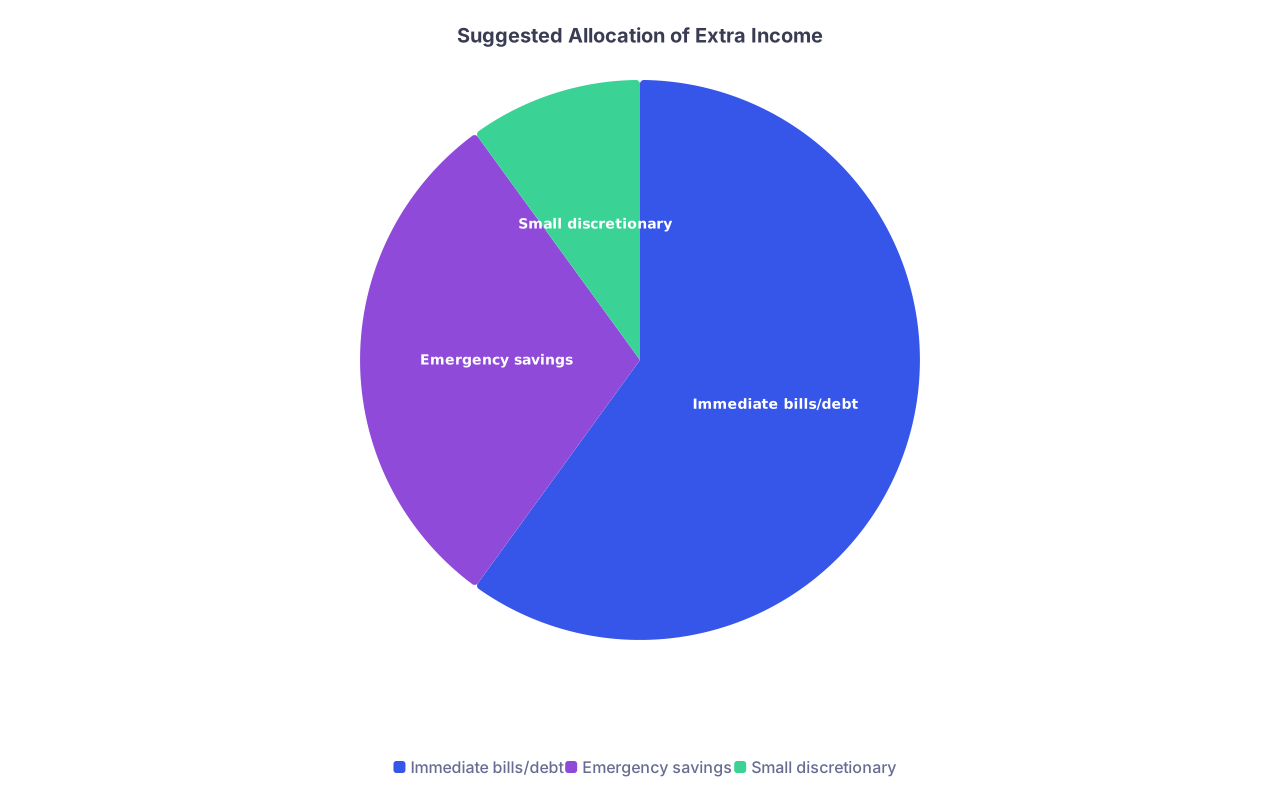
| Category | Value |
|---|---|
| Immediate bills/debt | 60 |
| Emergency savings | 30 |
| Small discretionary | 10 |
Once you survive residency, your income jump will be real. Your primary job right now is not to maximize your net worth. It’s to avoid catastrophic damage—academic, financial, or health—before that jump arrives.
What To Do Tonight
Do this in the next 30–45 minutes:
- Open your contract and GME handbook. Screenshot or highlight the exact lines about “moonlighting” and “outside employment.”
- Open a blank document and write one number: the actual monthly gap between your take-home pay and your “baseline survival” expenses.
- Brainstorm three specific non-clinical side gig types that could realistically give you that amount in ≤15 hours/month.
That’s it. No grand plan yet. Just those three concrete steps.
Once you’ve done that, you’ll know:
- What’s truly banned.
- How big your problem really is.
- Where to focus your effort.
Then tomorrow, send one inquiry email—to a Qbank, a test prep company, or a contact who does medical writing. One step, not ten.
Open your contract now and find the word “moonlighting.” Circle it. That’s where the workaround starts.