
It’s 10:45 p.m. between pages. You’re on night float, scrolling your email, and there it is:
“Moonlighting Opportunity – Hospital B ED – Competitive Rate – Internal Candidates Preferred.”
You work at Hospital A. Hospital B is not just in the same city; it’s literally on the same health system website, shares an EMR, and your PD drops their name at faculty meetings like you’re all one big happy family.
You’re underpaid, your loans are crushing you, and this moonlighting gig would cover your rent in two weekends a month. But your gut is tight because you know this is politically messy. It’s a competing hospital… inside your own system.
Here’s exactly how to handle it without blowing up your residency, violating your contract, or turning your PD into your enemy.
Step 1: Get Clear on What This Offer Actually Is
Before you say a word to anyone, you need clean facts. Not vibes. Facts.
Pull up the email or job posting and write down:
- Which hospital exactly?
- What department? ED? Hospitalist? Urgent care? Tele?
- Are they explicitly targeting residents? Or “any licensed physician”?
- Is it W-2 employment, 1099, or per diem through the system?
- Who’s the contact person (ED director, staffing coordinator, locums agency)?
Now ask yourself three quick questions:
- Is this inside your larger health system, or totally separate?
- Would this work put you in direct clinical competition with your own hospital? (e.g., ED shifts at Hospital B when you are training at Hospital A ED in the same system and same catchment area)
- Would this role touch patients or services that could overlap with your residency responsibilities or call coverage?
If you’re not sure, default to “yes, it could” and treat it like a sensitive situation. Because your PD will.
Step 2: Dig Out Your Contract and GME Policies (Yes, Actually Read Them)
Now you need to know what you’re allowed to do. Not what your co-resident said is “usually fine.”
You’re looking for three separate things:
- Your employment contract or resident agreement
- The GME moonlighting policy
- Any system-wide “conflict of interest” or “outside employment” policy
Common phrases you’ll see that matter:
- “Outside employment requires prior written approval by Program Director and GME Office.”
- “Residents may not moonlight in competing facilities within the same market.”
- “All moonlighting must be counted toward ACGME duty hours.”
- “Internal moonlighting within the system is permitted only with GME approval.”
- “Professional activities must not interfere with the educational mission.”
If you see anything like “prohibited,” “competing facility,” or “conflict of interest,” you cannot wing this. You need explicit permission before you even hint at saying yes.
If you see nothing about outside employment? That doesn’t mean it’s a free-for-all. It means you need clarification before you move.
Step 3: Figure Out the Power Dynamics (Uncomfortable but Necessary)
This is the part people skip and then get burned.
Ask yourself:
How conservative is your program about moonlighting in general?
- Do seniors openly moonlight and talk about it?
- Or is it more whispered, “don’t tell them where I’m working” energy?
Have you heard your PD or chair talk about Hospital B before?
- Are they “partners in the system”?
- Or “those guys stealing our volume”?
What year are you?
- PGY-1 or early PGY-2: you have less leverage, more risk.
- Senior: more leverage, but also closer to letters, chief considerations, fellowship recommendations.
Power reality: they can’t legally stop you from working forever as a physician. But they absolutely can make your life miserable as a trainee — schedule changes, evaluations, letters, subtle retaliation. You want them on your side, or at least neutral.
So you’ll approach this like a political… not just a financial… decision.
Step 4: Check Duty Hours and ACGME Rules Before Anything Else
Moonlighting is irrelevant if it will push you into duty hour violations. Then it’s dead on arrival.
Do a quick, honest calculation:
- How many hours per week are you actually working on service?
- How many weekend days are currently free?
- What’s the minimum shift length at the moonlighting site? 8? 10? 12 hours?
Remember:
- All moonlighting (internal and external) must be counted toward your 80-hour limit.
- You still need 1 day off in 7 averaged over 4 weeks.
- No more than 24 hours of continuous clinical duties (+ 4 for transition, if applicable).
If saying yes to this offer means you’ll hit 90–100 hours consistently, you’re walking into:
- A GME problem
- A safety problem
- A “your PD will shut this down hard” problem
If the numbers don’t work, your answer is “not now,” even if the money’s tempting.
Step 5: Quiet Recon – How Do People in Your Program Handle This?
You do not blast this out on the residency group chat. You talk to 1–2 senior residents you trust who:
- Moonlight already, or
- Are plugged into program politics
You ask them very specifically:
- “Has anyone in our program moonlighted at Hospital B?”
- “How does our PD feel about residents moonlighting inside the system?”
- “Do people get formal approval or just… do it?”
- “Anyone ever get in trouble for moonlighting at another hospital?”
If you hear:
“Yeah, people do it, PD signs the forms, it’s fine” — lower risk, but still follow the process.
If you hear:
“Someone got chewed out last year for shifting at [same system ED]” — then you know exactly what you’re walking into.
Step 6: Decide Your Strategy – Ask First or Walk Away
At this point, you should know:
- What the contract says
- How your GME office treats moonlighting
- How your PD tends to react
- Whether you can stay within duty hours
- How much you financially need this
Now you make a call: is this worth pushing?
Two honest options:
- You pursue it openly, by the book.
- You decide it’s politically radioactive and decline.
Let me be clear: the “secret moonlighting” option is dumb. Especially at a competing hospital in the same system. Same EMR, overlapping credentialing, HR systems talking to each other — you will get caught eventually.
If it feels too hot and your PD is known to be territorial about Hospital B, it may be smarter to:
- Ask instead about moonlighting opportunities at your own hospital
- Or look at completely unrelated sites (rural ED, urgent care chain, telehealth)
But if it seems potentially acceptable from what you’ve seen in policy and culture, you move to the next step.
Step 7: How to Talk to Your PD Without Sounding Like You’re Jumping Ship
You’re not going in with:
“Hey I got this awesome offer at the other hospital, can I go make more money there?”
You’re going in with:
“I want to make sure I stay aligned with the program and don’t violate any rules.”
That’s the frame.
Here’s a script you can adapt:
“Dr. Smith, I wanted to run something by you before I do anything with it. I was approached about a possible moonlighting opportunity at [Hospital B] in [ED / hospitalist / urgent care]. I have not accepted anything and I wanted to check with you first to see whether this would even be allowed from the program’s standpoint.
I’ve reviewed our GME moonlighting policy and my contract, and I know all hours count toward duty hours, and that it can’t interfere with my training. If this is something that’s not appropriate because of system dynamics or competition, I’m completely okay with not doing it. I’d rather ask up front than create problems.”
Why this works:
- You show you did your homework.
- You’re signaling respect for boundaries.
- You give them an easy out if politically this is a no-go.
- You’re not sounding like you’re abandoning your own site for “the better” one.
If your PD says, “We don’t allow moonlighting at Hospital B” — do not argue. Get curious, not combative.
“Got it, thank you for clarifying. Are there any internal moonlighting options you’d consider for seniors here or in other parts of the system that are more appropriate?”
That question sometimes unlocks stuff you never knew existed.
Step 8: If They Say “Maybe” or “Yes, With Conditions”
If your PD is open but cautious, you’ll probably hear:
- “Send me the details and I’ll run it by GME.”
- “We allow internal moonlighting at the other campus but only for PGY-3+.”
- “You can’t work in their ED, but inpatient night coverage might be okay.”
Now you handle the logistics like an adult:
- Get a written moonlighting approval form if your institution has one.
- Confirm:
- Max shifts per month
- Which services/units are allowed
- That all hours will be logged in your duty hour system
- Make sure the moonlighting hospital knows:
- You are a resident first, and your training schedule is non-negotiable.
- Shifts must be scheduled around your residency duties with enough buffer.
You also set your own personal red lines:
- No back-to-back 24+6 plus 12-hour moonlighting ED shift.
- No moonlighting on post-call days.
- No picking up shifts that push you to chronic exhaustion.
You’ll be tempted. Don’t be dumb.
Step 9: If They Say “No” – How to Respond and What to Do Next
Sometimes the answer is simply: “No. We do not want our residents moonlighting there.”
The wrong response:
- Getting defensive
- Arguing about your loans
- Comparing your salary to other programs
- Trying to go around them and ask GME behind their back
The right response:
“I understand. Thank you for being direct. If possible, I would still like to explore some way to supplement my income that’s acceptable to the program. Would you be open to me looking at telehealth, urgent care, or opportunities that won’t overlap with our system?”
Then your next moves:
- Look for moonlighting that:
- Is outside your system’s catchment area, or
- Is in a completely different line of service (tele-psych, tele-urgent care, rural weekend shifts)
- Or tighten up your financial life for now and delay moonlighting till you’re senior or an attending.
Harsh truth: in some systems, any “competing” internal site is just off-limits. No amount of arguing changes that.
Step 10: Protect Yourself Legally and Financially
If this moves forward, you’re going to be hit with another contract — and it might be worse than your resident one.
Look for:
Non-compete / restrictive covenants
Some systems sneak in language that could block you from working at your own hospital after graduation if you sign with the other site in a staff role. Don’t sign that garbage without understanding it.Malpractice coverage
- Is it occurrence-based or claims-made?
- Who pays tail if they terminate you?
- Are you covered for resident-level procedures or full attending-level expectations?
Termination clauses
- Can they fire you “without cause” on 30 days’ notice?
- Can you walk away easily if your residency schedule changes?
Compensation reality
A flashy hourly rate is meaningless if:- They cancel shifts frequently
- It’s RVU-based and volume is trash
- They stick you with unpaid orientation time
If you’re unsure, pay a couple hundred dollars to have a contract-savvy attorney spend an hour on it. That’s cheaper than one bad clause haunting your next five years.
System Politics: Why “Competing Within the System” Freaks Leadership Out
A quick dose of reality: from the C-suite viewpoint, this isn’t just “one resident picking up a shift.” It’s:
- Market share
- ED volumes
- Admitting patterns
- Loyalty within the system
If Hospital A and Hospital B are technically in the same system but they’re competing for:
- ED volume
- Specialty referrals
- Reputation
Then leadership gets nervous about “their residents” drifting over to “the other campus.” It feels like disloyalty, even if that’s irrational.
That’s why you frame everything around:
- Your educational priorities
- Maintaining duty hours
- Respecting the program’s expectations
Not “I want to go work where the nurses are nicer and the cafeteria isn’t garbage.”
Quick Comparison: Different Moonlighting Options
Here’s how this “competing hospital in your system” offer stacks up against other common moonlighting choices.
| Option | Politics Risk | Pay | Approval Difficulty |
|---|---|---|---|
| Same system, competing site | High | Often good | High |
| Same hospital, internal | Low | Moderate | Low-Medium |
| External local hospital | Medium | Good | Medium |
| Telehealth / remote | Low-Medium | Variable | Medium |
| Urgent care chain | Low-Medium | Moderate | Medium |
How This Plays Into Your Future (Fellowship, Jobs, Reputation)
You’re not just trading time for money. You’re trading reputation, relationships, and leverage.
Done well, moonlighting at a related hospital can:
- Build connections with another group that might hire you post-residency.
- Give you extra procedural volume and independence.
- Show you can function at attending level.
Done badly, it can:
- Brand you as “the resident who’s never rested and always late post-moonlighting.”
- Trigger duty hour investigations.
- Sour your PD right before they’re writing your fellowship letter.
When in doubt, ask:
“Would I be comfortable explaining this decision on a fellowship interview if they called my PD about it?”
If the answer is “no way,” you already know what to do.
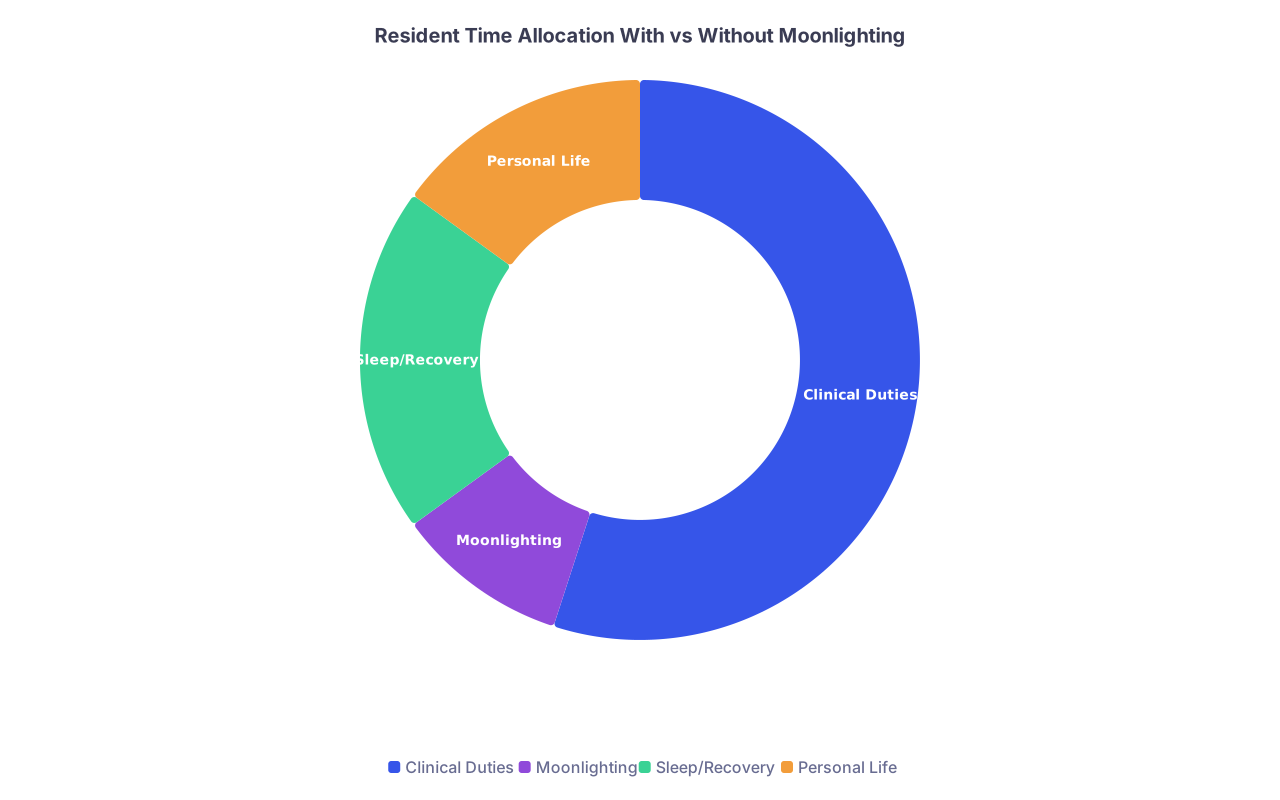
| Category | Value |
|---|---|
| Clinical Duties | 55 |
| Moonlighting | 10 |
| Sleep/Recovery | 20 |
| Personal Life | 15 |
Practical Do/Don’t Summary for This Exact Situation
You’re staring at that offer at a competing hospital in your system. Here’s the blunt version.
Do:
- Read your contract and GME moonlighting policy.
- Confirm with a couple of trusted seniors how the program really treats this.
- Bring it to your PD early, respectfully, and framed around safety and policy.
- Be ready to accept “no” without drama.
- If allowed, protect yourself with contract review and strict duty-hour limits.
Don’t:
- Start picking up shifts before you have explicit approval.
- Hide it from your PD or GME.
- Assume “same system” means “automatically OK.”
- Just chase the highest hourly rate and ignore your exhaustion.
- Sign a contract with ugly non-competes or unclear malpractice terms.

| Step | Description |
|---|---|
| Step 1 | Receive moonlighting offer at Hospital B |
| Step 2 | Read contract and GME policies |
| Step 3 | Standard moonlighting approval process |
| Step 4 | Talk to trusted seniors |
| Step 5 | Schedule meeting with PD |
| Step 6 | Submit formal moonlighting approval to GME |
| Step 7 | Decline offer and explore other options |
| Step 8 | Review contract, confirm duty hours, start carefully |
| Step 9 | Competes with your hospital? |
| Step 10 | PD approves? |
FAQs
1. What if the moonlighting hospital tells me, “You don’t need to involve your residency — we’ll handle it internally”?
That’s a red flag. They’re prioritizing their staffing needs over your training and ACGME requirements. Your duty hours and moonlighting approval are governed by your residency and GME, not the outside site. If they’re discouraging you from talking to your PD, that’s exactly when you must talk to your PD. Politely ignore their reassurance and follow your own institution’s rules. If they push back, that’s probably not a place you want to trust with your license or malpractice exposure anyway.
2. Can my program actually stop me from moonlighting if I’m fully licensed and keep duty hours legal?
They can’t stop you from being a licensed physician, but they can absolutely make moonlighting a condition of your residency. Your resident contract usually gives them the right to require approval for outside work, and to discipline or even terminate you if you violate those terms. So yes, practically, they can stop you from moonlighting while you’re in their program by making noncompliance a breach of contract. You’re free to walk away from the program; you’re not free to ignore its rules and expect no consequences.
3. Is it ever smarter to skip moonlighting altogether and just wait until I’m an attending?
Sometimes, yes. If:
- Your program is already brutal with hours,
- The politics around the “competing” hospital are toxic,
- You’re prepping for boards or fellowship apps, or
- You’re barely treading water emotionally,
then the extra cash is not worth the hit to your sleep, sanity, and future leverage. You can go from resident paycheck to attending paycheck in one step, and the financial gap usually closes very fast once you’re out. Plenty of smart residents decide: “Survive now, earn later.” That’s a valid choice.
Today, do one concrete thing:
Go download your resident contract and GME moonlighting policy, and actually read the sections on outside employment and duty hours. Highlight any lines about “competing facilities” or “prior written approval.” That’s your real starting point, not the email with the shiny hourly rate.