
The way most physicians sign non‑competes is reckless. You flip to the salary, skim the schedule, and treat the restrictive covenant as background noise. That’s how you end up stuck, bitter, and boxed out of half a city.
Let’s fix that.
If you’re asking “Is this non‑compete reasonable?” you’re already ahead of most residents and early attendings. The answer depends on a few specific clauses. Not vibes. Not “my buddy said it’s fine.” Concrete, negotiable terms.
This is the checklist I’d use before signing any physician employment contract, especially if you care about moonlighting, side gigs, or keeping your future options open.
First: Does This Non‑Compete Even Apply To You?
Before arguing about what’s “reasonable,” you need to know if the non‑compete is even enforceable where you work.
Here’s the basic reality:
- Some states heavily restrict or outright ban non‑competes for physicians.
- Some states allow them but with tight limits (scope, geography, time).
- Some states are the Wild West and will enforce almost anything that isn’t absurd.
You do not guess this. You ask.
At minimum, you want written input from:
- A health‑care employment attorney licensed in that state.
- Or, at least, a contract review service that uses such attorneys (not just a random “coach”).
Also watch for this sneaky move: some contracts choose the law of another state in the fine print. So you sign in State A (physician‑friendly), but the contract says disputes are governed by State B (employer‑friendly). That’s not theoretical; I’ve seen it.
If the governing law or venue clause doesn’t match where you’ll actually work, that’s a red flag to discuss with a lawyer immediately.
The Three Big Questions: Time, Distance, Scope
If non‑competes are allowed in your area, “reasonable” usually comes down to three things:
- How long does it last? (time)
- How far does it reach? (distance)
- What exactly are you barred from doing? (scope)
If a contract fails on any one of these, you’ve got leverage to push back.
| Factor | Common Range | Clearly Aggressive |
|---|---|---|
| Duration | 6–12 months | 2+ years |
| Radius (urban) | 5–15 miles | 25+ miles |
| Radius (rural) | 15–30 miles | 50+ miles |
Let’s break each down.
1. Duration: How Long Are You Benched?
Reasonable: 6–12 months
Aggressive: 18–24 months or more
Anything beyond a year is hard to justify in most physician jobs. If they want two years, they’re not just protecting their referral base — they’re trying to lock down the market.
Key clauses to look for:
- “From the date of termination” – fine.
- “From the later of termination or end of any tail coverage period” – sneakily extends the clock.
- “Renewed upon any breach” – can reset the clock if they allege you violated something.
Push for:
- A hard cap: “The restrictive covenant shall not exceed 12 months from the date of termination, regardless of any other provisions.”
- No “tolling” language that pauses and restarts the non‑compete if they decide you violated it.
If they insist on 18–24 months, a common compromise is a shorter non‑compete if you are terminated without cause or if you leave for cause. Which brings us to the next landmine.
2. Geography: How Big Is the Box Around You?
This is where many contracts go off the rails.
Reasonable urban range: 5–15 miles from your primary practice site.
Reasonable rural range: 15–30 miles, sometimes up to county‑level if the county isn’t huge.
Red flags:
- The radius applies to every location in the system, not just where you actually work.
- The radius is measured from any facility you “may provide services at from time to time.”
- The radius is so large you’d need to move your family to keep practicing your specialty.
A classic bad clause: “Physician shall not practice within 25 miles of any hospital, clinic, or affiliate facility of Employer.” If this is a large health system, that can effectively ban you from an entire metro area.
You want:
- Specific listed locations:
“The restricted territory shall be within 10 miles of Physician’s primary practice site at [address].” - Or: “Locations where Physician provides at least 50% of clinical services averaged over the preceding 12 months.”
- Clear definition of “practice” (see scope below).
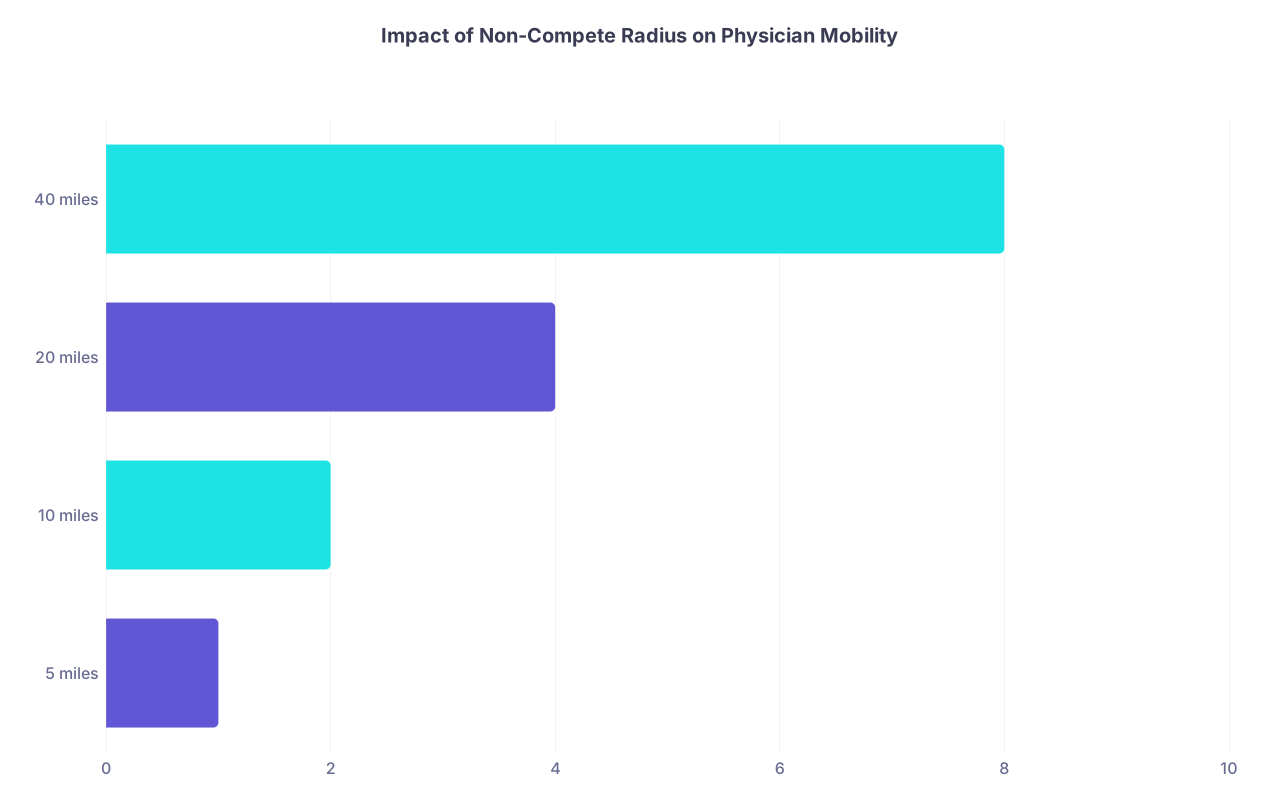
| Category | Value |
|---|---|
| 5 miles | 1 |
| 10 miles | 2 |
| 20 miles | 4 |
| 40 miles | 8 |
(In practice: a 5–10 mile radius in a city often leaves multiple groups/hospitals outside the circle. A 20–40 mile radius can wipe out every realistic local job.)
3. Scope: What Exactly Are You Barred From Doing?
This is where contracts get sloppy — or intentionally vague.
Reasonable: limited to your specialty and core clinical activities you performed for that employer.
Aggressive: bans you from anything “related to health care,” “consulting,” “telemedicine,” or “any services competitive with Employer.”
Watch for three dimensions of scope:
Type of work
Are you forbidden from clinical practice only? Or also teaching, telehealth, administrative work, consulting, med‑legal work, research, or joining a startup?Specialty/subspecialty
If you’re a cardiologist, are you banned from any internal medicine work? If you’re EM, does it also block urgent care, tele‑urgent care, or occupational medicine?Employment relationship
Does it ban you from being employed only, or also from being an independent contractor, partner, shareholder, or owner?
You want language like:
- “Physician shall not provide direct clinical services in the specialty of [X] within the Restricted Area.”
- “Non‑clinical activities such as teaching, research, expert witness work, and administrative roles are excluded.”
And you absolutely want exclusions for moonlighting that’s:
- Outside the restricted area, or
- In a non‑competing setting (e.g., VA, urgent care, telemedicine covering another state), or
- In a different specialty/scope than your primary role.
This is not automatic. You need it spelled out.
How Non‑Competes Mess With Moonlighting
If you’re moonlighting now or planning to in the future, you have to think three steps ahead.
Problem 1: “Exclusive employment” clauses
Some contracts claim you must obtain written permission before working anywhere else or that you must devote “full professional time and attention” to the employer.
That can mean:
- No moonlighting, even outside the non‑compete radius.
- No telemedicine shifts from home.
- No weekend locums without their approval.
If you want to keep or start moonlighting:
- Get explicit language: “Employer acknowledges that Physician may engage in moonlighting or locum tenens work, provided such work does not occur within the Restricted Area, does not interfere with Physician’s duties, and does not involve direct competition with Employer’s primary service lines.”
- Or at least: “Employer’s consent to outside clinical work shall not be unreasonably withheld.”
Problem 2: Future non‑compete + current moonlighting job
You might already be moonlighting at Hospital B while employed at Hospital A. Then Hospital A changes contracts or adds a non‑compete renewal that would block you from continuing at B in the future.
Solution: carve‑outs.
You want a clause that says:
- “Existing clinical roles at [named institutions] are excluded from this non‑compete and may be continued during and after employment.”
Yes, you can ask for that up front.
Termination: The Hidden Trigger That Changes Everything
You have to read the non‑compete in the context of how the agreement can end.
Key questions:
- Does the non‑compete apply if they terminate you without cause?
- Does it apply if you leave because they breached the contract (didn’t pay, changed call dramatically, etc.)?
- Does it apply if they decide not to renew a term contract?
Reasonable structure:
- If they terminate you without cause, the non‑compete is:
- Waived entirely, or
- Narrowed (shorter duration or reduced radius).
- If you terminate for cause (they breach), the non‑compete is waived.
- If you voluntarily leave without cause, the non‑compete applies in full.
Aggressive structure:
- Non‑compete applies regardless of who ends it or why, including non‑renewal.
- They can end you on 60 days’ notice and still bench you for a 25‑mile, 2‑year restriction.
You want those distinctions spelled out explicitly, not implied.
Buy‑Outs and Liquidated Damages: Can You Pay Your Way Out?
Some contracts include a “buy‑out” clause: pay X dollars and the non‑compete goes away.
Could be great. Could be a joke.
| Structure | Typical Size |
|---|---|
| Flat amount | 3–12 months of base salary |
| Revenue-based | 50–100% of prior 12-month RVUs or collections |
| No buy-out | Not offered / must litigate |
Reasonable:
- A clearly defined buy‑out tied to a realistic amount of money (for example, 6 months of base salary).
- Payment terms that don’t require a lump sum in 30 days.
Aggressive:
- Buy‑out equal to 1–2x your entire prior year collections.
- Vague language like “liquidated damages in an amount sufficient to compensate Employer’s losses” with no number.
If there’s a buy‑out clause, run the math:
- How much cash would you actually need?
- Could you finance it (bank loan, signing bonus elsewhere)?
- Would a new employer pay some/all of it to get you?
But do not rely on a fantasy future buy‑out to justify signing a terrible non‑compete today.
“But Everyone Else Signed It” – Power Dynamics and Reality
You’ll hear this line from recruiters, partners, even your co‑residents:
“Everyone else here signed the same thing; it’s just standard.”
“Standard” doesn’t mean smart. It doesn’t mean enforceable either.
Here’s what I’ve seen work in real negotiations:
- Residents and new grads actually have more leverage in shortage specialties (EM, anesthesia, psych, critical care, hospitalist in some markets) than they think.
- Private groups are often more flexible than big systems, but both can move if they want you.
- The more concrete and focused your ask, the more likely they’ll say yes.
Instead of: “I hate this non‑compete; can we get rid of it?”
Try: “My non‑negotiables are (1) no more than 12 months, (2) radius limited to my primary site, and (3) explicit carve‑out for telemedicine and teaching. If we can agree on those, I am comfortable signing.”
Be prepared to walk away if they will not budge and the restriction would seriously damage your future options. There is always another job. There is not another you.
Practical “Reasonableness” Checklist
Here is a quick lens to judge whether a non‑compete is in the “reasonable” vs “this will haunt me” category:
- Duration ≤ 12 months
- Radius:
- City: ≤ 10–15 miles from your main site
- Rural: ≤ 25–30 miles, or limited to specific counties
- Applies only to:
- Your primary specialty
- Direct competing clinical practice
- Explicitly excludes:
- Teaching, research, med‑legal, admin roles
- Telemedicine that is not competing locally
- Work for government/VA/academic centers (if appropriate)
- Non‑compete is:
- Waived or reduced if they terminate you without cause
- Waived if you terminate for cause
- Moonlighting:
- Allowed with reasonable consent standard
- Existing side gigs carved out by name
- Governing law:
- Matches the state you’re actually practicing in
- Not obviously chosen to dodge physician protections
- Buy‑out (if present):
- Clear number you can realistically pay or negotiate around
If a contract fails multiple items on that list, don’t rely on hope. Get legal help and either negotiate or walk.
How This Ties Into the Future of Medicine
Non‑competes are colliding with three big trends:
Telemedicine and remote work – If your contract bans you from “any telehealth involving patients in the Restricted Area,” you might be blocked from national platforms that can’t filter geography perfectly.
Portfolio careers – More physicians are building mixes of clinical, consulting, teaching, startup, and media work. Overbroad non‑competes and exclusivity clauses choke that off.
Policy shifts – Regulators and professional societies are warming to the idea that physician non‑competes are bad for patient access and bad for innovation. The direction of travel is clear: more scrutiny, not less.
You can either sign a contract that locks you into a 1990s model of “one employer, one job, forever,” or you can insist on terms that leave space for how medicine is actually evolving.
Bottom Line
Three things to remember when you ask, “Is this non‑compete reasonable?”:
- Judge it on time, distance, and scope – 6–12 months, tight radius, and limited to your specialty and direct competition is the sane middle ground.
- Protect your moonlighting and future options explicitly in writing — carve‑outs for side gigs, telehealth, teaching, and non‑competing work are not automatic.
- Do not sign on faith — have a health‑care attorney review the contract under your state’s law and be prepared to negotiate or walk if the non‑compete would trap you.
You only get to be “naive about contracts” once. After that, you’re either deliberate or you’re stuck.