
Last week, a hospitalist texted me a screenshot: “Offer expires in 24 hours. Another doc is interested in this assignment, so I need your decision today.” He’d spoken with that locums recruiter once. No contract review. No schedule details. Just pressure. He felt cornered—money on the table, fear of losing the gig, and zero time to think.
If you’re reading this, you’ve probably gotten a version of that message. Let me walk you through exactly what to do when a locums recruiter is trying to rush you—and how to flip the power dynamic back where it belongs: with you.
First: Recognize You’re Being Pressured (And Why)
You cannot handle pressure if you don’t call it what it is.
These are common pressure tactics locums recruiters use:
- “We need an answer by end of day.”
- “I have another candidate ready to sign.”
- “If you do not sign now, I cannot guarantee this rate.”
- “Credentialing deadlines are tight—you’ll miss the window.”
- “The client only authorized a limited number of submissions; I have to lock you in.”
Sometimes they’re half-true. Often they’re exaggerated. Occasionally they’re flat-out nonsense.
Why they push:
- They get paid when you sign and work. Faster sign = faster commission.
- Clients sometimes do set soft deadlines, but agencies routinely shorten them to create false urgency.
- If they control your decision speed, they control negotiation. Rushed docs don’t ask as many questions, don’t push rates, and don’t catch bad clauses.
Your mindset shift: a 12–24 hour “deadline” for a multi-thousand-dollar contract affecting your license and malpractice is unreasonable. Full stop.
When you feel that tightness in your chest—“I need to decide now”—use that as a red flag: This is not a normal, healthy process.
Step 1: Hit Pause – What to Say In the Moment
You need ready-made phrases because your brain will be flooded when someone is pushing you.
Use any of these, verbatim:
If they say, “I need your answer today”:
“I don’t make contract decisions same day. Send me the full agreement and I’ll let you know my timeline after I review it.”
If they say, “Another doctor is ready to take this”:
“Then give it to them. I only take assignments I’ve had time to evaluate properly.”
If they say, “Credentialing deadline is tomorrow”:
“If the facility really wants me, a 24–48 hour review window shouldn’t be a problem. If that’s a dealbreaker, I’ll pass.”
If they say, “Rates will go down after this batch”:
“If the rate changes before I can reasonably review the contract, I’ll just move on to another opportunity.”
You are not being difficult. You are being a professional.
If a recruiter reacts with anger, manipulation, or guilt-tripping after you say something like that, you just got valuable data: this is someone you should not tie your license to.
Step 2: Get the Actual Details Before You Even Think About Signing
Too many physicians commit mentally before they see the paper. That’s dangerous.
Do not commit, verbally or in writing, until you have answers to at least these categories:
| Category | Minimum Details Needed |
|---|---|
| Schedule | Shifts, hours, call, weekends |
| Pay | Hourly rate, call rate, overtime |
| Travel | Flights, lodging, car policy |
| Malpractice | Claims-made vs occurrence, tail |
| Support | Staff, EMR, backup coverage |
Here’s what to ask for, explicitly:
“Before I consider signing, I need in writing:
- Exact hourly rate, overtime, and call compensation
- Shift structure (start/end times, admit caps, average volume)
- Call expectations (home vs in-house, frequency, pay)
- Malpractice type and who covers tail
- Travel/lodging details and who books what
- Cancellation terms (both ways)
- Any restrictive covenants (non-compete, restrictions on working directly with the facility)”
If they can’t—or won’t—give you these, you are not “losing an opportunity” by walking. You’re dodging a bullet.
Step 3: Understand the Real vs Fake Deadlines
Some deadlines are real. Most are padded. You don’t need to guess—there’s a clear way to approach them.
Ask directly:
“Is this a hard deadline from the facility, or an internal agency target?”
And then:
“If this is a facility deadline, I’d like to see the timeline or get written confirmation that they’re requiring a decision by [date].”
Will they always give proof? No. But just asking tells them you aren’t naive.
Typical reality from what I’ve seen:
- “Need answer by today”: Often just the recruiter trying to close.
- “Credentialing window closing”: Sometimes true, but usually you have at least several days for a decision and weeks for paperwork.
- “Client wants to finalize candidates this week”: Translation: They’d like to move quickly, but one more day will not kill the deal.
If the deadline is supposedly “tonight,” test it:
“Understood. I never decide on the same day. If the role is still open after I’ve reviewed the contract over the next 48 hours, I’m interested. If not, no problem.”
If they suddenly say, “Well, maybe we could extend…” you’ve just proven it wasn’t real.
Step 4: Do a 20-Minute Risk/Reward Scan (Before You Emotionally Commit)
Locums money can look very seductive. That’s how they get you to ignore the landmines.
Here’s a quick, practical way to think:
Money vs risk:
- Rate: Is it truly exceptional for the specialty/location, or just average dressed up as urgent?
- Malpractice: Claims-made with no guaranteed tail? That alone can make a “great rate” trash.
- Work conditions: 24-hour call, no mid-level support, understaffed ED? That’s risk you’ll live with, not the recruiter.
Time cost:
- How many hours away is this from your main job or family?
- Travel days paid or unpaid?
- Double-coverage issues with your primary employer?
Long-term implications:
- Any non-compete that blocks you from working at that hospital directly or with another agency?
- Clauses about repayment if you cancel?
You’re not doing a line-by-line legal review yet; you’re asking: “Is this even in the ballpark of sane for me?” If it is, then you proceed. If not, you do not need more time—you just need to say no.
Step 5: Contract Red Flags That Demand You Slow Down
If you see any of these, pressure to sign becomes an immediate reason not to sign.
Look for:
- Broad indemnity language: anything suggesting you “hold harmless” the agency or facility for basically everything.
- Unclear malpractice: no clear statement that they provide coverage, no type (claims-made vs occurrence), or no mention of tail.
- One-sided cancellation:
- You: must give 60–90 days notice or pay penalties.
- Them: can cancel you with very short notice and no compensation.
- Heavy penalties:
- “Liquidated damages” if you work for the facility directly later.
- Fees if you cancel even for illness or family emergency.
- Non-competes:
- Vague geographic restrictions.
- Long time periods (1–2 years) around facilities or entire systems.
When a recruiter says, “Don’t worry, it’s standard,” respond with:
“Standard doesn’t mean acceptable. I’m not signing this without time to review and clarify these clauses.”
If they keep pushing, you have your answer about their priorities: speed over your safety.
Step 6: Use Time Deliberately (What to Do in the 24–72 Hours You Buy Yourself)
You’ve pushed back and gained time. Good. Don’t waste it.
Here’s how to use a short window efficiently:
- Send the contract to someone:
- Physician contract review attorney (ideal if you’re new to locums).
- At minimum, a colleague who has done locums for a while and is blunt.
- Cross-check with your main employer:
- Look at your primary contract for moonlighting/locums restrictions.
- Confirm there’s no conflict with non-compete or outside work clauses.
- Verify the basics outside of the recruiter:
- Google reviews of the facility.
- Ask in physician groups (Facebook, Reddit, specialty slacks): “[Hospital name] locums experience?” You’ll be shocked what comes out.
- Clarify all vague language:
- Email the recruiter: “Section X is unclear. Please confirm in writing that [your understanding].”
Document everything. Phone calls are where half-truths live. Write it out and get them to respond in writing.
Step 7: When to Walk Away (And How to Do It Cleanly)
You are allowed to simply decide this is not worth the headache.
Definite walk-away scenarios:
- Recruiter refuses to send full contract but wants you to “commit.”
- They won’t clarify call expectations or patient volume.
- Deadlines keep shifting depending on your resistance.
- You catch them in a clear lie (like claiming the facility said X, then facility staff later says that’s not true).
- Malpractice terms are vague or clearly bad—and they’re annoyed you’re asking.
Keep your decline short and final. Example:
“Thanks for sending everything. After reviewing the terms and timeline, I’ve decided not to move forward with this assignment. Please withdraw my name from consideration.”
If they push:
“I’m not reconsidering. Let’s revisit future opportunities if the process can be less rushed.”
If they are rude or manipulative, you quietly block their number and move on. There are many recruiters; you don’t need that one.
Step 8: Protect Your Future Leverage with This Recruiter (If You Keep Working With Them)
Sometimes the recruiter is pushy but not malicious. Just over-incentivized. You may want to keep the relationship but reset expectations.
Be explicit:
“For future roles, here’s how I work:
- I need the full contract before I commit.
- I don’t make same-day decisions.
- I may have a lawyer review the agreement.
- If a facility has a hard deadline shorter than 48 hours, I’ll usually pass.”
Good recruiters will actually appreciate this—they can pre-screen opportunities for you. Bad ones will drop you. You only lost a headache.
Step 9: Build Your Own “No-Rush” Locums Strategy
The way you avoid pressure is by not being desperate. That means having options and a system.
A few practical habits:
- Maintain profiles with 2–3 agencies, not just one. So if one plays games with deadlines, you have other irons in the fire.
- Keep a simple “locums readiness” folder:
- Updated CV.
- License and DEA copies.
- Immunization records.
- Malpractice history. This lets you move reasonably fast when something genuinely good comes up—without sacrificing review time.
- Decide your non-negotiables in advance:
- Minimum rate by specialty and region.
- Maximum call burden.
- States you simply won’t work in due to licensure or malpractice climate. When you know your rules ahead of time, pressure doesn’t work. You just compare the offer to your rules.
How This All Ties Into The Future of Medicine and Moonlighting
Locums and moonlighting are exploding because permanent jobs are getting more rigid and underpaid. Systems want flexible labor; docs want autonomy and higher rates. That tension creates fertile ground for aggressive recruiting.
Agencies know physicians are burned out, in debt, and sick of their day jobs. They lean on that. Fast.
Here’s where I’m blunt: The future will bring more:
- Algorithmic matching of docs to shifts.
- App-based short-term gigs.
- “Swipe to accept shift” platforms with built-in countdown timers.
The pressure will get more sophisticated, not less. If you don’t build a personal rulebook now, you’ll get steamrolled later by platforms designed to exploit urgency and FOMO.
You cannot control the market. You can control your response: No one gets a same-day signature on your license.
Quick Scripts You Can Save and Use
You’re busy. Here are a few you can literally copy-paste when a recruiter pressures you.
General pressure: “I don’t make decisions on clinical contracts same day. Send the full agreement and written details on schedule, pay, call, malpractice, and cancellation terms. I’ll get back to you after I’ve reviewed everything.”
Fake deadline feeling: “If the facility truly requires a decision by end of day without reasonable review time, I’ll pass on this one.”
After seeing red flags: “Thanks for sending the contract. Given the malpractice language and cancellation terms, this isn’t a fit for me. Please withdraw my name from this assignment.”
Setting future expectations: “Going forward, I’ll need at least 48 hours to review any contract and get questions answered before deciding. If that timeline doesn’t work for a particular role, assume I’m not a candidate for it.”
Save these in your phone notes. Use them when your brain is fried post-call and a recruiter is blowing up your phone.
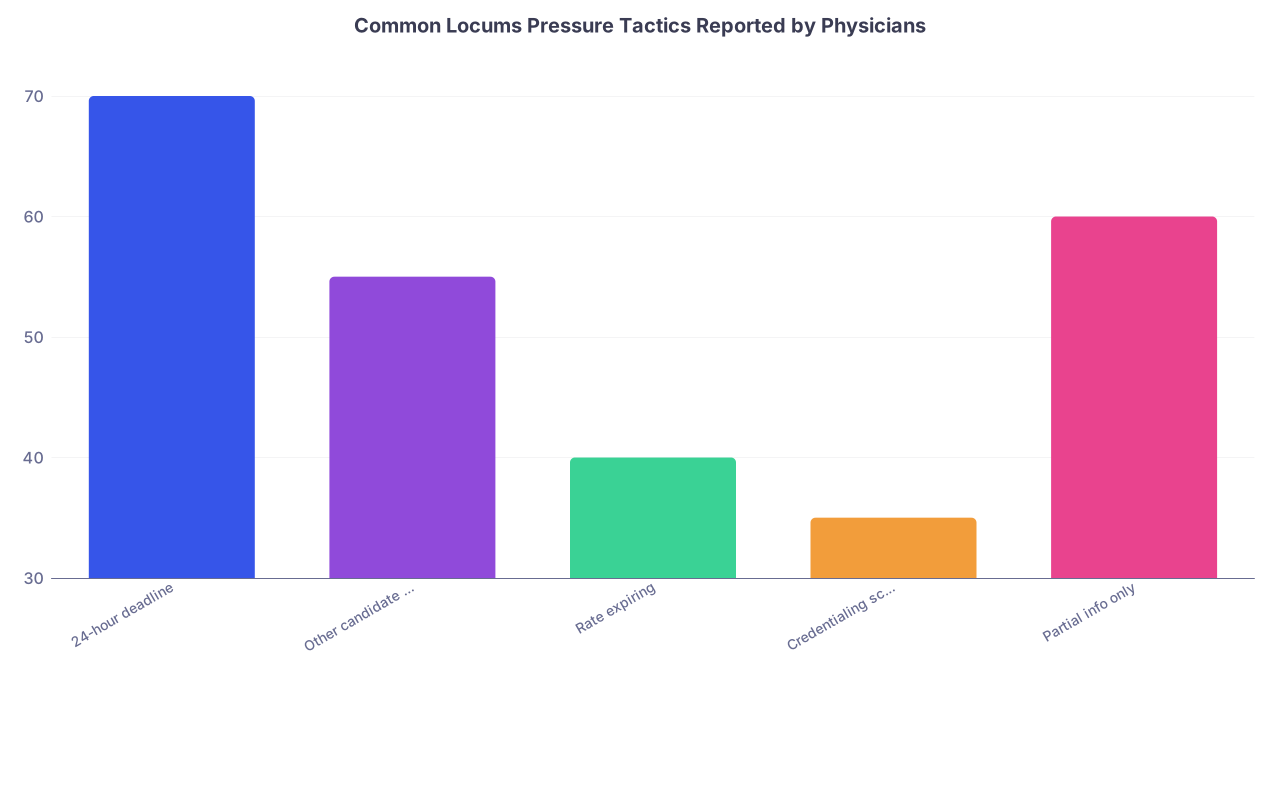
| Category | Value |
|---|---|
| 24-hour deadline | 70 |
| Other candidate threat | 55 |
| Rate expiring | 40 |
| Credentialing scare | 35 |
| Partial info only | 60 |

| Step | Description |
|---|---|
| Step 1 | Recruiter pressures you |
| Step 2 | Request full details in writing |
| Step 3 | Do not commit - move on |
| Step 4 | Review key terms |
| Step 5 | Ask for clarification or changes |
| Step 6 | Consider assignment calmly |
| Step 7 | Decide on your own timeline |
| Step 8 | Contract received? |
| Step 9 | Red flags or unclear? |
| Step 10 | Recruiter cooperative? |

| Situation | Recommended Action |
|---|---|
| Clear terms, no rush, fair rate | Consider proceeding |
| Moderate rush, cooperative recruiter | Proceed cautiously |
| Heavy rush, vague contract | Walk away |
| Refusal to clarify malpractice | Walk away |