
What do you do when your dream job offer hits your inbox… and then you read the fine print and realize they are not covering tail for your prior moonlighting?
Let’s walk through this like we’re sitting in the call room and you just showed me the contract PDF on your phone.
You: PGY-3 or fellow, or just finishing training.
Facts: You’ve done moonlighting under your own name or through a locums/prn company. Claims-made coverage. No guaranteed tail.
New employer: Great job, decent salary, nice location. But they explicitly say: “We do not cover prior acts or tail for previous employment or moonlighting.”
Now what?
1. Get Clear On What “Tail” You Actually Need
First thing: do not assume. You need details.
Here’s what you’re trying to answer:
Did your moonlighting work use:
- Your own personal malpractice policy?
- Coverage through a locums/staffing company?
- Coverage through the hospital or group where you moonlighted?
What type of policy was it?
- Claims-made (99% of the time for moonlighting)
- Occurrence-based (less common but sometimes used by hospitals or large systems)
Exact dates of:
- First and last shift
- Policy start and end
- Any gaps where you moonlighted but coverage might not match
Until you know this, arguing with your new employer or panicking about tail is just noise.
Pull together:
- Every moonlighting contract (PDF, email, or even text if that’s all you have).
- Proof of coverage certificates (COIs) you were given each year.
- Any emails from the moonlighting site/locums company about malpractice.
You’re looking for phrases like:
- “Claims-made coverage with limits of $1M/$3M.”
- “Tail coverage is the responsibility of the physician.”
- “Coverage is occurrence-based; no tail required.”
- “Employer will provide tail coverage upon termination.”
If you see “occurrence-based” anywhere, that specific coverage does not need tail for that time period. That’s a small win.
2. Understand Why Your New Employer Is Refusing Tail
Let me be blunt: most employers do not want to pay for your past life. Especially not random moonlighting gigs they never approved.
Common reasons they won’t cover your old moonlighting tail:
- Their malpractice carrier will not accept prior acts they did not control.
- They’ve been burned before by a hire who brought in a prior claim.
- They have a strict policy: “we cover tail only for work done for us.”
- Financial—tail can be expensive and they want predictable costs.
Do not waste energy trying to convince them they “should” pay.
Instead, you treat this like what it is: a defined problem with defined options.
Your job now is to:
- Protect yourself from uncovered liability.
- Protect the job offer if you want it.
- Avoid overpaying for nonsense coverage you do not need.
3. Risk Check: Are You Actually Exposed?
Not every moonlighting situation leaves you hanging. There are 4 common setups:
| Scenario | Tail Needed? |
|---|---|
| Occurrence-based policy | No |
| Claims-made with tail guaranteed by employer | No |
| Claims-made, tail on you, no tail purchased | Yes |
| Unsure / no written policy | Assume yes until proven no |
If your past moonlighting was:
Hospital-employed with a big system (e.g., HCA, Kaiser, large academic center)
Very often they carry claims-made but they pay tail when you leave, or the policy is structured within their captive. Ask directly, in writing.Locums agency (CompHealth, Weatherby, etc.)
Many locums companies use occurrence-based policies. Some use claims-made but keep the policy active without asking you for tail. You must confirm with the agency and, ideally, their carrier.Independent moonlighting with your own policy from MedPro, The Doctors Company, etc.
Usually claims-made. When you cancel, the clock starts on your need for tail. This is where people get burned.
If you cannot get a straight, written answer from the prior coverage provider, assume you need tail and plan accordingly.
4. Timeline Reality: How Long Are You on the Hook?
Malpractice is all about when the claim is made, not when you did the work (for claims-made).
So:
- If you worked moonlighting 2021–2023
- Policy is claims-made and ends June 2024 without tail
- A patient from a 2022 shift sues you in 2026
You’re naked. No coverage.
States differ, but most adult med mal statutes of limitation are 2–3 years from discovery, with special rules for minors. Practically, you want your tail to run:
- Many carriers offer 1, 3, 5 years, or unlimited tail.
- Unlimited is ideal, but 5 years is often what people end up with if money is tight.
Ask the carrier for quotes on different tail durations. Sometimes unlimited is only marginally more than 5 years. Sometimes it’s insane. Get actual numbers.
5. Your Real Options When The New Employer Won’t Pay
Here’s the part you actually care about: what do you do now?
Option 1: Push Prior Moonlighting Entity to Provide Tail
If there’s any plausible way the prior hospital, group, or locums agency should handle tail, squeeze that lemon first.
What to do:
Email your prior employer/locums contact:
- Ask: “Can you confirm whether my malpractice coverage for shifts at [site] between [dates] was occurrence-based or claims-made?”
- Ask: “If claims-made, who is responsible for tail coverage upon termination? Is tail already provided as part of the program?”
Ask for:
- Policy type
- Carrier name
- Policy number
- Written confirmation that no tail is required OR that they will provide it
Sometimes the admin genuinely thinks: “We covered you while you were here, so you’re fine,” but that’s only true with occurrence coverage. You need the carrier or a certificate, not well-meaning vibes.
I’ve seen residents get emails like, “Our policy is occurrence-based; once your shifts are done, you’re covered permanently.” That’s golden. Save that email.
If they drag their feet, escalate to:
- Medical staff office
- Risk management
- Legal/compliance
Be annoying. Politely. This is your career on the line, not a parking ticket.
Option 2: Negotiate Around Salary/Sign-On Instead of Tail Directly
Your new employer says: “We don’t cover tail for old work.” Fine. But money is still money.
Instead of “Please pay my tail,” you say:
- “I understand you cannot pay for prior acts coverage directly. However, I am required to purchase tail for my previous clinical work to take this job. The quote I received is $X. Can we adjust the sign-on bonus or salary to help offset that?”
Sometimes they’ll say no. But sometimes they’ll quietly increase your sign-on by $5–10k and call it a day. HR likes labeling things “sign-on” more than “tail subsidy.” Less precedent. Less drama.
You do not need them to label it as tail. You just need more cash to write the tail check.

Option 3: Buy Your Own Tail (Strategic, Not Panicked)
If it’s clearly on you and no one else is going to step up, then you treat tail like buying a used car: shop, compare, and read the specs.
Steps:
Call the current malpractice carrier that covered your moonlighting.
- Ask for tail quotes for 1, 3, 5, and unlimited years.
- Ask if there are any discounts (new-to-practice, risk management courses).
Ask if “nose coverage” through a new policy is possible.
- Sometimes a new employer’s carrier will pick up prior acts for your personal coverage, but this is rare for moonlighting and usually not done if employer has a hard-line policy.
Get written quotes. Then ask:
- “If I do not purchase tail now, can I purchase it later?”
- Some carriers require tail purchase within a fixed window (30–60 days post-termination).
Do not miss that window. Once it’s gone, it’s gone.
Real numbers I’ve seen:
- New attending, low-risk specialty, $1M/$3M limits, modest moonlighting volume: tail can be somewhere around 100–200% of the annual premium for that policy.
- If your annual premium was $4k, tail might be $4–8k.
- Higher-risk specialties (OB, EM, surgery): more.
Is that painful as a trainee? Yes. Is being personally on the hook for a claim worse? Absolutely.
Option 4: Rework Your Start Date / Overlap Period
Some people try the “I’ll keep my old policy active for a year instead of buying tail” move. Sometimes that works, sometimes it creates more problems.
If your moonlighting policy is:
- Personal, under your name
- Still in force
- Claims-made
You might say: “I’ll keep it active one more year to extend coverage instead of buying tail.”
Catches:
- You have to keep paying premium for a policy you’re not using.
- Your new employer may not like you having a separate active malpractice policy for side work (even if you do not plan to moonlight).
This is more of a temporary bandage than a real solution. But for some people, a year or two of premium is cheaper than full tail.
6. How to Talk About This With Your New Employer (Without Spooking Them)
You do not want to sound like a walking lawsuit. Phrase this like a responsible adult.
Sample script for the recruiter/HR:
“I’ve done some past moonlighting that was covered by a claims-made policy separate from my residency. To accept this position responsibly, I need to make sure I’m adequately covered for that prior work. Since your policy doesn’t cover prior acts for outside employment, I’m working on arranging tail coverage. The quoted cost is approximately $X. Is there any flexibility in sign-on bonus or relocation assistance to help offset this mandatory expense?”
If they push back with “This is your responsibility,” you can respond:
“Understood, and I’m not asking you to assume legal responsibility for the prior work. I’m just asking whether there’s room in the overall compensation structure to keep this financially viable. I’m very interested in the position and want to handle this correctly.”
You’re signaling: “I’m low-risk, thoughtful, and proactive.” That helps more than you think.
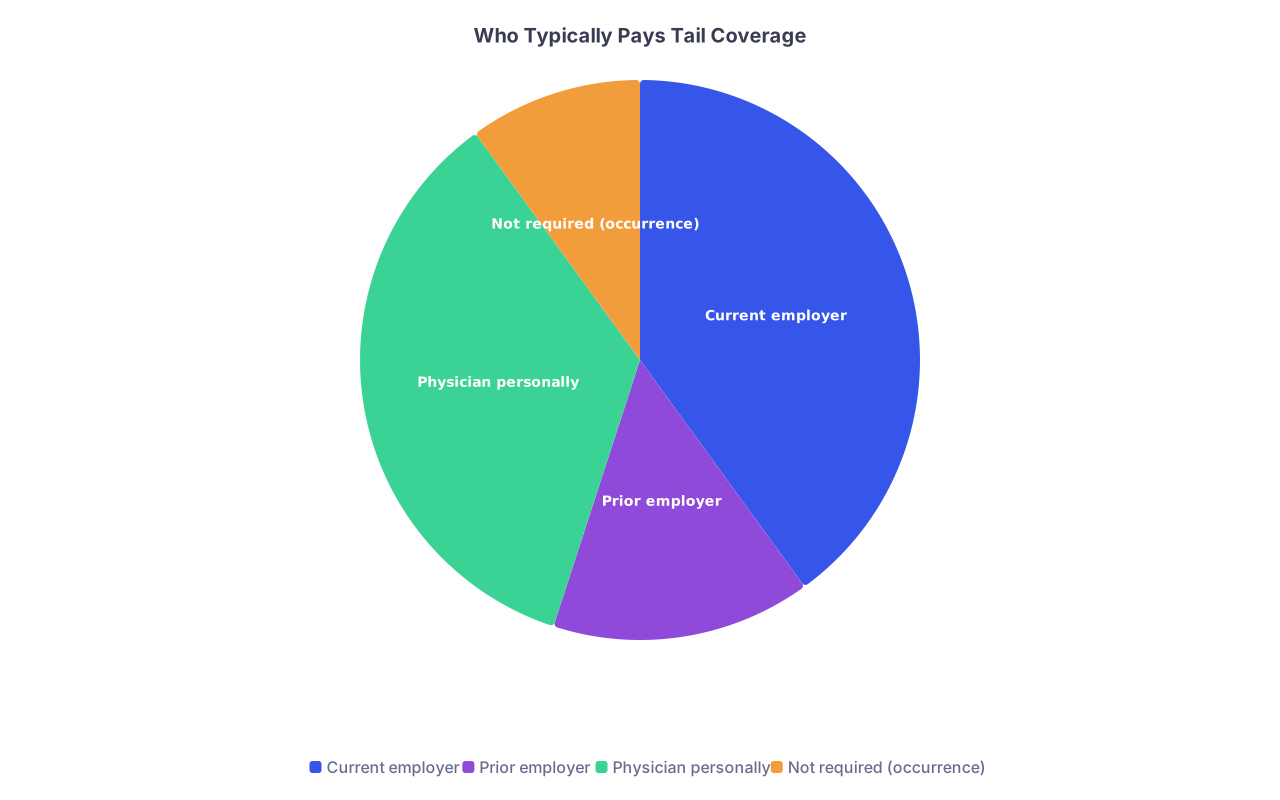
| Category | Value |
|---|---|
| Current employer | 40 |
| Prior employer | 15 |
| Physician personally | 35 |
| Not required (occurrence) | 10 |
7. Red-Flag Situations Where You Should Slow Down
Some patterns I’ve seen that should make you pump the brakes:
You have no written record of coverage for prior moonlighting.
- No certificate, no contract, nothing.
- Get something in writing from the site or agency before signing a new job.
The prior site says vague things like:
- “We always cover our doctors; don’t worry about it.”
- “We’ve never had a problem.”
That’s not an answer. Ask: “What is the policy type? Can you send me the certificate?”
Your new employer says:
- “You don’t need tail; our lawyers say you’re fine.”
- When their written policy literally says they don’t cover prior acts.
If their carrier isn’t explicitly providing prior acts coverage for your old moonlighting, then your “protection” is just someone’s casual opinion. That doesn’t count.
- The tail quote is massive compared to your expected benefit from the new job.
- Example: Tail is $30k, new job pays weakly, and they won’t move a dollar.
- It might be rational to walk away, finish training, or find a different employer who will at least help offset.

| Step | Description |
|---|---|
| Step 1 | Did you moonlight? |
| Step 2 | Ask prior site or carrier |
| Step 3 | No tail needed |
| Step 4 | Get written proof |
| Step 5 | Request quotes for tail |
| Step 6 | Buy tail |
| Step 7 | Negotiate comp or reconsider job |
| Step 8 | Know policy type? |
| Step 9 | Occurrence or Claims |
| Step 10 | Who pays tail? |
| Step 11 | Acceptable cost? |
8. What If a Claim Comes and You Had No Tail?
This is the nightmare scenario people try not to think about. You should.
If you had:
- Claims-made policy that ended
- No tail
- A lawsuit arrives on your doorstep 2–3 years later
The carrier will usually deny coverage because the claim was reported after the policy ended. Your new employer’s carrier will likely deny because the incident happened before your coverage with them and they didn’t accept prior acts.
You then:
- Have to hire your own attorney.
- May end up paying settlements or judgments personally.
- Have massive headaches with credentialing, NPDB reports, reputation.
That’s why you’re dealing with this tail mess now instead of sticking your head in the sand. The whole point is making sure you never end up in that spot.

9. Concrete Step-by-Step Plan (If This Is You Right Now)
If you’re literally in this position at this moment, here’s the move sequence I’d use:
List every moonlighting site and date range.
Hospital A – ED coverage – 2021–2022
Locums B – Telemedicine – 2022–2023
etc.For each site, identify the malpractice carrier and policy type.
Dig up:- Contract
- Certificate of insurance
- Old onboarding emails
Email risk management / locums agency / prior group.
Ask:- “Was my malpractice coverage for [site] occurrence-based or claims-made?”
- “Who is responsible for tail upon termination?”
- Ask for written confirmation.
Call the carriers directly if needed.
Have them explain in plain language:- Whether tail is needed
- Available tail options
- Deadlines to purchase
Calculate your total tail exposure.
Maybe:- Hospital A is occurrence → $0
- Locums B is claims-made, tail quote $5k for 5-year, $7k unlimited
Decide on a coverage strategy.
- If under $5k total: I’d personally just eat it or negotiate minor comp adjustment.
- If $10–30k: push hard on sign-on, relocation, or salary bump to offset.
Re-open negotiations with your new employer.
Show that you’ve done your homework and you’re not asking them to “fix a mess,” you’re solving it and just asking for fairness.Get every answer in writing.
Email confirmations, PDFs, updated contracts. Save them in 3 places.

FAQ (5 Questions)
1. My residency program covered my malpractice. Do I need tail for resident moonlighting done under the same umbrella?
Usually no, if your moonlighting was explicitly under the residency’s malpractice policy and that policy is occurrence-based or the institution provides institutional tail. You still need to confirm through GME or risk management whether ALL clinical work under your training appointment is permanently covered. Do not assume just because it was “in residency” that you’re safe; ask about policy type and whether moonlighting under your resident appointment number is included.
2. Can my new employer’s malpractice policy cover old moonlighting if they change their mind?
Sometimes, but it’s rare. Their carrier would have to agree to provide prior acts coverage for you personally, and that often conflicts with system-wide policy. If they truly want to, they’ll put “prior acts from [date] for all clinical work” into your offer or contract. Anything short of that is just talk. Get it in writing from HR or legal, referencing their malpractice carrier’s approval.
3. Is a cheaper, shorter tail (e.g., 1–3 years) good enough?
It depends on your risk tolerance and state law. A 1-year tail is almost always too short. Three years can be borderline for adult-only practice in a state with a 2-year statute, but discovery rules and minors can push beyond that. Five years is a more realistic minimum if money is tight. Unlimited is safest if the price difference is reasonable. If you’re in a high-risk specialty or did procedures, I’d lean toward longer coverage.
4. What if I truly cannot afford tail right now as a finishing resident or fellow?
Then you get creative, but you don’t ignore it. Push hard for an increased sign-on, early start bonus, or forgivable loan structured to cover tail. Ask the carrier about payment plans. Consider whether you can delay your start date a bit, work extra (safely) in your current role, and earmark that money for tail. If the tail is huge and nobody will help, it may be rational to choose a first job that explicitly covers prior acts for trainees or is willing to buy your tail as part of onboarding.
5. Does buying tail now affect my future malpractice premiums or credentialing?
Usually not in a negative way. Buying tail is seen as responsible. What does hurt you is having uncovered gaps or claims without coverage. Future employers and hospitals will ask about your malpractice history, including any gaps in coverage. Being able to say, “My prior work is fully covered, and here’s the documentation,” smooths credentialing and avoids awkward conversations with medical staff offices and risk management.
Key points to walk away with:
- Map your moonlighting coverage precisely; guesswork here is dangerous.
- If your new employer will not cover tail, they might still flex on money somewhere else—ask smartly.
- Uncovered past clinical work is a bet you do not want to make. If you need tail, buy it or get it paid for, then sleep at night.