
You’re in the call room at 2 a.m., eyes burning, scrolling through yet another LocumTenens or StaffCare email: “$220/hr, easy cases, malpractice included.” Your co-resident told you, “Don’t overthink it, just sign and make the money. Everyone does.”
You’re tempted. Extra cash for loans, childcare, maybe finally replacing that dying car. The contract is short, the recruiter is responsive, and HR already cleared you for the schedule.
So you click “Sign” without asking two critical questions:
- What happens if I cannot work tomorrow?
- What happens if someone sues me five years after I stop working there?
If you do not know the answers, you’re playing financial Russian roulette with your future. The two things residents and early attendings routinely ignore—disability coverage and tail coverage—are exactly the things that can blow up your life when you least expect it.
Let me walk through the mistakes I’ve watched people make, and how you keep yourself out of their mess.
Mistake #1: Treating Disability Insurance Like an Optional Luxury
Residents are great at worrying about the wrong risks.
You’ll agonize over a $200/mo gym membership, but shrug off the risk of losing $10 million in future earnings because you “feel healthy.” That mismatch is how people end up disabled, broke, and bitter, when it was avoidable.
The fantasy: “I’m young, I’ll be fine.”
Disability in your head means catastrophic trauma: car wreck, spinal cord injury, you in a wheelchair. That’s not the main danger.
Real-life disability claims for physicians? Much less dramatic:
- Severe depression and anxiety that will not resolve
- Back and neck problems from years of procedures
- Hand tremor that makes procedures unsafe
- Vision changes, migraines, autoimmune disease
- Cancer treatment that wipes you out for months or years
None of those are “I got hit by a bus.” But they absolutely can make you unable to practice your specialty—or medicine at all.
Here’s the ugly truth: your future income is your biggest asset by far.
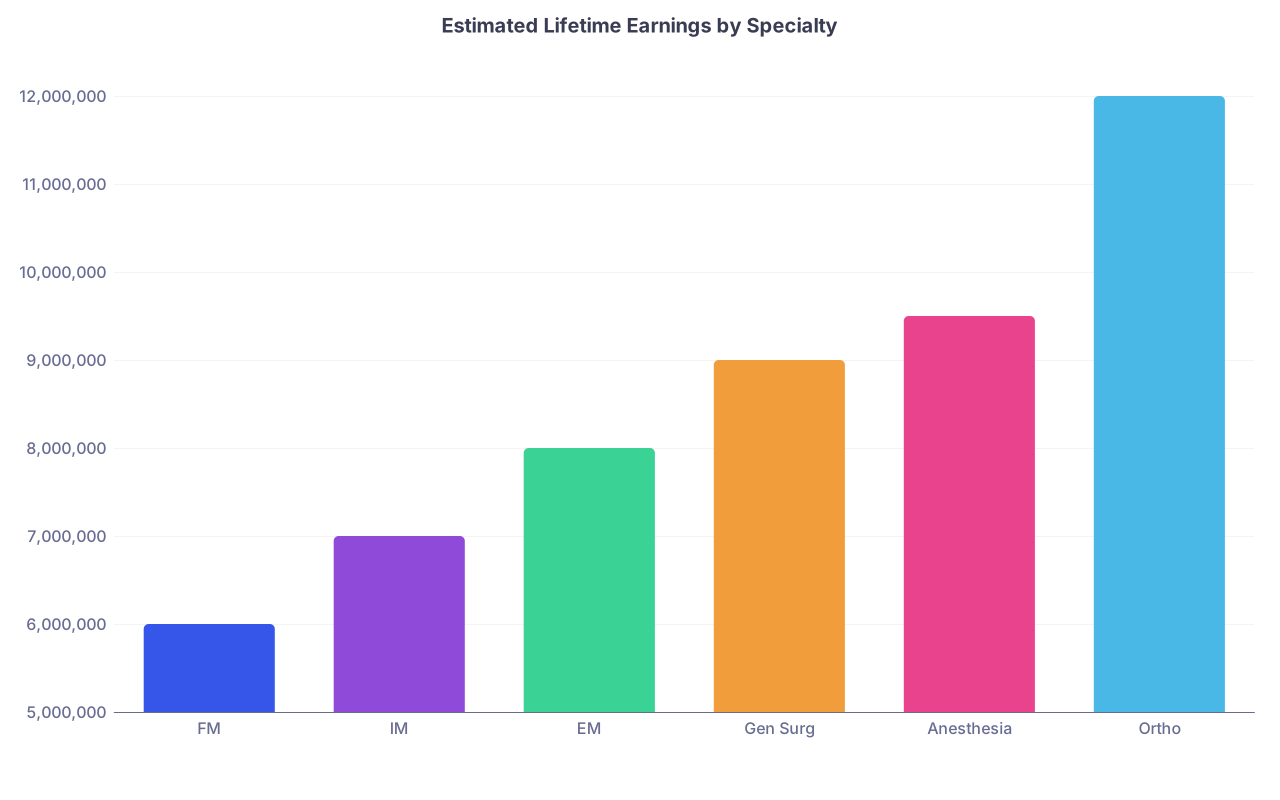
| Category | Value |
|---|---|
| FM | 6000000 |
| IM | 7000000 |
| EM | 8000000 |
| Gen Surg | 9000000 |
| Anesthesia | 9500000 |
| Ortho | 12000000 |
You would never leave a $50,000 car in a bad neighborhood with the doors unlocked. But many of you leave a multi-million dollar income stream completely exposed. No disability coverage, or worse—trash coverage.
That’s the mistake.
The dangerous assumptions that will wreck you
Here’s what I hear from trainees and junior attendings over and over:
- “My employer has disability, so I’m covered.”
- “I’ll get disability later when I’m making more money.”
- “It seems expensive; I’d rather just invest that money myself.”
- “I’m healthy, nothing in my chart, so I’m not worried.”
All four are wrong in different ways.
Employer coverage: usually short-term, taxable, and absolutely not designed to protect a physician’s lifetime earning potential. If you’re lucky, maybe 60% of your base pay, taxable, no bonus, no moonlighting. And if you leave that employer? Often gone.
“I’ll get it later”: later your health might not be “clean.” That back pain, that anxiety diagnosis, that new medication—underwriting will exclude it or jack your rates. I have watched residents get completely declined because of one psych hospitalization in intern year. And they applied “later.”
“I’ll just invest”: you cannot out-invest a permanent loss of income. Try building a portfolio big enough in residency to replace $300–500k/year. You will not.
“I’m healthy”: I’ve watched “bulletproof” PGY-3s end up out of training for:
- MS diagnosis
- Suicide attempt
- New seizure disorder
- Complicated pregnancy with long-term complications
None of them saw it coming. That’s the point.
The specific disability mistakes with moonlighting
Moonlighting adds its own traps.
If you do not set up disability correctly, you can:
- Under-insure yourself because you only counted base residency salary
- Lose coverage when you change institutions or go to fellowship
- Accidentally get a policy that defines disability in a way that screws you if you can “still do some work”
The big one: definition of disability.
If you buy or rely on a policy that is NOT true own-occupation, you’ve made a serious error. You want language that says:
If you cannot perform the material and substantial duties of your OWN specialty, you are disabled—even if you can still work in another job.
Otherwise, you’re a surgeon who loses fine motor control and gets told: “You can still see patients in clinic or do urgent care, so no benefit for you.” That’s the nightmare. And it happens when you chase “cheap” coverage.
| Feature | Bad / Risky Option | Safer / Preferred Option |
|---|---|---|
| Definition of disability | Any-occupation / modified own-occ | True own-occupation, specialty-specific |
| Provider | Employer-only group policy | Individual own-occupation policy |
| Portability | Tied to employer | Portable policy you own |
| Benefit taxation | Employer-paid (taxable) | You-pay premiums (tax-free benefits) |
| Riders | None or minimal | Residual, COLA, future increase |
If your eyes glaze over looking at that, that’s your cue: you need help from a physician-focused disability agent, not the random financial rep your hospital brought for free pizza.
Mistake #2: Ignoring Tail Coverage Like It’s Some Administrative Detail
Now the other landmine: tail coverage.
You sign a moonlighting agreement that says: “Malpractice provided.” You feel reassured. You never ask what kind of malpractice and what happens when you leave.
Then three years later: demand letter, lawsuit, or board complaint lands in your inbox from a patient you saw exactly once at that moonlighting gig.
You call the recruiter.
They say, “Oh, that contract ended. Our coverage only applied while you were working with us. You needed to purchase tail.”
That cold feeling in your stomach? That’s you realizing you’re naked in front of a plaintiff’s attorney.
Claims-made vs occurrence: the fork in the road people ignore
You cannot afford to be fuzzy on these two words:
- Occurrence coverage: covers you for incidents that occurred during the policy period, no matter when the claim is filed. No tail needed.
- Claims-made coverage: covers you for claims filed while the policy is active. When you leave, the policy stops covering new claims—unless you (or someone) buys tail.
Most moonlighting and locums gigs use claims-made. Especially if the rate sounds amazingly good: “We cover your malpractice.” That’s usually shorthand for “We bought the cheapest structure we could find.”
If you do not know which one you have, that’s your first mistake. If it’s claims-made and you do not know who pays for tail, that’s the second.
The bill for tail? It can easily be 150–250% of the annual premium. For some high-risk specialties, that’s tens of thousands of dollars.
Residents and early attendings do not have that lying around.
Mistake #3: Not Reading (or Understanding) the Tail Language in Your Contracts
I’ve reviewed a lot of moonlighting and employment contracts for people. The same problems keep showing up.
The tail landmines usually hide in a few lines of legalese:
- “Physician shall be responsible for purchasing tail coverage upon termination of this agreement for any reason.”
- “Employer-provided insurance is claims-made. No obligation for Employer to provide extended reporting endorsement.”
- “Malpractice coverage provided is limited to the duration of the agreement.”
If you sign that blindly, you’ve agreed to:
- Work under claims-made coverage
- Lose coverage the day the gig ends
- Personally pay for any tail if you do not want to be exposed
That’s the costly mistake.
Now imagine this scenario (I’ve seen versions of it):
An EM resident moonlights at a community ED PGY-3 and 4. Great money. Never checks the insurance type.
Two years later, as an attending in another state, they get sued for a misdiagnosis from one of those shifts. The locums company says their policy expired. They never bought tail. They’re now:
- Personally involving their new employer and new insurer
- Potentially paying out of pocket to defend the claim
- Risking personal assets if the judgment goes over policy limits or coverage is denied
All because they did not ask one specific question at the beginning: “Is this claims-made or occurrence? And if it’s claims-made, who pays for tail and is that in writing?”
Mistake #4: Trusting Recruiters and HR More Than the Written Policy
Another trap: letting a recruiter’s email reassure you more than a policy document or contract.
Recruiter: “Don’t worry, we take care of malpractice.”
You: “Okay, sounds good.”
No. Not good.
They may genuinely think it’s fine. Or they may just be trying to fill shifts. Either way, their understanding does not protect you. Only three things protect you:
- The actual malpractice policy
- The contract language about coverage and tail
- Your own personal malpractice or tail, if you bought it
If you cannot get a straight, written answer to:
- Policy type (claims-made or occurrence)
- Limits (e.g., $1M per claim / $3M aggregate)
- Who owns the policy
- Who is responsible for buying tail
…walk away. Or assume you’re going to be the one left holding the bag.
And yes, that sometimes means walking away from “easy” money. I have told people to turn down moonlighting that didn’t properly cover them. It’s not paranoia. It’s self-preservation.
Mistake #5: Assuming One Policy Automatically Covers All Your Work
This one is subtle and very common.
You might have:
- Hospital employment with employer-provided malpractice
- A personal side gig (telemed, urgent care, aesthetics, etc.)
- Moonlighting through a staffing company
- Maybe even some consulting or chart review
You assume one of those malpractice policies covers all of it.
It probably doesn’t.
Most policies are written for specific:
- Sites
- Scope of practice
- Employers / entities
If you start doing telemedicine on your own, or aesthetic procedures at a med spa, your hospital policy is almost certainly not covering that. And some moonlighting policies explicitly say they only cover work billed through that entity at that site.
I’ve seen people sued for side work where:
- They thought their “main job” coverage carried over. It did not.
- They used hospital letterhead or email for side advice and accidentally pulled their main employer into a conflict they never consented to.
Same with disability: employer group coverage is based on that job’s income and may evaporate once you switch positions. Your moonlighting income might not be considered at all when calculating benefits.
So you can be working 1.0 FTE at your main job plus 0.3 FTE of moonlighting, but only be insured for the 1.0 FTE salary. If you become disabled, you just lost 30% of your income that was never protected.
That’s a painful way to learn about policy limitations.
Mistake #6: Letting Cost and Inertia Talk You Out of Decent Protection
Disability and tail are expensive. Let’s be honest.
As a resident, $100–$300/month for disability feels like a lot. As a new attending, the idea of paying $15k–$40k for a tail on a job you hate feels insulting.
So people:
- Delay buying disability “until I’m an attending”
- Accept contracts where they are stuck buying tail themselves
- Walk into high-paying short-term jobs with no plan for coverage after they leave
You save money now and you buy a massive, invisible liability instead.
The disability mistake: buy it late, after a new diagnosis or two, and now coverage is:
- More expensive
- Excluding the exact things likely to disable you
The tail mistake: ignore it, switch jobs quickly, rack up multiple stints with claims-made coverage, and accumulate several uncovered risk windows in your career.
By the time a lawsuit or a disabling illness hits, you cannot go back in time and fix this. You can only regret it.
How to Avoid Getting Burned: Simple, Non-Negotiable Rules
You do not need to become an insurance expert. You just need a few hard rules you do not break.
For disability coverage
- Get an individual, own-occupation policy while you’re still in training if you can.
- Make sure it is specialty-specific own-occupation. Not “any occupation,” not vaguely worded.
- Add at least:
- Future increase rider (so you can increase coverage as an attending without more medical underwriting)
- Residual/partial disability rider
- Cost-of-living adjustment (COLA) if affordable
- Keep it portable and yours—not tied to one employer.
- Don’t count employer group coverage as your main plan. Treat it as a bonus.
And yes, that means you might be paying for disability on a resident salary. You are not paying for now; you are buying the ability to insure your attending income later, even if your health changes.
For malpractice and tail with moonlighting
Every time you consider a moonlighting or locums gig, you must get clear, written answers to:
- Is coverage claims-made or occurrence?
- If claims-made, who is contractually obligated to pay for tail?
- What are the policy limits (per claim / aggregate)?
- Does this policy cover board complaints or only lawsuits?
- Is coverage limited to certain sites / services?
If someone says “we cover your malpractice,” that’s not enough. Push until you have the policy type and tail responsibility in your contract.
If the contract makes you responsible for tail:
- Negotiate: ask for occurrence coverage or employer-paid tail, especially if they’re desperate for coverage.
- If they refuse, factor the tail cost into whether the work is worth it at all.
- Don’t sign “just for now” assuming you’ll sort it out later. You won’t.
A Quick Reality Check Flow
If you’re skimming this at 3 a.m., here’s the mental flowchart you should be running on any gig:

| Step | Description |
|---|---|
| Step 1 | Considering moonlighting job |
| Step 2 | Ask about malpractice type |
| Step 3 | Occurrence - No tail needed |
| Step 4 | Who pays for tail? |
| Step 5 | Safer - get it in writing |
| Step 6 | You pay tail - reconsider job |
| Step 7 | Review limits and scope |
| Step 8 | Decide if risk is worth rate |
| Step 9 | Occurrence? |
| Step 10 | Employer pays tail in contract? |
Do not let anyone rush you past these questions.
The Future-of-Medicine Angle: This Is Getting More, Not Less, Important
Telemedicine, side gigs, multi-state licenses, 1099 work, locums—this is where medicine is heading for a lot of younger physicians. Traditional single-employer, W-2, everything-wrapped-in-one-benefit-package is eroding.
That means:
- More claims-made policies.
- More fragmented coverage across entities.
- More opportunities for gaps and finger-pointing when something goes wrong.
And with burnout and mental health issues climbing, disability claims will not magically vanish either.
If you cling to the old mindset—“the hospital will take care of it,” “HR said I’m covered”—you’re setting yourself up to be the one holding liability in a system that’s very good at protecting itself and not so enthusiastic about protecting you.
Two Things to Do This Week
Not next year. This week.
Pull every disability and malpractice document you have.
- Do you have any individual disability policy?
- Do you know if your malpractice is claims-made or occurrence?
- Do you know who pays for tail on your current or past moonlighting?
For your next contract or moonlighting offer, refuse to sign until you have:
- Written clarity on malpractice type, limits, and tail responsibility
- A plan to get or upgrade an individual own-occupation disability policy
If a recruiter gets annoyed? Too bad. They’re not the one that will be sitting in a deposition or struggling to pay rent if you can’t work.
Key Takeaways
- Ignoring disability insurance is effectively gambling your entire future earning potential on staying perfectly healthy in a high-risk, high-stress job. That’s not brave; it’s reckless.
- Ignoring tail coverage—and not knowing whether your malpractice is claims-made or occurrence—is how you end up personally exposed to lawsuits years after a moonlighting gig ends.
- If you can’t clearly explain your disability coverage and who pays for tail on every job you do, you’re one bad month away from discovering the most expensive mistake of your career.