
Juggling Multiple PRN Jobs: Protecting Yourself From Schedule Conflicts
What do you do when two different PRN jobs “need you” the same Saturday, and both swear you already agreed to it?
If you are picking up per-diem/PRN shifts at multiple hospitals, clinics, or telehealth platforms, you’re walking into one of the most common traps in modern medicine: everyone wants “flexible coverage,” but they all want to be your priority.
Let’s get concrete. I’m talking about situations like:
- You’re a hospitalist with a 0.8 FTE main job and two PRN gigs: one at an LTAC, one doing telehospitalist weekends.
- You’re an EM doc with no full-time job, living on 3–4 different PRN contracts across systems.
- You’re a resident moonlighting at two different sites, both “casual” per diem, both texting you directly for coverage.
If that’s you, you need structure. Otherwise, you’ll double-book yourself, piss off schedulers, and possibly breach contracts without realizing it.
Let me walk you through how to protect yourself step by step.
Step 1: Know Exactly What You Signed – Before You Pick Up Anything
Most schedule disasters start with this lie we tell ourselves: “It’s per diem, so it’s casual. No big obligations.”
Wrong. A lot of “PRN” contracts have hidden expectations and vague language that becomes a weapon when they want leverage.
Pull every contract you’ve signed. Highlight these specific clauses:
- Minimum commitment
- “X shifts per month” or “X weekend per quarter”
- “Holiday rotation” requirements
- Exclusivity / conflict of interest
- “Physician agrees not to provide services at competing facilities within X miles”
- “Moonlighting must be approved”
- “Employee will not engage in other clinical work during on-call periods”
- Scheduling priority
- “Schedule must be submitted by [date]”
- “Shifts are locked in once confirmed and cannot be changed within X days”
- Cancellation rules
- Fees for canceling
- Blacklisting/unofficial retaliation if you back out last-minute
- Call coverage expectations
- Are you “available” even if not physically in the hospital? That time is already sold.
If you cannot answer, in 30 seconds, “Who gets first dibs on my time? Who can block out certain days?” you do not actually know your risk.
Here’s a simple way to compare your jobs:
| Job | Minimum Shifts | Exclusivity Radius | Cancellation Window | Call Requirement |
|---|---|---|---|---|
| PRN A | 2/month | 10 miles | 14 days | No |
| PRN B | None | None | 7 days | Yes, phone call |
| PRN C | 3/quarter | 20 miles | 30 days | In-house weekends |
Who wins if everyone wants you the same Saturday? The one with minimums or exclusivity and the rougher cancellation penalties. That job gets blocked into your calendar first every month.
If you see exclusivity clauses that conflict with another PRN gig, that’s not theoretical risk. That’s “you could be fired or worse if someone decides to enforce this.”
Do not shrug and hope. Either:
- Ask for a written exception/waiver (“I’ll be doing PRN at X facility as well; is that an issue?”), or
- Drop the riskier job before it drops you.
Step 2: Build a Hard, Non-Negotiable Scheduling System
You cannot juggle multiple PRN roles with “I’ll remember” or a random paper calendar. That’s how people double-book and then try to fix it with apologies and pizza. It never really fixes the damage.
You need one source of truth. Not three calendars. One.
Use:
- Google Calendar or Outlook as the master
- Color-code each job
- Turn on alerts
- Sync it to your phone
Then follow this order of operations every single time:
Block your non-negotiables first
- Core FTE job schedule
- Required PRN minimums (e.g., “one weekend per month at Hospital X”)
- Board prep, exam dates, family events that are genuinely non-movable
Decide a clear priority ladder for PRN gigs
Example priority:- Level 1: Job with minimum shifts or higher pay / key relationship
- Level 2: Job with more flexibility and no minimums
- Level 3: “Nice to have” telehealth or locums you use to fill gaps
When you tentatively agree to a shift (even verbal or over text), put it in your calendar immediately with the status “HOLD – not confirmed” and the name of who you spoke to.
Do not confirm with a second site for that date/time until the existing hold is either:
- Confirmed, or
- Explicitly released
Do not keep it in your head. The people who say, “I’ll remember I just texted Sarah,” are the ones calling schedulers at 5 am on a Saturday saying, “Wait, I thought that was next weekend.”
Step 3: Understand How Schedulers Actually Operate
Schedulers are juggling 30–100 clinicians. They’re not reading your contract every time. They’re filling gaps.
If you’re working multiple PRN jobs, you’ll hear stuff like:
- “I thought you were available that weekend?”
- “You said you could probably do the 14th.”
- “We really need commitment from our per diem staff.”
Here’s what’s really happening:
- They remember “you said maybe” as “you committed”
- They assume they’re your top priority unless you tell them otherwise
- They hate last-minute changes because it makes them look bad internally
Your job is to create predictable rules for them.
Example script when you have multiple PRN jobs:
“I commit my schedule in this order: my main job first, then Hospital A where I have a minimum requirement, and then I fill in with you and Telehealth B. If I’ve already confirmed somewhere else for that day, I won’t be able to switch. So I need final confirmation in writing before I can commit to those dates.”
You’re not asking for permission. You’re setting expectations.
Step 4: Lock in a Monthly Rhythm Before the Chaos Starts
The most dangerous time is the “gray zone” at the beginning of each month or schedule block, when all sites are asking:
- “What can you give us for March?”
- “Can you send us your availability for Q2?”
You respond to all of them, then they all circle back at different times, and suddenly the same Saturday looks “open” to three different people because you haven’t updated anything.
You need a standard process. Every month or block:
- Get your main job schedule (or best estimate)
- Block your must-do PRN commitments (the ones with minimums, or your highest-value site)
- Decide what days you want to work extra and which are truly off-limits
- Offer those remaining days to your other PRN jobs in strict order:
- Job A gets first pass. Once they confirm, update the calendar.
- Then Job B sees what’s left. Confirm, update calendar.
- Then Job C, etc.
Don’t blast out “I’m free these 4 weekends!” to three different schedulers at once.
Instead, stagger your offers. Or tell them clearly:
“I also work PRN at another site. I can’t guarantee these dates until you confirm them. Once you pick dates, I’ll block them off for you.”
Step 5: Protect Yourself With Written Confirmations and Receipts
Verbal agreements and text messages get “forgotten” the moment it’s convenient for the other side.
Any time you agree to a shift with your voice or thumbs, follow it with:
“Just to confirm: I’m on for Saturday, March 16, 7a–7p at [Site], correct?”
Then:
- Save the email or text chain
- Label the event in your calendar with “CONFIRMED” in the title
- If they use an internal scheduling system (Amion, QGenda, Intrigma, etc.), screenshot the assignment
Because when there’s a conflict, people will say:
- “We never confirmed that”
- “I thought you were PRN with us first that day”
- “I show you on our schedule for that weekend”
Receipts shut this down quickly.
You can also use them upstream when managing expectations:
“I’m already confirmed 7a–7p at [Other Facility] that day. Here’s the confirmation email. I can’t work two places at once.”
Simple. Boring. Hard to argue with.
Step 6: What To Do When You’ve Already Double-Booked Yourself
Let’s say the damage is done: you’re booked two places, same time.
Here’s the triage:
Check which shift was confirmed first (by time-stamped record)
Check:
- Which site has minimum shifts you must meet
- Which contract has stricter cancellation penalties
- Which relationship matters more long term
Decide which you must keep. That’s not emotional. It’s contractual + strategic.
Then you fix it with the site you’ll cancel on.
How to approach the cancellation conversation:
- Call first (if daytime), then follow with written confirmation
- Do not make it sound like you casually forgot
- Take responsibility, present a concrete make-up plan
Example script:
“I need to own a mistake on my side. When I confirmed for the 16th, I failed to log that I was already committed at another facility. That’s on me. I want to minimize disruption.
I’m able to cover [alternative date] or [alternative date], and I can also take an extra short-notice shift this month if someone drops. I understand if this affects priority for future scheduling, but I want to work on repairing trust rather than just bailing.”
The key: don’t lie (“family emergency,” “sudden travel”) when the real issue is scheduling chaos. People in medicine can smell that from a mile away.
Do it right once, apologize like an adult, fix your system so it never happens again.
Step 7: Design Your “Max Capacity” Before You Burn Out or Slip
Another stupid but common pattern: you keep saying yes to PRN shifts at multiple sites because “they really need me” and “it’s just this month.” Then you’re at 24 shifts this month, driving between three systems, doing random nights, days, tele, and suddenly:
- You misread a med order at 3 a.m.
- You fall asleep on the way home from a post-call PRN shift
- You forget you’re on call for one site while working physically at another
You can’t rely on “I’ll just be careful.” That’s how people get hauled in front of a committee.
Set hard rules for yourself:
- Maximum shifts per month total (regardless of pay)
- Maximum consecutive days worked across all jobs
- Hard “no PRN” zones around nights / 24-hour calls
Use a visual. For example:
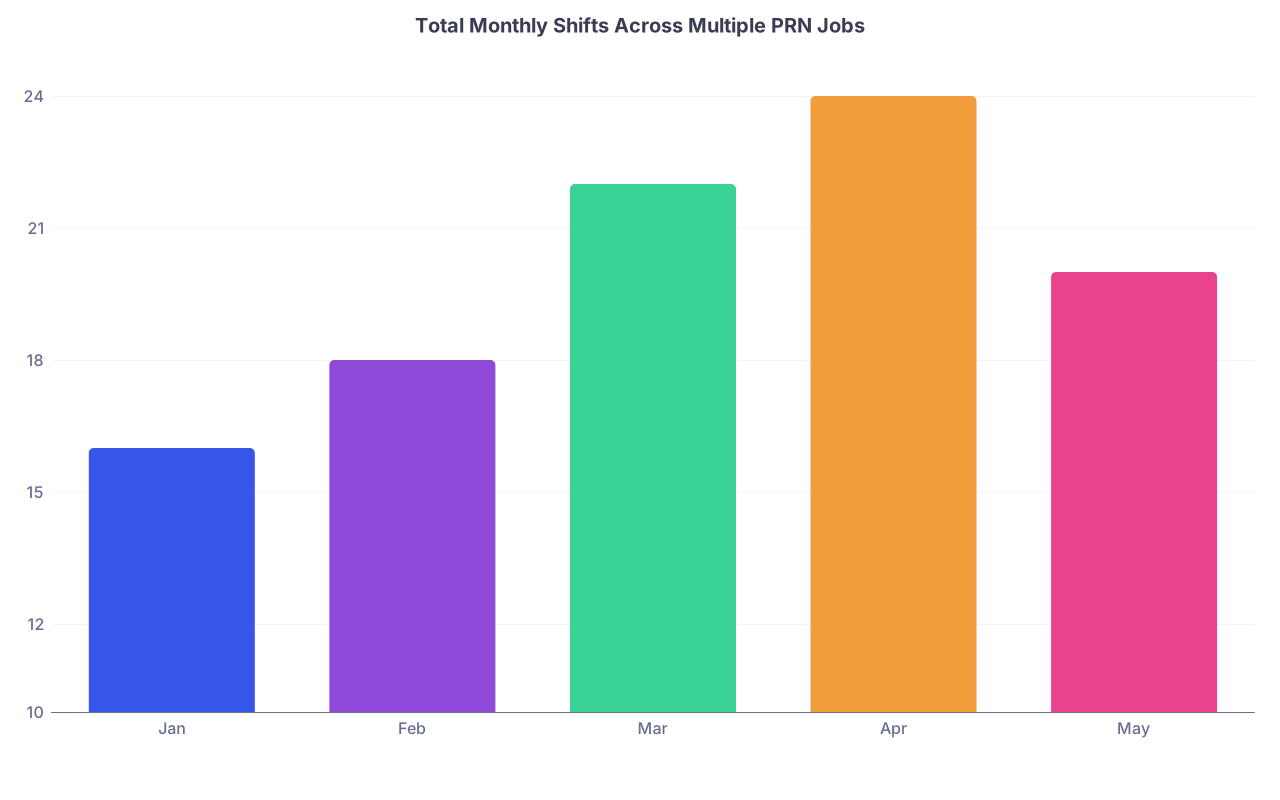
| Category | Value |
|---|---|
| Jan | 16 |
| Feb | 18 |
| Mar | 22 |
| Apr | 24 |
| May | 20 |
If you see the bar creeping up to 22–24 shifts across all gigs, that’s your risk zone. Most people start making sloppy mistakes in that territory, especially if nights are mixed in.
Your license and your brain are more valuable than whatever that extra $1,200 shift pays.
Step 8: Use a Simple Workflow to Decide “Who Gets This Day?”
You’re going to repeatedly face the same decision: “I have this weekend free. Who gets it?”
Make a simple decision tree. Something like:

| Step | Description |
|---|---|
| Step 1 | Free Day Identified |
| Step 2 | Offer to Job With Minimums |
| Step 3 | Honor Existing Obligation |
| Step 4 | Offer to Priority Job |
| Step 5 | Offer to Easiest / Least Stressful Job |
| Step 6 | Contractual Minimum Met? |
| Step 7 | Any Exclusivity or Call? |
| Step 8 | Who Pays Best or Matters Most? |
You want to remove emotion from the choice. You should not pick based on who sounded more desperate on the phone that day.
Common sensible tie-breakers once minimums and exclusivity are satisfied:
- Higher hourly or per-shift rate
- Less commute / time cost
- Better staff support / not soul-crushing
- Future opportunity (chance to convert to a good part-time or full-time offer)
If two sites pay the same but one runs 1:20 nurse ratios, you know which one should get your time. Do not be a hero.
Step 9: Separate Clinical Risk From Scheduling Risk
Some PRN work is low clinical risk (e.g., teletriage with strict protocols, supervised coverage). Some is high risk (solo night EM coverage at a critical access hospital with no backup).
Layer that on top of your schedule complexity.
If you stack:
- Unfamiliar environment
- High acuity
- Night shift
- Multiple PRN jobs in the same week
…you’re increasing the chance that a schedule slip merges with a clinical error. Wrong chart. Wrong orders. Late callback because you forgot who you were covering for.
Minimize this by:
- Not pairing your most chaotic PRN environment with your most chaotic week
- Avoiding back-to-back nights at two different sites if they chart differently
- Limiting yourself to one “new” or rarely worked site per week
This isn’t about being fragile. It’s about not being stupid.
Step 10: Use Technology Like an Adult, Not Like a Resident With 40 Group Chats
If you’re serious about juggling multiple PRN jobs, use tools properly:
- One master calendar synced across devices
- Notifications for:
- Shift start times
- “You are on call today” reminders
- 48–72 hour advance reminders for every assignment
You can also create an internal tracking system; something basic like:
| Date | Site | Time | Role | Confirmed By | Method (Email/Text/App) |
|---|---|---|---|---|---|
| 3/2 | Hosp A | 7a–7p | Hospitalist | Jane S | QGenda |
| 3/3 | Tele B | 8a–4p | Telehospitalist | System | |
| 3/9 | LTAC C | 7a–7p | Rounding | Mike R | Text |
Keep this in a simple spreadsheet. Five-second glance tells you:
- Where you are
- Who confirmed it
- How to prove it
For those who care about income clarity too, you can extend this to include rate and estimated pay:
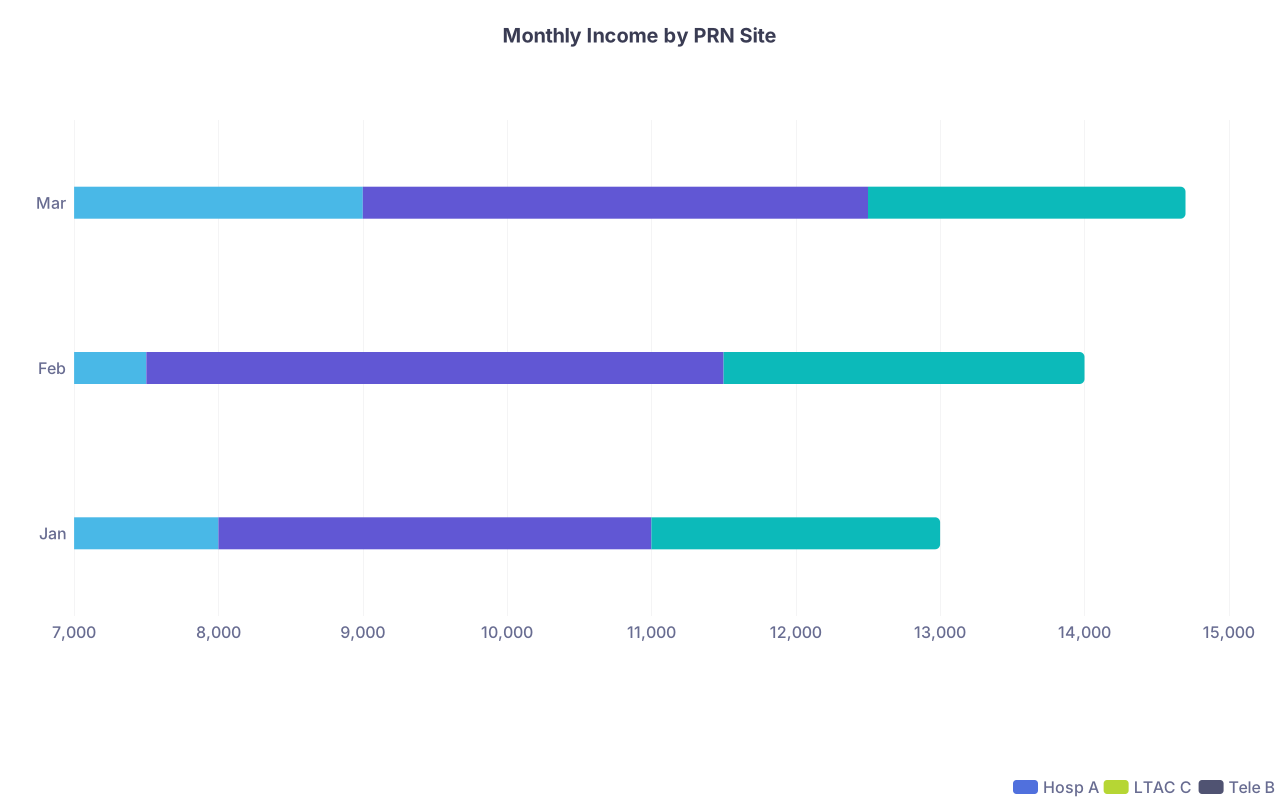
| Category | Hosp A | LTAC C | Tele B |
|---|---|---|---|
| Jan | 8000 | 3000 | 2000 |
| Feb | 7500 | 4000 | 2500 |
| Mar | 9000 | 3500 | 2200 |
Helpful for seeing which gig is actually worth the headache.
Step 11: Plan for When Hospitals Get Aggressive About “Commitment”
As staffing patterns shift, more systems are getting prickly about per diem docs who “aren’t available enough.” You may hear:
- “We need more consistent commitment from you.”
- “If you can’t give us at least X shifts, we may need to rethink your status.”
You have three options:
- Accept those increased expectations and drop other PRNs
- Push back and keep them truly PRN
- Move on if they’re trying to convert you into cheap part-time labor without benefits
When they start with the “we need more commitment” talk, ask:
- “Are you moving PRN to an internal minimum commitment status?”
- “How many shifts per month or quarter are you expecting?”
- “If I can’t meet that, will I be terminated or just given lower priority?”
Then decide cleanly. Don’t “half-commit” to 3 jobs that all want semi-part-time hours. That’s the perfect recipe for schedule conflict and burnout.
Step 12: Residents and Fellows: Extra Landmines for Moonlighting
If you’re still in training and juggling multiple moonlighting roles, your risk is even higher because:
- Your primary program usually must approve outside clinical work
- Your duty hours include moonlighting
- Your malpractice coverage might be more fragile than you think
You need:
- Written GME approval for each moonlighting site
- A system where your chief or PD can clearly see you’re not exceeding duty hours
- Absolute priority given to residency obligations (you can be fired as a resident a lot faster than a PRN doc at some outside clinic)
This is where a simple visual timeline helps you sanity-check your schedule:
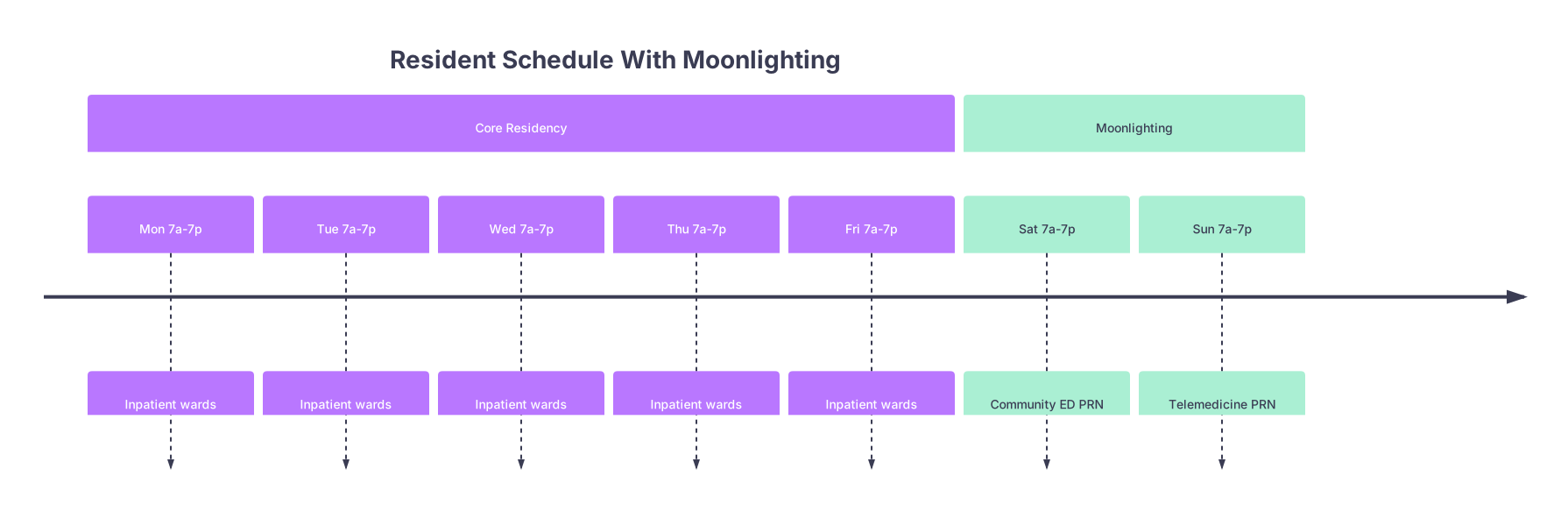
| Period | Event |
|---|---|
| Core Residency - Mon 7a-7p | Inpatient wards |
| Core Residency - Tue 7a-7p | Inpatient wards |
| Core Residency - Wed 7a-7p | Inpatient wards |
| Core Residency - Thu 7a-7p | Inpatient wards |
| Core Residency - Fri 7a-7p | Inpatient wards |
| Moonlighting - Sat 7a-7p | Community ED PRN |
| Moonlighting - Sun 7a-7p | Telemedicine PRN |
If you stare at that and your brain says “I can handle it,” that’s not the right test. The right test is: “What would my PD say if this was on paper in the CCC meeting?” Be honest.
The Bottom Line: Key Moves To Protect Yourself
Keep it simple:
Know your contracts and priorities. Minimum shifts, exclusivity, and cancellation rules decide who gets first rights to your time. Not “who asked first this week.”
Use one master scheduling system and get everything in writing. Every “yes” becomes a calendar entry and a saved confirmation. No exceptions.
Set hard limits and repeatable rules. Decide max shifts, max consecutive days, and a clear decision tree about which job gets your free days. Then stick to it.
If you want to juggle multiple PRN jobs without wrecking your reputation, your sleep, or your license, you don’t need more hustle. You need discipline and a system.