
It’s 7:30 p.m. on a Tuesday. You just finished another clinic that ran an hour late because the 3:30 “simple follow-up” turned into a train wreck of uncontrolled diabetes, depression, and no-showed specialists. You’re staring at your monthly productivity “dashboard” in your inbox.
RVUs, benchmarks, comp-to-mean, “conversion factor adjustments.”
You’re wondering: Who is deciding this? And how are they actually judging whether I’m “productive” or not?
Let me pull you into the room where those decisions are really made.
Because I’ve watched the conversations between CMOs, CFOs, consulting firms, and service line directors. The way they talk about your work would make your blood pressure spike.
The CFO’s Core Reality: You Are a Line Item and a Lever
The first mental shift: the hospital CFO is not thinking about your day like you are.
You see patients, problems, continuity, risk, moral injury.
They see service lines, margins, and cost-per-RVU.
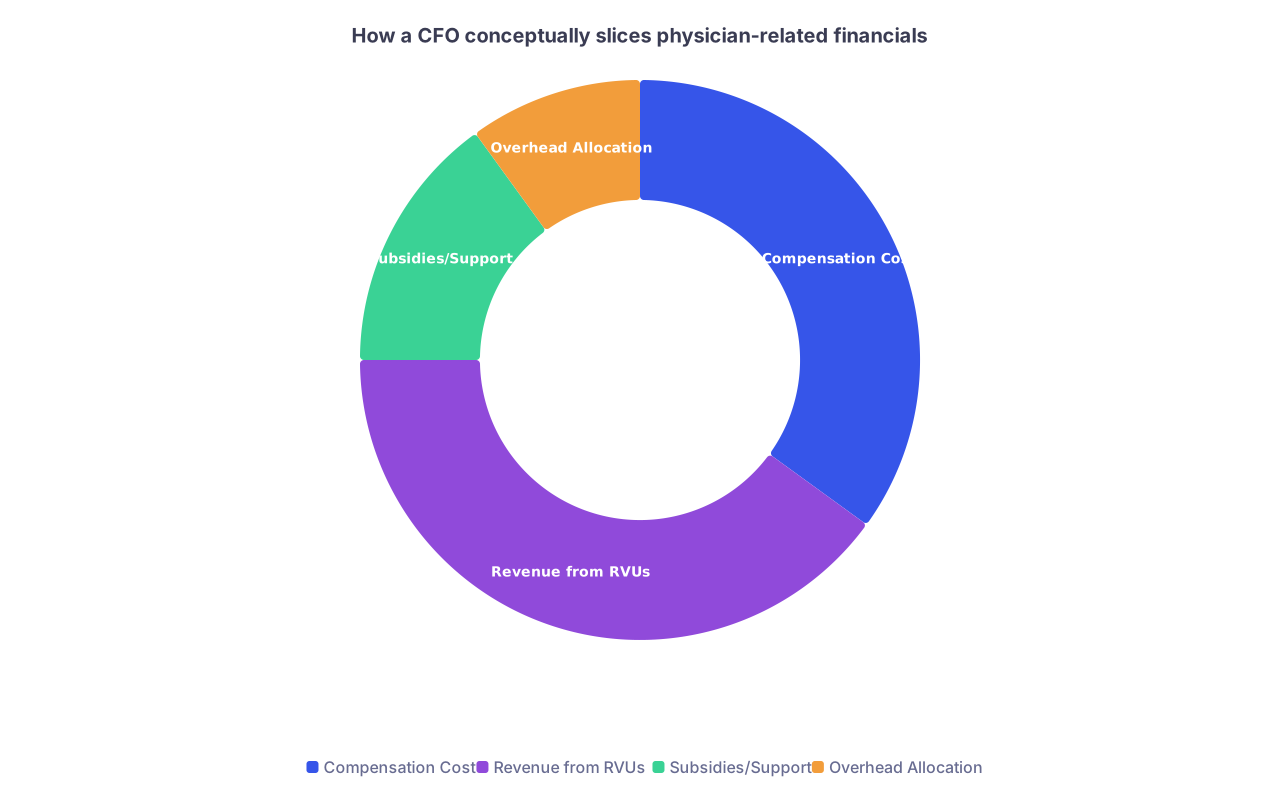
| Category | Value |
|---|---|
| Compensation Cost | 35 |
| Revenue from RVUs | 40 |
| Subsidies/Support | 15 |
| Overhead Allocation | 10 |
In most internal spreadsheets, physicians are grouped into a few buckets:
- Direct money-makers (proceduralists, high-RVU specialists)
- Indirect money-makers (hospitalists, ED, primary care feeding downstream)
- Necessary-but-expensive (neurology, ID, rheumatology, peds subspecialties in some markets)
Here’s the uncomfortable truth: “Productivity” is rarely about how hard you work. It’s about whether the revenue your RVUs generate justifies your compensation plus your support costs relative to peers.
That “relative to peers” part is where the games begin.
RVUs: The Currency They Actually Care About
Most physicians misunderstand what RVUs look like from the finance side.
You’ve been told: RVUs are a measure of work.
The CFO hears: RVUs are a billable unit I can plug into a contract, a pro forma, and a system dashboard.
Internally, they live in spreadsheets like this:
| Metric | Example Value |
|---|---|
| Annual wRVUs | 7,500 |
| Conversion factor | $50 per wRVU |
| Clinical comp at target | $375,000 |
| Professional collections | $320,000 |
| Hospital contribution/subsidy | $55,000 |
Notice that in that view, you are not “busy” or “overwhelmed.”
You are: 7,500 wRVUs, a $375k cost, producing $320k in variable revenue, needing a $55k subsidy.
The follow-up questions the CFO and their analysts ask—sometimes literally in these words:
- “Can we push this doc closer to the 75th percentile wRVUs without increasing base comp?”
- “Are we overpaying relative to MGMA for this specialty in this region?”
- “If we lose them, what downstream revenue is actually at risk?”
They pull MGMA/SullivanCotter tables and overlay local payor mix and collection rates. If you produce 7,500 wRVUs, they’re immediately mapping that against “median,” “60th,” “75th percentile” benchmarks.
Your sense that “I can’t work any harder” doesn’t matter if, on paper, you sit at the 40th percentile for wRVUs with 75th percentile comp.
That’s the fight you don’t see.
“Productivity” Is a Negotiated Fiction, Not a Neutral Metric
You’ve seen the tidy formulas in your contract:
- Base salary tied to X wRVUs
- Bonus paid per RVU above that
- Maybe a quality or citizenship component
Behind the scenes, those thresholds aren’t derived from some objective truth. They’re the product of:
- What MGMA data the consultants cherry-picked
- What the organization wants your comp-to-collections ratio to be
- How aggressive they think they can be before you quit
I’ve seen CFOs say this explicitly in comp meetings:
“If we set the threshold at 6,000 wRVUs, we’re just handing out bonuses. Push it to 7,200. They’ll grumble, but they won’t leave.”
They’re not calibrating to “fair.” They’re calibrating to retention risk.
Bonuses: Carrots, Not Gifts
Let’s talk about your bonus. That thing they pretend is a “reward” for good work.
From the CFO side, a bonus is a behavior-shaping tool. A lever.
Most organizations structure it so that:
- The base salary is “safe” but intentionally a little uncomfortable
- The bonus opportunity feels big enough that you’ll chase it
- Hitting the bonus puts your total comp right where they wanted it all along
Picture two internal scenarios they run:
- Scenario A: $300k base, no bonus
- Scenario B: $260k base + up to $60k in bonus at 8,000 wRVUs
They almost always choose Scenario B, because it shifts the risk and the hustle onto you.
If payors tighten, volumes drop, or coding audits hit, who eats that loss? Not the CFO. Your “potential” bonus just doesn’t get paid out. They present it as unfortunate economics, not a broken promise.
And one more thing: bonuses are easier to dial back “due to market changes” than base salary. I’ve watched this play out after every major reimbursement cut.
What They Actually Track When They Say “Productivity”
There’s the stuff they show you. And the stuff they only show in finance/ops meetings.
Patient-facing physicians get:
- wRVUs
- Office visits per day
- New vs established ratios
- Basic quality metrics
CFO/COO dashboards add:
- Collections per wRVU (by doc)
- Direct margin per physician FTE
- Contribution margin after support costs
- Referral patterns and downstream revenue (imaging, procedures, admissions)
- No-show/cancellation rates by schedule template
- Support staff cost per visit or per wRVU
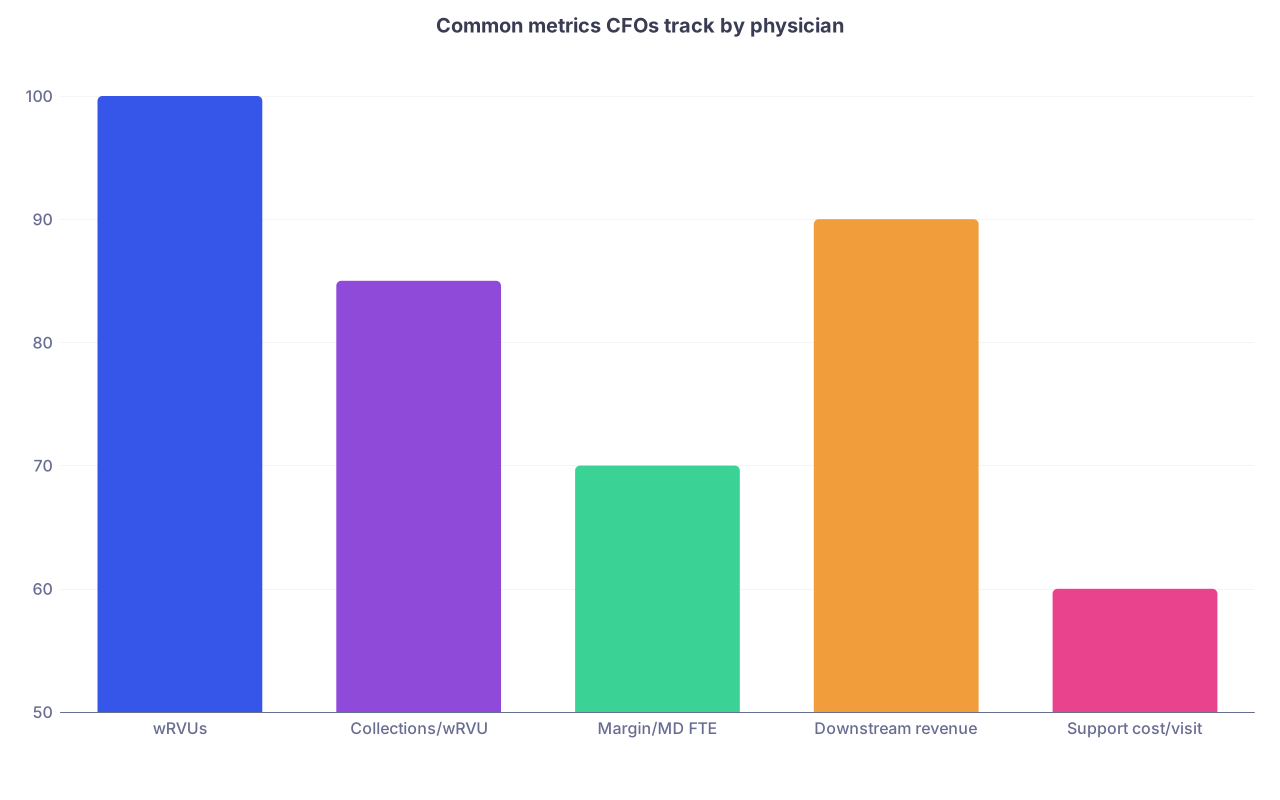
| Category | Value |
|---|---|
| wRVUs | 100 |
| Collections/wRVU | 85 |
| Margin/MD FTE | 70 |
| Downstream revenue | 90 |
| Support cost/visit | 60 |
So two internists both doing 6,000 wRVUs are not equal in their eyes.
One sends a ton of cardiology, GI, and imaging to the system, codes accurately, has low no-show rates, and uses one MA efficiently.
The other has constant staffing drama, low coding intensity, and meh downstream revenue.
If cuts come, guess who gets “restructured” first?
Why Moonlighting Freaks CFOs Out (And How They Actually Look at It)
You’re reading this under the “Moonlighting and Benefits” category, so let’s be blunt about how leadership sees your extra shifts.
Most hospital CFOs do not care about your side money morally. They care about two things:
- Are you moving your main FTE productivity in the direction they want?
- Are your outside shifts creating compliance, coverage, or optics problems?
A few specific issues I’ve watched them discuss behind closed doors:
“Her RVUs dropped 15% this quarter, and she’s now working nights at the community hospital across town.”
Translation: your loyalty and capacity are being questioned.“He’s doing telemedicine moonlighting and still signing out late notes. That’s going to show up in an audit.”
Translation: compliance red flag.“Our employed hospitalists are moonlighting at the SNF and then complaining about burnout.”
Translation: leadership frustration, not much sympathy.
If your main job is hospital-employed and RVU-based, the unspoken expectation is simple: your “A-game” belongs to them. Moonlighting is tolerated as long as:
- Your wRVUs meet/exceed target
- Your quality metrics don’t tank
- You’re not missing committee work, call responsibilities, or creating schedule headaches
Once any of those slip, moonlighting becomes the convenient scapegoat in the narrative.
How CFOs Think About Benefits vs Your “Cost”
You think of benefits as part of your compensation. The CFO thinks of benefits as your full “loaded cost.”
Salary is just the starting number in their model. Add:
- Employer-paid health insurance
- Retirement contributions
- Malpractice
- CME stipends
- Admin support, clinic space, IT, call pay, etc.
Internal spreadsheets look like this:
| Component | Example Number |
|---|---|
| Base + bonuses | $350,000 |
| Benefits (health, retirement, etc.) | $70,000 |
| Malpractice | $20,000 |
| Allocated overhead/support | $110,000 |
| Total loaded cost | $550,000 |
Now crosswalk that with your revenue:
- Professional collections from your RVUs
- Facility revenue attributed to your work (inpatient days, OR time, imaging, infusion, etc.)
Here’s the unspoken rule: if your all-in cost is $550k and they can reasonably connect you to $1M+ in net revenue for the system, you’re “worth it.”
If that number drops—because of payor mix, dropped volumes, or your partial FTE—they will start asking questions and “re-evaluating” the comp plan.
Benefits become the first place they trim when negotiating new contracts: lower CME, weaker retirement matches, higher health premiums. They present it as “industry standard adjustments.” Internally it’s: “We’re at 18% benefits load; we need to get down to 15%.”
How Contract “Revisions” Actually Happen
You see a new contract version every 2–3 years with updated targets. Feels like a natural refresh.
Behind the scenes, that usually follows this timeline:
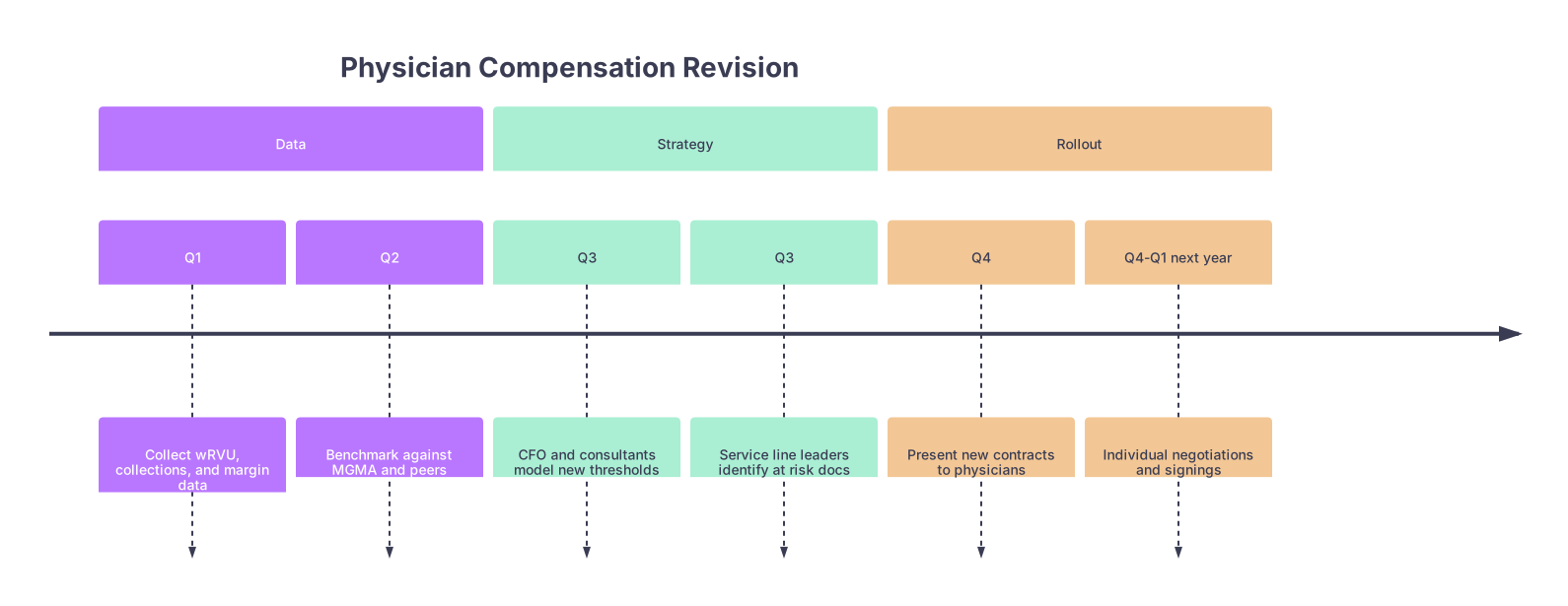
| Period | Event |
|---|---|
| Data - Q1 | Collect wRVU, collections, and margin data |
| Data - Q2 | Benchmark against MGMA and peers |
| Strategy - Q3 | CFO and consultants model new thresholds |
| Strategy - Q3 | Service line leaders identify at risk docs |
| Rollout - Q4 | Present new contracts to physicians |
| Rollout - Q4-Q1 next year | Individual negotiations and signings |
The important part? Your name is being discussed long before you see anything on paper.
Again, I’ve heard the actual words:
- “She’s over 90th percentile comp, 60th percentile productivity. We need to move her threshold up this cycle.”
- “He’s underpaid for his production, but we can’t afford to bump everyone. Is he likely to leave?”
- “These hospitalists are underwater. We’ll call it a ‘new market-adjusted model’ and flatten everyone.”
By the time you’re seeing “RVU targets adjusted for market conditions,” the real decision has already been baked into budgets.
The Dark Side: When CFOs Weaponize RVUs Against You
Sometimes it’s not just neutral math. Sometimes RVUs become a weapon.
A few patterns I’ve watched repeatedly:
Cherry-picking benchmarks
They’ll use median RVUs but 30th-percentile pay to justify lean offers. Or 75th-percentile RVUs with median pay to keep you “hungry.” Classic move.Moving targets mid-stream
Volumes drop because the system opened a new clinic that cannibalized your patients. You miss your bonus. Next year they bump the target up and tell you it’s “system-wide standardization.”“Citizenship” or “quality” used as backdoor cuts
If they think your RVUs are too high for your pay but don’t want direct confrontation, they start docking for vague “teamwork,” vague documentation concerns, or committee participation. The CFO wants the cost down; HR or CMO finds the language.Punishing part-time or flex FTEs
You go 0.8 FTE. On paper, they adjust your targets “proportionally.” In reality, they build schedules like you’re 1.0, then call you “unproductive” when you can’t hit 1.0 volumes in 0.8 time.
None of this shows up in glossy recruitment materials. But it’s absolutely being discussed in quiet offices with spreadsheets open.
How to Read Your Own Numbers Like a CFO
You’ll never fully control the game, but you’re in a much better spot if you can at least see the board.
Here’s what you should quietly collect and track every year:
- Your total wRVUs
- Your total compensation (all in: base + bonuses + stipends)
- Your specialty’s MGMA or SullivanCotter benchmarks (wRVUs, comp, comp per RVU)
- Your likely downstream revenue impact (OR cases, admissions, imaging, high-dollar procedures)
Then do the math they’re doing:
- Comp per wRVU = total comp / total wRVUs
- Compare that to MGMA medians for your specialty and region
- Look at your trend over 2–3 years
If your productivity has climbed but your effective comp per wRVU has fallen, don’t let them spin that as “great job, keep it up.” That’s a red flag.
On the flip side, if your comp per wRVU is significantly higher than benchmarks, know that you are already on someone’s radar. That doesn’t mean you’re wrong. It means your negotiating posture needs to be smarter and less emotional.
How This All Ties Into the Future of Medicine (And Your Moonlighting Choices)
The trajectory is clear in almost every system:
- More RVU-based compensation
- More granular productivity and margin tracking
- More “standardized” comp models designed by consultants
- Less flexibility in benefits, more uniform packages
And parallel to that, a growing set of moonlighting options:
- Telemedicine shifts
- Locums
- Urgent care per-diem
- Hospital cross-coverage
You have two basic paths:
- Stay fully inside the employed RVU machine, extract as much fair value as you can, and use moonlighting sparingly and strategically.
- Gradually diversify your income so your primary job is not your only financial oxygen source, giving you leverage when CFO-driven comp “revisions” start to tighten.
The CFO is betting that you won’t do the second one. That you’ll complain, maybe send an angry email, but ultimately sign.
Prove them wrong by quietly understanding the math better than they think you do.

Quick Comparison: How You See Your Job vs How the CFO Does
| Aspect | Physician View | CFO View |
|---|---|---|
| Time with patients | Quality, safety, ethics | Visit volume, throughput |
| RVUs | Exhausting workload | Billable output unit |
| Bonuses | Reward for hard work | Cost-controlled incentive lever |
| Moonlighting | Survival, debt, flexibility | Potential threat to core FTE productivity |
| Benefits | Part of fair comp | Load factor on total cost |

FAQs
1. My RVUs are well above target but my bonus feels small. Is that normal or are they underpaying me?
From the CFO side, that’s not an accident. Most systems design compensation so that your “upside” is capped or flattens after a certain point. They do this by:
- Setting a steep bonus rate between target and a certain threshold
- Then dropping the per-RVU rate above that level, or simply not paying extra
Pull your contract and look carefully: is the per-RVU bonus rate the same for all RVUs above target or tiered? Then compare your effective comp per wRVU to MGMA data. If you’re producing at 75th–90th percentile RVUs and sitting at median comp, you are subsidizing the system. Period.
2. Does moonlighting actually hurt me in my main job, or is that mostly paranoia?
It depends how loudly it shows up in your performance. If your notes are late, RVUs drop, or colleagues are covering for you, yes—leadership will connect those dots and start using “moonlighting” as a narrative. If you’re consistently at or above target, quality is solid, and you’re not missing commitments, most CFOs don’t care what you do with your nights. They just care about risk and optics. Keep your main job’s metrics clean, and moonlighting becomes noise, not ammunition.
3. How do I push back if my new contract raises RVU targets without increasing pay?
You do it with their language, not with “this feels unfair.” Come armed with:
- Your last 2–3 years of wRVUs and comp
- MGMA data for your specialty and region
- Your calculated comp per wRVU compared to benchmarks
Then say something like:
“With this proposed target, my comp per RVU would land at [X], well below [regional] benchmarks for my production level. I’m open to a model change, but the math needs to align with market data.”
You won’t always “win,” but you’ll be taken more seriously and you’ll anchor the conversation in something they respect: numbers.
4. Are there signs my group is about to change the comp plan in a way that will hurt us?
Yes. A few tells I’ve seen repeatedly:
- Leadership starts talking a lot about “alignment with national benchmarks” and “standardization across the system”
- Sudden requests for more detailed work logs or time studies
- Consultants from big-name firms sitting in on service line or finance meetings
- Increased emphasis on “value,” “quality,” and “citizenship” in town halls
When you see that combo, a new comp plan is coming. And it rarely means “you’re all about to get paid more for the same work.”
5. What’s the smartest way to structure my career given this RVU/bonus reality?
Stop thinking of your primary employed job as your only financial engine. Think of it as your anchor. Maximize fairness there by understanding the math, negotiating with data, and not being the easiest person to underpay. Then build a small portfolio of other income streams—carefully chosen moonlighting, maybe telemed, maybe locums, maybe non-clinical consulting—so that if (when) the CFO ratchets down the comp plan, you have options. The systems are optimizing for their survival. You need to quietly optimize for yours.
If you remember nothing else:
- To the CFO, your RVUs are a revenue unit and your bonus is a behavioral lever, not a “thank you.”
- “Productivity” is defined by their spreadsheets, not your effort—learn to see your numbers the way they do.
- Build leverage outside your main job so their comp “revisions” are an annoyance, not a crisis.