
What if the “fair” first offer you just signed locks you into losing $50,000–$100,000 every single year—and you do not even realize it until your third or fourth attending job?
Let me be blunt: most new attendings absolutely butcher benefits negotiation. Not because they are dumb. Because they are exhausted, grateful to have a job, and totally outgunned by HR and admin who do this every week.
You have trained for a decade to treat disease. They have trained for a decade to structure compensation so it looks generous while being cheaper than you think. If you walk into your first attending job thinking “salary = compensation,” you are walking into a $50K–$100K/year trap.
Let’s walk through the biggest mistakes that quietly strip that money away—and how to avoid bleeding cash before you even start your first clinic.
1. Treating “Salary” As The Only Negotiable Number
This is the classic rookie error: staring at the base salary line and ignoring everything else.
You see $280,000 as a hospitalist or $350,000 as a general surgeon and think, “That’s solid.” You compare it to anonymous Reddit/SDN threads and it looks… fine. So you sign.
Here’s what you missed.
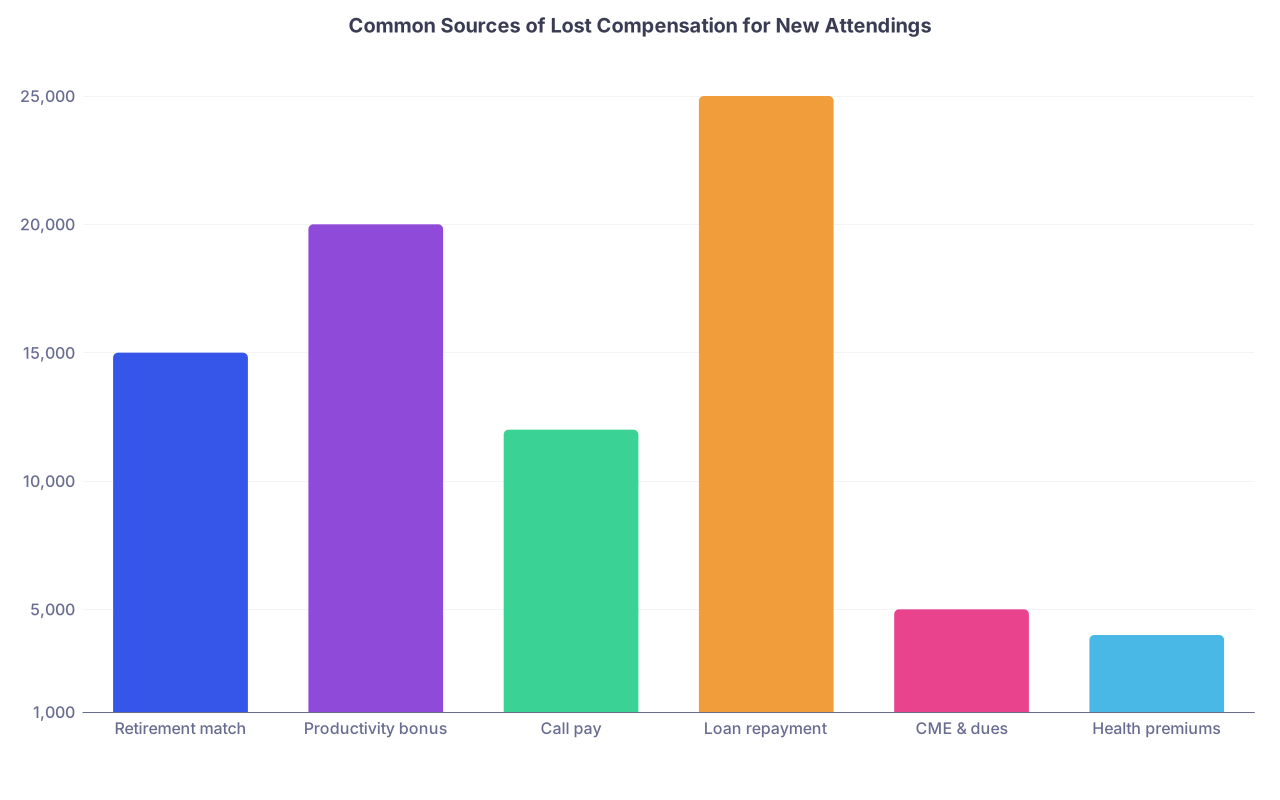
| Category | Value |
|---|---|
| Retirement match | 15000 |
| Productivity bonus | 20000 |
| Call pay | 12000 |
| Loan repayment | 25000 |
| CME & dues | 5000 |
| Health premiums | 4000 |
Every one of those line items is money you can either capture or forfeit:
- Retirement match
- Productivity structure
- Call pay and in-house vs home call
- Loan repayment/forgiveness
- CME, dues, licensing, moving
- Health insurance structure and premiums
If you only push on base salary, you’re leaving 5–6 other levers untouched. Worse, employers are perfectly happy to inflate one lever while gutting the others.
Example I’ve actually seen:
- Job A: $260K salary, 10% retirement match, fair RVU conversion, $20K sign-on, $15K/year loan repayment
- Job B: $290K salary, 3% retirement match, brutal RVU thresholds, no sign-on, no loan help
New attending takes Job B because “higher base” feels safer.
Over 5 years, Job A can easily out-earn Job B by $200K+ when you add match, bonuses, and loan repayment. But your eyes never left that base number.
How to avoid this mistake
- Ask for a total compensation breakdown: salary, bonus structure, call pay, retirement, CME, loan help, benefits cost.
- Run the math for 1, 3, and 5 years, not just Year 1.
- Compare all offers side by side.
| Component | Offer A | Offer B |
|---|---|---|
| Base Salary | $260K | $290K |
| Retirement Match | $26K | $8.7K |
| Productivity Bonus | $20K | $5K |
| Loan Repayment | $15K | $0 |
| CME + Dues | $8K | $3K |
| Health Premium Cost | -$3K | -$7K |
| **Total Year 1** | **$326K** | **$299.7K** |
If you’re not looking at a table like this before signing, you are almost certainly underpaid.
2. Ignoring Retirement Matching And Vesting (Huge Mistake)
This is one of the quietest, most expensive errors.
A lot of new attendings see “401(k)/403(b) with employer match” and mentally convert that into “free money.” Then they get burned because they never asked two critical questions:
- How much is the match, and is it % of salary or % of my contribution?
- What is the vesting schedule?
I’ve seen hospital systems with:
- 10% of salary, immediate vesting (excellent)
- 6% match, 5-year graded vesting (common)
- 3% match, 3-year cliff vesting (you leave at 2.9 years → you get nothing)
What actually happens in real life?
New attending signs a 3-year contract, hates the job, leaves at 2 years and 10 months, and walks away from tens of thousands in unvested retirement matching. Because HR sure as hell did not highlight the cliff vesting.
Let’s do simple math.
Say:
- Salary: $300,000
- Retirement match: 6% of salary = $18,000/year
- 3-year cliff vesting
You quit at 2.5 years. That’s $45,000 that evaporates.
Now add:
- Mediocre investment growth that could double that over ~20 years.
- Opportunity cost of not negotiating a better structure.
You just lost future six figures because you did not read—or negotiate around—one paragraph.
How to avoid this mistake
Ask, directly:
- “What percentage is the employer match, and match of what?”
- “What is the exact vesting schedule?”
- “If I leave at X years, how much is fully vested?”
Then, negotiate around it:
- If there’s a cliff vesting at 3 years, negotiate:
- A retention bonus at year 2
- Or a partial vesting/bonus if you are terminated without cause
- Or a higher base salary/bonus now to offset low match
Don’t accept a weak match + painful vesting and a mediocre salary. Pick your poison or push back.
3. Underestimating RVU/Productivity Traps
If you sign an RVU-based contract without understanding the thresholds, conversion factor, and collection realities, you’re volunteering to work extra for free.
The classic trap looks like this:
- “Base salary: $260K guaranteed for 2 years”
- “WRVU target: 5,500/year”
- “Conversion factor: $45 per WRVU after threshold”
Sounds fine. Until you learn:
- Average in that specialty at that institution is 7,000 WRVUs/year
- The group has terrible scheduling and no midlevel support
- Documentation requirements are insane, dragging productivity down
- RVU generation is constrained by hospital resources (OR time, imaging availability, etc.)
So you hit 6,000 WRVUs. Maybe more. But surprise—buried in the contract:
- Bonus doesn’t kick in until 10% above target
- Or certain payers are excluded
- Or your “productivity bonus” is “discretionary”
Suddenly that “upside” you mentally added as $40K–$60K/year just… doesn’t exist.
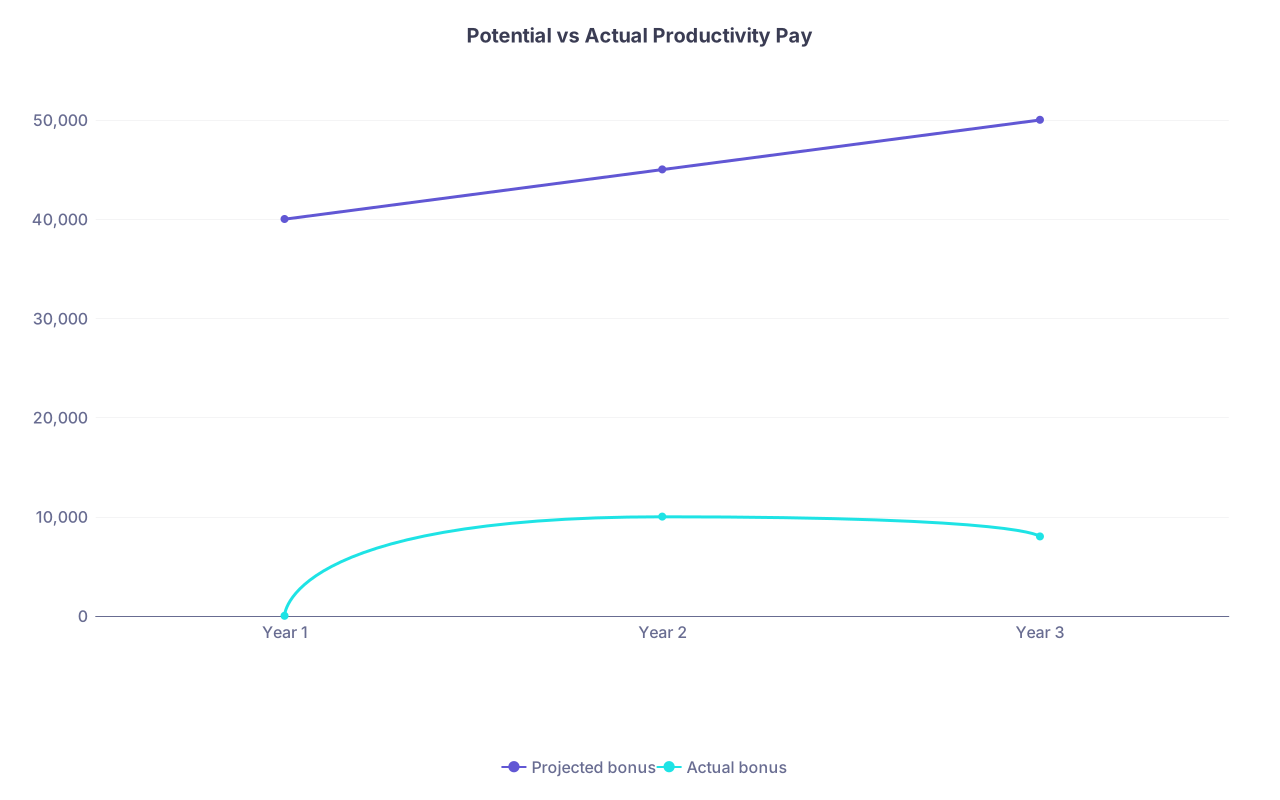
| Category | Projected bonus | Actual bonus |
|---|---|---|
| Year 1 | 40000 | 0 |
| Year 2 | 45000 | 10000 |
| Year 3 | 50000 | 8000 |
I’ve seen people leave $30K–$80K/year on the table because they never had another doc in that group explain what “typical” actually looks like.
How to avoid this mistake
You cannot skip this step: talk to current physicians in the group without admin in the room.
Ask:
- “What do you actually produce in WRVUs per year?”
- “How many hit the bonus thresholds?”
- “What percentage of your total pay is from productivity?”
- “Who sets your schedule and how much autonomy do you have?”
Then scrutinize the contract:
- Are there caps on RVU bonuses?
- Are there clawbacks?
- Are certain payers or services excluded from RVU credit?
- Is there a “group pooling” system that waters down high producers?
If you can’t get straight answers, assume the bonus is mostly theoretical and negotiate higher guaranteed base or a lower RVU threshold.
4. Accepting Garbage Call Pay And Call Structures
Nothing torches your effective hourly rate faster than unpaid or underpaid call.
New attendings routinely do this:
- See “1:4 call” or “Q6 in-house nights” and do not ask how it’s compensated.
- Assume “everyone does call” so it must be fair.
- Forget that call at 32 with kids feels very different than call at 27 as a resident.
The worst variant: “Call included in salary.”
Translation: “We found a way to get you to do 600 extra hours a year for free.”
Let’s quantify.
Say you’re a hospitalist:
- Salary: $270K
- Standard schedule: 7-on/7-off, 182 shifts/year
- Night call from home every 4th night on your “off” weeks, unpaid
Those night calls?
- Let’s say 2–3 calls per night, maybe you go in once
- Realistically 3–4 extra hours of work when you factor sleep disruption, charting, driving
Do the math:
- ~91 nights/year of call (every 4th night on off weeks)
- 3 effective hours each → 273 hours/year
- Effective pay for that work: $0
If you just negotiated $1,000/night for call (not crazy in many markets), that’s $91,000/year. You took $0.
You see the problem.
How to avoid this mistake
Interrogate every word about call:
- “Is call required? Home or in-house?”
- “How is it compensated? Flat rate per shift? Stipend? RVUs?”
- “Is call pay separate from base salary?”
- “How many calls per month did attendings actually take last year?”
If they say “call is included in salary,” you push back:
- “Given the call burden, I’d like to see either:
- A separate call stipend, or
- A higher base salary reflecting that workload.”
And yes, this is negotiable more often than programs pretend.
Do not swallow:
- “Everyone here does it.”
- “We can revisit this next year.”
Next year you’ve already normalized it, and your leverage is lower.
5. Ignoring Health Insurance, Disability, And Malpractice Details
This is the “boring” section of the contract that costs people tens of thousands because they skim.
Health insurance
You look at the summary sheet:
- “We offer competitive health benefits.”
- Maybe a silver/gold tier, HSA option, etc.
What you miss:
- Employee premiums vs employer-paid
- Family coverage cost
- Deductible and out-of-pocket maximum
- Whether they fund your HSA
I’ve seen attending families paying $12,000/year more in premiums and out-of-pocket vs a better-structured plan at another hospital down the street.
That’s money that could have gone into retirement, loans, or literally anything else.
Disability insurance
Another silent killer.
Common pitfalls:
- Short-term and long-term disability coverage with laughably low benefit caps (e.g., $5K/month max)
- Definitions of disability that basically require you to be half-dead
- No own-occupation coverage
If you can’t work as a surgeon but could theoretically be a cashier at Home Depot, some policies decide you’re “not disabled.” Enjoy paying private premiums on top of that to patch the gap you didn’t realize existed.
Malpractice tail coverage
If you’re in a claims-made policy environment and no one is covering your tail, you’re walking around with a six-figure liability bomb.
I’ve literally watched:
- A new attending accept a job with no tail coverage language
- Leave at 2 years
- Discover they’re on the hook for $80K tail policy
(the contract “encouraged” them to buy it but didn’t pay for it)
They didn’t negotiate a signing bonus to cover it. They didn’t even know to ask.
How to avoid this mistake
You must ask:
Health:
- “What are the actual monthly premiums for single vs family coverage?”
- “What are deductibles and out-of-pocket maximums?”
- “Do you contribute to an HSA or HRA?”
Disability:
- “What is the maximum monthly benefit?”
- “Is it own-occupation for my specialty?”
- “When does it kick in and for how long?”
Malpractice:
- “Is coverage occurrence or claims-made?”
- “Who pays for tail if I leave or am terminated without cause?”
- “Is this spelled out clearly in the contract?”
Have a physician-focused attorney or financial advisor review these terms. This is not DIY work if you do not speak this language fluently.
6. Failing To Monetize Loan Repayment And Tax Advantage Programs
This is where new attendings walking into $300K+ of loans get hammered.
Common mistakes:
- Taking a slightly higher salary instead of structured loan repayment
- Ignoring state/federal loan forgiveness programs tied to specific job types
- Not realizing how tax treatment differs (e.g., taxable vs non-taxable benefits)
Example:
- Job A: $280K salary, no loan repayment
- Job B: $265K salary, $25K/year of loan repayment for 5 years
Many people take Job A because “I want the higher paycheck.”
But $25K/year applied directly to loans (especially at 6–7% interest) is not just $25K. It’s:
- Lower interest accrual
- Faster payoff
- Less psychological drag
- And sometimes more favorable tax handling depending on structure
And if you qualify for PSLF or state-level forgiveness through a 501(c)(3) or underserved designation and you ignore that? You might be throwing away $100K–$300K+ in future forgiveness.

How to avoid this mistake
- Map your loans: balance, interest rates, federal vs private, PSLF-eligible or not.
- Before you negotiate, know:
- “Is this employer PSLF eligible?”
- “Do they offer loan repayment? How much, for how long, and under what conditions?”
- “Is repayment contingent on staying X years or repaid if I leave early?”
Then decide intentionally:
- If you’re PSLF-eligible, accepting a for-profit job with no forgiveness plan is a massive decision. Don’t stumble into it.
- If two offers are close, the one with structured loan repayment and forgiveness opportunities probably wins long-term—even if the base salary is slightly lower.
7. Signing Without A Specialist Reviewing The Contract
The dumbest high-dollar mistake of all: thinking “I’m smart, I can read a contract.”
No, you can read the English words. That’s different from understanding how they’re used to trap you later.
Typical rationalizations:
- “I don’t want to spend $800–$1,500 on an attorney.”
- “They said it’s their standard contract.”
- “The senior partner told me it’s a good deal.”
Here’s what usually happens:
- You skip the lawyer to “save money.”
- Miss 2–3 negotiable clauses worth $10K–$30K/year.
- Sign a restrictive non-compete that blocks you from working nearby when the job turns toxic.
- Accept vague language on bonuses and call pay that “looks fine” but has no teeth.
You “saved” $1,000 and cost yourself $50,000+ per year. Not exaggerated.

| Step | Description |
|---|---|
| Step 1 | Receive Offer |
| Step 2 | Skim contract |
| Step 3 | Detailed review |
| Step 4 | Miss hidden clauses |
| Step 5 | Negotiate key terms |
| Step 6 | Underpaid and stuck |
| Step 7 | Better pay and flexibility |
| Step 8 | Hire contract expert |
How to avoid this mistake
- Hire a physician contract attorney or experienced physician advisor. Not your cousin who does real estate law.
- Ask them explicitly:
- “Where is this contract weaker than peers in my specialty and region?”
- “What 3–5 items would you prioritize negotiating that have real money attached?”
- “What language is vague enough that I could get screwed in a dispute?”
Be willing to walk away. Most new attendings are so scarcity-minded—terrified of not having a job—they’ll accept almost anything. That mindset is expensive.
8. Forgetting That “Future You” Has Different Priorities Than “Resident You”
Last mistake, and it ties all of this together.
The resident version of you:
- Is used to terrible hours
- Has low expectations
- Is thrilled by any six-figure number
- Thinks, “I can do anything for a few years”
The attending three years from now:
- Has a family (maybe)
- Cares a lot more about call, schedule, and support staff
- Is burned out by EMR, admin demands, and productivity pressure
- Realizes benefits and flexibility matter more than an extra $10K of base pay
I’ve watched people lock into:
- Aggressive non-competes that trap them in toxic groups
- Compensation models that reward volume over sanity
- “Benefits-light” packages because the salary number looked sexy
They wake up later realizing they can’t leave without crushing financial and logistical pain.

How to avoid this mistake
Before you sign, answer honestly:
- “If I hate this job, how easy is it to leave?”
- Non-compete radius and duration
- Tail coverage responsibility
- Relocation commitments and clawbacks
- “If I stay, does the compensation actually improve with time or stagnate?”
- Retirement match vesting
- Partnership track or just forever W-2
- Bonuses that are real versus mythical
Negotiate from the perspective of the future you who’s been on service for 21 days straight and just wants a life.
9. CME, Dues, Licensure, And “Small” Line Items That Add Up
Last category people shrug off: the nickel-and-dime stuff that isn’t nickel-and-dime at all.
Underfunded or absent:
- CME funds
- Conference travel
- Board fees
- State licensure
- DEA registration
- Specialty society dues
If your contract gives you $1,500/year in CME + dues, you will absolutely pay out of pocket.
Real world numbers for many attendings:
- Board fees: $1,000–$3,000 every few years
- DEA: ~$800 (varies)
- State license: a few hundred each, multiple states if locums or telemedicine
- Basic CME to stay current: $2,000–$5,000/year easily
- One major conference: flights + hotel + registration = $3,000–$5,000
Now check your offer:
- “CME: $2,000/year, 3 days off.”
You will bleed cash.
How to avoid this mistake
Ask for:
- Minimum $4,000–$5,000/year CME for most specialties, more if you realistically plan on major conferences.
- Separate budget or explicit coverage for:
- Board fees
- Licensure
- DEA
- Required hospital staff fees
If they won’t budge on salary, these are often easier for them to improve. Push there.

Core Takeaways Before You Sign Anything
Keep this tight:
- Total compensation, not just salary. Add up retirement match (with vesting), bonuses, call pay, insurance costs, loan repayment, CME, and hidden fees. If you don’t do that math, you are almost certainly underpaid.
- Get the ugly details in writing. Call structure and pay, RVU thresholds, malpractice tail, non-compete, and loan terms must be specific, not “standard” or “discretionary.”
- Pay for expert contract review. The $1K you “save” by skipping a real review is the easiest way to lose $50K+ every year, locked into a deal you could have fixed with one uncomfortable email.
Do not be the attending who realizes three years in that everyone around them negotiated better—because they simply asked and you didn’t.